CDNetworks Acquires Panther Express To Speed Expansion In The U.S.

Cdnetworks-panther
This morning, CDNetworks announced that it has acquired Panther Express. Headquartered in NYC, privately held Panther Express has been in the content delivery business since 2005 offering HTTP based delivery services in the U.S and Europe. While details of the acquisition are not being discussed by either company, I will post more information on the valuation as soon as I dig up more info.

To date, Panther Express had raised $21.75M in two rounds of funding and was the largest privately held pure-play CDN on the market, doing between $15-20M in revenue in 2008. Steve Liddell, former CEO of Panther Express will stay on with CDNetworks and has been appointed President of CDNetworks International, focusing on U.S. and Europe.

While many deals look good on paper, this is one of those rare mergers that makes sense on many technical and business levels as well. Panther Express has a bigger footprint in the U.S. and Europe than CDNetworks with over 350 customers currently using their CDN services. Panther's footprint gives CDNetworks quicker access into North America and Europe and allows them to ramp sales much faster. What Panther Express lacks is the reach into Asia, the ability to support streaming media services, including live delivery and access to a large sales and marketing force. CDNetworks has the footprint in Asia, supports streaming of Flash, Silverlight and Windows Media live or on-demand and is an organization of over 400 employees after the inclusion of Panther's team.

CDNetworks said they will retain the bulk of Panther's employees but didn't say exactly how many that will be. Over time, CDNetworks will phase out the Panther Express website and brand but that won't take place until all customer integrations have been done, which is expected to take several months. In a briefing with CDNetworks yesterday they reinforced the point that they are in no hurry to finish the integration. They made it very clear that their number one goal is making sure current Panther Express customers get the same quality service they expect.

For me, there are a couple of key take away points from this deal. To almost any other CDN, Panther Express would not be a good acquisition since they are not global, only provide HTTP delivery, have no applications and are still relatively small revenue wise. CDNetworks is probably the one company where this does make sense since both company's strengths help equal out their weaknesses. Since Panther's services are very basic, the integration of Panther's infrastructure under the CDNetworks umbrella should be pretty straightforward. Unlike what we saw with the VitalStream and Internap integration, CDNetworks does not need to migrate any applications, streaming servers or customers broadcasting live content. While CDNetworks does not appear to be in any hurry to integrate, and does not need to be, it should be pretty simple when the time comes.

One thing that came across to me on the briefing was that at no time did CDNetworks use the Panther acquisition to call out the competition. Usually when I speak to CDNs that are expanding, the first thing they want to do is say how they are going to beat up on Limelight or Akamai. CDNetworks executives didn't use the merger as an excuse to try and convince me how they could crush the competition. It was refreshing to hear that they have very levelheaded expectations as they work to grow their business in the U.S and Europe.

On paper, this merger looks smart, seems logical and should be able to go down without a hitch. But like anything else, it's all about the execution, which is exactly the metric that CDNetworks wants to be judge on. They know that things can look good on paper but they made it clear to me that they want the industry to judge them on their actions going forward and the execution of their CDN business, as opposed to just a press release. I could not agree more.


Sponsored by

Defining Wall Street’s Role In The Online Video Industry

While most folks know what a venture capitalist (VC) is and the role they play in helping to fund companies in the industry, many don't know the differences between private equity (PE) firms, investment banks (IB), buy and sell-side institutional investors and money managers. To help clear up some of these terms, we've got a short article on StreamingMedia.com that many will find useful, describing the role each plays in the industry. The article was written by Colby Synesael, who yesterday announced his new job at Kaufman Brothers as SVP of Equity Research.

BT Plans To Enter The CDN Industry By Year’s End, Will Build It Themselves

BT_logo.jpg
Considering how many telcos and carriers have recently entered the market it should come as no surprise that BT plans to offer a content delivery service of their own by the end of this year. It's been widely known that for some time now, BT has been looking at the CDN landscape evaluating how best to enter the market and it appears they have decided on a strategy.

Based on an interview they did this week with Informa Telecoms & Media, BT said that, "We believe that we can build our own CDN as effectively as reselling others solutions." While this built it yourself approach by BT does not surprise me, unless BT only wants to have a regional CDN footprint, I think it's the wrong approach. It is possible that BT may just focus on building out a European based CDN which would be a lot easier for them than trying to deploy a CDN with a global footprint. But if they want to service content owners who need delivery to all regions of the world, BT is going to have a really hard time playing catch up in the market. You can't just throw a bunch of money at the problem. It takes a lot more than deploying lots of boxes to have a real CDN offering in the marketplace.

If BT only focuses on Europe, or even just the UK to start, they could have an offering out sometime this year that could be fairly well received. BT has a deep customer base to sell to and already has loads of infrastructure in place in the UK. If BT starts out small and stays regional, they could see some success with their offering beginning next year. But if they want to become a global content delivery network and think they can have something out in the market by the end of this year, that's just not realistic.

VUDU First To Sell HD Movies On-Demand, But Films Expensive, Library Limited

Vudu-logo
While most online video services have been renting HD quality movies for some time and Apple has been selling HD quality TV show via iTunes, to date, no one has been selling HD quality movies online. Today, VUDU announced that it would make fifty films available for sale from independent studios FirstLook, Kino and Magnolia Pictures.

While it's great that better quality movies are now available for sale, the price that all of these on-demand services charge is simply too much. Why would I buy the movie online when I can get the DVD cheaper? Delivering movies online means the studio saves a lot of money on packaging and distribution, yet they are not passing any of those savings onto the consumer. And then they wonder why services like Movielink and CinemaNow have never been successful.

VUDU says their HD movies are priced between $13.99 and $23.99, which is simply too expensive for films from independent studios. I don't blame those high-costs on VUDU as I'm sure the studios are dictating the pricing but clearly these studios don't get it. If you go right now and look at any of the first-run movies for sale on the home page of CinemaNow.com, like The Dark Knight, Pride and Glory or RocknRolla, all of these movies can be purchased from Amazon for three to five dollars cheaper than CinemaNow sells them. As a consumer, why would I want to buy a lower quality movie, for more money? That's just stupid thinking on the studios part.

For movie rentals, it's a different story. Services like VUDU, iTunes and others who charge $3.99 to rent a movie charge a fair price and VUDU's HDX video quality is extremely good. But I'm not sure why studios think consumers would want to purchase HD quality movies for more money to play back on a device like VUDU that them gives them no options to transfer or copy the movie to another device.

The movie industry complains and moans about piracy, lower ticket sales and how much they are hurting. Yet every year they raise ticket prices, make loads of really crappy pictures and charge customers more money to purchase movies online than in DVD. You would think the movie studios would have learned a thing or two from the record labels by now, but apparently not.

Why Can’t MSNBC.com Fix Their Online Video Offering?

Player
I've blogged about the problems with MSNBC.com's online video offering so many times now that they probably think I'm picking on them. But I'm not. It's just that the experience from their site is so poor, the video encoding quality is not up to par with other sites and frankly, many times I can't even get the video to play.

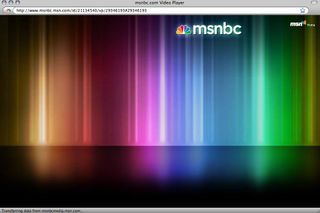
Last week I had trouble with videos taking more than thirty seconds to buffer. This morning for hours, when I clicked on any on-demand video links on their home page, I got a pop up window with no video player at all. It's just a colored background and the browser is trying to connect to msnbcmedia.msn.com but never resolves. (see screenshot above)

In the past few minutes, it seems they have fixed the player issue, which now loads, but the video doesn't. I'm still getting the "loading video, please wait" message for twenty or thirty seconds before videos play, if they play at all. I had someone check this on the West coast and they saw the same problems as well, not to mention I had it happened to me on two different machines, in Safari and Firefox.

Why does MSNBC.com continue to have so many video problems? Why isn't the video encoded at a higher quality? Why can't someone from MSNBC.com address these issues in a public forum? The last time I contacted MSNBC.com about a problem I had they said there was no issue. Then days later they quietly put out a statement on their website acknowledging that the webcast "was hindered by technical difficulties." So what is the problem today? A player that would not load for hours and videos that take forever to buffer.

I encourage someone from MSNBC.com to contact me or to give an official reply in the comments section on why MSNBC.com's online video offering continues to have so many problems.

Previous MSNBC.com posts:

MSNBC.com Won't Say Why Their Debate Webcast Failed

MSNBC Debate Webcast Constantly Buffering, Poor Audio

MSNBC.com Video Still Not Supported In Firefox Or Safari For Mac Users

MSNBC.com Needs To Dump MSN's Lousy Video Platform

Numbers Show Consumers Are Not Cutting Cable In Favor Of Online Video

While there has been a lot of talk in our industry of consumers cutting their cable TV services in favor of online video content offerings, that's more myth than fact. Yes, some consumers who don't watch a lot of TV or only watch shows that are available over-the-air (OTA) or with a Netflix subscription may be canceling their cable. But for the vast majority of consumers, getting rid of cable TV is not an option, as the recent cable subscription numbers show.

Most of the people I hear talking about cable being dead or writing about it needing to be saved from extinction are those in the online video industry. Yes, I know of a few regular consumers not tied to the industry who have cancelled their cable TV service in the past few months. But they have done so to save money and not because online video can replace their TV viewing experience. If they can now get some of their programs online for free, great. But that's not the reason they are getting rid of cable all together. Most consumers don't watch only two or three channels and the vast majority of shows on cable channels are not online. Case in point, I have nearly fifty season passes on my TiVo. Of those fifty, more than half of them can't be found anywhere online. Cable TV is my only option.

Now I happen to watch a lot of TV and many of the shows I am watching are not on FOX or ABC. Many of the smaller cable channels have not started placing full episodes online. But even if they did, I would not cut my cable service so that I can watch shows on my MacBook by myself. Getting online video to the TV is still not an easy task and the viewing experience leaves a lot to be desired. Yes, you can use software like boxee with Apple TV or connect your computer to play online video on the big screen, but that's not the purpose the TV serves today. I didn't spend a lot of money a year ago to buy a large screen HDTV so that I could stream a poorly encoded video to the set. With all the new broadband enabled sets that will come out later this year the process will get better and the quality will improve over time. But that's not going to happen in any mass scale even in the next few years.

And even when that experience does get better, what about content like baseball that is not available online? I can't get the Mets games online when I am not traveling due to blackout restrictions; so online video is no help at all. Not all consumers have the same viewing habits and again, for those that don't really watch TV or only like a few shows, they may not need cable TV. But for the vast majority of us who do watch more than a few shows, or want to see shows in HD on a big screen, cable TV will continue to be our only option. Online content delivered over the Internet can never scale the way cable TV can. Imagine trying to watch the HDNet channel online. Never going to happen.

And more importantly, since when did our industry start thinking that the viewing experience on a computer is the same as the one on TV simply because the content is the same? That seems to be all you hear people say, the fact they can get the episode online instead. Ok great, but in what quality? Talk about the experience instead of just focusing on the content.

Earlier I mentioned the recent cable subscription numbers and in the fourth quarter of this year, the cable companies signed up more TV subscribers than they did for the same period last year. Craig Moffett, an analyst at Bernstein Research analyst said that in the fourth quarter AT&T, Verizon, Comcast, Charter, Time Warner and DirecTV signed up 441,000 subscribers. That's nearly 50,000 more than they signed up a year ago at the same time. Now how many of these are subscribers who are switching from one carrier to another is not known, but the point is the numbers are not going down.

As a FiOS customer, I love my service and think the price is fair. I
pay $95.99 for a 20Mbps connection, unlimited calling and a TV service
that has the best picture around, not to mention more HD channels than any other company. If I were to cut my TV service out of the triple play package, I'd save about
$30 a month, which is not a lot of money.

I'm sure I am going to get some comments on this post telling me that I'm too stuck on what's happening today and that as someone who is in the online video industry I should be looking to the future. The problem with that argument is that many want to say something is dead today, because of something that has yet to take place down the road. Trends are based off of things that actually take place in the present, not something that could take place years from now.

It's also important to remember that this entire industry imploded in 2001 because so many people were talking about the future. Many were so high on what might, could or should take place that most didn't set realistic expectations of what was taking place today. While it seemed like our industry died almost overnight, it didn't. The industry spent a long time proclaiming success with things like multicasting, content delivery via satellite or video to the handset, which never got adopted then, or eight years later. Remember the word convergence? That word was used in our industry more than any other to talk about the merging of the Internet and TV, yet eight years later, we are only just now starting to see some of that come to reality, in small numbers.

Don't get me wrong. I am excited to see what is taking place today with online video and the TV set today. Services like Netflix on the Xbox 360, the Roku device, broadband enabled TVs and Blu-ray players are all a step in the right direction. New content models will be created, new services will come online and online video will start being thought of as simply IP based video when more devices outside of the computer are enabled.

While everyone is excited with these new offerings, lets set expectations correctly and look to the future without forgetting what is taking place today. If we don’t and start to declare online video the winner and preach the death of cable TV, companies are only going to let down VCs and Wall Street when those expectations are not met with higher earnings, more profit or faster adoption.

Sun’s CEO Claims JavaFX As The Fastest Growing RIA Platform: Completely Untrue

Javafx-logo
Last week, Sun's CEO Jonathan Schwartz declared on his blog that Sun's JavaFX is "the fastest growing RIA platform on the market", based on Sun announcing that it had shipped its 100 millionth JavaFX runtime. While that sounds like a big number that everyone should be impressed by, we're not. In fact, it only makes Sun look like they have no idea what is going on in the industry.

Anyone who has read my blog long enough knows I question numbers from all vendors and I hate proclamations based on marketing fluff. Sun is new to the RIA market yet apparently, has already declared themselves the winner, even though no JavaFX based video apps are being used in any wide scale adoption. Not a single one.

I have to wonder how the CEO of Sun is allowed to make such bold, inaccurate statements without his blog posts first being reviewed by someone at Sun who is in better touch with reality. Jonathan goes on to say in his post that, "The Java platform continues to provide the world's most complete open source platform for a rich internet." Is he serious? JavaFX does not even support H.264. How can you talk about having the world's most complete open source platform when your own platform does not support H.264 for video applications? Saying you want to support it in the future does not count.

Not to mention that because JavaFX supports different video codecs on different platforms, it makes it impossible to "write once, run everywhere", which as a result, dilutes one of Sun's key marketing messages. In addition, since On2's Flix software application is the only tool that can encode video for JavaFX today, it will be difficult for a large number of designers and developers to create video content for the Sun platform.

JavaFX has a limited set of APIs and to date, Sun considered only the basic scenarios, not all of the complex and difficult scenarios that customers may encounter. As a result, developers may run into some difficulty when trying to build complex RIAs with early versions of JavaFX. Case in point, look at all of the comments on Jonathan's post from Java developers and designers complaining about the lack of features and tools. One commenter even asks how Sun can call this the world's most complete open source platform when as he says, "you haven't even released it for the open source OSes. Not even your own Solaris."

Adding to the problem is also the questionable designer-developer collaboration story.  Looking at an early video of the Adobe Photoshop and Illustrator plug-ins (formerly referred to as Project Nile), it appears that support for "round tripping" may be limited or non-extant.  While it is clear that designers will be able to export graphic elements to be used in NetBeans (or Eclipse), it is unclear how designers will be able to take projects developed in NetBeans and customize the UI, add skinning, etc.  Since NetBeans has no visual designer, making simple changes to design elements may be tedious for developers. 

Jonathan also says in his post that, "And most importantly – JavaFX allows content owners to bypass potentially hostile browsers, to install applications directly on user desktops and phones." I don't know what he means by "hostile browsers", but I have a suggestion for the definition. Trying viewing Sun's own javafx.com website using Safari or Firefox on the Mac. The browsers constantly force quit or I'm given slow script error messages from Sun's SimpleVideoPlayer prompting my broswer to ask me if I want to stop the script. That's my definition of a product that makes my browser hostile. When I do get lucky and the javafx.com site works, the demos I get look horrible. The video is choppy, completely pixelated and takes more than twenty seconds to even load.

Getting back to the 100M download number that Sun says is such a milestone, how about Sun explaining where that number comes from? What about the bundling of JavaFX via the Java Updater? Is Sun trying to say that of the 100M downloads, each person who initiated the download was specifically trying to get the JavaFX runtime? As one comment on Jonathan's post says, "what did you guys count as JavaFX downloads, are
these downloads that were initiated by an application requiring JavaFX,
downloads counting visits to the JavaFX main site, or does it also
include any upgrades in existing Java runtimes?
" That's a great question and one we should not have to be asking. Did Sun think no one was going to ask? They started this by giving out the number, using that number as the reason for their success but then held back by giving out any details. What are they hiding? Do the numbers not look as good once we find out where the 100M comes from? You can't put out numbers like that, declaring a success and expect us to just take it at face value.

Now if Jonathan's post was simply we've had 100M downloads and we're building out this platform to compete, no problem. Great, welcome to the party. But to call out the other RIA competitors by name and mention them in the same vein as JavaFX, as if they are equal, is flat out asking to challenged. Jonathan's says in his post, "what you can do with Flash is comparable to Silverlight, and again comparable to JavaFX." Please, stop the marketing spin. Why does the entire post feel like Sun is trying to talk to us as if we are all dumb and don't know what is really taking place in the market.

Anyone who has read my blog long enough knows I hit back hard at any vendor who wants to lead with marketing fluff and gives out numbers backed up by no details. It's bad for the industry and bad for the vendor doing it. Nothing good comes from this practice. This is not personal to Sun or to Jonathan. But the simple fact that Sun acknowledges that they only entered the market in December, yet already declare themselves the "fastest growing" and "world's most complete open source platform" in only three months time is really something they should know better than to try and convince us of.

To Sun I say welcome to the space. Happy to see another competitor in the RIA arena but you need to convince us of your success based on the adoption of JavaFX based applications, functionality of the JavaFX platform and let content owners and designers dictate what they deem to be a successful offering in the market. Anything outside of that is just marketing fluff.

Note: It should be mentioned that I contacted Sun before this post to see if they wanted to provide me with any more details on Jonathan's post or setup a time for me to speak with him directly. They were very responsive but were out of the country at the Mobile World Congress show and said they usually don't comment on what Jonathan posts in his blog. But if Jonathan or Sun wants to reply to this post, I will publish any official response from them exactly as I am sent it.