BitGravity Announces Live HD Streaming, But Traction Will Be Hard To Come By

Bitgravity
On Monday, BitGravity announced their new live HD streaming offering dubbed "BG Live HD" which will be available in April. The technology supports 720p or 1080p at 30 frames per second with 1080i support in future development plans. While the demo I saw of the service looked excellent and had very good quality, I think traction could be hard to come by even with BitGravity's low pricing in the market. While I agree that the total cost of ownership for BitGravity's live system could be cheaper than some of their rivals, customers are not buying on price alone.

Over the past year we've seen many CDNs and live video offerings come to the market saying they can take share from guys like Akamai, Limelight and Move Networks. But to date, the big vendors still have nearly all of the live event business and content owners have yet to flock to any of the smaller players simply based on a cheaper price.

BitGravity's new live offering is not going after customers who outsource the need for a broadcast video platform to someone like Move Networks, but rather is targeting the content owner who wants to do their own encoding in-house and is not just looking at how much it costs to deliver some bits. That could be BitGravity's advantage, targeting a smaller segment of the market others aren't focusing on as hard, but it's too early to know if they can get any traction. BitGravity has been out in the market for over a year now and we have yet to hear if any major broadcasters are using their service.

In that time, BitGravity has already been offering very low prices in the market, usually half of what Limelight or Level 3 charge and many times, with no commits. I have not yet seen that aggressive pricing strategy pay off in the way of large customers and anyone who follows the CDN market knows that trying to grab market share with low pricing never works out in the long run. That said, BitGravity does not license or run their network using Adobe's Flash Media Servers, so it is possible that their costs are lower than others, but no one truly knows.

BitGravity's live HD service looks really nice, but so do a lot of others and each day it is getting more and more difficult to see the quality difference from one HD video over another. BitGravity is selling their live HD service with the value that it has very low latency, around six seconds. That's good to hear, but it still does not beat Adobe's Flash Media Live Encoder with FMS that has a default of only two seconds for a non multi-bitrate encoding. BitGravity may truly have a cheaper offering in the market but for me, the proof is seeing if BitGravity can sign up customers to use the service. If BitGravity can show that major broadcast customers are using their live HD platform, they might be able to get some traction. But until we can see if that happen, it's all speculation.

Since BitGravity is a private company, it's hard to really gauge how much money they are burning through. They raised $11.5 million from Tata Communications about six months ago and raised a smaller round of $2.5 million a few months before that. In that time, BitGravity has been doing a lot of development work and has expanded their headcount so clearly they are spending a good amount of the money they have raised.

For me, like many of the new CDNs in the market, the verdict is still out on BitGravity's potential success as we don't really know enough about their business to judge if they might have the staying power to survive in the market. Adoption is the key. If they can get customers signed up and scale their business, they have a chance. But if they can't grow revenue quick enough, they will be like a lot of the other CDNs in the market who have enough cash today, but come 12-18 months from now, will be hoping to sell their company if they can't raise more capital. Right now, it's too early to know where BitGravity may end up until we hear more concrete details about their business.

Sponsored by

Review: Hands-On With Amazon On The Roku, Close To 300,000 Units Sold

This morning, Roku officially announced that the Roku digital video player can now stream movies and TV shows from Amazon's Video On Demand offering. I've been playing around with the beta for the past few weeks and while the interface is very nice, HD quality videos from Amazon aren't offered. That said, if Roku can continue to add more content partners for the device and improve the video quality, I think they have a very good chance at having a total of half a million boxes sold by the end of this year.

Setting up the Roku box with your Amazon account is easy and requires you to add a five digit PIN. Once done, you're up and running and searching through movies and TV shows is pretty simple. The Amazon offering on Roku allows you to browse Amazon's Video on
Demand menu right form the TV, which is something currently not
available for Netflix content. The only real problem I found was that there is no way to skip through a long list of movie titles. You have to scroll through them one by one and if your list is really long, it can take awhile.

Unlike the Netflix service on Roku, users who want to get content from Amazon need to pay $3.99 for a 24 hour movie rental or $1.99 to purchase TV shows. Initially that may surprise some Roku owners who have always thought of the box as providing free content via Netflix, but Amazon's Video On Demand offering is not an all-you-can-eat service.

While the video quality was good for most of the videos I watched, it could definitely be improved. I have seen some Roku users speculating on discussion boards that the Roku is not powerful enough to stream HD quality movies, but we know that's not the case. Three months ago, Roku announced that HD quality videos were now available for the Netflix streaming service, so the lack of HD content from Amzon is a content problem, not a technical one. In addition, while the Roku supports stereo audio, there is no support yet for surround sound.

While still priced at only $99, the Roku is a really nice affordable box, but is still quite limited with regards to the content one can get on it. As with any offering, the content available for viewing will dictate Roku's success in the long term. While I expect Roku will announce more content partnerships this year, the key is for Roku to get some major content owners on board. They need to get some major broadcasters or someone like Hulu to agree to make their content available to the Roku. While Roku has talked about going after the major broadcasters, it's a sure bet that they won't license their content for free. That means that any content offering on the Roku from a major broadcaster will enable some form of advertising tied into the service, which might be ok if done correctly.

While I don't have an exact number of units sold, I do know that to date, close to 300,000 Roku's have been sold since it first launched in the market last year. I think that's a pretty successful start, but when compared to the Xbox 360 which to date has sold 13.3 million consoles in the U.S. alone, the Roku still has a long way to go before it is thought of as the primary device one uses for playing back movies and TV shows. While I have a TiVo, Xbox 360, Apple TV, Vudu, Roku and broadband enabled Blu-ray player, the Xbox 360 is still the device that is my first choice, based on video quality and the catalog of content available.

Over time, I think the Roku box will compete less with the Xbox 360 as both devices primary roles and price points are very different. But for now, the Roku is competing with the Xbox 360 in my household.

CDNetworks Valued Panther Around $5M, Not A Sign Of Major CDN Consolidation

While many want to proclaim that yesterday's announcement of CDNetworks acquiring Panther Express is the start of major consolidation in the CDN sector, it's not. More than a year ago people were saying the exact same thing and in that time, we've only seen this one deal take place. Not to mention, the CDNetworks acquisition was for a company that was not profitable, had many non-commit contracts and from what I keep hearing, CDNetworks got a very good deal, valuing Panther Express at a little over $5M. But even if Panther was valued for more money, it still would not signal the start of any major consolidation.

The problem with thinking that major consolidation will take place is that the vast majority of CDNs don't own any real technology, don't have applications, have no patents, no intellectual property, have a small number of customers and very little revenue. Lets say that you are a telco that wants to enter the CDN market. What do you get by acquiring a current CDN that has very little in the way of technology or revenue? While we've seen many telcos and carriers enter the CDN market with offerings, none of them have made any acquisitions yet and most are simply reselling another third party CDN.

Some CDN vendors do have some value add technologies, but most don't yet have a lot of revenue. There is some value placed on hybrid networks and those CDNs who have more application layers on top of their CDN that would be considered more valuable. Certainly Akamai and Limelight are always possible acquisition targets simply based on their revenue, but they are the exceptions. Looking past them, the rest of the pure-play CDN vendors all did less than $20M in revenue
last year and for the vast majority of them, they won't even do half that much this year.

Cdn1
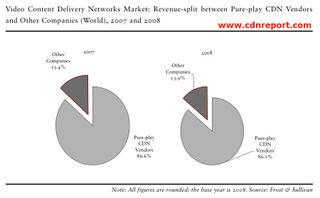
That said, in a few years, the revenue share from pure-play CDNs, (defined as those who get the vast majority of their revenue from CDN services versus other companies who get revenue from things like colocation and transit) is going to drastically change. In 2008 the market size for video delivery services was $398M (www.cdnmarket.com). Of that, pure-play CDN vendors accounted for 86.1% of the total revenue. At some point, a larger percentage of CDN revenue is going to come from the telcos, carriers and those who provide other services outside of just content delivery. But until that time comes, the pure-play CDNs still control the vast portion of the market.

One of the main reasons we have not yet seen any telco or carrier do an acquisition is simply due to the fact that the video delivery market is still very small. This isn't a knock on the CDN industry, or the vendors, it's just reality. As much as we all want the market to be bigger, the market for video CDN services is still very small revenue wise when compared to the other services carriers and telcos offer. As IP based video delivery continues to grow, these companies will start to take more of an interest in the pure-play CDNs. But that's why for now, aside from Level 3, who bought some CDN assets and technology, all of the other carriers and telcos have decided to license or resell a CDN instead of buying one.

They want to get their feet wet with CDN services, get a handle on customer requirements, see how current CDNs handle things like provisioning and scaling their networks and then decide if they want to be in the business. This is exactly what folks like Global Crossing told me this week when they discussed how they want to slowly enter the market, without having to deal with capex spending. Once they evaluate the market, if they decide they want to be a major player, then they will look at doing an acquisition 12-18 months down the line. This thinking is nearly identical amongst all of the telcos and carriers I have spoken to who have chosen to resell another CDN, for now.

Even if Panther Express was valued for more money, this still would not signal the start of any kind of major consolidation in the market. While I do know of two other CDNs who have offers on the table now and could potentially be acquired shortly, like Panther, they are very small and it won't impact the market dramatically.

For more details on the CDN market, including lots of revenue and market share and sizing numbers, see my Frost & Sullivan CDN report, which you can still get at a discounted price.

Qualcomm Acquires Digital Fountain

Dflogo
A few days ago, Qualcomm acquired privately held Digital Fountain. The deal went down almost a week ago and while I have yet to see a press release, Digital Fountain's website now has a brief announcement about the acquisition on their home page. While Digital Fountain does have a CDN offering, that's clearly not why Qualcomm wanted them.

Digital Fountain's CDN offering only recently got off the ground and their real value is the technology they provide to the defense department and other companies in the IPTV and mobile space. Much of their core technology has been adopted by standards bodies including 3GPP, DVB and others.

I'll update this post later in the day when I get some more details.

Updated: Short e-mail I got from Qualcomm with some more details. "Qualcomm has acquired a team of seven key engineers that will continue to support the technology and existing Digital Fountain customers. The Digital Fountain team will be located in Qualcomm’s Santa Clara campus. Also, that team will be led by Mike Luby, Digital Fountain’s founder and CTO, who will report to Qualcomm’s Chief Technology Officer."

Internap Updates Me On Their CDN Strategy, Now It’s Time To Execute

Logointernap
About two weeks ago I published an article entitled "Steps Internap's New CEO Could Take To Get The CDN Business Back On Track". In it I outlined steps I believe Internap should take to streamline their content delivery product offering which would enable them to get their CDN business back on track. Internap's management read the post and last week contacted me to arrange a call where they could discuss my ideas and give me an update on the steps they are working on and have already taken regarding their CDN business.

While some of my conversations with Internap's CTO, Tim Sullivan, VP of Engineering, Steve Kiene, and VP of Marketing, Jim Leach was off the record, much of what we discussed about their CDN offering I can talk about. One of the overall themes I got from the call was that Internap has already streamlined their product offering, decided on what market they are going to focus on and has a CDN plan in place. To me, it's very clear that Internap has put the legacy VitalStream technical issues behind them and is only looking forward to the service they deliver today and the steps they need to take to grow their CDN business. I got a clear sense that their number one goal is to improve the functionality of their CDN offering, re-brand their product line, re-focus their marketing message and go after a very specific segment of the market.

In my blog post, many of the suggestions I made for their CDN business are already underway or in some cases have already been completed. For a long time now I have believed that Internap needs to sell their CDN services stand alone, without the need to have to bundle them with other non-CDN related services. Internap agreed that in the past, there was too much emphasis on the bundled offering and as result, they missed out on much of the stand alone CDN business in the market. Going forward, their new approach will be to highlight to current Internap customers the value in the bundled offering while at the same time targeting content owners who only want CDN services. This is a good move for Internap and one that should enable them to get on the list for more RFPs that require nothing but content delivery services.

Internap took action in this area late last year by establishing a CDN only focused sales team. These CDN specialists are experienced and focused on selling just content delivery. This is a major shift from earlier days where all reps could
sell any product offering, but none really focused specifically on CDN.
Having experienced CDN reps out in the field enables them to have
evangelists who are now championing Internap's CDN message to the rest
of the industry. This process is only just underway and Internap plans
to hire more experienced CDN sales specialists to increase their
visibility in the market.

I was happy to be told on the call that Internap has officially exited the ad sales business and is working with partners for ad insertion into the CDN streams it provides. Through the acquisition of VitalStream, Internap had a legacy ad services portfolio that was primarily focused on ad insertion for customers who streamed radio stations on the web. Over the past few months, Internap finished moving the ad insertion offerings off of their network and no longer has any stand alone sales force selling advertising inventory. This is a smart move for Internap as the ad insertion technology was quite old and had many technical issues, not to mention, was not a fit with the rest of Internap's CDN offerings. The ad sales business wasted too many internal resources and never generated much in the way of revenue. Internap will still continue to provide CDN streaming services to radio stations and other music download websites.

While there are many CDNs in the market, Internap made it clear on the call that they are going to focus on different customers than Akamai and Limelight are going after. They know that to land huge customers like MLB or Netflix you need to have tons of dedicated resources internally and need to grow the head count of your organization to a really large number. Internap is being very realistic in their approach to the market and is going to focus on medium size customers and ones who want to grow their business. This is crucial to Internap's success and at no time on the call did I get any sense that Internap does not fully understand the importance of this. From what I can tell, they are setting their own expectations correctly which means they will be able to do the same for their customers.

On the subject of making Internap a fun place to once again work, a point I brought up in my earlier post, Internap
executives said that there are still many good people at Internap who
like the company and enjoy their job. While that is what I would expect
them to say, I did get quite a few e-mails, almost a dozen, from
employees who work at Internap and contacted me privately after my post
about two weeks ago. The vast majority of them said that Internap has
some really smart people in the company and that they still want to
work hard to get Internap back in shape. Many of them did say the mood
has gotten better knowing they will get a new CEO and many are hoping
that he will rally the troops and give them confidence that Internap
can once again grow. So it does seem like the mood has gotten somewhat better and the new CEO could really take that up a notch very quickly with the right actions. Only time will tell.

Overall it was really good to hear that Internap now has a solid plan for their CDN business and something they can follow and work to execute on. While they still have some work to do and have not yet re-branded their offering out in the market, this should happen soon and start to get the Internap name back in the spotlight for content delivery services. After the VitalStream acquisition there were simply too many legacy VitalStream employees involved and too many cooks in the kitchen. The CDN business strategy which is closely aligned with sales opportunities now falls under the responsibility of the VP of Engineering and it seems that internally, it's very clear who is responsible for what.

While a plan is always great, everyone knows that execution is the key to any company's success, a fact not lost on Internap. They know they need to do more than just streamline their CDN offering and need to continue to execute on the steps they have started taking. While it is too early to know what impact Internap's new CEO will have on their CDN business when he takes over next month, the fact he comes from Tandberg Television and has experience in the video market should only strengthen their efforts.

StreamingMedia.com Webinar Tomorrow: Transcoding 101

Tomorrow at 2pm ET is another StreamingMedia.com webinar that I will be moderating, this time discussing the subject of transcoding. Because no single format can serve all needs, transcoding technology is
fast becoming the linchpin in enterprise and broadcast content
delivery pipelines.

David Trescot from Rhozet will discuss the different video and audio formats, why and when format transcoding is critical, the vocabulary of transcoding and how content owners can generate supplemental revenue streams via IPTV, VOD, DVD, web and mobile media.

We’ve already got over a thousand participants pre-registered for the event and will be doing an extensive Q&A session so that we can answer as many questions as possible. All those who attend the event are also entered to win a free TOMTOM GPS unit. You can sign up for the free webinar here.

WA State Wants To Tax Streaming Content, Get Ready To Help Us Fight It

Washington State Representative Ross Hunter is proposing a new bill (House Bill 2075) that would start charging consumers a tax for any content that is delivered via streaming media, even though the consumer is not downloading any physical assets. As I understand it today, the proposed bill would only affect those companies who have physical offices or employees in Washington State. But if this bill passes, it could set a really bad precedent and could easily have a trickle down affect.

Almost twenty states already tax digital downloads of movies, music and books, but in those cases, the consumer is actually buying something and retains some kind of physical asset. So even though you are already paying tax when you sign up for MLB.com's streaming service, or a Netflix account, this bill would require companies who charge for any kind of service that has a streaming component to it to have to collect a new "streaming" tax. Details are still sketchy on how exactly this would all work, but the bill is starting to get some play and was discussed last week in the House Finance Committee.

I'll be dammed if we're going to let someone try to come along and tax our industry unfairly without a fight. Trying to use a "streaming tax" to make up for the budget problems in their own state is a pretty poor excuse. While you may not have read a lot about this as of yet, get ready to.

We're going to take all the resources we have at StreamingMedia.com to get the word about about this tax and get the industry to fight it. I'll be putting up an information site shortly at www.StopTheStreamingTax.com and we will be looking for those in the industry to help us get the word out on the damage such a tax could have on our industry. I've also spoken to a firm in DC that we are going to team up with and will have more details on all of this shortly.

In the mean time, if you know of anyone writing a story about this, please have them contact us so we can start to tell our side of the story.