TV Everywhere: The Future of Television, or Another Over-Hyped Promise?

2009-SM-Think-Series-3 Over the past year, cable companies such as Comcast, Time Warner, and Verizon have all announced what they call "TV Everywhere" trials. The premise behind these trials is based on the notion that one day, the cable companies will give subscribers the ability to view on their computers the same content they get to their TV set.

While many want to proclaim that such TV Everywhere offerings will be the future of the cable industry and that the cable companies will be forced to offer such a service, it's not at all clear that this will indeed become a reality. Such a service would be interesting and valuable to many consumers, but no cable company has yet to figure out how the service will be paid for, who will manage the content, what video platform will be used, what type of video quality viewers can expect, and how this content will be delivered with scale and performance. Too many questions still remain about the service and, to date, the trials that are taking place are extremely small-in some cases, as few as 5,000 cable subscribers.

There has been a lot of talk in our industry of consumers cutting their cable TV services in favor of online video content offerings, but that's more myth than fact. Yes, some consumers who don't watch a lot of TV or only watch shows that are available over-the-air (OTA) or with a Netflix subscription may be canceling their cable. But for the vast majority of consumers, getting rid of cable TV is not an option, and the number of cable TV subscriptions is actually going up, not down. Some are predicting that as long as the cable companies can offer the service for free with the knowledge that consumers will use it, the value proposition for the cable companies is that it will allow them to retain their subscribers.

Continue reading »

Sponsored by

Moderating Webinar At 2pm ET Today On Enterprise Video Challenges

Today at 2pm ET I’ll be moderating another StreamingMedia.com webinar on the topic of enterprise video challenges. Sponsored by Internap, we’ll also have a presenter from Microsoft and will be talking about new multicast and adaptive streaming technologies. There will also be an extensive Q&A session after the presentation so bring your questions and we’ll get to as many of them as possible. You can register here to attend this free webinar and one luck attendee will win a Flip video camera.

Apple’s QuickTime X Player Does Not Support Authentication For HTTP Streaming

Quicktime When Apple launched Snow Leopard in late August, it included a new version of the QuickTime player simply called QuickTime X. While it looks nice and has some new features, one of the major problems is that it can't authenticate to streaming servers or video being delivered via HTTP, which is bad since Apple has been focusing on HTTP support as one of the key advantgaes of the new player.

When you try to play a video the player gives you a message of "unauthorized" and other Mac folks I have asked to check, have gotten the same message. The only work around I can find for it is deleting it and re-installing version 7 of the QuickTime player using the custom install option from the Snow Leopard DVD.

Anyone from Apple care to comment on when this will be fixed? I see a few others have noticed the problem as well and have been talking about it on Apple's discussion list.

Videos From Google’s Music Hub Vevo Won’t Play, Same Crappy Experience As YouTube

For all the talk of how many videos YouTube delivers each month and the number of hours of content that's uploaded to YouTube each minute, why is it no one seems to ever question Google on why their playback experience is so poor? Why does the media continue give Google a pass on this? This should be something that everyone is talking about, yet it seems that hardly anyone is writing about it, even while so many users continue to complain about it, myself included.

This morning, I had half a dozen emails in my inbox from people asking me who's doing the delivery of the videos for Vevo and why they won't play. While I know Vevo has only been up for less than 48 hours, that's no excuse for Google not to be able to have it working properly. How many times am I going to be given a message that says "We're sorry, there was an error processing your request" when I try to play a video? Even worse, most times I don't get a message at all. I just get a blank page when I click play or the video starts to buffer and gets stuck at 73% and goes no further.

I've been complaining for three years now (2008, 2007) that the quality of delivery for YouTube's videos, delivered via progressive download, continues to stink. It's a regular occurrence that videos take two minutes to buffer, don't buffer at all, or stops halfway through to re-buffer. And I'm taking about videos that are only ninety seconds in length. And every time I write a post about YouTube's playback problems, I get dozens and dozens of comments from viewers experiencing the same problems.

In a CNET article this morning, it was reported that in his speech introducing Vevo, Doug Morris, Universal Music Group's CEO said, "the best thing about Vevo is that it's our platform". Actually, no, it's Google's platform. But if this crappy, poor-quality user experience is the best thing about Vevo, then we should consider it to have already failed, less than 48 hours after launching.

And I still want to know, why does the media give Google a pass on the problems YouTube's platform has in delivering videos for so many years?

Updated: YouTube just announced the launch of the Vevo site on their blog saying, "it blends Google and YouTube's leading technology…." and will "redefine the way people watch and engage with music online". That's a great strategy, hype the launch, when it does not even work.

Latest Data Shows HD Video Adoption Growing, But At A Very Slow Rate

While I've heard some folks say that one of the reasons Akamai is showing signs of their M&E business picking back up is as a result of the adoption of HD quality content, that's not what's driving revenue today. Yes, Akamai and all of the other CDNs are seeing more content owners use HD quality video, but it's not yet happening in large volumes or at mass scale to impact revenue.

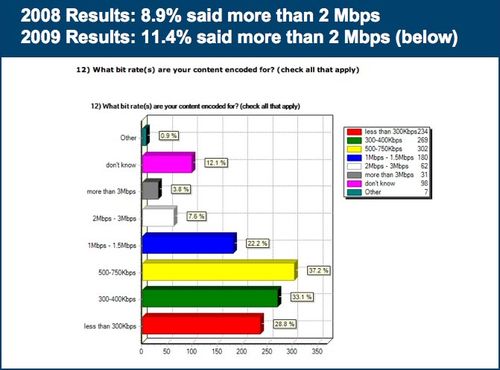
Based on a recent StreamingMedia.com survey we conducted in September and October, we asked content owners what bitrates they were encoding their content in. Of the 812 content owners who responded only 11.4% said they were encoding video for at least 2Mbps or more. Compare that to the same survey in 2008 when 8.9% of over 1,000 content owners said they were encoding over 2Mbps. That's not a lot of growth.

Slide2-cdn

Some might say that the M&E vertical probably has better adoption of HD video than say the enterprise or advertising market and they'd be right. But of the 812 content owners who took our survey, nearly 45% of them classified themselves as being in the M&E vertical. HD quality video will drive additional revenue and growth for the CDNs, but it won't be in the next few quarters.

Brightcove Giving Away 25 Flip Mino Cameras To Readers Of My Blog

Flip2 Three weeks ago, Brightcove announced the general availability of Brightcove 4, the latest version of their online video platform. Along with the release, Brightcove also announced a new product version of their platform called Brightcove Express. The Express product starts at $99 a month and allows small and medium sized content owners the ability to use Brightcove at a fraction of the cost of a professional or enterprise account.

Over the past few days, I’ve been using the new Brightcove 4 platform and will have a hands-on review of it later in the week. To celebrate the launch of Brightcove’s new Express offering, Brightcove has nicely offered to give away 25 Flip Mino cameras to the first 25 readers of my blog who sign up for a Brightcove Express account.

The rules are that the first 25 U.S. residents who (i) sign up for a Brightcove Express account via the Brightcove website at www.brightcove.com, (ii) remain a Brightcove Express customer in good standing for at least 60 days, and (iii) provide Brightcove with a promotional code obtained from Dan Rayburn will receive a free Flip Mino Camcorder! To request a Brightcove Express promotional code from me simply email me at mail@danrayburn.com and be sure to check out all the details on the official rules page.

The offer is only good for the first 25 folks who sign up and I’ve already given out a couple of codes, so email be quickly if you want one. A BIG thanks to Brightcove for this giveaway for readers of my blog.

Video Traffic Grew 35% This Year, Same Rate Of Growth As 08′, Flat Year-Over-Year

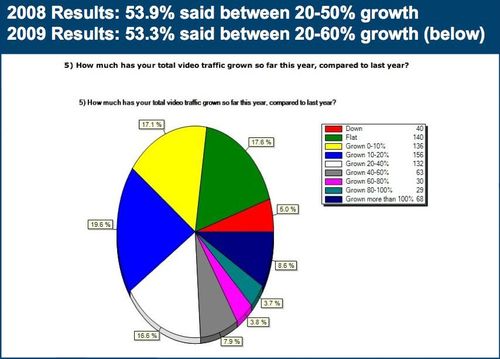
The question I got asked most frequently at last month's Streaming Media West show was when I thought the rate of growth for video traffic would once again begin to accelerate. Based on a recent StreamingMedia.com survey we conducted in September and October, of which 812 content owners responded, 53.3% of the respondents said their traffic grew on average of only 35%-40% this year.

When compared to the same survey last year, 53.9% of over 1,000 content owners said their traffic grew a total of 35% in 2008. This lack of growth probably comes as no surprise to anyone who tracks the CDN space as revenue amongst the CDN vendors has been flat all year. When pricing is down nearly 40% year-over-year and traffic is only growing at 35-40%, that makes it really hard for CDNs to show revenue growth from their M&E video business. 

Cdn-pricing-slide

If you're wondering just how big these content owners are who took our survey, 13.4% of them spend at least $10k a month, 4.8% of them spend at least $25k a month and 3.9% spend at least $50k a month, just on video delivery. I'll be giving out more details and numbers from the CDN pricing survey in the coming weeks.