Best Practices for Measuring Performance of Streaming Video

At the Streaming Media West show next week, (#smwest) Nathan Dye, Software Development Manager at Amazon Web Services, will demonstrate the best practices for measuring and monitoring the quality of your videos streamed to end-users. Nathan will provide practical guidance using external agent-based measurements and real user monitoring techniques, and discuss CDN architectures and how they relate to performance measurement. Finally he’ll walk through real-world CDN performance monitoring implementations used by Amazon CloudFront customers for video delivery.

It’s not too late to get a pass to the show and readers of my blog can register using my own personal discount code of DRF1, which gets you a two-day ticket to the show for only $595. That’s $300 off the regular ticket price and it gets you access to both keynotes, 35 sessions and how-to presentations, 100+ speakers and all the networking events, including the special MPEG-DASH event.

Sponsored by

Learn How Huffington Post Built Their Live Video Network

At the Streaming Media West show next week, (#smwest) Dylan Armajani the Streaming Manager for HuffPost Live we will present a case study of the recently launched HuffPost Live, which generates 12 hours of live programming five days a week. Attendees will learn about the challenges faced in launching a long form community driven live streaming platform. Learn about live streaming workflows, quick VOD turnaround, community based collaboration technology, and Huffington Post’s attempt to break away from standard broadcast methods.

It’s not too late to get a pass to the show and readers of my blog can register using my own personal discount code of DRF1, which gets you a two-day ticket to the show for only $595. That’s $300 off the regular ticket price and it gets you access to both keynotes, 35 sessions and how-to presentations, 100+ speakers and all the networking events, including the special MPEG-DASH event.

Boxee’s New DVR In The Cloud Device To Run On Amazon Web Services

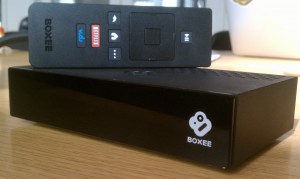
On Tuesday, Boxee introduced a new $99 box called the Boxee TV that has dual-tuners, WiFI, ethernet and connects to Boxee’s cloud based DVR platform. Consumers can get local unencrypted basic broadcast channels over-the-air, record them in the cloud with no storage limitations and also stream video from premium content services like Netflix and Vudu. Launching on November 1st in eight major cities in the U.S., the monthly DVR service will cost $14.99 a month and Boxee also plans to offer what they are calling a “freemium” option, allowing users to get a limited number of DVR cloud recording hours and streaming hours to devices, before they have to sign up for a monthly service.

While there has been a lot of talk about the new hardware, little has been mentioned about how the service will record, store and stream content. Boxee’s been working on the new cloud-based service for 18 months and has an exclusive partnership with Amazon, building out their entire video ecosystem using Amazon’s platform. Unlike previous cloud based DVR services from cable companies that simply recorded everything in the cloud on their own, Boxee is relying on end-users bandwidth to record and upload content to Boxee’s network. Boxee’s says they have spent a lot of time optimizing the way they buffer the stream being sent into their network and the way they optimize the upload and storing of content. Boxee says that as long as consumers have 1Mbps of upload throughput, the Boxee cloud system will work in a very reliable fashion.

Video will be recorded using the H.264 codec, at 720p and playback will be somewhere between 1-4Mbps using HLS and delivered by Amazon’s CDN service, CloudFront. Boxee says they won’t initially use adaptive bitrate streaming, but will move to that over time. Playback will take place using a HTML5 web player, which means Boxee won’t need to develop apps for any mobile devices. While Boxee will still offer support on their current Boxee box by D-Link, the company will officially stop selling the unit. Boxee plans to offer a special promotion to existing Boxee Box customers for the new $99 Boxee TV to make the transition easier, the details of which will be announced shortly.

As to how many $99 boxes Boxee expects to sell, the company isn’t saying. But in a discussion I had earlier in the week with Boxee’s CEO, the consensus is that Boxee hopes to sell a few million boxes in the next two years. That’s a number I was happy to hear them tell me as it means Boxee’s management is being very realistic about the market opportunity and setting correct expectations. With Roku having sold under 4M units and Apple around double that to date, I think Boxee has a very good shot at selling at least a few million in the next 24 months.

Updated 10/22: Boxee said that there will be a limit on how long recordings are stored for non-paying users, but that paying subscribers will be able to keep their recordings in the cloud for as long as they like. Also, Boxee will enable 5 concurrent streams per account, so multiple people in the household can all stream different content at the same time.

Boxee will release additional details shortly on where the box will be sold and which big box retailers and online websites they have partnered with, with some being an exclusive partnership.

Public Facebook Pages No Longer Viewable, Unless You Have A Facebook Account

I’m no Facebook guru, so others should chime in here in case I’m missing something, but within the past day or so, public Facebook pages I use to be able to read, are no longer visible unless you have a Facebook account and sign into it. When I visit a public page, a pop-up window instructs me to login to Facebook or create a Facebook account. If I don’t login, and close out the pop-up window, the scroll bars on the page disappear and I can’t read any of the posts on a public Facebook page. I tried this on multiple pages, including Coca-Cola’s and they are not readable, which also means I can’t watch videos.

If this is Facebook’s new policy, it’s bad news for content owners, especially for those who want to promote videos on their public pages. While I realize Facebook is huge, not everyone has a Facebook page and Facebook shouldn’t force users to have to log into a Facebook account just to be able to see videos or other content that’s on public pages. And as usual, it seems Facebook make this change to their system without announcing it as I can’t find any kind of news of the change anywhere on their site. I don’t care how many users Facebook has, the company has no respect for their users.

Special MPEG-DASH Networking Event In LA, At Streaming Media West Show

The MPEG-DASH Industry Update Speed Networking Event at Streaming Media West Show in two weeks, will provide face-to-face access to the forces driving the adoption and success of the DASH standard. Attendees will be introduced to leaders from each of the attending MPEG-DASH Industry Forum member companies and given a chance to have a quick 1 on 1 conversation regarding what the member company’s DASH rollout plans are and how they “fit in” within the overall DASH movement.

The Event will be held on Tuesday Oct. 30th, at 6:00PM in the Beverly Hills Room at the Hyatt Regency Century Plaza, in Los Angeles CA. Drinks and hors d’oeuvres will be served. Attendance to this event is limited to speakers, full conference pass attendees, and the MPEG-DASH Industry Forum special guests & panelists. So go online and register for a conference pass, enter my personal discount code of DRF1 in the box, and save $300 off the regular ticket price.

MPEG-DASH has gained a lot of attention over 2012 and this is the ultimate opportunity to engage on the topic. Conference sessions covering the topic at the show include:

C102: The Current State of MPEG-DASH in the Industry
The industry has been buzzing about the potential offered by MPEG-DASH as a complementary format that brings together the various adaptive bit-rate (ABR) specifications in use by the industry today. This panel discussion takes a fresh look at the key questions that were posed when MPEG-DASH came on the scene and sees what answers we have found. Panelists also tackle the next round of topics as we head toward mainstream adoption of DASH technology. What’s the technical reality in terms of encoding and players? Who is deploying DASH? Are there any early results in? And what can we expect over the next year?

  • Moderator: Matt Smith, VP, OTT Strategy and Solutions, Envivio
  • Kevin Towes, Sr. Product Manager, Adobe
  • David Price, Head of TV Business Development, Ericsson
  • John Griffin, Senior Director, Online Services and Gaming, Dolby Labs
  •  Joe Inzerillo, SVP, MLB.com

A103: Making DASH Workable, The DASH-264 Recommendation
To make the DASH standard useful in the real world, a number of key industry players are defining a practical subset of the standard to serve as a baseline for device implementations. In this session, attendees learn what feature capabilities are available with DASH (multi-bitrate, multi-language, multi-channel, common encryption, trick modes) and how these are being defined and presented as a set of conformance and interoperability tests. If you need to ensure that DASH will work with your encoder, CDN, playback device or website, this is the session for you.

  • Moderator: Michael Luby, VP Technology, Qualcomm
  • Michael Stattmann, Managing Director, CastLabs
  • Will Law, Principal Architect, Media Division, Akamai Technologies
  • Jan Nordmann, Director, Marketing and Business Development, Fraunhofer USA Digital Media Technologies
  • Andrew Popov, CTO, BuyDRM

A202: HOW TO: Creating a DASH-264 Player
With all the device fragmentation in the market, it is getting increasingly difficult to provide content to all of them equally. The MPEG-DASH specification promises to unify the field and provide a ubiquitous format, which can be used by most devices. Within the DASH specification, several different Codec’s can potentially be supported, but among the most promising is DASH-264, which uses H.264 within the DASH standard. This technical session explores how to build a DASH-264 player using OSMF. This will be most useful for ActionScript developers familiar with Adobe’s Open Source Media Framework.

  • Presenter: Jeff Tapper, Senior Consultant, Digital Primates

Google Lacks A Strategy To Support Live Video On Android Devices

For content owners that want to get their live event-based streaming content on mobile phones and tablets, many are quickly finding out that getting it to Android devices is extremely challenging. Unlike Apple’s iOS platform, Google has yet to provide an easy way to get live video to Android devices and to date, hasn’t detailed any kind of strategy of how they plan to fix it. Many content owners I have spoken with, as well as those who help these content owners encode and distribute their video are now questioning why they should even continue to go through all the trouble of trying to support Android based devices at all.

While media companies can always build an app for their event series, most do one-off events and are faced with streaming to the mobile web and reaching their audience using browsers on Android and iOS devices. When Android phones became popular, live video was supported in the mobile browser thanks to Flash. Digital video professionals with live content to distribute were able to keep doing what they were doing on the desktop and Flash made it easier than it is now. That’s not to say that Flash was perfect as in many cases their desktop players were heavy, containing ad overlays and metadata interaction that had a major impact on the playback quality. To get better quality video playback, some people turned to RTSP delivery, which Android touted as its native live video format until Android 2.3.4 came out, when that feature no longer worked.

The most effective way to get live video to Android browsers was to make a stripped-down Flash player that didn’t demand much from the phones. Video was decoded in the software but it would drain batteries quickly. It was imperfect but it functioned well enough to play video. With the introduction of Android 3.0 it looked like HLS support was going to be built-in for all future devices, and that has held true, sort of. HLS support doesn’t match the specification, and buffering is common. Industry-leading HLS implementations like those from Cisco and Akamai will not load on Android devices, so for the most part, content owners went back to Flash. But now Flash isn’t available to new Android phones.

Right now, content owners are left in an awkward state if they want to deliver live video to Android browsers. If Flash is present, you can deliver a basic Flash video player. If it is not, you can try to deliver HLS but the HLS manifests must either be hand-coded or created using Android-specific tools. If the HLS video can play without buffering you’ll find that there is no way to specify the aspect ratio, so in portrait mode it looks broken. The aspect ratio problem seems to have been fixed in Android 4.1 but often, if you enter video playback in landscape mode and leave in portrait it will crash. You can allow the HLS video to open and play in a separate application, but you lose the ability to communicate with the page, and exiting the video dumps the user back on their home screen.

In comparison to iOS devices, content owners can still send the same live video to iOS devices that they could in 2009, and it will play smoothly with little buffering. Live video support for browser-based streaming within Android tablets and phones is a significant challenge with little help available from Google, and with Android still talking about removing H.264 video support, many content owners are wondering why they should even try to support Android any longer? What’s clear is that Google doesn’t have a strategy to fix the problem and many content owners and video ecosystem vendors are frustrated. Content owners want to get their live video on as many devices and platforms as possible and right now, getting it to Android devices is very difficult and costly. Unless Google steps in to solve the problem, don’t expect content owners to continue to try to support Android devices for live video streaming.

Content owners that want to give their feedback to Google about this, feel free to do so in the comments section below.

Note: I emailed a representative of the Android team asking if they were willing to talk about this subject but didn’t hear back. If Google would like to respond to this issue, I’ll be happy to post their response or hear any plans they may have to address the problem.


The Future of Digital Entertainment in a Multiscreen World

At the Streaming Media West show (#smwest) in two weeks, Oct. 30-31, we’ve got a panel of leading content owners and platform providers discussing how they solve some of the challenges in delivering the creator’s intended entertainment experience across new devices. Come learn where the future of digital entertainment is heading and key industry drivers that could enable the next-generation entertainment experience on mobile and tablet devices. Confirmed speakers include:

  • Moderator: John Couling, Senior VP, E-Media Business Group, Dolby
  • Jeff Shultz, VP, Business Development, TV.com, CBS Interactive
  • John Penney, EVP, Strategy & Business Development, Starz
  • Adam Sexton, GM, Samsung Media Solution Center America
  • David Tochterman, Head of Digital Media, Innovative Artists

It’s not too late to get a pass to the show and readers of my blog can register using my own personal discount code of DRF1, which gets you a two-day ticket to the show for only $595. That’s $300 off the regular ticket price and it gets you access to both keynotes, 35 sessions and how-to presentations, 100+ speakers and all the networking events.