Streaming Media West Session Videos Will Be Archived Next Week

ScribeMedia.org is almost done editing all of the videos from last week’s Streaming Media West show. We should have all of the sessions uploaded into Brightcove and available for on-demand viewing by the end of next week. I’ll post the link to all of the videos as soon as they are ready.

Sponsored by

Akamai Shows P2P Solution To Select Customers Last Week

While no official announcement was put out by Akamai last week about their P2P offering, last week in Munich Germany, Akamai showcased some of it’s P2P offering for a very small select group of clients and partners. Based on what some of those customers have told me, Akamai stated that P2P traffic will be priced lower than CDN traffic, but Akamai did not give out any pricing details.

Technical details of the service were not covered in depth, but those at the event were told to expect a technical white paper on the product within the next 60 days and were told that the P2P service will initially be limited to HTTP delivery only. No public launch date was mentioned for the service.

For me, seeing what Akamai does with P2P is important since they do have the most market share for video delivery and would be the first major non-hybrid CDN to deliver on an in-house P2P based service. With the number of video customers Akamai has, I’m eager to see how many customers are going to be willing to help push out a player to their viewers. If Akamai can get some of their major customers to do this, think Apple, then they could get some great traction for the player and give more valid exposure to the P2P industry.

CDN Pricing Data: Average Cost Per GB Declines In Q4 Due To Startups

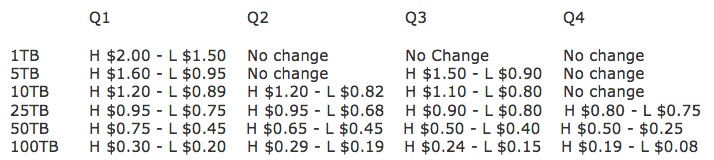
(Note: My latest pricing data can be found at www.cdnpricing.com)With all the talk in the market about the"pricing wars" taking place in the CDN industry, each quarter I review what the average going rate is and how it compares to pricing in the previous quarter. (Q3 pricing details here) The pricing data below is from my presentation last week at the Streaming Media West show entitled "CDN Pricing: Costs for Outsourced Video Delivery". The on-demand video of the presentation will be available shortly.

Before I get into pricing, there are some crucial things to cover. For starters, these are the average prices paid in the market. This does not mean that this is what every customer pays, or should pay. I list a high and low price based on the fact that there are a lot of variables with regards to the CDN product that end up determining the final price a customer pays. It is also REALLY important to understand that customers are not buying on price alone. In addition you CANNOT compare one vendor to another and doing so is not a fair apples to apples comparison. You can only compare the product lines of one vendor with another.

That being said, below is the pricing I have seen so far in Q4 and how it compares with Q3. If you look at these numbers by themselves, you will NOT get a full picture of the market. First, read my post from Monday entitled "Pricing Pressure On Akamai and Limelight Overblown By Analysts" which will give more insight into pricing.

While the high and low pricing average went down from Q3 to Q4, the reason behind that is the fact that a lot of new CDNs in the market are undercutting the more established players to try and grab some market share. Can they do this for awhile, yes. But over time, they won't be able to as they will lose money. For now, many of them have raised a lot of cash and can survive pricing lower in the market for the time being. For a new CDN, it is hard to sell a customer on value when you are new to the space and don't have a lot of customers to talk about. Over time, if they are successful, they won't have to lower prices and can sell on value, but that takes time.

These numbers also don't mean that every CDN in the market is undercutting the major players. In some cases they aren't and are selling on different features and functionality, not price. The bottom line is that pricing is still very fluid in the market on large deals, over 100TB delivered a month, BUT there is not as big of an impact in the market as many make it out to be. The whole idea that the CDN space is about to implode because there is a "pricing war" going on is inaccurate and backed up by no data. Are some companies not growing as fast as investors may like, yes. But don't blame that sole reason on the current or future price in the market. Again, there is more to a CDN than just the price.

And next year, pricing will be going up. When the new players in the market have been around for 6+ months, pricing will stabilize and many will realize they don't need to lower pricing to do a land grab. By then they should also have enough in place on their network to have an angle to up sell. We are at the point now where pricing has pretty much leveled off. Sure, there is always going to be a fluctuation in the market, but come 12 months from now, you won't see that much change in pricing at all from the established players. They won't give this stuff away at a lower price just to win business if they are going to lose money on the deal. Those days are over.

The pricing below is specific to video delivery, streaming or progressive download, there is no difference. This pricing does not include the platform license fee that CDNs charge for Flash Streaming. Before long, some things will be announced in the industry that will affect those numbers and I will cover the Flash Streaming license fee numbers at that time. The below numbers do NOT include video delivery costs via P2P. I will break those costs out in a different blog post as I now track those numbers separately.

So with all that being said, below is what the going rate is for video delivery based on a per GB delivered model. These figures are based on actual contracts and RFPs I have seen in the market and comes from customers telling me on a weekly basis what they are paying.

One_4


You can download all of the slides from my presentation here (Download DanRayburn-CDNPricingQ4.ppt)

I will be posting details on P2P pricing and P2P market trends shortly and will also cover a lot of what took place at the Streaming Media West show last week pertaining to P2P.

Pricing Pressure On Akamai and Limelight Overblown By Analysts

Everywhere I turn, all I keep reading about is the "pricing wars" taking place in the CDN market and how much it is affecting Akamai and Limelight. Yet to date, I have not seen a single article in the media or from an analyst that actually mentions any real numbers or examples when it comes to the pressure in the market. Many keep saying Akamai and Limelight are feeling pressure, but then give no details on what percentage of their contracts, customers, business or products they think it is affecting. Most of them, don’t even know what the services cost. Way too many analysts are speculating without any real data on the true impact of the pricing decline in the market.

The Wall Street Journal had an article from last week saying that "On average, content-delivery companies charge customers 30 cents to 60 cents for each gigabyte of content transported, say industry insiders. Some media and video sites move hundreds of thousands of gigabytes each month, meaning their fees can total in the hundreds of thousands of dollars." If you are moving that much data, you are not paying a rate even close to that. The article also went on to say that "Panther Express, a small content deliverer in New York, now says it plans to drop its prices 20% to 30%." 20-30% of what? Without knowing the starting price, those numbers meaning nothing. And how can you write about Akamai and Limelight’s stock price taking a beating and then talk to pricing in the market and use Panther as an example of how prices are declining? Panther Express does not even support streaming, does not support Flash streaming, does not do live streaming etc… all stuff Akamai and Limelight support. So if you are going to use an example, use one that fairly compares one companie’s CDN product to another.

The pricing pressure discussion in the CDN market is overblown by analysts. Yes, the price per GB delivered has dropped from Q3 to Q4, but Limelight is not the one dropping pricing. In fact, Limelight’s price per GB delivered is nearly identical to where it was 12 months ago, except for a very small percentage of their largest customers. And while Akamai had to drop much of it’s pricing for the past 3-4 months, specific to video delivery only, much of that has since stabilized. For customers looking for more than just video delivery, in many cases these customers are still willing to pay Akamai more for their services since Akamai offers more than just video delivery. Are they willing to pay 50% more? No. But paying about 20% more per GB delivered is not uncommon.

Many analysts need to better understand that customers are not buying on price alone. And when you look at the actual pricing data, which I will publish tomorrow, the reason the pricing average has dropped in the market is due to all the new CDNs in the industry who are selling on price alone or are trying to ramp up their business with lower pricing. New entrants like EdgeCast and BitGravity are pricing lower in the market which is normal for newly launched CDNs. And there is no pressure from the P2P players on the major CDNs in terms of reducing CDN pricing. P2P is NOT a replacement for CDN, it’s a compliment.

The whole pricing pressure discussion is way overblown in the market. Yes, there was some adjustment, in particular by Akamai, but that’s pretty much done and moved on now. And when Akamai or Limelight does give guidance to the market and says we are feeling some pricing pressure, it’s not across their entire business, across all of their contracts or even across their entire product line.

Over time, CDN pricing is going to be going up, not down. CDN providers are still closing business at a higher rate then their competitors based on crucial factors like reporting, SLA, geographic reach, formats supported, etc…. if this was only about the lowest price in the market, many of these CDNs would have gone out of business already. Limelight and Akamai are not in the business of pricing contracts under cost. That’s not a model of survival. The majority of customers do not buy on price alone. I hear from customers all the time they are willing to pay a little bit more, on average 20-25% from what I hear, for things they see value in from the different CDNs. The key is how the CDN shows them that value and what it is worth to the customer.

And even with pricing pressure, Limelight and Akamai are still growing at a rate of at least 40% a year. Ok, maybe that is not good enough for investors, as I am not a financial analyst and don’t care about stock prices, but it’s not as doom and gloom as some analysts want to make it out to be. Comments in the media like "the space is deteriorating" and "we can expect to see a slowdown" can be proven wrong by the data that shows growth on the number of consumers watching more video, at longer lengths, more often, on more devices AND at higher bitrates. No CDN vendor anywhere is not growing. Yet analysts want to say the market is "deteriorating"? There is no data to support that and to date, nearly no large media company has brought video delivery in-house. And no, Google and MySpace don’t count since they are not the typical media company. So where is the doom and gloom?

Tomorrow, I will publish the going rate for CDN pricing for video for Q4 and explain how that compares to Q3 pricing, based on the data I have seen. I will also be posting details on Level 3’s new streaming CDN pricing model, which is not, as many are speculating, 50% cheaper than their competitors in the market.

CDN Pricing Presentation And CDN News From Streaming Media West

On Thursday, the Streaming Media West show winds down and I’ll start writing up a lot of coverage of what took place at the show including an analysis of Level 3’s CDN announcement and their pricing model; reviews of all the CDN news put out news this week by vendors and I will be posting my slides and the latest pricing data from my presentation entitled "Demo: CDN Pricing: Costs for Outsourced Video Delivery". I will also be reviewing the P2P pricing data in the market and covering many other topics from the show. All coming next week.

Another CDN Goes Hybrid: Internap Launching P2P Service

As was expected, Internap announced this morning details on their new P2P service due out by the end of the year. Developed in conjunction with Pando Networks, Internap now joins VeriSign and CacheLogic as CDNs with a hybrid delivering offering. Akamai is also expected to announce their P2P offering next week.

This is a big shift in mentality for many of the CDNs who even 18 months ago would not even consider P2P as being a legitimate offering. But based on the change in the market with more bits being delivered, at higher bitrates, with lower pricing and different tiered levels of service, not to mention laying the framework for the HD demand that will result a few years from now; P2P technology is something the CDNs had to embrace.

This is good news for everyone, customers and vendors. The one size fits all mentality that CDNs have had for some time is now being replaced with the idea that it’s about using the best combination of technologies to deliver the right type of content, to the right user, in the right manner. The mentality of many CDNs has changed quite a lot in the past two years, all for the better.

Video Search: Finding Content In A Thousand-Channel Universe

Smwest_logo_4
With the arrival of "video everywhere" and increasing online video viewership, what role does search need to play to make it easier for consumers to find what they want to watch?

That’s what we are looking to discuss next week at the Streaming Media West show with a session entitled "Video Search: Finding Content In A Thousand-Channel Universe". The confirmed speakers include:

  • Larry Bouthillier, Educational & Multimedia Technology Architect, Harvard University (moderator)
  • Dmitry Shapiro, CEO, Veoh Networks
  • Tim Tuttle, VP, AOL Video
  • Rose Karpel, Director, Video Products, Reuters
  • Suranga Chandratillake, CEO, blinkx

It’s not too late to register. While the early registration discount period has now passed, you can use PROMO CODE: DRF1 to get in with a discount.