Brightcove’s Consumer Upload Service Cancellation Overblown By Many

Brightcove_logo
Last week, Brightcove announced via an e-mail to users that it was shutting down its consumer upload service at their Brightcove.TV destination. Many of the blogs that covered the announcement pretty much agreed that Brightcove should not have offered the service to begin with and felt that it didn’t align well with their core service offering around professionally produced content; which is something I agree with. But much of what posts about Brightcove on WebTVwire, InsideOnlineVideo and Mashable talk about I completely disagree with. (note: I can read the
InsideOnlineVideo article in Google Reader, but the link to it on their
website is broken, hence why I don’t link to it)

For starters, too many of them compare the Brightcove.TV service to YouTube or wanting to compete with YouTube which was never Brightcove’s intention. Anyone who looks at the content on Brightcove.TV could easily see that it was not the same type of content shown on YouTube. Yes, there was some overlap, but not much. Most of it was still relatively well produced content, something YouTube isn’t. And as the story on Mashable pointed out, Brightcove’s cost to run such a destination site was probably extremely low since they were simply re-purposing the platform they already had in place. It’s not like they re-invented the wheel and dedicated a lot of internal resources to the offering.

That being said, I disagree with the Mashable article as it portrays Brightcove as a company being in trouble and not being focused with it’s offering. Shutting down Brightcove.TV does not put the company in jeopardy. It’s focus from day one has always been about it’s platform, their tools, syndication and advertising. The fact it used those tools to showcase consumer content in addition to professional content is not a big stretch. Yes, the consumer side is probably not a viable business model today, but if it costs them next to nothing to offer it, gets branding for the company name and Brightcove is smart enough to stop the offering as soon as they saw it didn’t make sense, how does that put them in jeopardy? Mashable says management has problems but the fact they shut it down only a little while after it came to market, shows to me that management understands the market opportunity and moved quickly to address it. In my eyes, there would be problems with management if they waited years to shut it down all the meanwhile saying how great it is working out, like many companies in this industry do.

The WebTVwire article also questions the long-term success of Brightcove as a company and says, "Whether the company has
a shot a succeeding now is still a question that is up in the
air." True, but that can be said of any company, but I don’t see how shutting down Brightcove.TV now creates more doubt. Yes, Brightcove has raised over $80 million and if we know how much revenue they were doing I’m sure their evaluation multiple would be quite high, but Brightcove is signing up a lot of new customer and content companies we have all heard of. They have large customers and they are getting more of them. While we don’t know the average price they are paying, Brightcove had 800 customers at the end of 2006. Today, Brigthcove says they have over 4,000. No, customer count does not help us in trying to figure out revenue, but look at how many companies in the industry won’t say anything about how many customers they have. At least it’s one metric we can use to show Brightcove’s growth.

As for the Brightcove service itself, options vary on how Brightcove’s solution stacks up in the market. The post about Brightcove at InsideOnlineVideo says, "Their platform is
a commodity, and they’re about to kill their own community. We may as
well relegate Brightcove to the deadpool." The Mashable article likes Brightcove’s platform and says "…they have the absolute most complex and cool back-end for their video
management system that allows for customization of how your videos
display. Personally, of the solutions I have used and looked at, I think Brightcove has the most robust tools and features in the market, however I don’t use the advertising component of the platform so I can’t speak to that functionality.

Some say that others have better tools than Brightcove and I’d love to see in the comments section who readers feel those companies are. Who do you compare to Brightcove when it comes to their platform?

For me, the bottom line is that more and more sites I visit are using Brightcove and years later, they are still focused on their core offering, that being their platform. I know what they do, what they offer and what the value is to a content owner. That is a lot more than I can say about many companies in this space who’s service offering is confusing, complex or every changing. Is Brightcove guaranteed to make it in this space? No. No one is guaranteed anymore. But the fact that many companies have made acquisition offers for Brightcove and feel they have a platform worth owning also tells me that their business is not "shaky" or "in trouble" as some bloggers suggest.

Sponsored by

Speakers Wanted: Streaming Media East 2008 In NYC

Smeast_logo_4
The next StreamingMedia.com conference and exhibition will be Streaming Media East, May 19-21st, 2008 at the Hilton Hotel in NYC. I have just opened up the call for speakers and all submissions should be sent in via the form on our website. If you are interested in speaking, or are interested in submitting for a company you represent, I can’t stress enough how important it is that you get the submission in on time. The deadline is January 1st 2008.

Many don’t realize how much work goes into planning a show months in advance. Last year I got some really great speaking submissions a few weeks before the show after the program was already complete. The East show has over 100 speakers and 35 session slots, it’s not something you can just program a few weeks in advance. So if you want to speak, please get the submission in by January 1st.

If you have any questions about a submission, ideas you want to run by me, thoughts on what you can do to help the show, call me at anytime. 917-523-4562. I pick up my phone 24 hours a day 7 days a week. I am always reachable. Don’t let the fact you may have a question stop you from getting your submission in on time. If you have any questions at all on the submission process, contact me so you can get it in on time.

Blog Traffic Growing Nicely: Thanks To Readers And Sponsors

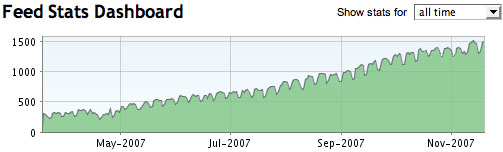
It’s been 8 months now since I started this blog and in that time the number of page views, readers and RSS subscribers continues to climb nicely.

Feedstats_8

This is largely due in part to the loyal readers and subscribers of
the blog and all the sponsors who enable me to be able to sit down and
write something nearly everyday. Thanks to Limelight Networks, Tremor
Media
, Ignite Technologies and PEER 1 who have been long time sponsors
and also thanks to Ortiva Wireless, Akamai and EdgeCast who are recent
additions to the blog.

While many blogs and sites charge a lot to get exposure on
their site, my goal has always been to keep the sponsorships affordable
on the blog and give as many companies as possible the ability to get
exposure from a few hundred thousand page views a month. And while sponsorships are not sold on a CPM model, comparing it to
a per CPM model it can be as affordable as a $3 CPM for those who
sponsor for an extended time.

If you are interested in sponsorships details please contact Joel
Unickow
or myself and I will be happy to get you connected with Joel.
Over the next few weeks I will also be adding new ad positions on the
blog and will be adding additional ways to make it easier to find
content.

Thanks again for everyone’s support and as always, if you have ideas
for the blog, if there are topics you want me to write more about, I am
always open to feedback, good or bad.

Adobe’s New Flash Server Pricing Improves CDNs P&L, Lowers License Fee For Customers

Fms3_60x45_5
While Adobe has gotten a lot of traction in the market with their Flash video platform, many content companies have not adopted Flash streaming due to the server license costs or the license fee that CDNs are required to charge for Flash streaming. With today’s announcement by Adobe of Flash Media Server 3 and the new Flash Media Interactive Server, those licensing costs have now been drastically reduced.

As was expected, Adobe cut the cost of the Flash Media Streaming Server which is now priced at $995 for an unlimited connection license. And the newly announced Flash Media Interactive Server, which is geared towards customizable streaming solutions, multi-way social applications, content protection and allows for more server side customization is priced at $4,500. (For technical details about the functions of each server read Stefan and Ryan’s blogs)

For some time now, Adobe has known that price has been the biggest hurdle for many customers to overcome in the adoption of the Flash platform. With the new pricing, Adobe has essentially removed the number one barrier to entry and while not discussed in the press release, has also reduced the cost that CDNs need to charge customers for Flash streaming delivery.

By reducing the costs that CDNs need to charge customers for Flash streaming, Adobe is making it a lot easier for customers to use CDNs  and enabling the content delivery networks to increase their margins. While the Adobe streaming license fee that most CDNs have been charging averages around $0.05 per GB delivered, the new Adobe streaming pricing is somewhere between $0.01 – $0.025 cents per GB depending on the CDN and the volume of Flash streaming they are pushing. Some CDNs have a better rate based on the volume they push and some CDNs include the price into their overall cost and reduce the price even further. The bottom line is that the average price per GB Flash streaming fee that the CDNs are now charging is at least 50% cheaper than what it was a few weeks ago. Within the past 2-3 weeks, quotes from many of the major CDNs have already shown lower license fees.

This is good news for the industry as a whole and for Adobe as the best way we can all truly benefit in the market is by having more widespread adoption, with a lower barrier to entry.

VeriSign Expected To Sell Their CDN Business

Verisignlogo
A few weeks ago, VeriSign held they annual analyst day where they unveiled new details about the company’s strategic direction for 2008. Their newly announced strategy is to sell a number of businesses in the company’s portfolio, such as communications, billing and commerce and focus instead on their core business and a smaller group of products and services.

While VeriSign stated that it would review its content delivery offering over the next six months and decide whether or not to keep it, the CDN business is already being shopped around to other CDNs and content companies who many want to own their own network. While all the major CDN players are looking at the assets, it’s unlikely any of them will be a good match for the business. VeriSign’s CDN business really only consists of the P2P offering they acquired from Kontiki and has very little in the way of any traditional CDN products, so it’s really a P2P infrastructure sale. Most CDNs already have a P2P offering they have been working for some time or don’t have an interest in P2P until there is more traction in the market.

There is also the possibility the CDN business could be sold along with other products and services in a larger deal or all together if VeriSign as a company is sold. A few of the telcos not yet in the CDN business are currently investigating whether or not to offer a CDN product and this could be a cheap way for them to potentially enter the market with a P2P offering to start. The real question is how much revenue the CDN business is doing and what it’s assets are worth. My guess is that VerSign will probably do about $8-10M for 2007, but I don’t know for sure. One thing I would be willing to bet on is that VeriSign would unload it for a lot less than the $62 million in cash they paid for it.

It will also be interesting to see how this affects a few of the major broadcasters in Europe including
the BBC, Sky and Channel 4 who all currently use VeriSign’s P2P
solution for video delivery. Although based on a story yesterday by PaidContent.org, it sounds like Sky is abandon its P2P player and moving to a browser based system.

The biggest speculation I keep hearing is that Limelight Networks will buy the business so they can acquire a P2P offering and add some additional revenue. But the more that comes up, the more I think it’s not a fit for Limelight Networks as a company and if they were to do any acquisitions, they would have to be all stock based and one would think VeriSign does not want stock. My feeling is that VeriSign will make the decision very soon and part with the business very shortly. The real question is to who.

NBC Direct To Use P2P Video Delivery From Pando Networks

Pandologo_4
In September, NBC announced that come this fall they would launch a new service, named NBC Direct, that would enable viewers to watch some of NBC’s top TV shows as ad-supported downloads. While NBC plans to use many platforms to make their content available including iTunes, the move by NBC is essentially driven by the desire to cut out the middle man and deal directly with the viewer.

While most details surrounding the service have not yet been disclosed, three companies have been working together to build the NBC Direct service. ExtendMedia is doing the interface, YuMe is providing the advertising platform and Pando Networks has been chosen as the P2P technology of choice. When contacted last night, executives at Pando Networks would not comment for me on their involvement, but others I have spoken to have confirmed that after a long evaluation of various P2P networks by NBC, Pando has won the business.

When NBC Direct launches out of Beta, this will be the first major TV network in the U.S. to adopt P2P and make it such a crucial part of their distribution strategy. I know some will say Joost is already doing this and the BBC has been doing it for awhile but they don’t count in my eyes, for obvious reasons. The NBC Direct service will bring a lot of exposure to P2P and will help to legitimize P2P as a solution for some, not all, kinds of video delivery. NBC won’t be using P2P exclusively and as anyone who truly understands the value of P2P will tell you, it’s not a replacement for other distribution platforms but rather a compliment or enhancement.

For Pando Network’s it’s a big win and should lead to other major broadcasters and content companies giving them and other P2P platforms a legitimate shot at solving their video distribution needs. 2008 is shaping up to be the "perfect storm" for the video delivery segment of this industry.

Two weeks ago, I interviewed Yaron Samid, the Co-Founder and CMO of Pando Networks from the Streaming Media West show and discussed the current hurdles in the P2P industry and what role Pando Networks is looking to play in the market. (apologies on my audio levels as I was battling a cold)

New Book: Hands-On Guide To Creating Flash Advertising

20075235112352924
Last month, the latest book in my series came out entitled "Hands-On Guide To Creating Flash Advertising", written by Jason Fincanon. Amazon has the book the cheapest for $23.

The book covers how to create awe-inspiring, mind-blowing Flash ads and microsites that engage consumers and demonstrate their worth to clients and delivers the nuts and bolts of the development process from initial design conception to ad completion. You can views the table of contents on the Amazon website and see more details about what the book covers.

Anyone who posts a review of the book on Amazon will get a free copy of the next edition of the book when it comes out. This goes for bad reviews of the book as well, as all reviews are welcomed.