
Video CDN Report From Frost & Sullivan Now Available At Discounted Price

Cdn
I'm happy to announce that the first report I helped author at Frost & Sullivan on the video CDN market is now available for sale. (Full table of contents at: www.cdnreport.com) The report will only be available for the next three weeks at a special price of $1295. Most major research firms don't sell individual reports on a one-off basis and only make them available to customers who sign up for a subscription based service.

Frost & Sullivan realizes the importance of this report and like me, wants to be able to get the data into the hands of as many people as possible. To make that process even easier, I will be personally taking the orders and fulfilling the reports myself. You don't have to buy it through a website and wait hours or days to get it delivered. Simply call me anytime at 917-523-4562 and I will take payment over the phone and send the report out in real-time.

While there have been a bunch of research reports put out on the CDN market, this one is unique for multiple reasons. For starters, it focuses specifically on the video CDN market and breaks out video revenue and market sizing from the larger, more generic CDN industry. Some of the data includes:

  • dual scenario revenue forecasts based on current and future economic conditions
  • compound annual growth rate percentages for video delivery from 2005-2013
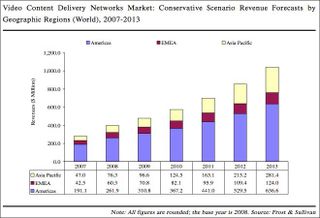
  • revenue forecasts by geographic regions
  • revenue forecasts by vertical markets (M&E/enterprise)
  • vendor market share by revenue
  • market drivers and restraints
  • types of web video applications and customers
  • database of key industry participants

The 75 page report includes nearly 40 charts and graphs and anyone who purchases the report has access to do a follow up call with me with any questions they may have. I am also willing to help further break down the data in the report and provide even more granular details on the numbers.

I've always found that the process of purchasing one-off research reports is too un-personal, takes too long to get fulfilled and many times, is difficult to follow up with those who authored the report. So we're going to do the exact opposite and really try to help folks better understand the data and market, even after you have already bought the report. We stand behind our research and think it is important to provide a different level of personalized service and look forward to doing so.

Sponsored by

Amazon Lowers CDN CloudFront Pricing Down To $0.05 Per GB For Volume

Amazon announced this morning that come February 1st, it will lower pricing for their content delivery network service, CloudFront, for large customers doing more than 1,000TB a month in volume. Amazon has already posted the new rates on their website.

This is an expected move from Amazon as their pricing was a little high for really large volume deals and with CloudFront now up and running for a few months, Amazon says, "As we continue to reduce our costs, we're able to pass the savings on to our customers."

The new pricing still does not make Amazon a threat to any of the large scale CDNs, but it only increases pressure on the smaller CDNs for customers who need very commoditized download services.

Apple Moves To Dual CDN Vendor Strategy: Now Using Limelight With Akamai

Images
For many years, Apple has relied on Akamai to deliver the vast majority, if not all, of Apple's content. But in the fourth quarter of 2008, it appears that Apple moved to a dual-vendor strategy and started using Limelight Networks in addition to Akamai for the delivery of OSX software updates, iPhone updates and app delivery from Apple.com and the iPhone store.

Starting in the fourth quarter of 08, content that I historically saw being delivered from Akamai, also started coming from Limelight Networks. Now I don't know if this content was "exclusive" to Akamai or if 100% of it historically came from Akamai, but as an example, in Q2 of 08, my OSX updates always came from Akamai domains. Last Friday, Apple released an update to QuickTime, version 7.6, and the update came from the Limelight network out of a Seattle POP. (cds.303.sea.llnw.net)

I don't know what parameters Apple uses to decide how they redirect a user's request to one CDN over another, but it appears much of it could be based on the geographic location the user is coming from as I also noticed this exact same QuickTime update getting delivered from Akamai depending on what city the user was located in.

I saw this dual-vendor approach happening across many different pieces of content for Apple including OSX updates, application downloads from the Apple.com site (like the iLife trial) iPhones software updates and some apps for the iPhone app store.

I started noticing all of these changes around the November time frame and didn't see a single piece of content being delivered for Apple, by Limelight, anytime before that. That's not to say it could not of been happening earlier, but I am one of those Apple freaks who downloads tons of stuff, always looking at where it comes from and have never seen the llnw.net domain show up anywhere before November.

In addition to this, I also saw the Limelight domain showing up for a limited time for HD videos coming from the Apple.com site, mostly around the holiday time last year. Tracing tons of that content now only shows me Akamai domains though, so I don't know if that is still happening.

It is also interesting to note that Apple's change to a dual-vendor strategy comes soon after Apple had major issues with the iPhone 3G launch and the MobileMe offering after experiencing outages with both services in the third quarter of last year. However, I don't know if either of these problems were a result of an outage or capacity issue on the network since Apple didn't say why the services went down. And while both Akamai and Limelight told me "no comment" when I asked them for details on delivering content for Apple, Akamai did go on record to say "Akamai had no service issues on our network in Q3 of 2008".

But the fact that the llnw.net domain is starting to show up for some of Apple's downloads shows Apple is looking to rely less on just one CDN to handle all of their traffic requirements which makes sense if you want to ensure you always have enough capacity. I don't know Apple's traffic volume, but considering how many iPods and iPhones they keep selling, you have to imagine their traffic has some crazy growth each quarter and moving to a dual-vendor strategy should help keep Apple's services from having future performance issues. We already know that no CDN has unlimited capacity and can only handle so much traffic at any given time and if you are Apple, using more than one CDN is just smart business.

Now one could speculate that Limelight only has a very small fraction of Apple's business. That may or may not be true, we don't know. But even if it's only a small percentage, a small percentage of Apple's traffic is huge considering how much volume Apple must be doing every month. And for most customers who move to a dual-vendor strategy, they don't put only a small amount of traffic with one vendor as that defeats the whole purpose of why you have a dual-vendor strategy to begin with. What financial impact Apple's move to a dual-vendor approach has on either Limelight or Akamai is yet unknown, and I don't know any of the contract details.

Quite often I am asked if most content owners use more than one CDN vendor for video or if what we are seeing by Apple is a trend. It's really hard to answer that question since some content owners tell me that using two vendors is a hassle due to having to two contracts, two sets of raw logs, two kinds of reporting etc. But other customers tell me they never want to rely on just one vendor and using two CDNs is essential to their business. That said, I have noticed that lately, it seems many of the big content portals do seem to be using two vendors, but not all of them.

I also think this move by Apple is a testament to both Akamai and Limelight's network performance, specific to video downloads. While I am sure both companies would disagree with me when I say that they both offer a similar level of performance on their network, the fact is that most customers tell me they see very little difference between the two networks for commoditized video delivery services, as it pertains to network performance.

In terms of pricing, reporting and other services outside of simple video downloads there are plenty of differences between the two companies. But if any customer is willing to give both CDNs the same type of video content for simple downloads, clearly the customer trusts both networks and does not see a big difference between the two in terms of performance, especially if they are sharing the traffic.

Limelight To Akamai: “My Network Is Bigger Than Your Network”, The Debate Begins

A few minutes ago, the RSS feed from Limelight's blog showed a new entry with more details on Limelight's network capacity during the Obama inauguration webcast. While both Akamai and Limelight put out stats after the event was over, they each used different metrics in their releases making for an apples to oranges comparison.

Akamai said the total number of simultaneous audio and video streams on their network across all of their customers for that day was 7.7 million. Limelight's release only gave out the total number of simultaneous streams for the webcast, which was 2.5 million. Days later, Akamai broke out for me the total number of simultaneous streams for just the Obama webcast at around 3.8 million. Today, Limelight's blog post says that at the same time Akamai was reporting 7.7 million simultaneous streams for all of their customers, Limelight saw just over 9 million simultaneous streams for all of their customers on their network.

Clearly this is turning into a "my CDN is bigger than your CDN" debate which quite frankly, is impossible to prove for either side. For starters, neither CDN says what the average bit rate was for the simultaneous streams on their networks. If one CDN had more audio streams, or lower bitrate streams, they could deliver more than the other and it would completely skew the numbers.

In addition, network capacity is difference than network performance. Lots of folks have capacity, not as many have good performance. We don't have any third party metric to show the performance difference between the two networks during the inauguration webcast.

Limelight's bog post points to a graph by Arbor Networks that shows traffic data from ten U.S. consumer ISP networks which says that Limelight saw an increase of 160% versus Akamai's 17%. Those numbers don't make any sense to me and quite frankly, it's really hard to tell exactly what they mean.

Network scale is important, but I think performance measurement is even more crucial. I guess the CDNs putting out all of these numbers are a start, but still, I think it's nearly impossible to compare any of them apples to apples for the Obama webcast based on such limited data.

Gregg Moss, SVP Of Enterprise Video, Bank of America Confirmed As Keynote For East

GreggMoss-Headshot
I am happy to announce that in addition to Paul Sagan, CEO of Akamai, Gregg Moss, who is the SVP of Enterprise Streaming Media Strategy and Delivery for Bank of America, is our second confirmed keynote for the Streaming Media East show in May.

While the media, entertainment and broadcast verticals seem to get all the press these days, there are still lots of exciting things taking place with the entire online video ecosystem in the enterprise market. Gregg's presentation will detail how Bank Of America is using online video both internally and externally and also talk about the role that devices other than the PC play in helping them deliver their message.

In addition to Paul and Gregg, we'll have two more keynotes to announce shortly who are both from the M&E/broadcast industries. We'll have a nice balanced set of keynotes representing the media, broadcast, enterprise and infrastructure verticals.

The advance program for Streaming Media East is now complete and will be posted this week and placement of speakers will begin in the next few days.

Deutsche Telekom Enters The CDN Market, Partners With EdgeCast

Dt-edgecast
This morning, Deutsche Telekom announced that it would enter the content delivery market by reselling the content delivery services of EdgeCast. For months, the two companies have been quietly working to put the solution in place and Deutsche Telekom is already actively selling the service, and launching it with customers, primarily focusing on the European market.

Deutsche Telekom is now the fifth telco to have entered the content delivery market in the past 18 months. Reliance Globalcom is reselling Internap, Tata Communications licensed BitGravity, Level 3 acquired the CDN assets of SAVVIS and AT&T is building out their own CDN from scratch. It's interesting to note that of the five companies, four of them have taken completely different approaches to enter the market.

While EdgeCast will get to leverage some of the IP assets of Deutsche Telekom, customers of Deutsche Telekom won't just be using the Deutsche Telekom network. Content will be delivered over Deutsche Telekom IP backbone and through EdgeCast servers located on other networks. This should give Deutsche Telekom a leg up on some of the other telcos who have chosen to only deliver content over network assets they control.

While the pure-play CDNs still control nearly all of the market for video CDN services, the telcos are positioning themselves for the future, when video delivery becomes a billion dollar industry. While the telcos still have a lot to put in place in order to compete with the pure-play CDNs, as long as the telcos can wait it out, they should start to grab some share of the market over the next 24 months.

Breaking News: Jury Rules In Limelight’s Favor, Not Infringing On Level 3 Patents

A ruling just came out in the Level 3 versus Limelight patent infringement suit. The jury found that Limelight does not infringe on Level 3's patents. More details to come as I get them.