Akamai: About 3.8 M Simultaneous Obama Streams, Details Capping Of Customers

Last night I had a long conversation with Akamai about the inauguration webcast and got more details on the actual number of simultaneous streams they served and their methods and reasoning for capping customers on their network.

Many who are writing about inauguration traffic numbers are quoting from the Akamai press release and implying that Akamai delivered, at peak, 7.7 million video streams of the inauguration, which is incorrect. That 7.7 million number is the total number of all audio and video streams for all of Akamai’s 2,800 customers delivered on their network that day. Out of that 7.7 million number, Akamai said roughly half of that was just for the inauguration. That puts my earlier estimate of around 8 million simultaneous streams combined across the Akamai, Limelight and Highwinds CDN a little high, with the number being more around 7 million.

Akamai also stated that they delivered the live webcast for “twelve major broadcast customers” although I can’t say who all of those customers were since they don’t have permission to use all of the customers names. How much revenue they earned from the inauguration webcast amongst all of those customers is not being shared right now since Akamai is currently in a quiet period. But if someone asks them on their next earnings call about this, it sounds like they might make that number public. Needless to say, it’s not a big number and anyone who knows the space well knows that being in the live events business means tons of work, lots of headaches and very little revenue. These one-off, large-scale webcasts are not moneymakers for the CDNs.

Aside from the numbers, we also had a lengthy discussion about how and why Akamai caps customers and the business reasoning behind it. As much as some may want to think, there is no such thing as unlimited capacity on a day like the inauguration, even for Akamai. On the StreamingMedia.com discussion lists, there were some Akamai customers talking about how they had been capped by Akamai on the day of the webcast without asking to be. While some Akamai customers seemed upset by this practice, it’s also important to realize that many customers did not provision properly for the event. Many customers also were not willing to pay Akamai to guarantee a certain level of service or capacity. A few of Akamai’s largest customers were in fact willing to pay more and paid upfront to guarantee they would have the capacity they wanted. Even with that, those customers went way over what they were expecting in terms of traffic and had to be capped. One major customer provisioned for 30GB and peaked at 125GB and Akamai still delivered it. But at some point, they had to cap what they would deliver when the customer is 4x over their capacity planning.

Akamai had to make a business decision to cap customers based on the fact that they have 2,800 other customers they have to keep up and running. Any other CDN would have made the same decision and when customers don’t plan, or are not willing to pay to provision for a surge in traffic, no CDN can let that affect all of the other customers on their network. Imagine the impact to Akamai if they didn’t cap any video customers on that day and as result, their ecommerce customers went down. Akamai has 83 of the top 100 ecommerce sites on their network and just think of the impact that would of had on the ecommerce industry if Akamai didn’t take the necessary steps to keep video from taking down their network. This is simply the way CDNs have to operate on the rare occasions when something like the inauguration webcast happens.

Akamai did say that moving forward, they should cap customers using a better method by using things like a waiting room as opposed to viewers getting an error. The waiting room is what was used by CNN and while I didn’t like the experience, it makes more sense to me now knowing the reason behind it. But this also raises a very interesting scenario though since the inauguration webcast was a planned event. What happens if a major breaking news story happens and we see traffic like this again? In that case, CDNs would have to cap customers again since almost all customers do not pay any premium for what is essentially breaking news insurance, thereby guaranteeing them tons of excess capacity at a seconds notice.

While the content delivery market as a whole has historically used marketing phrases to imply that they have “unlimited capacity”, that’s simply not reality. This is the way the Internet works and it puts things into perspective when many want to say that the Internet will drive broadcast TV out of business, that HD quality video will be delivered to millions anytime soon or that online video will get the same sized audiences that TV broadcasts get. The Internet has major limitations for delivering video to large-scale audiences and while many want to complain about the problem being at the ISP end, or with the end users broadband speed, the bottleneck is also on the CDNs end.

Sponsored by

MSNBC Now Porting Video To Xbox Live: Inauguration Videos Playing In Dashboard

XBOX-Obama
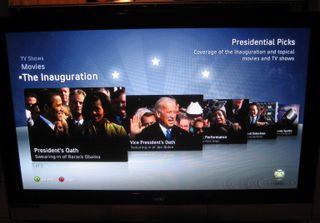
Less than four hours after Obama was sworn in, I logged into my Xbox Live dashboard and was surprised to get a special section that had all of the inauguration videos already archived and available for viewing. The videos, provided by MSNBC, had pretty good quality and started playing very fast. This is the first time I've ever seen MSNBC providing any video content to the Xbox and I wonder if this is going to be the start of a new trend on their part. While much of what MSNBC covers would not be relevant to the Xbox Live audience, I could see other forms of content potentially making it to the console.

Has anyone else ever seen content like this before on Xbox Live?

Inauguration Numbers: CDNs Deliver Over 8 Million Simultaneous Video Streams

While it is impossible to know the exact number of people that watched the event at one time, Akamai, Limelight and Highwinds combined did over eight million simultaneous streams for Obama's inauguration video, across all of their customers. Limelight said they peaked at around 2.5 million streams, Highwinds say they saw about 625,000 and my estimate is that Akamai did around 5 million.

While Akamai put out a press release saying they did seven million simultaneous streams across their network, they did not break out how many of those were just for the inauguration. Since they peak at around a million streams already on any given day and the release states that some of the seven million streams were on demand, I figure Akamai did around five million simultaneous just for today's inauguration. (I have a call into Akamai asking for an explanation and will update the post when I hear back)

In addition, CDNs including Level 3 and others delivered some live streams of the event, but in much smaller numbers. Adding all of them up and I think a fair estimate would be that between 8-9 million people were all watching a live video stream at the same time.

Hard to know how this compares to other events since most of the CDNs don't give out simultaneous stream counts, but it's definitely up there in terms of being a large number across all of the CDNs combined.

Inauguration Question Of The Day: What’s The Largest Online Event Ever?

Over the last 48 hours, I have gotten almost a dozen calls from some of the major news portals and CDNs asking what's the largest online event in the history of the Internet? Clearly, many are already starting to write up their post inauguration press releases to talk about the number of users to their online broadcasts. While this is a question many want to know the answer to, it's one that nobody can truly answer. 

There is no such thing as the largest event ever since after many large-scale online broadcasts we never hear what the simultaneous stream count was. And for those that do release numbers, they are typically very generic and we have no idea if they are even accurate. Apparently CNN is already reporting numbers, but they are only giving total number of streams served and not the number of simultaneous streams they peaked at.

I have done many, many large-scale webcasts where the content owner inflated the numbers the day after the event. But the bigger question here is does it really matter what the largest event was? Should a live event be solely judged based on how many streams were served?

The bottom line is that no matter how big a day it is for streaming video on the net, the combined users of all the news sites and portals would only equal a few Nielsen points. The number of Internet viewers should not be compared to the number of viewers via the traditional broadcast medium. The Internet as we know it today is not capable of supporting the kind of traffic someone like FOX gets to a show like 24. Furthermore, it's not really fair to compare the two when the quality of the video on the Internet is only a fraction of the quality seen on TV, especially in HD. The moment the quality equation comes into the picture, the number of users the Internet can support now and into the future is even smaller when compared to TV broadcasts.

But this lack of traffic volume as compared to TV is not a bad thing, as they are two completely different mediums. I think the real story for today is not the number of simultaneous streams a website is doing, but the fact that some broadcasters were inserting ads into the live stream, offering multiple viewing angles and really embracing online video. Too bad many of them had really poor quality.

At some point you have to ask not only how many users did you reach, but what was the quality of the experienced they received? Success should be measured by more than just raw traffic numbers.

CBS Best Inauguration Video Quality, Hulu, C-SPAN The Worst, Others Not Loading

I've now watched over a dozen live feeds of the inauguration from most of the major news portals and hands down, CBS has the best quality and most reliable stream. Others like MSNBC, C-SPAN and Hulu are some of the worst and at least a couple sites has videos that would not even load. He's a quick run down on how the videos compare.

ABC News
The ABC News site had no problem delivering me an ad, but the live stream simply won't load and by the looks of it, the player doesn't even have a full-screen option. 

Associated Press
Looks like they are sharing the MSNBC stream, which makes sense since the stream does not even work. Looks like it is getting hung up on release.theplatform.com

BBC
Video takes a bit too long to load and quality is nothing special. Not bad, but lots of pixelation at full-screen. Should be a lot better for the BBC.

CBS TV Stations
Has the best looking video quality by far with at least seven HD quality streams to choose from. Clean, crisp and great frame rate. Hands down the winner for me.

CNN
Upon trying to get the live stream, I was put into a waiting room telling me I would be able to get the stream as soon as there was room. After about a minute of waiting, I got the stream which has decent video quality, but not great. And having to sit in a waiting room is just a bad idea. What is CNN thinking?

C-SPAN
Aside from crashing my browser twice, when I did get the video it was simply horrible. They are using the RealPlayer to embed the video in their page with no full-screen option and a very small video window, getting about two frames a second.

FOX News
While the video from FOX News loaded quickly, the video was quite dull with subdued colors and quite a lot of pixelation.

Hulu
Is sharing the same stream as FOX. Tons of stuttering and barely watchable.

MSNBC/NBC
Poor video quality. Very low bitrate, tons of pixelation and the stream took over 30 seconds to load. Same for the NBC News website since they are sharing the same stream.

NewYorkTimes
Probably the faster loading video of any site, with decent video quality as long as you don't want to enter full-screen mode.

Presidential Inaugural Committee
The video feed from the official website looked pretty good. Still not as good as CBS for me, but was still very good.

SKY
The SKY news site looked pretty good. Good frame rate, nice and smooth. Still gets beat by CBS, but not bad at all.

USA Today
Here's something I was not prepared for, the stream opened up in my
RealPlayer! Quality is horrible and it looks like a stream that was
setup for someone on dial-up.

UStream
Video would not load for me at all. The video player says "on air" but nothing shows up. Even tried the pop-up player with no luck.

Overall, not very impressive. Delivering live video on the Internet is not new and any major news site that relies on days like this to generate traffic has no excuse for not getting it right.

Akamai CEO Paul Sagan First Confirmed Keynote For Streaming Media East Show

PaulSagan
We're happy to announce that Paul Sagan, CEO of Akamai is our first confirmed keynote for the Streaming Media East conference and exhibition in May. We will have a total of four keynotes, including major content owners and one large enterprise corporation.

Some will probably say that with all of the new CDNs in the market today, why did we select Akamai for a keynote position? For me, it was an easy decision. For starters, Akamai has never keynoted our show and I think the timing could not be better. While Akamai has been feeling some competitive pressure over their CDN services, they still do more CDN revenue that anyone other vendor in the industry. People still judge the entire CDN space by what Akamai is doing and the trends they are seeing in the market. It is a great opportunity to hear what kind of traffic growth on the Internet Akamai is expecting and an opportunity for them to tell the industry why they think they should still be thought of as the leaders in the CDN industry.

Video CDN Pricing Stable In Q4: Discounts Given For Lower Bandwidth Tiers

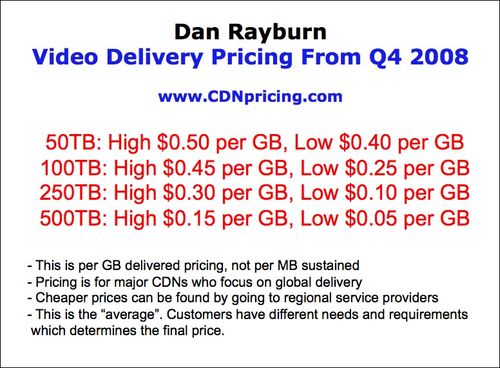
I've just completed my review of all the contracts and RFPs I saw in the market for the fourth quarter of 2008 and overall, pricing from the major content delivery networks for video delivery was pretty stable without much decline in pricing from the third quarter. (note: you can easily find my latest pricing post at www.cdnpricing.com)

Looking at pricing year over year, it looks like CDN pricing for video on a per GB delivered model fell between 30-35% from 2007 to 2008. While many of the contracts from the fourth quarter was for new business in the market and not contract renewals, those with renewing contracts saw on average about a 50% decline in pricing from a year or more ago. While that might make some think pricing fell in half year over year, remember that many of these contracts are 12 and 24 months in length and also included a lot more traffic over a twelve month period. Additionally, we saw many content owners increase their video bitrates from 300Kbps in 2007 to 500-750Kbps in 2008. In many cases this increased the number of bits they pushed by two or three times without any additional growth in traffic year over year.

The other trend from the fourth quarter is that many of the major CDNs are giving volume discounts on lower tiers. In the past, customers had to be doing hundreds of TBs per month to see major discounts, but in the fourth quarter, many CDNs were dropping the volume tier to lower levels. Those doing around 250TB a month are getting better volume pricing.

While many want to say that some CDN vendors are only competing on price or are giving the business away, this is not the case with the major providers. I have seen multiple instances where Limelight and Level 3 have passed on business because the customer wanted pricing that was too low. Yes, pricing is a factor but it is not the only factor for customers when signing contracts. For the quarter, the lowest pricing I saw in the market was still from newcomer BitGravity and the highest pricing was still from Akamai.

While some are speculating that Akamai is now starting to cut pricing for commoditized video delivery, I don't see that being the case across the board. In many cases they are offering lower pricing than before, but their bottom price that I saw was still about 20-25% more than what Limelight, Level 3 and CDNetworks are charging for completely commoditized video delivery business. You can read more on Akamai's recent pricing trends from my post last month entitled "Akamai Getting More Aggressive On CDN Pricing, But More Steps Are Needed."

For 2009, I don't expect to see a big decline in pricing. Even with the lower pricing that we are seeing from folks like Cogent and others, the CDNs all know that they can't give this stuff away. The content delivery business is all about the economics of scale. CDNs have to multiply the volume of traffic on their network many times over before the next round of major pricing discounts can take place. I think it will at least a year in the market before we see that happen. So while pricing always goes down based on customers doing more volume, I don't expect a big drop at all this year.

In my previous pricing posts, I was including pricing averages from roughly 15 different CDNs. I've quickly realized that this causes the average price to fluctuate greatly based on one provider being very high or very low in the market and skews the numbers. The pricing also changes drastically based on the volume of bandwidth that one is committing to, which I have also varied over previous post based on deals I'm seeing in the market.

Starting with this post, I am only going to use the pricing I see from the 4-5 major CDNs in the market to come up with the average price per GB delivered. Moving forward, I'm also going to keep the GB volume the same each quarter so that it is easier and more accurate to compare pricing from one quarter to another. This is not an exact science but keeping the data points consistent from one quarter to another will help everyone be able to better compare pricing over the course of the year.

For content owners, please keep in mind that the below pricing is not necessarily what you should pay. Many factors can and should affect the pricing and the averages I published are for large volume commoditized video delivery contracts.

Q4CDN-Pricing

The average contract length I am seeing for video only delivery is
still 12 months. For contracts that include more than just video
delivery, things like small object delivery, static caching etc.
contract lengths average close to 24 months.