When Evaluating Video Platforms and Formats, Look At The Total Cost Of Ownership

We get a lot of questions at StreamingMedia.com about online video platforms as well as inquiries about the different video formats. Typically, most of the questions are around the costs associated with delivering video in one format over another or the price differences between multiple video platforms. While video delivery costs are always an important factor, I think a lot of content owners are missing the bigger picture when it comes to the total cost of any platform or service.

When evaluating any system or platform, the total cost of ownership needs to be taken into account and content owners need to look at more than just the cost of delivery, or a monthly platform fee for a video management system. Before you pick any solution you have to evaluate the impact it will have on your entire video ecosystem. Sometimes one format can be more expensive than another for delivery, but that does not mean that picking the cheapest video solution will save you money.

What you might save in delivery costs you might have to spend in other pieces of the video ecosystem like encoding, ingestion or management. You have to consider all of the costs associated with the entire video ecosystem of content creation, capture, ingestion, transcoding, storage, management, distribution and tracking. Does picking the cheapest solution cause you to have to spend more money to encode your content? What kind of hardware is required? Do you need more processing power? And what about turn around time? In many cases the money you might be saving in video delivery you could actually be spending in other pieces of the ecosystem. It's not just about the cost of delivery.

I see a lot of folks saying one format or platform is cheaper than another, but typically only the cost of delivery or the monthly platform license fee is being discussed. While some of those numbers can look enticing, make sure you look at the total cost of ownership and have a good handle on how your decision affects your entire video ecosystem.


Sponsored by

Looking For Moderators: Streaming Media East Conference

Smeast_logo
While the program is almost complete, I still have a few open spots for moderators at the Streaming Media East show in NYC in May. Below are the details on each round-table session. Ideally, I am looking for fellow bloggers or members of the media who are already covering these topics and can bring their expertise to the discussion. I need folks who are experts in the subject of the session and understand the role of a moderator.

If interested, please e-mail me ASAP and please make sure to detail your expertise of the session you are applying for. In addition to these moderating positions, I will have a few open
speaking spots to announce later this week. Keep an eye on the blog as once
they are posted, they go quick, usually the same day.

Tuesday, May 12th, 2009

Bridging TV And Broadband And Cutting The Cable
Streaming sites like hulu, CBS, ABC, and others have proven that savvy audiences are turning to their computers for entertainment, and in a way that's profitable. How are traditional and cutting-edge companies capitalizing on this trend? In addition to providing the content, how are they taking advantage of this "connected" platform as they deliver content? And finally, how will this affect cable companies that are losing subscribers to this new content source?

Media Framework: Video Publishing Platforms
A number of vendors offer video publishing platforms, the features and functionality—not to mention cost—vary widely. Some vendors focus their solutions on content management and monetization, while others are geared towards enabling syndication and interactive advertising campaigns. Adding to the confusion is the fact that different platform vendors have different metrics for billing, and costs rise as content owners become more successful. This session will lay the groundwork for content owners to better understand what type of publishing platform they need and what they should expect to pay for managing content.

Wednesday, May 13th, 2009

Reinventing The Ad Model Through Discovery And Targeting
While advertising has emerged as the primary business model for broadband video, it remains relatively immature. Key constraints include users' inability to find the videos they seek and limitations on targeting ads against particular content. This panel will explore how industry participants are addressing these challenges and starting to show results. Come hear the factors that are affecting the current business models for online video advertising and the hurdles that need to be overcome to truly allow content to be monetized on the Web.

The Impact Of Broadband-Enabled TVs, Gaming Consoles And Devices
With the influx of new devices, consumers no longer rely on just the PC for their online video consumption. With the number of new broadband-enabled TVs and Blu-ray players expected to be sold, along with devices such as the Xbox, Roku, TiVo, and PS3, consumers now have many ways to get their video fix. So what are the new business models that will be created from these new devices? What hurdles need to be overcome so that content can be monetized for multiple platforms? Explore with this panel the role of current consumer entertainment devices in this new convergent world and how these devices will play together to offer a superior video experience.

How Old Media Is Embracing Online Video and New Media
This session will discuss how converging media technologies are redefining traditional distribution methods; how interactive and on-demand services are changing; and how entertainment and news video is being consumed. Come hear from some of the leading publishers, broadcasters, and advertisers about the impact that video and new media is having upon their business models.

Transit Data From XO and Cogent Not An Indication Of Traffic Growth On CDNs

I do a lot of calls with financial analysts and many of them ask about the rate of traffic growth amongst the CDNs. It's a good question and one that is hard for them to really put a number on since nearly all of the major CDNs don't give out any data about the traffic on their network from quarter to quarter. While most CDNs always say it is growing, we don't know at what rate, even when they say it grew by x percent. Without real baseline numbers to base those percentages off of, it's hard for anyone to really know what kind of traffic growth the CDNs are seeing.

We hear all the CDNs say they are seeing traffic growth, but is it at the same rate as previous quarters? How much of that growth is coming from video? And what percentage of traffic passed on the network comes from video? These questions and more at things we all want to know so we can have a detailed screenshot of exactly what trends are taking place in the market with online video delivery. Since CDNs aren't breaking out these numbers for us, that leaves many financial analysts looking for traffic growth estimates from transit providers like Cogent and XO Communications as an indication of what the CDNs are seeing.

The problem with this approach is that companies like Cogent will have one or two quarters with lower traffic growth and then next quarter, show a spike in traffic. This is typically due to the rate at which they were selling their transit that quarter and not a direct result of how much transit the CDNs bought in the quarter. Using transit providers growth as a barometer for the growth of traffic on CDNs really does not give us any guidance, especially since we typically have no details on how much transit the CDNs are buying and whom they are buying it from. Since the CDNs all buy different volumes of transit from multiple providers, it still leaves us guessing.

The way I judge traffic growth on content delivery networks is by speaking to their customers. The content owner is the only accurate barometer on how the CDNs are doing and if you speak to enough large customers each month, you can start to see traffic trends. The good news is that I still have yet to speak to any major content owner who says their traffic growth rate is declining. Content owners are still putting more content online, at higher bitrates, for more devices and in many cases, more long form content as well. While some are speculating that next year we see a real surge in video traffic on the CDNs, I would argue that we are seeing that today. The surge is now. Devices like the Xbox 360, Roku, TiVo and others are creating continued traffic growth on the CDNs. Online video offerings from those like MLB, NFL, NHL, Hulu, Netflix and others are giving us a surge right now since the quality of their video offerings are encoded at such high bitrates.

But today's surge does not seem to be enough for many financial analysts. The question they really want to know the answer to is when does the next tipping point take place in the market that results in the CDNs seeing tremendous traffic growth? While that's a question we all want to know, it's pretty easy to see from what is taking place in the market that the next real tipping point does not come this year or even next year. While there are a bunch of devices out in the market today, it will take a few years before the install numbers are large enough to make a real impact. New offerings like broadband enabled TVs and Blu-ray players show promise, but are really only just being offering by multiple manufactures in the second half of this year. HD video is starting to gain some traction, but is still far off from being thought of as a "default" setting in your video window.

The good news is that it's all on the way, but lets be realistic and not expect it to happen overnight. While many talk about the surge of 05' when YouTube started to take off, keep in mind that didn't happen overnight as many make it seem. It took a few years before YouTube and Flash video really started to impact the market and it will take a few more years before devices and HD video impact the market in a big way again. In the mean time, traffic growth on the major CDNs is good, is still ticking up and content owners say that they see no signs of it slowing down.

Related Posts:

Content Owners See Their Video Traffic Growing 2-4x Over Last Year

Economic Conditions Not Affecting Video Traffic On CDNs, For Now

CDNs Getting Ready To Benefit From Higher Bitrate Content

Speakers Announced For Streaming Media East, Some Spots Still Open

Smeast_logo
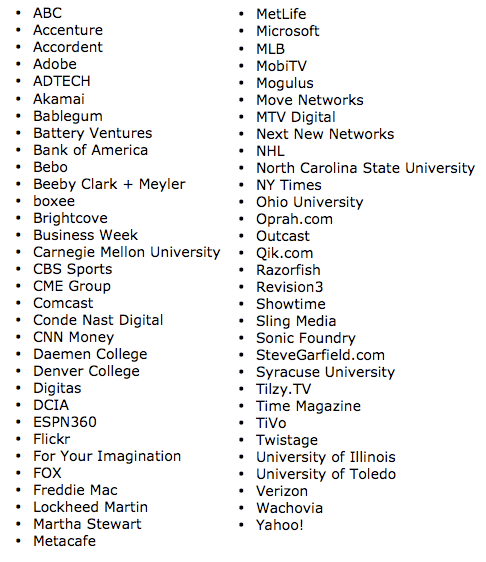
I'm happy to announce that I've now confirmed 80% of the speakers for this years Streaming Media East conference and exhibition, taking place May 12-13th in NYC. I still have some open speaking spots left and have a few positions for those who may want to moderate. Keep an eye on my blog over the next few days as I will be announcing what I am still looking to fill.

Here is a partial list of confirmed companies speaking at the show. Speaker details will go online next week.

East-companies 

I'm still working on the CDN Summit agenda and hope to have that online next week. I'll be posting open speaking spots for that as well as the few remaining spots for East over the next few days.

Updated List Of Carriers and Telcos Entering The CDN Market

There's been a lot of changes in the CDN industry in the past few quarters with many carriers and telcos entering the market, mostly via partnerships with other CDNs. Here's an updated list of CDNs in the market, broken down between pure-play CDNs versus non pure-play vendors like carriers and telcos. (To make the list easier to find on my blog, all you have to do is go to www.cdnlist.com for the latest update)

Non Pure-Play CDNs

Pure-Play CDNs

Before anyone starts saying it's not fair to put all these folks on a list, please read my disclaimer in my last CDN post which explains many of the differences between the CDN vendors in the market.

European Carrier TeliaSonera To Enter The CDN Space Next Month

TeliaSonera_Logo.jpg
With all the carriers and telcos entering the CDN space of late, it's no surprise that European carrier TeliaSonera plans to enter the CDN market and will probably make the announcement at the MIPTV show in Cannes next month.

TeliaSonera is the number one carrier of IP traffic in Europe and their website says they provide direct connections to their network for more than 80% of all European broadband service providers. They basically own the vast majority of eyeballs in Europe. Currently, many of the CDNs who have delivery services in Europe buy from TeliaSonera and it appears as if they now want to cut out the CDNs and take that business on themselves.

I'm also hearing that they plan to offer a video content management service across their network and plan to make an acquisition in the market to add this functionality to their offering, although I don't know who they plan to acquire or how close a deal may be.

TeliaSonera will need to do a lot more than just be able to deliver bits if they want to truly enter the CDN market and if they do plan to add some applications to the network to help manage video assets, it's a similar approach that Level 3 is taking in the States. The CDN market is going to look very different 24 months from now and while it will take many years for the shift to take place, we're already starting to see a lot of the carriers and telcos lay the ground work for what it to come.

Is There A Shortage Of Online Video Advertising Inventory?

LNJF_Logo_510x290.jpg
I didn't get a chance to see the premiere episode of Late Night With Jimmy Fallon on TV Monday night so last night, I checked out the archive online. Over the course of the entire show, NBC delivered the exact same 30 second Windex commercial five times. While I have been complaining about the lack of targeted online video advertising for some time, this isn't even about targeting.

Why is NBC delivering me the same ad five times in a row? I find that hard to believe that NBC has no other ad sponsors for the premiere episode of Late Night With Jimmy Fallon. I know it says Windex is the sponsor, but if I play back other clips from the same show, I get an ad for FedEx. And even if Windex is the only sponsor, what impact do they think their ad is going to have when played five times in a row? Now it just annoys me and makes me want to not buy any Windex products. What's the problem here? Is there a shortage of online video advertising inventory? Do advertisers just not get it? Clearly, this isn't working.

Related Posts:

Lack Of Ad Targeting Keeping Publishers From Making Money With Online Video

Yahoo! Video Shows Us The Problems With Online Video Advertising Today