Free Giveaway: Roku XR With Three Month Netflix Subscription

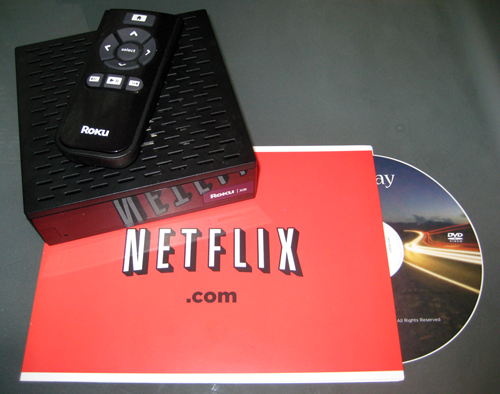
IMG_0020 The drawing is now closed. Congrats to Lance Pfantz of Des Moines Iowa who won the unit. I've got one more Roku streaming device to give away and this time, it's one of the older Roku models, the Roku XR, released in 2009. It comes in the original box with all the accessories and I'm throwing in a free 3 month subscription to Netflix (compliments of Roku). To enter the drawing, all you have to do is leave one comment on this post and make sure you submit the comment with a valid email. The drawing is open to anyone with a mailing address in the U.S. and I will select one winner at random next month. Good luck! Congrats to Robert Mirman who won the last Roku giveaway.

Sponsored by

Blue Coat’s New Transparent Caching Appliance Adapts In Real-Time To Changes In The Web

If you needed any more indication that transparent caching is hot, last week Blue Coat announced their new CacheFlow 5000 appliance, targeted at service providers looking to get greater throughput and cache storage for video. Blue Coat says their CacheFlow appliance, originally released about 18 months ago, is now deployed in "nearly 50 service provider networks" and that these customers have, on average, "achieved 40-50% bandwidth savings on general Web traffic".

The name CacheFlow might sound familiar to some folks and that's because the company was one of the original caching pioneers, along with Inktomi and F5 Networks, that launched around 1996. While all of the vendors during that time tried selling caching solutions, the market was simply too small and the product was too early in the market. CacheFlow changed their product lineup to focus on security solutions in late 2002 and renamed the company Blue Coat, but retained the original CacheFlow technology and brand, which is now a product within the company.

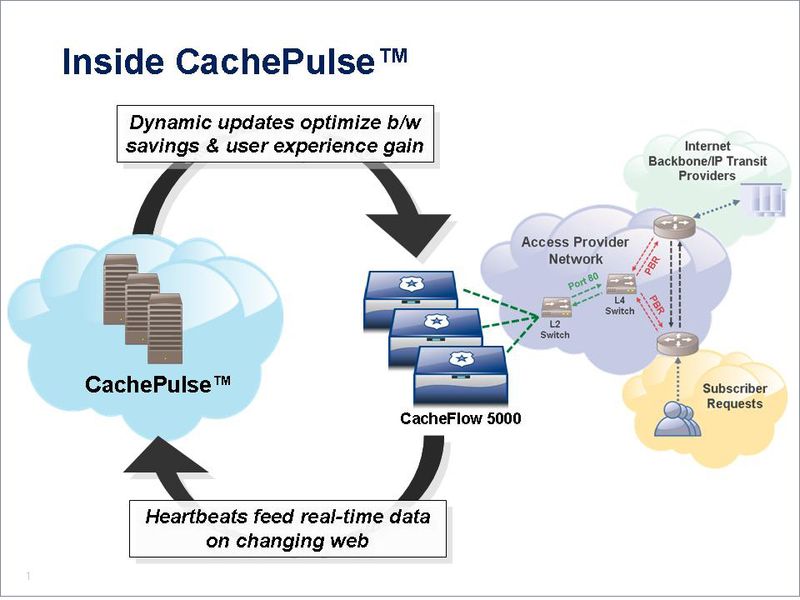
Of course, there are a lot of transparent caching solutions out in the market today, but Blue Coat is approaching the market a bit differently with a feature they call their CachePulse cloud service. Very simply, CachePulse delivers on-the-fly caching rule and instruction updates to deployed CacheFlow appliances and it gathers via heartbeat data, changes in the web, allowing Blue Coat to pro-actively optimize the delivery of content. CachePulse adds site-specific or content-specific caching rule and instruction updates based on their learning's and input into their cloud.

Blue Coat says the competition addresses these changes in the web with software updates that usually require a full reboot of the system, which of course is never popular in a telco environment, or requires the customer to manually create a custom caching policy to address a web change. This means the customer needs to know that a change is needed, needs to have the technical skill and know-how to create custom policies and then support that custom rule long-term without creating support issues or breaking the web experience for their users as content on the web continues to change.

To me, the most interesting aspect of CachePulse is that it also leverages all of CacheFlow's roughly 50 customers around the world and hundreds of deployed appliances, providing inputs and learnings into the CachePulse cloud. Basically its an intelligent system that tells operators and Blue Coat how the web is changing, in real-time, so that CacheFlow can adapt to that change the fly. Below is a slide that illustrates how it works.
DAN

Though getting increasingly more traction within operators, many are still not familiar with transparent caching solutions. In many cases where the service provider might be aware of transparent caching, the full value proposition might still not be clear. Currently, it is the CDNs and not the operators who make their money from content publishers who typically pay based on volume of content delivered. Operators are fast realizing that they are leaving money on the table by simply looking at video growth as a traffic problem and not an opportunity to monetize. As a result, service providers are accelerating the roll-out of and investing heavily in transparent caching solutions along with platforms that will enable them to build out their own CDN services.

For Blue Coat, and other vendors in the market, this growth is exactly what they have been waiting for, as service providers demand that these platforms deliver more content, with better performance, at a reduced cost. At Frost & Sullivan, we expect the worldwide transparent caching market to reach $708.3M in revenue by 2015, which puts Blue Coat and other vendors in a nice position for the expected market growth. For a more detailed description of CacheFlow, you can see a video overview of the product on the Blue Coat website.

EdgeCast and PeerApp Team Up To Combine CDN With Transparent Caching

Transparent caching is a topic I have been writing a lot about lately [see: "A Summary Of Transparent Caching Architectures" – "An Overview Of Transparent Caching and Its Role In The CDN Market"] and is one of the hottest subjects of discussion when talking to carriers, telcos and ISPs in the market. While there has always been a lot of seperation between vendors who sell carrier grade CDN platforms and vendors selling transparent caching solutions, last week's announcement by PeerApp and EdgeCast shows that line is starting to blur.

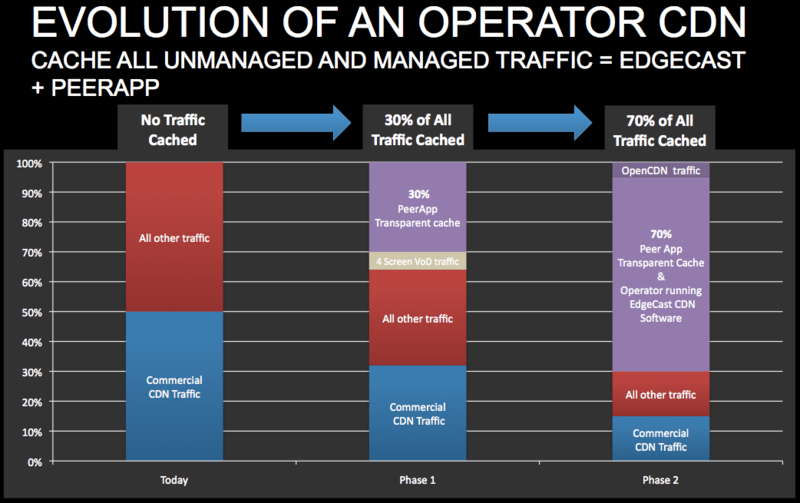
The EdgeCast and PeerApp collaboration combines both EdgeCast's licensed CDN platform with PeerApp's UltraBand transparent caching platform, giving carriers the ability to cache all content, managed and unmanaged, across their network. Of course the goal is to allow the carrier to provide a better QoS, reduce their internal costs, and in the long run, provider carriers with a platform that powers new content services. While today it's about cost savings and quality of service, soon it will be about revenue generation and new content services.

The combined product offering will allow customers to cache up to 70% of the all traffic on their network resulting in huge cost savings and putting carriers back in control of the bits going over their network.

Screen shot 2011-09-20 at 6.37.43 PM

While both solutions from EdgeCast and PeerApp are still sold as separate contracts, the companies are working together to give customers one platform for operations, management and reporting integrations so content customers have more visibility into the outer edge of the network and carriers have more control of the traffic.

Carrier based CDN software is  good at what it does, serving content to subscribers quickly, and in the process alleviating costs for service providers, but there's an enormous amount of traffic that it can't serve, and that's where the value of transparent caching comes in. Stand-alone, both products fill a need in the market. But by combining what EdgeCast and PeerApp do, it now provides a real solution for carriers who are desperately trying to control managed and unmanaged content on their network. I suspect we'll see more CDN and transparent caching companies teaming up with one another shortly.

Netflix Removes Titles From Instant Queue To Hide The Fact They Are Expiring

Over the weekend, without telling users, Netflix decided to stop displaying all titles from users instant watch queue if the rights to stream the content has expired. In the past, these titles remained in the queue and if they were to expire soon, they would also list the date when they would no longer be available for streaming. While Netflix took to their blog on Saturday saying they made this change to, "make the instant Queue easier to manage", clearly all they are trying to do is hide the fact that so many titles are expiring.

Even though Netflix says they didn't actually remove any of the titles from the queue and that they will reappear once again if they get the rights to stream the title, the fact is users can no longer see them, or manage them. And since most of us probably don't remember what all those titles were, how are we suppose to add them to our DVD queue since they are no longer available for streaming? Not to mention, the titles that we can longer see in our queue, count towards the limit of 500 titles you can have in your queue at any one time. So if we can't see them, how are we suppose to delete them so that we can add more titles to our queue?

What Netflix has done is take the problem of too many streaming movies becoming unavailable and turned it into two problems; we can't keep track of them to add them to the DVD queue and hidden movies count toward our queue count but we can't see them to delete them. How dumb. Not to mention, Netflix says while it "looks like some titles are gone", they didn't "remove" them. Really? So we can no longer see them and we have no way to manage them yet Netflix says it only "looks like" the titles are gone? The titles are gone if w can't see them! I am getting so tired of Netflix's blog posts lately which are starting to sound like they are written by a bunch of lawyers being creative with words.

Netflix can try and spin this any way they want but the bottom line is that the Starz contract is due to expire in about five months and at that time, a lot of users would have a bunch of titles showing up in their saved queue and would starting realizing just how many movies are becoming unavailable for streaming. And some Netflix users would reconsider keeping their account active or not. This is simply Netflix's way of trying to make sure we don't notice what's expiring, by not letting us see all the movies in our queue. Brilliant job Netflix. You just made your service harder to use and you announced the change only after people noticed it and started complaining. You may be in the driver's seat now, but I can't wait till Amazon eats your lunch.

If I didn't have to review Netflix's streaming service across all the different platforms and devices for blogs and articles, I would have already cancelled my Netflix subscription.

Free Giveaway: Sony Internet TV, Roku 2, Netgear Roku, Western Digital WD TV Live Plus

Everyone loves to get free stuff and right now, I'm giving away some great streaming media devices on my blog. Simply visit any of the links below to be entered into the drawing or follow me on Twitter (@danrayburn) to be entered into all the drawings.

The drawings are open to anyone with a mailing address in the U.S. and winners will be selected at random in about two weeks. Good luck!

Sony Free Giveaway: Win A 24" Sony Internet TV, With The Google TV Platform
https://www.streamingmediablog.com/the_business_of_online_vi/2011/09/free-giveaway-win-a-24-sony-internet-tv-with-google-tv-platform.html

Roku Free Giveaway: Win A Roku 2 XS Streaming Player
https://www.streamingmediablog.com/the_business_of_online_vi/2011/08/free-giveaway-win-a-roku-2-xs-streaming-player.html

Netgear2 Free Giveaway: Win A Netgear Roku Streaming Player
https://www.streamingmediablog.com/the_business_of_online_vi/2011/08/free-giveaway-win-a-netgear-roku-streaming-player.html

Wd Free Giveaway: Win A Western Digital WD TV Live Plus Streaming Player
https://www.streamingmediablog.com/the_business_of_online_vi/2011/08/free-giveaway-win-a-western-digital-wd-tv-live-plus-streaming-player.html

Thursday’s Webinar: Learn All About Mobile Content Acceleration

I've been writing a lot about mobile content acceleration and how it's the future of the content delivery business and tomorrow, at 2pm ET, I'll be moderating another StreamingMedia.com webinar entitled "The Need for Speed: Accelerating Mobile Content".

Presented in conjunction with AT&T, the webinar will discuss how content owners can deliver optimal site performance to a proliferation of connected devices; why site performance matters; how new acceleration technologies speed delivery of hard to cache, dynamic content; and best practices for maximizing content distribution to mobile devices.

Register here and bring your questions for the presenters for the live Q&A portion of the event.

Pacnet Building Out Their Own CDN, Licenses Technology From EdgeCast

Pacnet Around the world, telcos and carriers are hard at work building and deploying their own CDNs for on-net distribution and today, we can add Pacnet to the latest list of carriers entering the market. The company has just announced that they have licensed EdgeCast’s carrier CDN platform to build out their Pacnet CDN and expect to launch the service in Asia by the end of the year.

Back in 2009, Pacnet announced they were entering the CDN space and made a lot of noise, but they didn’t actually build anything and were simply re-selling Internap’s CDN offering. This time around Pacnet will actually build their own CDN with EdgeCast’s technology layering EdgeCast’s software on top of the Pacnet network.

For EdgeCast, it’s another big win for the company who now has ten telcos and carriers using their platform including Pacnet, AT&T, Telus, Deutsche Telekom, Global Crossing, Dogan Telecom in Turkey and AAPT in Australia in addition to others. The company also counts Yahoo!, ESPN, JetBlue, WordPress, LinkedIn, Kelloggs, IMAX and Lifetime Networks amongst its 3,000 customers.

In July EdgeCast said they now carry 4% of all worldwide Internet traffic and serve more than 1.5 billion objects per hour.

Similar Posts:

CDN Provider EdgeCast Says They Now Carry 4% Of All Worldwide Internet Traffic

AT&T Building Out Their Content Delivery Network Using EdgeCast’s Software

Content Delivery Network EdgeCast Now Profitable, EBITA Positive Since Q2