Get Hands-On With More Than 50 Over-The-Top Video Devices & Platforms, All In One Room

Device-coverThe 2012 Streaming Media East show (May 15-16 in NYC) will feature a special broadband-enabled device pavilion, allowing thousands of attendees to get hands-on with more than 50 of today’s leading streaming devices and Over-The-Top video content platforms. It is the only show where you can try out all of these devices and platforms in action, compare them side-by-side and get your questions answered – all for free.


Simply register for an exhibits only pass and come test out any combination of gaming consoles, stand-alone streaming boxes, smart TVs, connected Blu-ray players and tablets that you want. Additional devices and platforms will be added leading up to the show. Confirmed devices/platforms include:

  • OTT PLATFORMS: Netflix, Hulu Plus, HBO GO, iTunes, VUDU, Xbox LIVE, Amazon Prime Streaming, DISH/Blockbuster, Sony PlayStation Network, Google TV, MLB.TV, NHL, EPIX, UFC, ESPN, YouTube, OnLive.
  • DEVICES: Apple TV, Boxee Box (with Live TV dongle), Xbox 360 (with Kinect), Nintendo Wii, Roku XDS, Seagate GoFlex TV, Sony PS3, Sony SMP-N200, TiVo Premiere, ViewSonic NexTV, Vizio Stream Player, WD TV Live, WD TV Live Hub.
  • TABLETS: Amazon Kindle Fire, Apple iPad, ASUS Transformer Prime, B&N Nook Tablet, BlackBerry PlayBook, Dell Streak, HP TouchPad, HTC Flyer, Motorola Xoom 2, Motorola Xyboard, Samsung Galaxy Tab, Sony Tablet S, Vizio Tablet.
  • CONNECTED TV PLATFORMS: From Sony (BRAVIA Internet Video), Vizio (V.I.A.), LG (NetCast), Panasonic (Viera Connect), Philips (NetTV), Samsung Smart TV, Sharp (Aquos Net+), Toshiba (NetTV). 
  • CONNECTED BLU-RAY PLAYERS: From Samsung, Philips, Sony, Vizio, LG, Panasonic, Sharp, Toshiba, Magnavox and Sylvania

2011-pavilion

Attendees will also have the chance to win many of these devices and other giveaways during the two-days of the show so register online and come get free access to the largest collection of OTT devices and platforms all in one room.

Sponsored by

Yottaa Launches New CDN For Dynamic Site Acceleration, Targeting SMB Market

Screen shot 2012-02-12 at 9.04.41 PMBoston based Yottaa (pronounced "Yo-ta") has announced a new dynamic site acceleration service aimed at the small and medium sized business (SMB) market. For those who have never heard of the company before, Yotta was founded in 2009 and for the last year, has primarily been offering a website performance monitoring service. The company raised $4M in a Series A round and now employees 40 people.

Unlike many of the larger CDNs who target enterprise customers with their DSA offering, Yottaa is going after small and medium sized customers who can't afford a larger vendor like Akamai. Yottaa says they have more than 75,000 websites that use their website performance monitoring service, with the typical paying customer spending about $500 a month. The company says 36% of their customers are small e-commerce websites and 40% of their revenue comes from outside the U.S.

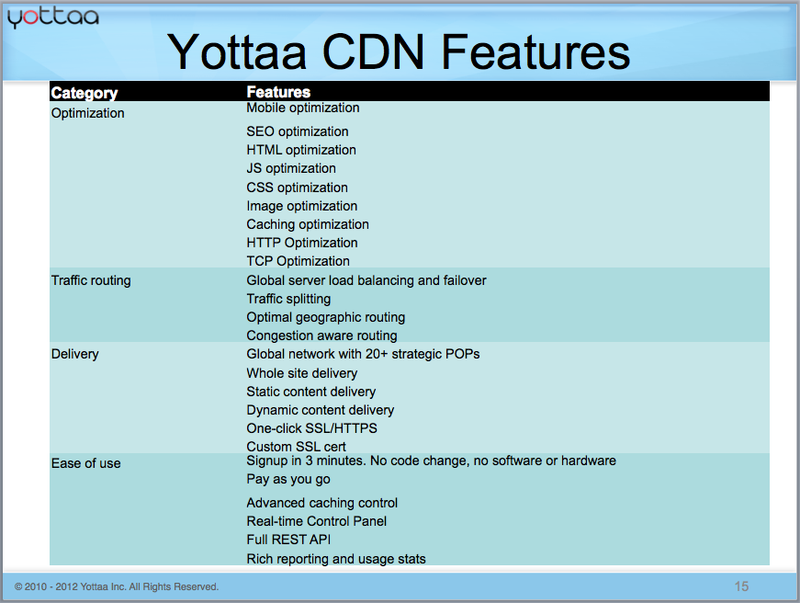
Yottaa's new dynamic site acceleration platform is deployed across 20 data centers in North America, Europe, Asia and Australia and the company is adding a location in Sao Paulo later this year. The company offers a pay-as-you-go model and doesn't require long-term contracts. Below is a slide that outlines the features of their new DSA service.

Screen shot 2012-02-12 at 9.11.03 PM

Yottaa sells their services direct to customers but most of their business comes from partnerships with hosting companies and cloud providers who act as re-sellers. While Yottaa's revenue was a "few million" dollars last year, the company expects they can more than double revenue this year as they see continued demand for their new DSA service.

The CDN space sure is getting crowded and we're going to see even more companies entering the market with dynamic site acceleration services later this year.

Sources Say Akamai’s Next Acquistion Could Be Tag Management Platform BrightTag

BrightTag_Logo_medOver the past two months, Akamai's been on a buying spree and it sounds like it may not be over. After agreeing to buy Cotendo for $268M and acquiring Blaze for what is rumored to be a $12-$15M evaluation, multiple industry sources say Akamai is in negotiations to buy Chicago based and privately held BrightTag. If true, this would be a very smart acquisition for Akamai and something their ad and commerce customers would love.

BrightTag is one of a handful of vendors that offer a cloud-based tag management platform. These solutions provide a connectivity layer between first-party data and the marketing and analytics services supporting a website. As BrightTag explains on their blog, today's marketers are overwhelmed by the complexity of data collection and coordinating how their data is used across multiple services for re-targeting, ad networks, search, analytics, product recommendation, content optimization, widgets, etc.

Tag management platforms facilitate direct connections between a marketer’s website and its chosen marketing partners using a cloud-based approach that eliminates the need to put third party tags directly on a client site. This helps customers improve the performance and reliability of their websites while increasing their ability to leverage data in marketing efforts. In BrightTag's case, clients can monitor in real-time all the data they have chosen to share, know where that data is going and who is using it.

BrightTag has raised $8M to date from New World Ventures, TomorrowVentures, EPIC Ventures and I2A Fund. The company competes with other tag management platform vendors in the industry including BlueKai, Demdex, Tagman, Tealium and Ensighten amongst others. BrightTag customers include Orbitz, Gap, jetBlue, Westin Hotels, Old Navy, Crate & Barrel, 1800 Flowers, TransUnion, Sheraton Hotels and Banana Republic.

With a significant lack of centralization and standardization when it comes to the data gathered on a website and all of the ad and commerce companies Akamai already counts as customers, it is only a matter of time before Akamai is going to be forced to offer a tag based management platform. I'm not an expert when it comes to the tag management space, but sources say BrightTag has one of the best platforms in the market and it sounds like it would be a natural fit in Akamai's product portfolio.

NBC Failed With Their Super Bowl Webcast, But Wants Us To Believe It Was A Success

NBC completely failed in their execution of streaming Sunday's Super Bowl on the web, yet they want us to believe that it was an engaging and successful webcast. Do they think we're stupid? Instead of coming clean and saying they had technical issues, especially with the quality of the video and re-buffering, the company is trying to blame these issues on the "last mile" networks and are pointing the finger at someone else. NBC should know better than this and should be ashamed of themselves.

Tim Siglin has a great article at StreamingMedia.com that re-caps all of the problems with the webcast, so I don't need to repeat a lot of what he said, go read his article. What I will add to Tim's piece is that NBC does not get that the success of any webcast is judged by the message you deliver, the experience you provide, and how you engage the user – not simply how many streams you deliver. Would you rather reach a lot of people with a poor experience or fewer people with a good experience that keeps them engaged longer?

NBC was quick to say how many streams they got, but didn't say how many simultaneous streams they did. Most webcasts are measured by simultaneous streams, so why isn't NBC giving out that number? They called the event a record and they are quoted on news sites as saying things like, the event “exceeded our expectations in every way," and that it was a, "tremendous success". Exceed their expectations? If poor quality video with bad re-buffering is something that "exceed their expectations", I'd hate to see how low they set the bar internally.

If the quality issues were as a result of the last mile like NBC claims, why were users like me able to stream videos from other sites with perfect video quality during the Super Bowl webcast, but not from NBC directly? That's such a cop-out on NBC's part and any viewer who played videos from others sites during the same time could easily see it wasn't a last mile issue. In addition, while NBC isn't saying what bitrates the Super Bowl was encoded for, it looks like the average bitrate was about 2Mbps. So how could I stream clips at twice this quality from other websites during the Super Bowl if there were last mile issues? Of course I couldn't, but I guess NBC thinks we won't notice that.

All NBC had to do was come clean and say they had issues, they screwed up and they have learned for next time. While failure is no good, at least no one could claim that they aren't in touch with reality. Also, I find it very strange that as I write this post, Akamai is doing their quarterly earnings call and has referenced the Super Bowl webcast as an example of a "great experience", when it was actually a very poor experience. Akamai was the CDN provider for the online webcast, so I am not surprised they are also saying the same thing as NBC since that's their customer.

If the webcast was such a "success" and was a good quality experience like both companies suggest, why isn't NBC or Akamai releasing any video quality assurance data from a third party like Conviva? Myself and others can show, by example, all the issues we had with the webcast, so where's NBC's data to show it was a last mile issue? Their data doesn't exist.

In Tim's article he says "it's disingenuous for NBC to blame last mile issues" and I'd say it's even worse than that. Streaming media technology is not new, it's not cutting-edge and we've had companies webcasting live events, with success, for over 15 years. So for NBC to encode such a low quality video to begin with, and then try to blame the last mile networks for video quality and buffering problems, someone should hold these guys accountable. So nice try NBC, but there are plenty of us who are not buying it.

Hosting CDN Dinner For Wall Street Money Managers, Wed. Feb. 15th in NYC

I have been invited to host a dinner for buy side analysts, next Wednesday February 15th in NYC. The event will start at 6pm and the location is midtown. It will be an informal event where I will be presenting some of my latest pricing data and talking about Akamai, Limelight and Level 3's recent earnings as well as answering questions about technologies like front-end optimization and dynamic site acceleration amongst others. It will be interactive, so you'll also have your chance to get your specific questions answered.

If you would like to attend, please contact me and I will put you in touch with the group that is organizing the event. Space is limited and currently, it is only open to buy side analysts.

Akamai Acquires Blaze, Adds Frontend Optimization Services: Here’s What That Means

This morning Akamai announced they have acquired Blaze Software, a cloud based provider of front-end optimization (FEO) services. Terms of the deal weren't disclosed, but the numbers will come out, maybe even by Akamai during their earnings call today. Either way, I'll update the post once I hear what value was placed on the deal. FEO is going to be a big push from all the CDNs this year and Akamai needed to acquire someone to add a FEO product to their portfolio. This acquisition is probably also to combat Level 3 which has been working closely with FEO provider Streangeloop and has been having success in taking some big deals away from Akamai as of late.

FEO might sound similar to another subject I have written about lately, dynamic site acceleration (DSA), but it's very different. DSA's focus is to bring network resources closer to the user by pre-fetching or caching files. FEO makes the content itself faster. DSA makes page resources download faster. FEO reduces the number of page resources required to download a given page and makes the browser process the page faster. For example, analysis shows that popular sites like CNN, who already use a CDN, can double current performance by implementing FEO.

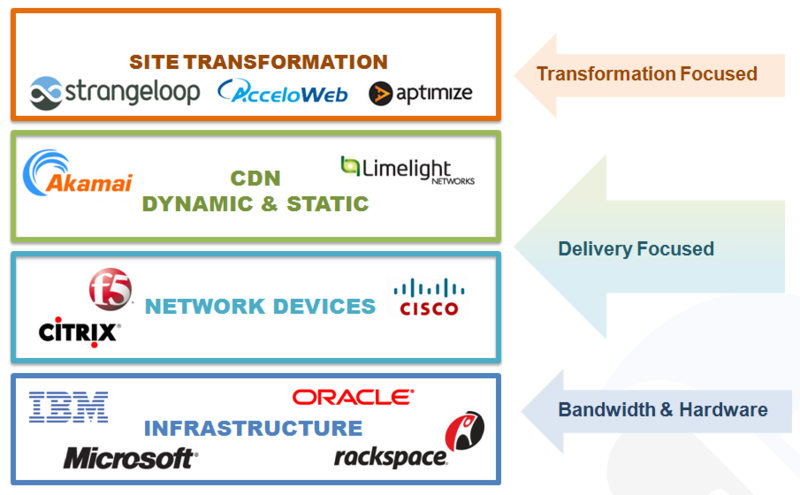
There are a lot of small FEO vendors in the space and many of them have now been acquired or teamed up with larger CDNs. While some might think that Akamai's recent purchase of Cotendo gave them a FEO product, that's not something Cotendo was doing. Blaze is now owned by Akamai, Limelight acquired AcceloWeb, Strangeloop is working with Level 3 and Riverbed acquired you also have stand-alone FEO services from Aptimize. Here's a slide that helps to break out where all the vendors fit in, but these lines are quickly blurring as many of the larger companies are taking out the smaller ones and adding this kind of functionality to their product suite.

Photo

For content owners, it used to be that the answer to most website performance problems was either to add more hardware, use a CDN, or re-engineer their backend application code. But for a number of reasons, investing in backend optimization is now providing diminishing returns. Google's research shows that for many popular sites it's the front-end that accounts for over 90% of a users wait time. Content delivery networks help to address part of this problem by reducing network latency, but even larger performance gains can be achieved through front-end optimization techniques that streamline the Web page HTML code and resources.

If you want to learn more about how front-end optimization works and what role it plays within a CDN, see my blog post from last year entitled: "Why Web Applications And Mobile Browsing Are Making The Frontend A Major Performance Bottleneck".

We will be talking a lot about FEO and seeing demos of these services at the Content Delivery Summit, May 14th in NYC.

As Brightcove Prepares To Go Public, Here’s What To Keep An Eye On

Yesterday, Brightcove filed an amended S-1 as the company prepares to have their IPO in the coming months. The company is looking to raise between $50-$60M from their offering and estimates shares will be priced between $10-$12. After IPO expenses and spending approximately $7M to repay an outstanding loan, the company looks to net about $40M in working capital. Depending on the share price, Brightcove would have a market cap of between $275-$300M, which is about 5x 2011 revenue.

While I saw lots of folks repeating the highlights from the filing in their blog posts and simply cutting and pasting the numbers, I didn’t see anyone asking the questions that have yet to be answered regarding Brigthcove’s revenue or the size of the market they are in. It’s also clear that many folks only read the first few pages to the filing and not the whole document as their are lots of data points that gives one a lot to think about, and question. It’s just another example of many showing that too many blogs only care about publishing as many 500 word posts as possible in one day, rather than actually telling a story, engaging a reader, or trying to explain the impact a company could have on the broader market.

Brightcove had revenue of just over $63M in 2011 which makes them the largest provider for online video platforms, sold direct to content owners. Other video platform vendors selling direct to MSOs like Cisco, thePlatform and Kit digital have more revenue than Brightcove, but aren’t selling into the same vertical with the same solution. Many people want to compare a Brightcove to thePlatform or Kit digital, but they are selling very different solutions and should not be compared to one another.

There are three kinds of online video platform (OVP) providers in the market. Those that sell direct to content owners, those that offer carrier grade solutions to MSOs and vendors that offer video management platforms for enterprise customers who deploy video inside their firewall. Brightcove has been going after the enterprise market as of late, but most of their customers are still content owners and publishers in the media space and I have yet to see Brightcove enter the carrier and MSO vertical as of yet.

But the real question is what’s the breakdown of Brightcove’s revenue and how much of it comes directly from their SaaS business? Through Brightcove’s CDN partners like Limelight Networks and Akamai, almost 9 billion streams went through Brightcove’s platform last year. That’s a lot of bits and since the delivery of those videos are handled by a third party, Brightcove pays the CDNs for those delivery services and marks up the bandwidth to their customers. So one has to wonder what percentage of Brightcove’s total revenue comes from the re-sale of bandwidth? Brightcove doesn’t break that number out in their filing and the company told me they could not comment on those details when asked.

While there is nothing wrong with some of Brigthcove’s revenue coming from bandwidth, considering that the average cost per GB delivered drops at least 20-25% each year, there is only so much of a markup Brightcove can add on top of what they pay the CDNs. Some have told me that it really does not matter as the percentage of Brightcove’s revenue that comes from the re-sale of bandwidth continues to decline each year, but that’s a bad answer. Just because it is declining doesn’t mean the number isn’t material. I don’t know what percentage of their revenue is from bandwidth and I won’t put a number out there as it would be a complete guess on my part. But if the number was low, think single digits, then my guess is that Brightcove would be all too happy to say what it is.

While Brightcove admits they will lose money in 2012 and even possibly beyond, that’s not what worries me. Brightcove is trying to follow the Amazon mentality of “get big fast’ and that’s why the company has raised and spent so much money over the past few years. My biggest concern is how quickly the market Brightcove is in will grow and what the total market opportunity really is. While Brightcove gave out some of those numbers in their original filing, they are so big that they are hard to believe. Brightcove says that by their estimate their “total potential market opportunity was approximately $2.3 billion in 2011, growing to approximately $5.8 billion in 2015“.

Those numbers are far too big. If Brightcove’s entire market opportunity was $2.3B in 2011 and the company did $63M in revenue, that means Brightcove only captured 2.7% of the market. That’s not a lot. Brightcove has some really interesting methodology on how they came up with the total market size though, which you can read in detail on page 69 of the S-1 filing. My other concern with any business like Brigthcove’s is that R&D costs are high. In 2011, 25% of Brightcove’s revenue went towards R&D, which is a lot. Also, while all of Brightcove’s revenue comes from one product and the company is working towards diversifying their revenue, app cloud is an example, they have yet to do that to any large degree.

All of this aside, Brightcove does have a some positive things going for them which gives them a legitimate shot at building a long-term profitable business. For starters, Brightcove invented the market they are in and to date, even with increased competition, has yet to fall behind any of their competitors. They have lead the market for more than five years and while being a first mover is not always a guarantee of long-term success, so far, Brightcove has shown that they can continue to be the leader.

Brightcove had a total of 3,872 customers at the end of last year of which 2,571 of those customers were using the Brightcove Express product which costs between $99 and $499 a month. If those customers are all paying $250 a month on average, that means that about one third of Brightcove’s customers make up about 91% of their revenue, which is very good. At the same time, no one customer makes up more than 4% of Brigthcove’s total revenue which is a nice balance. Another thing I like is that in each of the last eight fiscal quarters, Brigthcove’s recurring dollar retention rate was at least 86%, and for all of 2011, was higher at 93%, which is quite impressive.

And finally, in order for any company to do well they have to have a good management team that has experience in building and cultivating their business, especially when it is still in the early stages of real growth. Brightcove isn’t even a $100M company yet so for them to really get to the next level with their business, management needs to be laser focused and take the necessary steps to make sure the growth happens. If there is one thing I think Brightcove is very strong with, it’s the management team they have in place.

Brightcove’s CEO Jeremy Allaire is smart, he’s easy to speak to and reachable (even if you are not a member of the media) and he doesn’t have the arrogance a lot of CEOs tend to have, which can sometimes hurt the growth of their company. You don’t see Brightcove getting into public spats with their competitors and the management team that Jeremy has built at the company has a lot of experience in building and scaling software companies in the past. That alone does not guarantee that Brightcove will be successful, but it sure helps gives them the opportunity to make it possible and they are going to be closely watched by a lot of other companies in the space who want to follow in their footsteps.