Limelight Launches Managed CDN Offering For Carriers, Is A Deal With F5 Next?

This evening, Limelight Networks announced their new managed CDN offering, called Limelight Deploy, aimed at helping telcos, carriers and service providers build and deploy CDN services inside their network. While this is a new product line for Limelight, they aren’t new to the carrier space and have already built out networks for Bell Canada, starting in 2009, and Asia’s largest telecom provider, Bharti Airtel in 2010. In what I think is related news, I have gotten a lot of calls today asking me about rumors people are hearing about F5 buying Limelight Networks. I have not heard any of those rumors, and it makes no sense, but my guess is that F5 may be working to license Limelight’s CDN technology the same way Juniper just licensed CDN technology from BitGravity. But that’s just a guess.

The licensed and managed CDN business has really been heating up over the past few months and is still dominated by EdgeCast who has the most carrier based licensed CDN deployments and re-sellers in the market. But unlike EdgeCast who simply licenses their software to carriers, Limelight’s approach it to actually help build and manage the CDN component of the carriers network with their professional services group. In conversations with Limelight, the company said carriers were asking for more hands-on help and Limelight’s goal is to help the carrier build and manage the network with the carrier eventually taking over 80% of the operation of the service on their own. This approach also allows network operators to get their CDN up and running much faster since they get to leverage Limelight’s expertise of running a network over the past ten years.

Customer’s who use Limelight’s Deploy solution are not required to have to re-sell or use Limelight’s off-net services, but that’s clearly an option if they want to. Limelight also said they have no desire to create a federation of CDNs, like EdgeCast has done, although nothing would stop Limelight’s customers from exchanging traffic amongst one another if they wanted to. Limelight said their Deploy offering will be offered worldwide and that they now have a dedicated team inside the company, focused just on their managed CDN offering.

There are two primary uses cases for a managed CDN and not ever customer is trying to “reduce their cost” like you hear people say. The first use case is a carrier that is looking to add CDN services and expand their product portfolio with products that are adjacent to services they already offer on their network, thereby increasing their revenue. The second use case relates to the network operators who have the eyeballs and are concerned with the volume of video being delivered over the last-mile to their customers. In this case, most of them are trying to control their costs, improve their quality of service (QoS) and create content services that will allow them monetize the video they are delivering. (think Xfinity) Limelight says that customers for their managed CDN offering range in size and could be asking for help to build out small deployments in the 10Gbps range to customers who have the desire to support 700Gbps within three years time. Not surprisingly, Limelight and all the managed and licensed CDN vendors I talk to say the biggest demand for these services comes from outside the U.S.

The terms “licensed CDN” and “managed CDN” will probably start being used in the industry as if they are interchangeable, but they are really very different solutions. Right now, there are basically three different kinds of licensed, managed or carrier based CDN products in the market. EdgeCast, Jet-Stream and Aflexi offer software based licensed CDN services. Limelight Networks and Highwinds offer managed CDN services which go beyond a software license and vendors like Juniper and Cisco are or will offer carrier based CDN solutions that combine hardware with software, but won’t help the customer actually build the CDN. Alcatel-Lucent is also in the business, but is targeting MSOs more than carriers. Other vendors like Akamai have talked about a licensed CDN product but have not yet entered the market.

Limelight’s Deploy offering is somewhat unique in the market as their platform isn’t only focused on helping carriers build their own CDN for video delivery, but also for website and application acceleration services. EdgeCast also has this functionality in their application delivery network, which can also be licensed by carriers and it is expected this is what AT&T will license when they stop re-selling Cotendo once Akamai completes the acquisition of the company. Vendors like Juniper are focusing more on the video side, but then also offer a transparent caching component that some of the other managed and licensed CDN vendors don’t have. If you’re a bit confused by all of these different technologies, you’re not alone.

In the past two years, it’s my opinion that the CDN market has been pretty stagnant, with not a lot in the way of new services being offered in the market. The term “CDN” usually referred to the delivery of video content and small objects as a service based business, but that’s about to change. Content delivery products and offerings now encompass services like video delivery, licensed and managed CDN, dynamic site acceleration, front-end-optimization (something you will hear a lot more of soon), mobile content acceleration and a host of other services. These days, calling a product or a company a “CDN” offering, could mean a lot of very different things.

The CDN industry is starting to get really interesting again and we’re starting to see lots of new types of CDN services and products coming to the market. We’ll be covering all of these CDN technologies at the fourth annual Content Delivery Summit, taking place May 14th in NYC. You can come see these technologies in-action, talk to the carriers that are using them and hear about real-world deployments.

Realted Posts:

Updated List Of Vendors In The Content Delivery Ecosystem

An Overview Of Transparent Caching and Its Role In The CDN Market

Transparent Caching & CDN Merging: Juniper Licenses BitGravity’s CDN Technology

Here’s Why The Future Of The CDN Business Is In Mobile Content Acceleration

Sponsored by

Video Optimization Company Conviva Raises $15M: Is There Enough Of A Market For These Services?

41610_331868044740_3665_nThis morning, California based Conviva, a video quality optimization and analytics platform, announced a series D round of funding totaling $15M, lead by Time Warner Investments. Founded in 2006 as Rinera Networks, the company changed their name to Conviva in 2008 shortly before Darren Feher, former CTO of NBC Universal took over as CEO of the company. The company is not saying how much of the latest round of funding comes from Time Warner Investments, but did say that it was the "majority" investor. To date, Conviva has now raised $59M.

Unlike a CDN, Conviva does not deliver the video themselves but rather works with content delivery networks and content owners as a software based overlay service. Conviva's software monitors the performance of end-users video quality and not only records the experience but can also manage, in real-time, the shifting of traffic amongst multiple CDNs. Conviva has deals with both Level 3 and Limelight Networks who uses their technology and has a nice roster of content owners as customers including HBO, NBC, MLB, Netflix, MTV, ESPN and is also used for a lot of one-off live events like the 2010 Winter Olympics and the FIFA World Cup.

Conviva is one of those interesting companies in the industry because no one really competes with them in the market and as a result, many don't really know what bucket to put them in or how they should be classified. I don't see a lot of companies trying to develop a similar solution to Conviva's mostly because the market size for SaaS based video quality optimization services just isn't that big. That said, if the market grows fast enough and Conviva is the only major player, the company could have a nice exit strategy, getting purchased by a larger entity for their technology. At the same time, Conviva has raised $59M in five years and from what I hear, still isn't profitable. So if the market does not grow fast enough, Conviva could have a difficult time growing their revenue to meet their VCs expectations.

On the surface, I like what Conviva is doing as their whole goal is to improve the video quality for the end-user, in real-time, without anyone knowing what's taking place. Whether it's bad buffering, a frozen encoder or some problem on the network, Conviva's platform brings the intelligence to proactively switch servers mid-stream, change the bitrate and apply policy filters, all on the fly. This is a solution that I really would have liked to have had in the market ten years ago when video quality on the Internet was poor and there were very few ways to correct the problem in real-time. But today, with the quality of video being delivered from the major CDNs getting better each year, I just don't know how much of a demand there is for Conviva's solution, since video quality is only getting better overall, not worse.

Conviva's solution is not affordable for a small or medium sized content owner and that's why to date, Conviva's customers are mostly the larger content brands on the web. That could be a good thing for Conviva if the company can ramp revenue fast enough, but their are also fewer big content brands on the web than there are small and medium sized business, which is probably why Conviva is now working directly with CDNs to have them offer this functionality to any of their video based customers. Content owners I have spoken with who use Conviva's solution like how it works, but many also don't use it exclusively as their only video optimization and measurement platform. For example, Netflix and MLB both have their own internal platforms that offer a lot of the same functionality as Conviva, but Conviva offers them the insight of a third party.

To date the company has done very little in the way of marketing and most of the content owners I speak to haven't heard of the company, don't know what they do, or think they are a simple analytics company – which they're not. The company does much more than analytics and their solution really does work. But Conviva needs to get more brand recognition and exposure in the market and hopefully, they will use some of their new funding to increase awareness with content owners.

I like any solution that's designed to improve the quality of video being delivered to end users, so I'd like to see Conviva be able to become a profitable vendor in the industry soon. But I just don't know how big of an opportunity there is for this kind of service in the market, how quickly Conviva can grow or how much content owners will value this service, and be willing to pay for it. All that aside, Conviva is an interesting company to watch and hopefully soon we'll be able to get a better insight into their business.

Updated: Conviva contacted me to say that the majority of their revenue does not come from live streaming, but that it is mostly recurring revenue from video on demand content.

Transparent Caching & CDN Merging: Juniper Licenses BitGravity’s CDN Technology

A few weeks ago Juniper announced they had licensed BitGravity's CDN technology and plans to add the functionality to their transparent caching Media Flow solution. Terms of the deal were not disclosed, but I hear that there is a revenue sharing component between Juniper and Tata Communications, which owns BitGravity. Juniper does not plan to re-sell any of Tata Communications CDN service for off-net delivery and is simply licensing the service management layer of BitGravity's CDN platform, on a non-exclusive basis, for Juniper's own product, expected to be introduced later this year.

As service providers look for products and solutions that deliver more than just one type of content, more deals like this need to take place, especially from the hardware manufactures. Last year, we saw licensed CDN provider EdgeCast team up with transparent caching provider PeerApp to merge their platforms for telcos and carriers and I suspect other vendors in the space are looking at similar partnerships.

The CDN space is finally starting to evolve once again with vendors deploying all kinds of solutions like dynamic site acceleration, front-end-optimization, transparent caching, licensed CDN and application acceleration, which now all fall under the generic term of "content delivery". After year's of the CDN space being pretty stagnant, lots of new solutions are coming to the market that combine many different technologies and types of content delivery, into single platforms. This is exactly what customers are looking and asking for be it inside the carrier network or for off-net CDN based services.

We'll be talking a lot more about all of these different content delivery technologies at the Content Delivery Summit, taking place May 14th in NYC.

Streaming Media East Program Now Live: Speaker Placement Starts Today

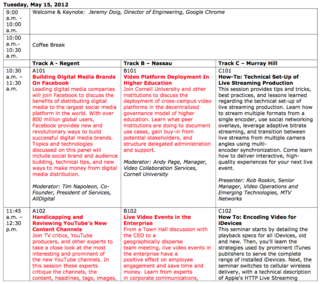
Screen shot 2012-01-31 at 10.43.44 AMI've been a little behind on blogging lately as I have been hard at work finalizing the advance program for the Streaming Media East show, taking place May 15-16 in NYC. I'm happy to say the program is now done and speaker placement will start today. You can see a PDF of the program here and all sessions in red are open. I now have to sort through hundreds of submissions and work with moderators to place speakers over the next eight weeks. If you see a session in red you want to be involved on, send me an email.

One thing you may notice is that we have a lot of stand-alone how-to presentations by single presenters this year and we also added a fourth track to the conference. For those that may be wondering where all of the sessions are pertaining to infrastructure related topics, we'll be covering that segment of the market the day before the East show at the Content Delivery Summit, taking place Monday May 14th. I have just started working on the advance program for that show and will have something to share in a few weeks.

If you want to propose a speaker for one of the sessions on the program you are welcome to do so, but please keep in mind that I get hundreds of submissions. So sending me an email saying you want someone to speak but don't include any bio on the speaker, company background, details on what previous conferences they have spoken at or which topics they can speak to, is a sure way not to be considered. If you are serious about placing them on a panel, please detail why they are an expert on that particular topic and what they bring to the table. As always, all vendors who bring customers will always get picked before vendors that don't bring customers.

Studios Still Don’t Get It: Paramount Charging $20 To Stream 10+ Year Old Movies

For all talk from the studios about how much they are "embracing" digital, they really aren't. Consumers are asking for more choices when it comes to being able to get first-run content in digital form, for multiple devices, yet the studios continue to launch services that are limited in playback, with pricing that's too expensive.

The latest example comes from Paramount which has just started offering the streaming of films from the cloud, using the UltraViolet platform, and are charging between $22.99 for HD and $12.99 for SD. Support for Android and Windows Phone are not possible and while it works on iOS devices, HD quality isn't possible, only SD. It also doesn't work on set-top boxes and on average, the DVD of these movies they are selling cost 2/3 the price of digital. On the ParamountMovies.com website, a recent movie from 2010 costs $22.99 to buy rent in HD, yet a movie that is thirteen years old is only $3 cheaper and still costs $19.99.

What studio executive thinks consumers are going to pay $22.99 to stream a movie when we can buy the DVD for $7 or rent it for less than $2? The economics don't make sense for how the studios price digital content and the fact they are keeping Netflix and others from even renting physical discs, only so they sell more DVDs, clearly shows where their true interest lies – and it's not in digital. At some point, the studios are going to get burned just like the music industry did and while they spend a lot of time complaining about piracy, they need to wake up and realize that consumers are demanding digital content, for a fair price. So far, the studios are not willing to give it to them and over time, are going to see their business models crumble as of a result. They own arrogance is going to be the death of their legacy business.

Streaming Media West Conference Videos From LA Now Online

All sessions from the Streaming Media West 2011 show in LA this past November are now online and available for on-demand viewing at www.streamingmedia.com/videos

You may re-purpose these videos as you wish. Due to some technical issues we had with the recordings, one session entitled, "Making a Living on YouTube" was not able to be archived and two of the recorded sessions have less than ideal audio levels. I apologize to those speakers that have archived sessions  affected.

Wanted: Pre-Conference Workshop Presenters For Streaming Media East Show

On Monday May 14th, the day before the Streaming Media East show kicks off, we have four workshops that provide hands-on instructional classes. All workshops are three hours in length and I currently have two workshops confirmed on the topics of "Planning Online Video Deployment for HTML5 and Flash" and "Encoding for Flash, Mobile, and HTML5".

I am looking for two more workshops and am open to topic ideas and suggestions. Instructors will be paid and I am looking for those who have experience in doing hands-on classes. These aren't high-level discussions taking place but rather actual classes that show and explain to attendees how to do something. I am not looking for vendor workshops on how to use a particular product, but showing off multiple products and platforms is ok. I am looking for technical topics pertaining to anything in the video ecosystem that would be interesting to a large portion of the market.

If you would like to be considered for one of these workshop presentations, please contact me this week. I will be making a decision within the next few days.