Thursday Webinar: Q&A Session on Advanced Transcoding Essentials

On Thursday January 30th, at 2pm ET, I’ll be moderating another StreamingMedia.com webinar, this time on the topic of, “Advanced Transcoding.” Take your encoding and transcoding knowledge to the next level with this instructional webinar highlighting the latest advanced techniques. Get details on delivering higher video quality at lower bitrates and how to prepare high-quality video for delivery to any screen using multiple formats. Full Q&A session in which your questions will be addressed. Please do prepare questions in advance – we will address as many as we possibly can, live.

Join our expert panel from Telestream, Haivision, Wowza and the 1,000+ other industry professionals tuning in to this high level, live technical web event, which is free too attend.

Sponsored by

Google Launches Video Quality Report, Rates ISPs On Delivery Of YouTube Content

Screen Shot 2014-01-21 at 11.38.17 PMGoogle has just launched something new called the “Google Video Quality Report“, which ranks ISPs based on how well they deliver YouTube content. It’s an interesting website as Google also takes the time to explain, via simple diagrams, how video gets to consumers and the factors that can affect the quality of the video they receive. Right now the results are only open to those in Canada and Google won’t say when or if this will come to the U.S. Also, the main icon that says, “troubleshooting tips for improving video playback”, links to a page that says, “Page not available”. Clearly Google still has some work to do with the site and needs to roll it out to more regions if they want it to be useful, but this is a good first start in addressing how video is delivered and putting pressure on ISPs to improve it, just like Netflix has done with their ISP speed index ratings.

I have been complaining about the quality of YouTube video delivery for seven years now [1, 2, 3, 4, 5, 6]and I still routinely get buffering times of 20+ seconds for YouTube clips. So it would be nice to shame ISPs that to date, haven’t been very good in making sure they can deliver YouTube’s content without issues. It’s interesting to note that on their new website, Google calls out the fact that they will directly interconnect with any ISP who can reach their 70 points of presence worldwide without charge. This isn’t new with Google, they have been working with ISPs for years, but the problem is that some ISPs don’t care about the QoS of YouTube’s videos. I’ve even heard of some ISPs who know they have issues, but don’t want to work with Google, buy enough transit, or deploy transparent caching solutions to handle YouTube’s traffic over their last mile.

On the new site, Google also discusses their methodology for how an ISP can become “YouTube HD Verified”, but it’s confusing. It’s interesting to note that they use 720p video as the default, not 1080p. Also, the ISP has to deliver video with quality only 90% of the time, which seems like a pretty low bar. They mention that to become certified ISPs must provide consumers with “quick load times,” but don’t define what that means, even if you read through their methodology. Since this website is targeted towards consumers, Google should make it simpler and use a sliding scale of seconds when it comes to startup times, as a way to explain their methodology.

Google tried to do something like this in the past when in 2010, they launched the “YouTube Video Speed Dashboard”, with the goal of giving users an, “insight into what your YouTube speed looks like compared to the YouTube speed of users in other regions and different ISPs.” While that sounded like a good idea, the results didn’t tell you anything in terms of your “YouTube video speed” or the quality of the video you were viewing. At the time, the results were not based on data from actual streams, so YouTube’s video speed dashboard was nothing more than a speed test of your ISP.

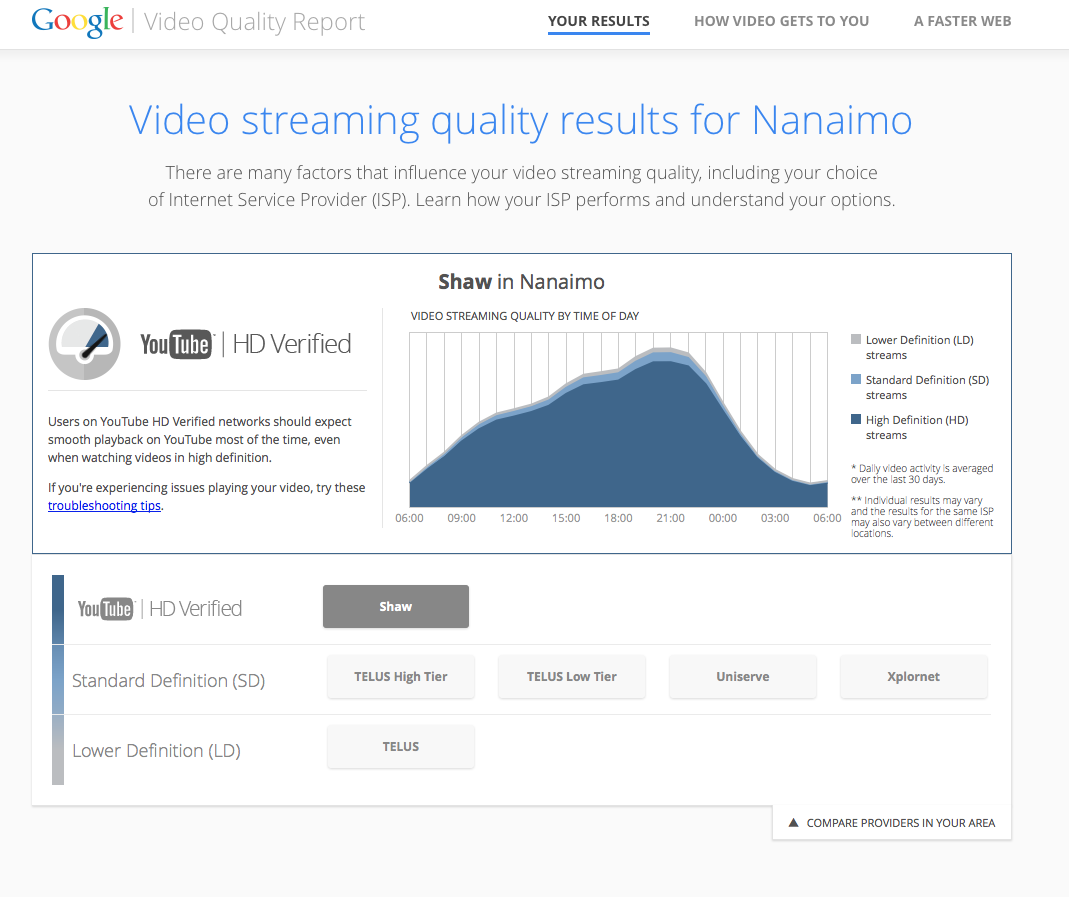
Google says that their new Google Video Quality Report will be based on billions of YouTube videos watched across thousands of ISPs, but that’s not going to happen if the service only works in Canada. So hopefully this means they have plans to make it available to many more regions. If they do, we should finally be able to see some real insight into how ISPs are delivering Google’s content, but since I’m not in Canada and can’t see what the results look like, it’s hard to really gauge the service.

Updated Jan 23: Here’s what the chart looks like:

Screen Shot 2014-01-22 at 6.42.59 PM

Verizon’s Planned Acquisition Of OnCue Is About Cost Savings and Making FiOS TV 100% IP Based

I’ve read just about every piece on the web today about Verizon’s plans to acquire the OnCue assets from Intel, and the one question I haven’t seen anyone answer is, what exactly is Verizon getting for their money? What are OnCue’s “assets”? Intel has never been very open with regards to OnCue from a product or technology standpoint and as a result, no one other than Verizon really knows what they are acquiring. It’s impossible to evaluate what this deal means for Verizon, outside of the cost savings benefit, as too many questions are still unanswered. We don’t know how far along the OnCue technology is, how much additional development is needed or how quickly Verizon can deploy it at scale. Many assume it works perfectly right now, as is, but that’s a big assumption. You also have to think about the integration time that it would take Verizon to deploy this inside their network, which won’t happen overnight.

I’ve seen a few people write that Net Neutrality plays a role in this since Verizon is getting Intel’s “over-the-top TV service”, but that’s not accurate as Intel doesn’t have a service of any kind. Intel never brought any kind of service to the market, so Verizon isn’t acquiring a “service”, only technology assets and people. Others are talking about the impact this will have on Verizon being able to offer some kind of OTT content play, but Intel didn’t have any content deals in place, so that’s not why Verizon wants to acquire them. This deal isn’t about content, or even OTT as much as it is about infrastructure, costs savings and providing IP services at scale.

From the little I do know about Intel’s OnCue technology, what Verizon is getting out of the deal, and what I would classify as the most valuable part, is the technology to be able to make their FiOS TV service 100% IP based. A lot of North American MSOs talk about going all IP, but none have yet to do it, at scale, and from what others have told me, that’s what the OnCue technology gives Verizon. Verizon would have the only true 100% IPTV service in North America and the cost savings alone they would get from going all IP would by itself pay for the OnCue acquisition.

Anything Verizon gets from OnCue on top of that regarding the front-end consumer facing piece, like video playback interfaces, search and usability would all be an added benefit. Some have said that the user interface Verizon will get is “key to the deal”, but Verizon’s not paying hundreds of millions, if that sale price estimate is accurate, just to get a better interface. So initially this deal isn’t about accelerating Verizon’s content strategy or OTT play, at the core it’s all about costs savings and infrastructure, at scale. Everything else they get on top of that is gravy.

Verizon had a total of 6.1M FiOS Internet and 5.3M FiOS Video connections at the end of 2013.

Streaming Media East Show: Call For Speakers Closes Soon, Program Publishing Shortly

The Streaming Media East show is only four months away, taking place May 13-14 in NYC and the call for speakers will close soon. If you want to be considered as a speaker, get your request in now! I already have hundreds of speaking proposals and am actively working on the advance program, which I will publish in about two weeks. I’ve already locked in topics in the program including webcast platforms, transcoding, business of 4K, video players, HEVC, monetizing premium content, viewing TV via apps, DASH, connected devices and a lot more to come. We’ll have more than 100 speakers and 30+ sessions and presentations over the course of two days.

So if you want to be involved, especially as a moderator – you need to contact me now with your ideas.

The call for speakers for the Content Delivery Summit, taking place the day before Streaming Media East, on Monday May 12th, will open shortly along with the launch of the new website.

The Dirty Little Secret About 4K Streaming: Content Owners Can’t Afford The Bandwidth Costs

When vendors and industry executives go to a show like CES, none of them seem to be satisfied to talk about what they are doing now. Almost always, they want to talk about the future and something more exciting and for this year, it’s all about 4K. All week we’ve seen companies talking about the role HEVC plays with 4K, improved compression, higher-quality video and hardware devices that will be able to decode and playback 4K content. While it all sounds exciting, the reality is, no one is discussing the business models around 4K streaming and the fact that for most, the economics of delivering 4K content don’t work.

This week we’ve heard a lot of technical talk about encoding, chips and devices, but no one is addressing the cost or QoS issues associated with 4K streaming. Lots of vendors are saying how HEVC “solves the 4K challenge”, but that’s just a technical challenge. What about the business challenge? I have yet to see a single vendor even mention it. No service like 4K streaming will ever come to the masses and survive if both the technical and business challenges aren’t worked out. I don’t doubt that the technical side of 4K streaming will be solid as there are a lot of vendors in the industry who excel in the encoding and compression segment of the market. But so far, vendors are not talking about how they are going to convince content owners to actually adopt 4K streaming and what the benefit is to them for doing so. How does streaming something in 4K instead of HD help the content owners business?

At CES, Netflix, Amazon and Comcast talked about their 4K content offerings and all of them disclosed that the bitrates they plan to use to deliver 4K content, using HEVC, will be between 12Mbps-20Mbps. That’s great for Netflix and Amazon, who have subscription based services and don’t rely on video advertising for revenue, but what about the vast majority of content owners who only make money from their content via advertising? The average broadcaster, news site and publisher, even the large ones, won’t be able to do 4K streaming as the cost for all the extra bits means they will have a content business they can’t monetize. Just think about how much content you view every day, from major content portals, where the max bitrate is 1Mbps. Why aren’t those websites delivering the video in 3Mbps? The answer you get when you ask them is that they can’t afford the extra bandwidth costs associated with it.

To put some real numbers behind it, for a content owner delivering video today at 3Mbps, one hour of video is going to consume about 1.4GB. If they are paying $0.02 (two cents) per GB, which is a low price, it’s currently costing them about $0.03 (three cents) to deliver one hour of video. If they then want to deliver that same content at 4K quality, it’s going to cost them between $0.11 (eleven cents) and $0.18 (eighteen cents), depending on the bitrate used, for one hour of video. Anyone see a problem with this? Content owners won’t be able to sell enough additional ad inventory to be able to justify the costs associated with moving to 4K and that’s just for the delivery part. That does not take into account all the extra costs they will have for encoding the content, storing it and additional costs associated with changes that will be required in their video workflow.

For all the talk of 4K streaming, there will be very little content available in that kind of quality for years to come. That’s the reality when it comes to 4K streaming. I know some will want to argue this point with me and will comment about how compression improves each year and how we’re producing better quality video at lower bitrates. But those are all technical arguments, not business ones. And CDN pricing is not declining enough each year to offset the costs of all the additional bits that are required due to 4K. I’ve spoken to multiple content owners about 4K and they all say that they can’t make the business rationale of offering content in 4K quality, unless it’s just a few pieces of their content to use as a test so they can get familiar with the technology.

Content owners and syndicators like Amazon, Netflix and a handful of others will make a very limited amount of their content available in 4K in the next eighteen months. But even they won’t foot the bill to make a large portion of their catalog available to stream at 4K quality, even years from now. We still don’t have 4K device penetration and that always takes 2-3x longer than the market predicts, to truly get to scale. Content owners aren’t going to spend a lot of money to reach such a small amount of 4K devices in the next 3 plus years. But even if that wasn’t the case, there are only a handful of companies like Amazon and Netflix where the additional costs associated with 4K streaming even makes sense, from a business point of view. They can afford to do it, they are big companies and can experiment. That’s all 4K streaming is going to be for years to come, an experiment. It won’t and can’t be adopted by the masses and content owners and consumers, unless there is a clear business value proposition for doing so.

Next week I’ll discuss how bandwidth costs and business models aren’t the only problem with 4K streaming, delivery and QoS is also something no one is talking about.

Verizon’s Acquisition Of EdgeCast Now Complete

In December, Verizon announced their plans to acquire CDN provider EdgeCast in a deal valued at $400M. Less than a month later, Verizon get regulatory approval for the deal and the acquisition of EdgeCast is now complete. EdgeCast’s brand name is going to stick around, at least for the time being, and the official name for EdgeCast’s CDN service is very simply “Verizon EdgeCast”. I’ll have further details in the coming weeks on the Verizon/EdgeCast integration, Verizon’s go to market strategy and my thoughts after getting hands-on with Verizon’s video ecosystem platform for broadcasters.

My Thoughts On Brightcove Acquiring Unicorn Media; Why Company Won’t Be Profitable In 2014

On Monday, Brightcove announced they have entered into a definitive agreement to acquire privately held Unicorn Media at a deal valued around $49M. Unicorn will do between $8-$9M in revenue for 2014, so they are getting a valuation of about 6x 2014 revenue, on a business expected to lose $12M next year. The deal consists of approximately 2.9M shares of Brightcove stock and approximately $9M of cash and is expected to close sometime this quarter. Brightcove is also paying approximately $2M to certain Unicorn employees as part of a multi-year retention plan and has announced that as part of the acquisition, five Unicorn Media executives will have senior leadership positions at Brightcove.

While this deal makes sense from a technology integration point of view, Unicorn is losing a lot of money. The company did about $5M in revenue for 2013 and expects to grow that to between $8-$9M in 2014. The problem with the business is that Brightcove says that Unicorn will lose between $11M-$12M in 2014, which is a lot to lose on such small revenue. As part of this announcement, Brightcove has also announced preliminary fourth quarter and yearly revenue. Total revenue for the company in 2014 is expected to be $126M-$130M and they expect to lose $9M-$12M for the year.

Brightcove had been telling Wall Street they were going to end 2013 as a profitable company, but now they don’t even expect to be profitable in 2014. Wall Street was expecting Brightcove to be profitable this year, so naturally they aren’t liking this news and Brightcove’s stock closed down $2.98 a share, losing 20% of their value. Earlier in the day it was down 26% on the news. While Brightcove might have shown slight profitability for 2013 if they had not done the Unicorn acquisition, revenue growth would have been lower than expected. Brightcove’s rate of growth is slowing with their 2014 projected revenue putting the growth of their business at about 10% for 2014.

For those not familiar with Unicorn Media, the company sells a cloud based platform called Unicorn Once. It allows premium content owners to easily take one piece of video and deliver it to multiple screens and platforms and dynamically insert ads for VOD and live streams. The company’s CEO, founder and largest shareholder is Bill Rinehart, who formerly was the founding CEO at Limelight Networks and their CTO, AJ McGowan was also from Limelight Networks where he served as Director of Solutions Engineering. Customers I know who use Unicorn’s platform have spoken highly about it and Unicorn gets very high marks when it comes to support and service, but like all vendors in this particular segment of the market, Unicorn has had trouble scaling their business.

The company was founded in 2007 and six years later only grew revenue to $5M in 2013. For all the talk of online video advertising, companies offering ad insertion services and platforms for premium content owners haven’t had much success in becoming profitable and/or scaling their business. The market for these services, while very crucial to content owners, is too small and will stay so for a very long time. While Unicorn is tiny, even the two largest vendors in this market, Brightcove and Ooyala, have raised almost $275M to date but still aren’t profitable. It takes far too much money to scale an online video platform business, especially when these vendors still get a large percentage of their revenue from the re-sale of CDN bandwidth and not from cloud platform services. Once companies in this sector grow to around the $100M mark, it gets very hard for them to grow their business at the rate they are accustomed to.

It also doesn’t help that vendors continue to set expectations in this market that aren’t realistic, which Brightcove seems to have a habit of doing. I get that they are excited about the market they are in, I am too. Having passion is a good thing. But you have to temper that passion with setting the proper expectations in the market and being realistic. Brightcove made this mistake when in their S-1 filing before their IPO they said the, “total potential market opportunity was approximately $2.3 billion in 2011, growing to approximately $5.8 billion in 2015”. And I cringed when I read today’s press release that quoted a high-level, generic research report on the online video ad market saying, “the online video advertising market represented $10.4 billion U.S. dollars in worldwide spending in 2013, with spending expected to grow to $16.8 billion by 2015.” Using these numbers, the size of the market Brightcove is going after is more than $13B, which means for 2013, Brightcove would not have even captured one half of one percent of the market. Yet, they have the most revenue of any other vendor. So how can the market be as big as these numbers say? It can’t. Again, I get the excitement some vendors have for what they are doing, Brightcove included, but set the right expectations.

Unicorn Media does have some unique intellectual property as they have been issued 14 U.S. patents and  7 international ones with 20 additional patents pending. Maybe that would explain why Brightcove game them the high valuation they did, but patents are only worth something if you can enforce them. It takes a lot of effort and money to enforce patents and I don’t see that being a business Brightcove is looking to get into, patent enforcement and/or licensing. As part of the deal, Unicorn’s CTO will be become the new CTO of Brightcove and Unicorn’s CEO will become SVP, Market Development for Media, which is a new group Brightcove has created inside the company to, “define and bring to market focused solutions that help media companies increase their revenue and decrease costs.” How this goal is any different from what Brightcove is and has already been doing for years with media companies is not clear to me.

As with any deal like this where a lot of technical integration needs to be done between multiple platforms, the success of this deal is going to be judged on how well both companies combine what they have. Based on what needs to take place, the companies have a lot of work cut out for themselves. Rather than me try to explain it, here’s what the CEO of Brightcove said in a blog post, “We plan to integrate Once technologies with future versions of Brightcove Video Cloud and Brightcove Zencoder. Over time, Video.js and other Brightcove Web players and native player SDKs will integrate with OnceUX technologies to support instrumented playback of Once streams. In a similar fashion, Video Cloud will eventually integrate with Once for video on-demand streaming, and Video Cloud Live and Zencoder Live Cloud Transcoding will integrate with OnceLIVE for fully monetized live event streaming.” That’s a lot of integration. No date was given as to when they expect it all to be completed.

In 2012, Brightcove spent $30M to acquire Zencoder which was projected to do $2M in revenue for the year. Add in the Unicorn Media deal and Brightcove has now spent $79M in two deals for two companies that combined, will add $12M-$14M in revenue in 2014. I understand where the pieces that Zencoder and Unicorn bring fit into Brightcove’s ecosystem, which does make their platform stronger, but the valuation they gave both companies was way too high. Brightcove is making some huge bets as to the future of this market and while there is nothing wrong with that, you have to be realistic on what’s really transpiring in the market and how quickly it will grow. Saying in your press release that you “believe that online video has the potential to surpass traditional TV” is simply buying into the hype. If the market Brightcove is targeting is really more than $13B dollars this year, how are they only expecting to grow their business as a whole by 10%? These inflated market projections that many vendors all use are simply that, inflated and not realistic.

When it comes to doing ad insertion, in particular for live streaming, it’s hard to make it work right. Even if you can do it, the market is and will be small for many years to come as there is more VOD content available than live. Plus even when it comes to the smaller live ad insertion market, it’s a crowded arena. Vendors who have solutions, or are working on solutions for live ad insertion include mDialog, Yospace, Jivox, Ooyala, Blackarrow, Vubiquity, FreeWheel, Azuki Systems, Adobe, Volar Video and others. Some of these companies are still working on such solutions and others may not work as well as advertised, in fact some don’t, but the point is there are a lot of vendors in the market trying to solve the same problem, for a market that can realistically only support a few of them. Remember when there was 20 OVP vendors in the market? Or 25 CDN providers? There aren’t that many anymore because the market for these services is not as big as many vendors say it is.

Not to mention, the fragmentation in the online video advertising world is a nightmare as no standards exist, which keeps the market for online video advertising services from growing quickly. You have physical ad insertion vs. ad/campaign management and content ops vs. ad ops with no overlapping server-side insertion functionality between the two. Add in the fact that there is a lot of strategy involved with premium content owners trying to find the balance of  how much content is streamed on the Internet vs. protecting their legacy cable TV ratings, and stream stitching for ads is only one small part of the problem. A larger business problems exists in addition to the technical one.

I respect Brightcove for what they have done. They basically created the industry they are in. They are passionate, they love what they do and from everything I have seen and heard, they treat employees well and treat customers with respect. But they have to set realistic expectations not only for Wall Street, but also for the rest of the industry. I talk to a lot of Wall Street money managers about Brightcove’s business and many don’t find them a compelling story anymore. They always say to me, “I expected the market for these services to grow faster and be larger.” And it’s not just Wall Street Brightcove has to set the right expectations with.

As long as Brightcove is the leader in this market for these services, based on revenue, others look to them for the valuations they put on the acquisitions they make. Like it or not, Brightcove is the barometer for the online video platform industry and everyone notices what they do. Eighteen months after Brightcove’s acquisition of Zencoder, we have no data points from the company to show if it was a success. I hope after the Unicorn Media acquisition is closed and the platforms integrated, the company will provide the industry concrete evidence as to what’s really taking place in the online video ad market, with real numbers on how it is growing.