Archives

Tuesday Webinar: Best Practices for Video Search and Discovery

Screen Shot 2013-08-19 at 2.10.36 PMAnalysts agree that video is growing, both in terms of volume and the need to expose it to search. In fact, Cisco’s 2013 VNI study predicts that globally, consumer Internet video traffic will be 69 percent of all consumer Internet traffic in 2017, up from 57 percent in 2012. But video as a format inherently lacks comprehensive metadata that would make it searchable in the same way text-based content is, thus rendering it an “invisible” asset even if the content is appropriate and meaningful. Applying rich metadata to video content is manual, time-consuming and costly — until now. On Tuesday August 27th, at 2pm ET, I’ll be moderating another StreamingMedia.com webinar, this time on the topic of, “Best Practices for Video Search and Discovery.”

During this session, you will learn about several best practices that can be applied to unlock the value in your video, and make it more discoverable for your target audiences, including:

  • How automatically creating a rich metadata “fingerprint” for video enables it to be discovered via search
  • How that metadata can be further exposed and cultivated to create experiences that drive users to related content, and increase video stream starts and time on site
  • How metadata can be used to drive contextual advertising experiences that offer additional revenue generating opportunities for you and your advertisers.

We’ll have a full Q&A session in which your questions will be answered and as always, all StreamingMedia.com webinars are free. So register here and save the date for this instructional webinar.

Sponsored by

CDN Provider Highwinds Closes $205M In Debt Financing

This morning, content delivery provider Highwinds announced they have closed $205M in a debt financing deal with Cerberus Business Finance and Goldman Sachs BDC, Inc. along with a follow-on investment from General Catalyst Partners. Highwinds plans to use some of the money to buyout older investors, but won’t say how much of the $205M will be left once that’s done. The company raised $100M in financing between 2006-2010, so one has to imagine at least half of the new debt financing will go directly to Highwinds expansion.

Highwinds has been in the industry since 2002 and use to be in the large volume, low price, video delivery business but exited that market a few year’s back to focus on the gaming, advertising and software delivery markets. The company plans to use the money to expand their network in China and Russia and further expand their presence in Latin America. The company has egress capacity in excess of 4Tbps and plans to add to that as well. Highwinds isn’t disclosing revenue numbers, but I expect the company will do about $100M this year. One thing Highwinds is open about is that they are profitable, with the business generating a lot of positive cash flow each month. The majority of Highwinds business is CDN related, HTTP and NNTP delivery, with only a small portion coming from transit and co-location products and services. The company has done a good job of signing up PC gaming customers including Valve, GameFly, Wargaming.net, Hawken, World of Tanks, Bigpoint and others.

Why AOL Paid Too Much For Adap.tv, Inside The Numbers No One Else Is Mentioning

This morning AOL announced it would buy ad technology platform provider Adap.tv for $405M in cash and stock. The strange part is that for all the news outlets that covered the deal, more than 86 by my count, none of the more than two dozen articles I have read even mentions what Adap.tv’s revenues are. I don’t see anyone asking what multiple AOL paid for the company or an article that gives any kind of breakdown on the valuation AOL put on Adap.tv’s business.

I’ve read articles on Ad Age, Ad Week, USA Today, Forbes, Business Insider, New York Times, CNET, Bloomberg, Tech Crunch, GigaOm, WSJ, Venture Beat, PC Magazine and not a single one mentions anything pertaining to Adap.tv’s revenue. As a whole, the media did a really bad job reporting this deal and it seems everyone simply rushed to get something up, but no one told any kind of real story. There is also no real mention in the articles I read on what Adap.tv does, what makes it different from an ad “network” or ad “exchange” and very little details on what Adap.Ttv’s growth has been like over the past seven years. It’s another example of why the current blog model, for most blogs, is wrong when all they are focused on is getting up as many posts as possible that are 700 words or less.

Adap.tv has been around about seven years now and last year, did under $100M in revenue. No one at the company wants to give an exact number, but from multiple sources I have spoken to they put the number at about $85M. Some at the company have been quietly telling people since the beginning of the year that they are on a run rate of “under $140M in revenue for 2013”, but realistically, I expect 2013 revenue to be more in the $120M range. Based on that 2013 projected number, AOL paid 3.5x revenue for Adap.tv. Keep in mind that AOL did say that Adap.tv has “grown global revenue over 100% per year in each of the last three years”, so whenever a company grows revenue by 100%, for many years in a row, you know the base number they are working off of is small. The one post I did read that mentioned revenue numbers (WSJ), said AOL paid 5x Adap.tv’s 2012 revenue, but these deals are done on the projected run rate of revenue for this year, not what they did last year.

Some might suggest that Adap.tv used the recent IPO of Tremor Video, which has a market cap of just over $400M as a way to measure their value, but Tremor Video had raised 2x more cash than Adap.tv ($116M vs. $50M), yet their revenues weren’t 2x higher. Tremor Video did $105.2M in 2012 revenue and wasn’t profitable. Adap.tv wasn’t profitable in 2012 either, but with the scale and resources they will now get thanks to the AOL platform, they probably could be.

I’m sure this is a long-term play for AOL and they are looking at what the future of online video advertising will grow into, but keep in mind that every projection made for this segment of the industry has historically been wrong. Four years ago I wrote a blog post entitled “What’s The Size The Online Video Advertising Market? All Depends On Who You Ask“, and of the eight sources I listed who gave out projections for the next three years, none of them look right. People have been making a lot of predictions about the size and growth of the online video ad market but the truth is, the market has simply not grown as fast as some want to imply. When the largest vendors in any space are doing $100M in revenue (Tremor Video, Adap.tv) the market is not as big as many want to suggest. And when you go to CNN or ESPN or any of the other major web portals and they deliver you the same video pre-roll ad literally ten times in a row, it’s clear there are plenty of problems with the market. Video ad targeting does not truly exist. Video CPM rates have been stagnant for years. All the vendors will say otherwise, but we all see what kinds of video ads we get.

While you may not think it from what I have written so far, I actually like this acquisition by AOL. Adap.tv was doing a good job in the market, they have a smart executive team and combined with the video plans that Ran Harnevo is in charge of executing at AOL, Adap.tv is fills a void AOL was missing. But AOL overpaid and based on how AOL’s CEO is talking about the deal, realistic expectations aren’t being set. During an interview on CNBC, AOL’s CEO was talking about the size of TV advertising being $240B and that’s going to move online over the next decade. What he does not say is what percentage of that AOL predicts will move online and over what time. He mentions Adap.tv is the number one technology in this space, yet they don’t even capture 3% of the programmatic ad buying market, which eMarketer estimates will be more than $3.36B this year. Also, while I see others using the eMarketer estimates, note that they say that number is for “all digital display spending”, not just video. So video is a much smaller fraction of the overall $3.36B number.

I’m sure many will say that this is a long term bet for AOL and I get that. But if you look at the estimates analysts gave out ten years ago, on what the video advertising market will be in 2013, none of them were even close, in some cases off by tens of billions. So AOL has a long way to go before they can show they got $405M in value from this deal. I hope they get it, but it’s going to be many, many years before they can show justification for paying the price they did.

Streaming Media West Conference Program Published: Speaker Placement Starts Today

Screen Shot 2013-06-03 at 9.16.27 PM

We’ve got a great lineup of content planned for the 2013 Streaming Media West conference (nov. 19-20), and have moved the event to a beautiful new venue this year, located in Huntington Beach. Below are all of the topics that will be covered at the show and we’ll have a combination of “how-to” instructional sessions, “presentations” by stand alone speakers and “round-table” panels that consist of a moderator and four panelists.

imagesIf you want to speak, download the full agenda and follow the instructions. Here’s the list of what content will be featured at the show and as you can see, we’re covering a lot of really great subjects:

  • Instagram vs. Vine: Hands On With Social Video Apps
  • Online Distribution and Monetization Strategies for the TV Industry
  • Understanding the Significance of HEVC/H.265
  • LTE and The Mobile Video Business Opportunity
  • How-To: Evaluating Your H.264 Encoder
  • YouTube Strategy for Brands
  • How To: Using Google Glass to Capture and Publish Videos
  • Connected Device Support: Creating OTT Apps
  • The State of Over-The-Top Video and TV Everywhere Rollouts
  • MPEG-DASH: Commercial Deployments and Outlook Towards HEVC and 4K
  • Requirements For TV Everywhere Enablement
  • How To: Choosing an Enterprise-Class Video Encoder
  • Video Capture and Delivery For Students in Higher Education
  • Building An Open Source DASH-AVC/264 Player
  • OTT Services and Their Effect On The Bundled TV Model
  • How To: Making the HTML5 Video Element Interactive
  • The Future of Digital Entertainment in a Multiscreen World
  • Using Cloud-Based Video Services For The Enterprise
  • Cutting Through The Hype Of HEVC
  • How To: Using YouTube’s Platform For Live Events
  • Best Practices For Implementing Accessible Video Captioning
  • Matching Up Streaming Video Metrics with Traditional TV Ad Buys
  • Re-Inventing Education With Video
  • Best Practices For Live Streaming
  • The Business of TV Everywhere
  • How To: Picking and Choosing A Video Management Solution
  • How-To: Choosing a Cloud Encoder
  • Truths, Half-Truths and Outright Myths About Live TV and Streaming Consumption
  • The Keys To HEVC’s Successful Deployment and Growth
  • How The BBC Built A Resilient Broadcast Grade System In The Cloud
  • Best Practices For Building An Enterprise Video Platform
  • Overcoming The Challenge Of Getting Live Video To Android Devices

I can’t reinforce enough how fast spots will go. So if you want to speak, don’t wait!

Latest ISP Data Shows Transparent Caching Increasing QoE Inside Carrier Networks

This morning transparent caching provide Qwilt announced they have raised $16M in a Series C round, now having raised a total of $40M to date. The funding, led by Bessemer Venture Partners, includes contributions from its current investors, Accel Partners, Redpoint Ventures and Marker LLC., some of the original VC’s that invested in Facebook and Netflix. For those not familiar with transparent caching technology, (a market I expect to grow to $350M By 2016) these platforms make intelligent decisions about which content can and should be cached inside carrier, MSO and mobile operator networks. By deploying intelligent caches strategically throughout their networks, operators can cache and deliver popular content (think Netflix and YouTube) close to subscribers and reduce the amount of transit traffic across their networks.

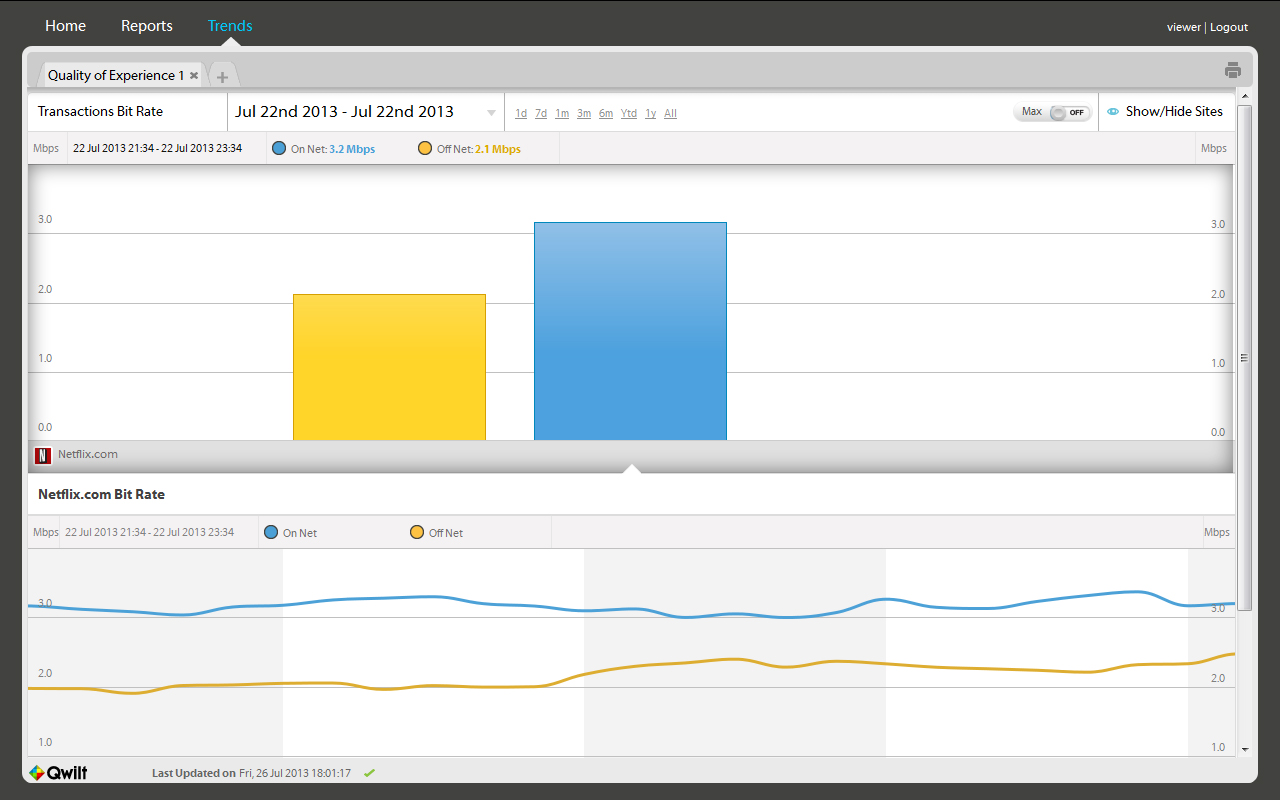
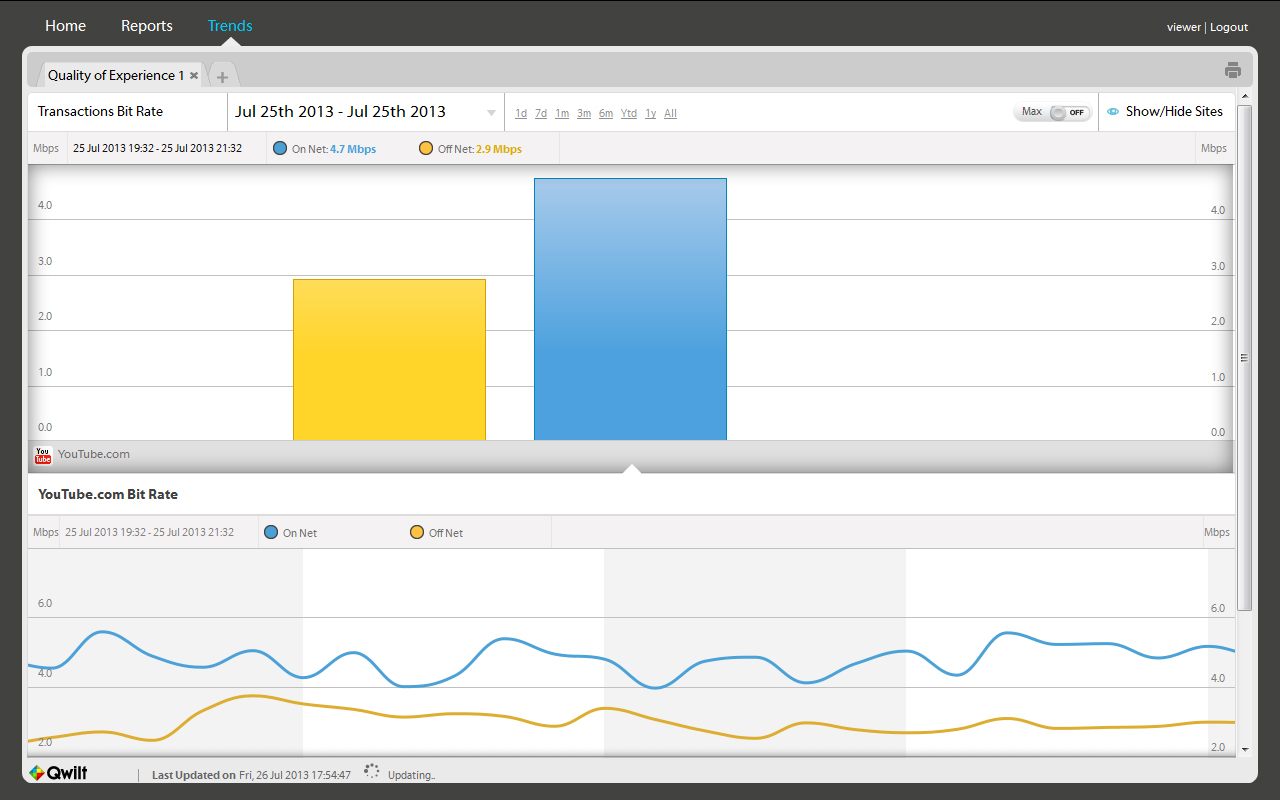
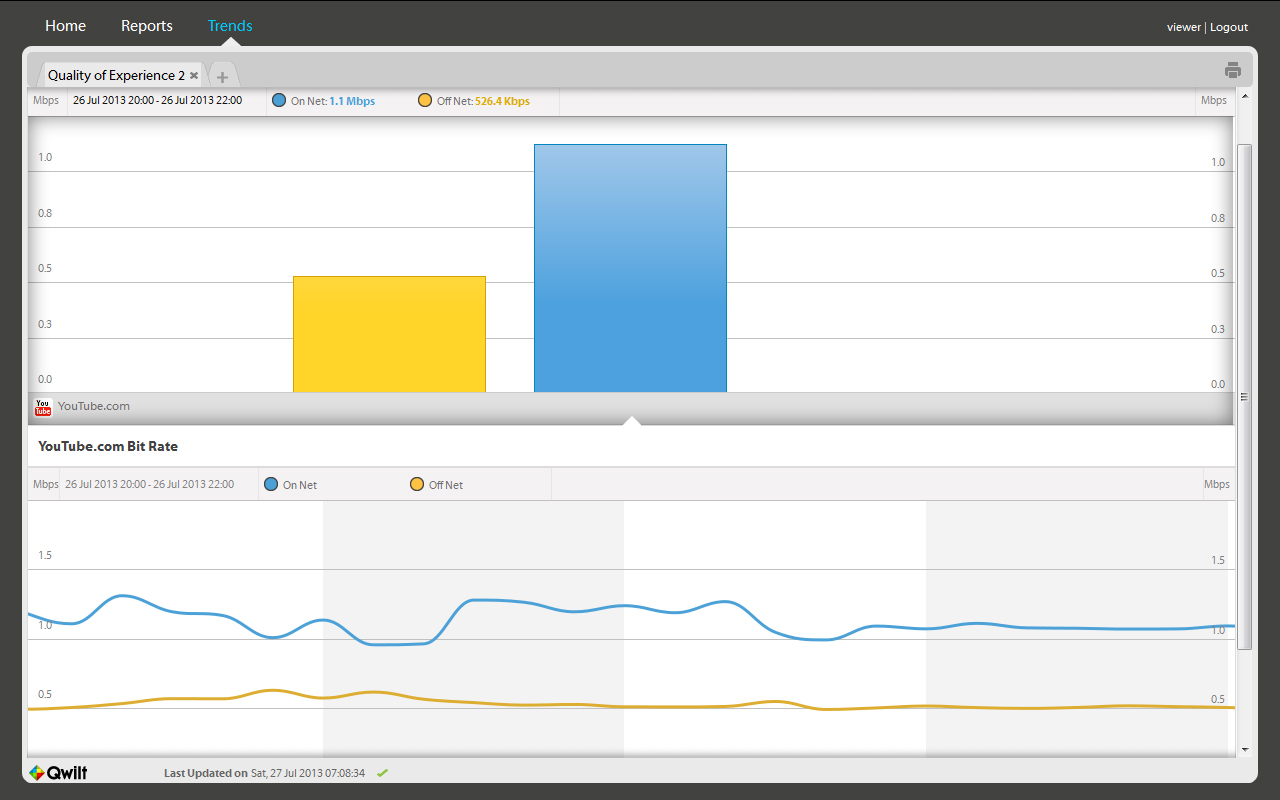
Qwilt started developing their technology in 2009 and in 2011, entered the market in beta. Since then, the company continues to win business and gain momentum in the market and over the coming months, expects to be able to publicly announce some major deployments. Qwilt has a lot of interesting data directly from customers and recently shared with me some charts that show the QoE improvement that is introduced when deploying Qwilt in carrier networks. The comparisons below shows the average video bitrate which is a key parameter in measuring QoE (and also the parameter used by Netflix in their ISP rankings) and how Qwilt allows for higher quality to be delivered, from inside a carrier’s network. In all cases the Qwilt systems were delivering roughly 50% of video traffic in the network.

Netflix (US customer) – 52% improvement – 3.2 Mbps OnNet (delivered by Qwilt) vs. 2.1 OffNet (delivered by Netflix or CDN)

netflix
YouTube (US customer) – 62% improvement – 4.7 Mbps (by Qwilt) vs. 2.9 (by YouTube)

youtube_us

YouTube (International customer) – 209% improvement – 1.1 Mbps (by Qwilt) vs. 526.4Kbps (by YouTube)

youtube_intl

Nearly every major telco, MSO, and mobile operator is actively looking at or deploying some kind of transparent caching technology today. It is a required element in their network to control OTT video content consumption and to provide the best possible end-to-end user experience. It is a unique technology that simultaneously benefits a content owner, a network operator, and, most importantly, a broadband or wireless subscriber.

Now a grown-up technology, transparent caching is the most cost-effective medium today for service providers to deliver OTT video with the kind of QoS demanded by consumers. Once considered a cost-savings initiative, it is now viewed as an investment, providing demonstrable return on investment by enabling service providers to better monetize their video services, like shown above in the QoS improvements.

At my Content Delivery Summit event this past May, Qwilt presented best practices for network insertion of transparent caching solutions and went through pre-deployment analysis and sizing strategies, demonstrating Qwilt’s platform video analytics capabilities. They also provided some guidelines in sizing and comparing TPC solutions and what the gotchas are that operators should look for. You can check out a video of their presentation here. And for more details on how transparent caching technology works, its role in the CDN market and market sizing projections, visit www.transparentcaching.com, where all my posts on this topic are located.

CDN Provider EdgeCast Raises $54M: What It Means For The Industry

I’ve been out for a while with a cold, so I’m late in writing up the recent news from CDN provider EdgeCast, which on July 18th, announced a big fourth round of funding for the company, totaling $54M. But don’t let my tardiness take away from how big of a deal this is for EdgeCast, and the impact on the CDN industry.

This latest round of funding is a testament to the success EdgeCast has shown in the market over the last five years, growing their business to a run rate of $100M in 2013, with only $20M in previous funding. At a time when many services in the CDN market are facing pressure on the pricing and competitive front, EdgeCast has managed to grow quickly, with products and services that have better than average margins, because of their unique strategy. From day one, EdgeCast stayed away from contracts where all the customer wanted was the lowest price. They walked away from a lot of potential bad business deals and didn’t try to win any portion of traffic from companies like Netflix, which was a smart move on their part, since many CDNs later regretted taking on those type of deals, learning they could not make money on them. EdgeCast will compete for high volume lower margin deals in video and software delivery, but will only do profitable deals.

EdgeCast also saw a need in the market, year’s before anyone else, around licensed and managed CDN and while it accounts for less than 25% of their revenue today, it allowed them to diversify their portfolio and get revenue from high-margin services. The company now competes in the market for traditional CDN services, licensed/managed CDN, application acceleration services and recently launched a dedicated PCI network for retailers. EdgeCast has quickly grown their product portfolio to include all the major services a CDN needs to have in the market to be able to truly compete.

EdgeCast came to the market in 2007 at a time when many other CDNs were in business and has been able to survive while most of the others have gone under. (i.e. Panther Express, BitGravity, Vusion, Grid Networks). EdgeCast joins the ranks of Akamai, Limelight, Level 3 and Amazon as one of the five remaining, large-scale CDNs in the market, offering delivery services for video and other forms of content. The company says they carry more than 5% of all worldwide Internet traffic, has 4Tbps of egress capacity deployed, and at their current rate of growth, is on a run rate of over $140M by the end of 2014. The company has been profitable since Q3 of 2009 and has grown to 275 employees, all on only $20M in funding, before this latest round. That’s quite an achievement, considering that in 2009, we saw video CDN pricing decline by an average of 45%, yet EdgeCast was still able to grow.

To highlight just how well EdgeCast has done to date, with little funding, all you have to do is look at Limelight Networks numbers for comparison. Limelight, which to date has raised more than $400M, is on a run rate of about $200M in revenue for this year. If EdgeCast does in fact end the year with $100M in revenue, they will have raised about 1/6 of the money Limelight has raised, yet is already at half of Limelight’s revenue. At a time when other CDNs are struggling to grow their CDN business by double digits, and keep their margins on CDN services high, EdgeCast has managed to do both. The company has their work cut out for them moving forward because it’s much harder to grow your revenue as you get larger and have to scale out every facet of your business, but they now have the money to do it.

Unlike a lot of the later big rounds of funding that took place at Limelight Networks and Highwinds, where some cashed out, 100% of EdgeCast’s management is staying put and all of the money EdgeCast just raised will go into the company’s expansion. Some CDNs like Limelight raised a ton of money pre-ipo and then cashed out their management team, got rid of a bunch of key founders including the CEO, and then brought in a team of outsiders who didn’t have the same passion and domain expertise to drive the business forward – and those were the guys who took it public. While they had some of the founding team still there, Limelight wasn’t the same after that, a mistake EdgeCast isn’t going to make.

EdgeCast plans to use the money to grow their network, add POPs into markets they don’t service today and augment capacity in their existing POPs to handle even more traffic. They also plan to expand their sales force and put more feet on the street in different geographies as to date, EdgeCast has been selling mostly over the phone. But the bigger customers need higher touch, something EdgeCast will be in a better position to support and will use the money to enhance some of their new products such as Transact (PCI/e-commerce network) and new DNS and security offerings rolling out later this year.

EdgeCast wants to remain focused. They aren’t getting into the transcoding business, becoming an OVP, trying to be a cloud hosting company or selling any kind of network services like transit. EdgeCast has done well thanks to their focus, and with a lot of new capital in the bank, they don’t plan to lose that focus anytime soon.

Some of EdgeCast’s customers include: Twitter, Hulu, WordPress, Mercedes-Benz, JetBlue, Kellogg’s, Yahoo!, Etsy, EMI, Campbells, Overstock, Bluefly, Garmin, Pinterest and Atari.


Verizon’s Pipe Dream: Consumers Will Need 500 Mbps To The Home, Will Sell It To You For $310

While I have been a FiOS triple play customer for more than five years, and like my FiOS service so much I let them film an Internet commercial at my house, it pains me to see that Verizon has just announced a new 500 Mbps service, with a blog post implying that consumers will need this kind of speed in their home in the future. While I am all for faster speeds, there is only so_much bandwidth any device/service can consume at any one time. There will NEVER be a time when the average household needs or can even use anything close to 500 Mbps and all Verizon is doing is setting false expectations in the market.

Of course, Verizon’s argument is that according to some NPD data, by 2022, the average household with two teenage children will own roughly 50 Internet-connected devices. While that sounds like a big number and impressive, it’s not about how many devices you have connected to the Internet, it’s about how much bandwidth they use and how often they connect. Even if NPD’s estimate of 50 devices comes true, most of those devices won’t be consuming video, which is really the only application that consumes huge amounts of throughput. Thermostats, washers, lights etc. may all be connected, but they don’t use a lot of bandwidth. I know as I have nearly all of them. My Nest’s, lights, security cams, washer, etc. all combined don’t even use 1% of my bandwidth, all running at the same time. It’s video services like Netflix and other video applications like gaming that consume the bits.

While some will argue that 10 years from now Netflix video will be delivered at a much higher rate, they would be right. But, it won’t be anything close to where a family of four would need 500 Mbps, even if all four of them were watching Netflix at the same time. And I guess Netflix isn’t keep an eye on what’s happening in the video world because content services like Netflix continue to deliver higher quality video, with LESS bandwidth. Netflix has improved its encoding process so that their videos take up less bandwidth, but delivers higher quality. Even if you look at video consumption moving to 4k quality, thanks to HEVC, most reports speculate that H.265 will allow 4K video to be delivered over the Internet at between 20-25 Mbps. So even a family of four, all watching Netflix at the same time, on four different devices, would only consume 80-100 Mbps. But Verizon wants you to think you’ll need 5x that. It’s a pipe dream.

Verizon’s blog post and PR email that discusses this new service is filled with all kinds of incorrect ideas or assumptions, for instance:

  • HD files consume a lot of memory and bandwidth.” Yes, but what does Verizon’s FiOS service have to do with memory on one’s device? Nothing. Faster bandwidth does not allow a device to encode video better, or provide any boost in memory. That would be like saying Verizon’s faster service allows you to have more storage on your computer. One has nothing to do with the other.
  • Approximately one-third of small businesses recently indicated a need for broadband service requiring greater capacity networks than currently exist in many locations in the nation.” Sounds plausible, but Verizon’s FiOS service isn’t available in a large portion of the U.S. market which means these business that need faster broadband can’t get Verizon to begin with. It’s a poor argument when you can’t service the majority of the market that may want the product.
  • “As more and more devices in your home become connected to the Internet your connection will get slower”. That’s not true. Just because a device is “connected” to the Internet does not mean it will slow the connection down for other devices. If I disconnect my Nest while using my iPad, it doesn’t make my iPad any faster. And since most users in the home connect via WiFi, when there is a slowdown, it’s almost_always a WiFi related issue, not a lack of bandwidth.
  • When appliances are plugged into the same circuit,  the strength gets weaker with each additional appliance“. From an electrical standpoint this is true, but a bad argument on Verizon’s part because this argument is the whole reason they tell people to get fiber to the home instead of cable services that only bring fiber to the block. Also, comparing how electricity gets split out between devices that have to have a certain voltage just to be able to turn on is not the same as devices that don’t have to have a certain level of Internet speed just to be connected.
  • The average U.S. household currently owns 7 internet connected devices“. That does not mean all 7 are on at the same time and consuming content. So again, it does not matter how many devices you have, only how many are connected and actually being used to pull down content.

Many consumers in the U.S. don’t have the ability to shop around when it comes to Internet service as they only have one provider in their area. And a service like FiOS, which is fast, but very limited in its footprint, simply isn’t available to a large portion of the population. Instead of all the time and effort Verizon and other cable/Internet companies put into silly marketing and PR stunts like this one, they should instead spend the time to find out what consumers REALLY want to make their service better. No one like myself who has 50 Mbps to the home ever says, I need more bandwidth. I get that as American’s we always seem to want more and order everything in the “supersize”, but if you already have 50 Mbps, you’re not interested in paying more to get even 100 Mbps, let alone 500 Mbps. The number one complaint by consumers is the cost of their bundled services, so why would they want to pay a hefty sum on top of what they are already paying for a service they can’t truly take advantage of?

But the worst thing about all of this is the idea that Verizon wants you to pay for something you’re not using. Pay for 500 Mbps every month, even if you have no way to actually us it all. Can anyone even think of a way to consumer 500 Mbps, in the home, even with streaming video? If you streamed a movie at 10 Mbps, you’d have to have 50 devices doing it all at the same time, from the same home, to saturate the pipe, if you got a full 500 Mbps. The idea is crazy. No one likes paying for something they can’t fully use, and that’s exactly what Verizon is asking consumers to do.

Verizon’s 500 Mbps service costs between $310 and $330 per month, depending on the double or triple play package your choose. Only businesses will be able to sign up for just the Internet portion, at a cost of $370 a month.