Thomson Reuters Acquires Webcasting Platform Provider Streamlogics

Streamlogics In a deal that had been in the works for some time, it was announced today that effective last week, Thomson Reuters has acquired Canada based Streamlogics. Terms of the deal were not disclosed and I don't have any details on the valuation but will update the post if I find out.

This is a nice deal for Streamlogics who has been providing webcasting based services for the past ten years to many major enterprise, government and pharmaceutical organizations in North America and Canada. While headquartered in Toronto, Streamlogics had sales offices in Los Angeles, Chicago, and Nashville Tennessee.

For Thomson, Streamlogics is now at least the seventh webcasting company they have acquired over the past ten years. While I'm sure I am forgetting a few of them, the ones that come to mind are CCBN, NetVision, Earnings.com, Broadcast1 and RAW Communications amongst others.

Sponsored by

Many Vendors Need To Refine Their “Who We Are Pitch”

Over the holiday weekend I started going through all of the speaking submissions for the Streaming Media West show and after looking at a few hundred submissions, it's clear that many companies in this space can't describe in one sentence what they do. I've always been one to believe that it's crucial that every person in your organization be able to deliver the exact same pitch on who you are and what you do as a company.

All organizations should be able to describe in one sentence, or within ten seconds if speaking, what their value proposition is. They should not have to fumble for words, have long drawn out answers or take up a lot of time. While many sales executives can do this, it's something everyone in the company needs to be able to do, whether they are a sales person or not.

On our speaking submission forms, one of the required fields is a brief description of who your company is and what they offer in the market. After going through a few hundred of these submissions and e-mails, it's clear that companies are either very good at this, or very poor. While I don't need to call out any companies by name, here are some of the pitches on what was submitted to us:

  • is a leading provider of world-class solutions for online video technologies.
  • the world's leading provider of online video solutions in the consumer space.
  • is a fully integrated, digital media technology company.
  • our solutions allow you to realize the potential of online video with consumers.
  • is a one-stop, turnkey provider of online video services and entertainment.
  • is a leading video services company powering the distribution of live online video for the web.
  • our company is committed to delivering content to consumers, along with more effective ways for companies and advertisers to promote their goods and services to this growing audience.

While many of these descriptions all use a lot of buzz words from the industry, none of them describe what exactly any of these companies do. What kind of provider? Hardware? Software? Video platform? Are you focused on marketing? Technology? Content creation? All these descriptions leave me with more questions that answers.

However, not all of the company descriptions are bad. Many are quite good and it seems none were in-between. Half were really on point, half were pretty poor. As an example, here is just a small sample of company descriptions that were very good:

  • Visible Measures is the independent third-party measurement firm for Internet video publishers, advertisers, and social marketers.
  • Similar to online photo sharing sites, Motionbox makes it extremely easy for consumers to share high quality personal videos with friends and family.
  • Accordent Technologies provides enterprise-wide rich media communications solutions that enable world-class organizations to inform, train and engage their audiences online.
  • Sigma Designs is a leading fabless provider of highly integrated SoC solutions that are used to deliver multimedia entertainment throughout the home.

The point of sharing this is not to look down on any company but to make vendors realize that they need to refine their pitch. If you can't describe what your company does and what they offer in the market without someone having to go visit your website to figure it out, then the messaging needs to be corrected. This principle is no different for any other industry sector and certainly applies to any business in any market. Take a look at your company description, deliver that message to others inside your organization and ask for feedback. Is it clear? Does it use too many marketing terms? Are you using buzz words just for the hell of it? How does it compare to your competitors?

Once you think you have it refined, share it with others in the industry, run it by your customers and see what the feedback is. Always keep refining the message and make sure that everyone in your organization can always deliver the same clear, concise message no matter who they are talking to. Back when I worked at Globix, everyone in the company had to stand up in front of others and was tested on giving the company pitch, even if you didn't work in the sales organization. It's great practice for all employees and in today's economy, everyone in the organization is in sales one way or another.


Akamai Launches iPhone Video Streaming And Showcase Portal (iphone.akamai.com)

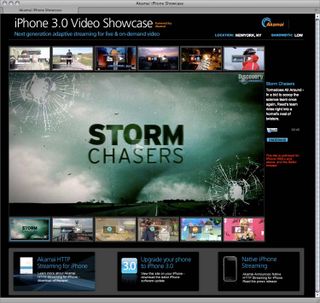
Akamai Today, Akamai "officially" announced support for variable bit rate streaming of live and on-demand video content for the iPhone and iPod touch and has launched a new showcase site at iphone.akamai.com. The site which has been live for about a month, showcases content from about a dozen content providers including FOX News, MTV and USA Today amongst others.

Akamai's new iPhone streaming service is based on the standard HTTP delivery protocol which for Akamai, means they can utilize more of their HTTP network infrastructure as opposed to proprietary based streaming protocols. Earlier in the week I came across the showcase site and tested the quality and while it looks pretty good, there were times when the video appeared choppy. Hard to know what exactly caused that as the videos as they play now, don't give you any performance or quality indicators in the player to know if your connection is having problems. That's one feature I'd like to see in the player and one that most PC based video players already have built in.

I have some videos of what the quality looks like on an iPhone and will post those shortly. Here's a short clip:


Akamai and Limelight To Deploy P2P For Higher Quality, Not Cost Savings

While there's been a lot of hype about peer-assisted technology (P2P) over the past few years, in reality, the technology has gotten very little adoption when it comes to being used to distribute video, let alone streaming. Today, most of the content being delivered via P2P is for software and gaming downloads and so far we haven't seen any of the major CDNs offer a real peer-assisted solution on their network. Later this year, that is going to change.

Within the next two quarters, both Akamai and Limelight are going to bring to the market peer-assisted delivery services on their network. And unlike previous deals where some of the CDNs were simply reselling a third party P2P platform, these solutions are going to be their own, deeply deployed and integrated directly into their networks.

(Correction: In the case of Limelight, they will work with other existing P2P companies who want
to use the Limelight Network for peer-assisted delivery.)

While some might think the reason Akamai and Limelight need peer-assisted solutions is to reduce their costs, or offer a cheaper level of delivery in the market, they would be wrong. This is not going to be about reducing a customer's bandwidth bill as many P2P providers pitch in the market today, but rather the ability for Akamai and Limelight to guarantee a certain level of quality. For all the talk in the market about HD video and the word "quality", the fact of the matter is that the CDNs don't control the last mile and have no way to ensure truly HD quality video.

Continue reading »

CDN Abacast Announces Flash Support For P2P Streaming

This morning, Abacast announced the availability of Adobe Flash support for their live peer-assisted (P2P) delivery platform and now supports both live and on-demand peer-assisted Flash video delivery across their network. While P2P has gained almost no traction amongst the major CDNs whom have thought about peer-assisted technology after their networks were already built out, Abacast's network was built on peer-assisted technology from the start and they have had some good success in the market.

While Abacast is not the size or scale of the major CDNs and focuses on targeting small and medium sized businesses, one of the things they have going for them is the fact they are profitable and focused. Before long, I would expect to see Abacast acquired for their peer-assisted technology by an MSO or potentially, larger CDN. From the Abacast customers I speak to, their peer-assisted technology actually works and is not a bunch of smoke and mirrors like some of the other P2P solutions on the market. There are a lot of P2P companies out there claiming to have a robust solution in the market, but most customers who have used them say otherwise.

Speaking of CDNs, some very interesting things are taking place regarding the major CDNs adopting peer-assisted technology on their networks, later this year, to deliver a higher level of video quality. I'll have more on that story shortly.

CDNetworks President Steve Liddell Resigns, Replaced By John Milburn

CDNetworks has confirmed that Steve Liddell resigned today and has been replaced by long time CDNetworks board member John Milburn. Steve held the title of President of CDNetworks International and was opointed to that position after the company he was CEO at, Panther Express, was acquired by CDNetworks in February of this year.

John is a member of the CDNetworks Board of Directors, representing Oak Investment Partners, and was instrumental in organizing the syndicate of investors that provided $96.5 million in funding to CDNetworks in December 2007.

CDNetworks says John has served as an advisor or board member for many ISPs and Telcos in Asia and several Silicon Valley based companies, including Juniper Networks, AboveNet and Aleton Websystems. John recently served as the chief negotiator for the sale of GMarket to eBay for $US 1.2 billion dollars. 

This move comes at an interesting time as I was just saying to someone the other day that it seems like CDNetworks has been really quiet in the U.S. lately and has not made much noise since the Panther acquisition. Of the contracts I have seen in the market for CDN services it seems like CDNetworks name isn't showing up as often. Not sure what to attribute this to, but I'll be speaking with John before too long to hear his strategy on how CDNetworks plans to try and really crack the U.S. market.

Updated 2:14pm – When reached by phone, Steve Liddell said his main goal after the Panther acquisition was for him to stay on board and make sure the integration between the two companies went smoothly. He says with the integration now done and completed about 90 days later, it was time for him to move on to a yet undetermined new opportunity.

CDN Pricing From 2005 Shows The Rapid Decline In Bandwidth Costs

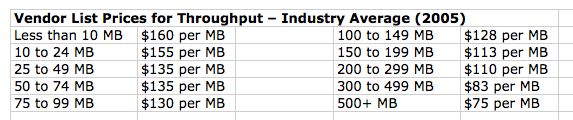
While going through some of my old files, I came across a bunch of my pricing data from 2005. This was around the time I started collecting CDN pricing a couple of times a year and the charts below show pricing from the market in 2005 based on per MB sustained, per GB delivered and includes pricing on storage as well.

While no one who follows the space will be shocked to see just how far pricing has dropped over the past five years, it's also funny to look at the buckets of volume that were being priced back then and what was considered to be a large volume customer, compared to today.

One 

Two

Three

But if you think these prices are crazy, just look at what the going rate was in the industry in 1999 for a live webcast. Below is what InterVU's list price was at the time for a webcast at 56Kbps. To put these numbers in perspective, the $95K cost to do a 4 hour webcast to 25,000 simultaneous users today would cost on average about $1,500.

Webcast