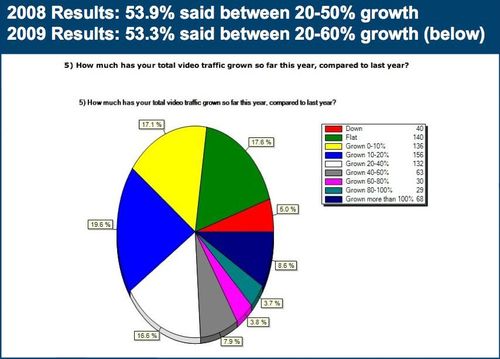
Video Traffic Grew 35% This Year, Same Rate Of Growth As 08′, Flat Year-Over-Year

The question I got asked most frequently at last month's Streaming Media West show was when I thought the rate of growth for video traffic would once again begin to accelerate. Based on a recent StreamingMedia.com survey we conducted in September and October, of which 812 content owners responded, 53.3% of the respondents said their traffic grew on average of only 35%-40% this year.

When compared to the same survey last year, 53.9% of over 1,000 content owners said their traffic grew a total of 35% in 2008. This lack of growth probably comes as no surprise to anyone who tracks the CDN space as revenue amongst the CDN vendors has been flat all year. When pricing is down nearly 40% year-over-year and traffic is only growing at 35-40%, that makes it really hard for CDNs to show revenue growth from their M&E video business. 

Cdn-pricing-slide

If you're wondering just how big these content owners are who took our survey, 13.4% of them spend at least $10k a month, 4.8% of them spend at least $25k a month and 3.9% spend at least $50k a month, just on video delivery. I'll be giving out more details and numbers from the CDN pricing survey in the coming weeks.

Sponsored by

On2 Gives Update On Google Merger, Don’t Think It’s Enough To Make It Happen

Looking to quell investors fears about their acquisition by Google, On2 has posted to their website some more details about the proposed merger. Even with these supporting documentation, I think there is a good chance the deal won't be approved by shareholders when they vote on December 18th. That said, the problem shareholders face if they vote against the deal is that On2 would have to find a way to raise more money. As of September 30th, On2 only had $2.2M in cash and short-term investment and negative working capital of approximately $4.1M. That's not a good position to be in.

On2 also announced that since the proposed merger with Google, no other company has come forth expressing interest in acquiring the company, something investors have really been championing for. That said, if I was a company interested in purchasing On2, I think I'd wait to make that known until after shareholders voted down the deal, if that happens. No company wants to compete with Google in a bidding war. While On2 makes their case in these new documents that the deal is a good one for shareholders since On2 says the transaction valuation is supported by multiple third party financial analysis, I still get the feeling that shareholders are going to vote no on the deal. Exactly where that would leave On2 is to be seen, which puts investors in a tight spot either way.

Akamai Now Getting Aggressive On CDN Pricing, Seeing Some Positive Results

For the past couple of quarters, I’ve written many times on my blog that Akamai needs to be more aggressive on their CDN pricing for video so they can grow revenue, increase the volume of traffic on their network and make it harder on their competition. Many have said Akamai would be crazy to lower their pricing, as it would negatively impact their margins. But I’ve always argued that you make up that decline in profit with more volume on the network, which in time actually increases your margins. Economics of scale is what the CDN business is all about and determines whether you win or lose in the market.

At the Streaming Media West show two weeks ago, I got to speak with dozens of content owners about who they were using for video delivery and what they are paying. I also got to speak with a lot of Akamai’s competitors and it’s very clear that Akamai started lowering their pricing, especially with contract renewals, when it comes to video delivery. While it’s hard to pinpoint the exact frame time this started to happen, customers I spoke to said they saw the pricing shift around the September time frame. Content owners currently with Akamai said Akamai had dropped their pricing to be near Limelight’s and Level 3’s and in some cases, was matching their pricing for renewals.

At the Streaming Media West show, some competitors of Akamai also privately expressed to me some frustration over Akamai’s lower pricing practice as they said they were losing deals to Akamai as a result of the pricing change and that it was now making it harder for them to close certain contracts. While Akamai’s not re-pricing everything across the board and still being selective, clearly any pricing change in strategy by the leading CDN is going to impact those competitors trying to take away their business. While some will naturally ask me how much Akamai has reduced their pricing on average, there is no way to say. I’ve seen deals where they dropped pricing by 50%, but then other deals where they have dropped it by even more to match Limelight or Level 3.

This shift by Akamai to adjust their pricing strategy is a smart one; I just don’t know why it took them so long to do it. I think that after three quarters of poor growth in their M&E business, Akamai finally came to the conclusion that it would help jump-start their M&E business and that by doing it on the tail end of the year, at a time when traffic tends to grow going into the New Year, it would have a much greater impact. So I’m not at all surprised that Akamai raised their guidance today for the fourth quarter. I think we all knew that at some point, Akamai would re-visit their CDN pricing and when they did, they would see pretty positive results quickly. It was just a matter of when they would start executing that strategy in the market.

For Akamai competitors, especially Limelight and Level 3, this is not good news. Limelight has shown no revenue growth at all for the past three quarters and has guided to a flat Q4. While Limelight believes they are ready to turn the corner with growth in 2010, a topic I will be posting about shortly, having to compete with Akamai’s lower pricing only makes Limelight have to work even harder. By my estimates, Akamai still does 4x the revenue Limelight does when it comes to CDN, which I classify as software downloads, small object delivery, streaming and HTTP video downloads.

Last month at the Streaming Media West show, I presented the last pricing numbers from the video CDN market and I’ll be posting those number to the blog this week.

Zappos.com Sells 6-30% More Merchandise When Accompanied By Video Demos

While the rest of the online video world seems to be paying attention to ad formats, the death of pre-roll, YouTube's ineffectiveness, and video content monetization, a quiet revolution is brewing in the commerce industry. At the Streaming Media West show last month, we had a great session with speakers from the retail industry who explained just how crucial video is to their business.

On of our speakers, Rico Nasol, a Content Team Senior Manager at Zappos.com gave out some great details on what video means to their business, how they utilize video today and what their goals are for next year. Rico was also one of our speakers that was interviewed live on Fox Business News which you can see here. Also, check out this link for a longer interview with Zappos from the show.

The best stat Rico gave out was that Zappos sells anywhere between 6-30% more merchandise, depending on the item, when accompanied by product description videos. Rico says that by the end of next year, Zappos will have ten full working video studios, with the goal of producing around 50,000 product videos by 2010, up from the 8,000 videos they have on the site today. If you want to see a longer interview with Rico, you can check out his red carpet interview on the StreamingMedia.com website.

I get the sense that a lot of people in the online video world forget just how much is going on outside of the media and entertainment industry, or are simply not aware of what's taking place. The commerce, enterprise and government sectors are all doing more with online video today, with positive results, than we have seen so far seeing in the broadcast world. If you're interested in following the online video market in the commerce industry, then you need to check out Justin Foster's blog at www.video-commerce.org and Xavier Casanova's blog at www.videoretailer.org

Movie Studios Just Don’t Get It, Part IV: Pay More For Movies On USB Drives

Transformers First it was the studios delivering two-hour movies to cell phones, even though consumers weren't and still aren't asking for the service. Then came the studios charging more for a digital download over the physical DVD. That was quickly followed by Sony charging $24.95 for a 24-hour rental and admitting it does not want to upset Walmart and the studios own DVD business.

Now comes word that Kingston, manufacturer of USB drives and SD cards, has teamed up with movie studio Paramount Pictures to release Transformers, Revenge of the Fallen directly on to a 4GB USB stick. The catch? A 4GB USB stick with the movie costs $29.99 through Office Max stores nationwide. Where is the value to the consumer with this offering? The physical DVD costs $17.99 on Amazon and a 4GB Kingston USB stick costs $8.89. So why is does it cost the consumer almost $4 extra to get the movie on a USB stick? Where is the demand in the market for this offering?

Keep in mind, the quality of the movie on the device is not at 1080p and it's only being offered online or at Office Max stores, not exactly the place most folks go when they want to buy a movie. But maybe that's exactly why the studios are doing it this way, since the average person visiting an Office Max store has no idea it's more expensive than it should be.

Paramount and Kingston have announced that they have signed a deal to deliver additional movies on Kingston USB drives and SD cards, so expect to see more of these pointless offerings in the market shortly.

China Based PPLive Confirms Investment Round Of About $15M

This morning, China based PPLive confirmed in an email that it has in fact raised another round of funding. While the company would not confirm the exact number, they said the earlier report of ir being around $15M, in U.S. dollars, is pretty accurate. NewTeeVee.com did a write up of PPLive and their business earlier in the year.

CEOs from Move, Internap, Highwinds And Others Provide Update On Their Business

Biz-cards One of the great things about the Streaming Media West show two weeks ago was the fact that so many industry CEOs were in attendance. Many of them have only recently taken on their CEO roles and I had the chance to sit with a bunch of them for the first time. I came back with over 100 business cards that I now need to follow up on.

I spent a good deal of time talking with Roxanne Austin, Move Networks' new President and CEO on the TV Everywhere business and what they are seeing in the market. Much of the conversation was off the record, but I'll have a great follow up post shortly about my conversation with Roxanne and what Move Networks is working on.

I also had the chance to meet with Eric Cooney, Internap's new President and CEO and got an update on their CDN business and we chatted about some of Internap's strategy moving forward. I still have a post to do about Internap's recent re-launch of their CDN offering and will have more on that later this month.

Speaking of CDNs, I also had a chance to sit with Steve Miller, President and CEO of Highwinds, along with some of his executive team. I now have a very clear picture on what Highwinds is working on with regards to their CDN offering in the New Year and where the future lies for the company's CDN business. I'll be doing a write-up of that shortly as well.

I had the chance to have lunch with Jamie Howard, President and CEO of Imagine Communications, who are the folks behind the digital platform that runs many of the cable and satellite companies digital video services. Some really interesting things are taking place in that arena which I'll also be discussing on the blog shortly.

In addition I had the chance to talk with Bill Stone, President of FLO TV, Peter Csathy, President and CEO of Sorenson Media, Jim Louderback, CEO, Revision3, as well as many others. Other C levels executives in attendance included Paul Scanlan, President, of MobiTV, Tal Saraf, GM of Amazon's CloudFront services, Emil Rensing, Chief Digital Officer of EPIX, Mitch Berman, CEO of ZillionTV, Bob Donlon, GM of Adobe TV, Mark Pascarella, CEO of Gotuit, Mike Newman, CEO of Accordent Technologies, Herve Utheza, President of RCDb, Brett Wilson, CEO of Tubemogul, Marc Whitten, GM of Xbox LIVE, Eric Armstrong, President, Kontiki, Alex Castro, CEO of Delve Networks, Ron Yekutiel, Chairman and CEO of Kaltura, Bismarck Lepe, Co-Founder of Ooyala, Daniel Graf, CEO of Kyte, Jeremy Allaire, Chairman and CEO of Brightcove, Brian Shin, Founder & CEO of Visible Measures, Ben Weinberger, CEO & Co-Founder of DigitalsmithsPete Kocks, President of Truveo, Tom Wilde, CEO of EveryZing, Lou Schwartz, Chairman and CEO of Multicast Media Technologies, Jay Pritchard, CTO of Datpresenter, Benjamin Wayne, CEO of Fliqz, Alex Blum, CEO of KickApps, Scott Broomfield, Co-Founder and CEO of Veeple, Max Haot, Co-Founder and CEO of Livestream and many, many others.

The number of C-level executives in attendance at our Streaming Media East and West events continues to grow each year and it was great to see so many of them in person, even if it was just to say hi. If we didn't have the chance to chat at the show, my apologies, I simply could not make it to all the meetings I wanted to. I'm happy to catch up with any of you now that the show is over.