Special Device Demo Spots Available At Streaming Media West

At the Streaming Media West show in November, I will be presenting a device showdown session between Roku, Xbox 360, PS3, Apple TV and others. The goal is to allow attendees to see these devices in action, learn which platforms they run, what their video quality looks like and let them see the different content choices available for each device.

In addition to the session I am doing, I am thinking of adding a special demo session for all the new or updated products that will be launched around the time of the show. If your company plans to launch a new product or has something hardware based they want to demo, for free, please contact me.
Ideally I am looking for vendors who have broadband enabled devices like TVs, Blu-ray players, gaming systems, etc.

Sponsored by

Streaming Media West Program Done, Speakers Now Being Selected

Some of you may have noticed I've not blogged much over the past week and that's because I've been hard at work on finishing the advance program for the Streaming Media West show taking place in LA this year from November 1-3. The program is now down, all session subjects have been chosen and now it's time for me to begin the speaker selection process.

Here's a quick run down of all the session/presentation titles and you can download a PDF of the program with all of the session descriptions here.

  • Technology Bakeoff: VP8 vs. H.264
  • iPad Revolution: Streaming Media Boon or Bandwidth Bust?
  • Internet-Enabled TVs And The Future Of The Connected Living Room
  • Device Showdown: Roku, Xbox, PS3, and Apple TV
  • Defining Advertising Standards And Stacks
  • Debunking HTML5 Video Myths: A Guide For Video Publishers
  • Mobile Video Syndication: App Stores and Smartphones
  • Online Video Use Cases For Small And Medium Size Businesses
  • The Future of Video In Education
  • Here Comes Google: TV Meets The Web
  • The Future Of Enterprise Webcasting
  • What the Advertisers Want: Meet The Online Video Ad Buyers
  • The Impact Of TV Everywhere And Over-The-Top Video
  • Original Web Content: Are We Monitized Yet?
  • Entertainment Content In The Cloud
  • Windows Media Server and Network Troubleshooting In The Enterprise
  • How Old Media Is Embracing Online Video and New Media
  • Cutting The Cord On TV: Will Online Video Really Lead To Cable's Demise?
  • Cost Savings From Enterprise Streaming: How The Conversation Has Changed
  • Monetization And Video Advertising Formats
  • The Impact Of Broadband-Enabled TVs, Gaming Consoles And Devices
  • CDN Pricing: The Going Rate For Video Delivery
  • Successful Content Syndication And Aggregation Strategies
  • How To Produce Effective Educational Video
  • HTML5 And Web Video Standards
  • How Streaming Video Is Changing The Television Landscape

Workshops

  • HTML5 And Web Video Standards
  • Encoding H.264 Video for Streaming and Progressive Download
  • Live Streaming with Microsoft Silverlight and Windows Media
  • Flexible Delivery and Interactive Experiences on the Adobe Flash Platform

If you think you have a speaker that would be a good fit for one of these sessions, you have until Friday to send in a speaking request.

RGB Acquires Ripcode: $60M In Combined Revenue, $220M Combined Evaluation

Rgb-logo This morning, RGB Networks announced it has acquired mobile video transcoding provider Ripcode in an all stock transaction. While terms of the deal were not in the press release, I had the chance to speak with RGB Networks CEO Jef Graham and Ripcode CEO Brendon Mills who gave me more details. Jef said that he expects the combined companies to generate about $60M in sales for 2010 and says that before the Ripcode deal, RGB Networks was already profitable. After the Ripcode integration he expects the company to return to profitability in “a couple of quarters”. All but one of Ripcode’s 26 employees will be folded into the new company, totaling 175 employees, and Ripcode’s CEO will now be the GM and VP of the mobile video division.

In addition to Ripcode investors taking stock in RGB Networks, investors in both companies have also made an additional “small” investment into RGB to assist with Ripcode’s burn rate. The investors now value RGB Networks at around $220M and to date, RGB has shipped $150M in products. While an evaluation of 4x revenue might seem a bit high in today’s market, RGB has $11M in cash and with Ripcode’s mobile offering, they really will have the only carrier-grade solution in the market to handle video to all three screens.

Since RGB has been successful in getting MSOs to put their ultra-dense video processing platform inside their network, it makes a lot of sense to now add the ability for the platform to also support mobile video since MSOs are desperately trying to figure out how to transcode video for mobile devices and optimize their network to handle the traffic. For Ripcode, the deal also makes a lot of sense and keeps them from having to raise another round of funding. To date the company had raised $32M in VC funding and with their cash burn rate, they would of needed to raise more funding shortly. While many acquisitions tend to seem like a good idea in principal, this is one of those rare deals where the synergy between the two companies is what I would classify as perfect.

Combined, Ripcode and RGB have a much better exit strategy and stand a better chance at getting taken out of the market as opposed to being stand-alone companies. While RGB’s CEO mentioned the idea of an IPO when we spoke, my take is that the real play for them is being acquired down the line by a hardware company like we say with Alcatel-Lucent acquiring Velocix. While the market for these service are only just beginning, once the MSOs start offering more in the way of OTT video services, plenty of larger companies like Cisco and others are going to take notice and want to get into the game.

Blade One of the things that always worries me in deals like this is the integration of the different technologies and platforms, but in this case, the integration for RGB should be pretty seamless. Ripcode’s software already runs on the Intel platform and RGB simply needs to port that software over to their Intel based hardware and drop it into their rack mount system. Combined with the hardware are three modules that handle management of the content, ad insertion, a transcoding engine, and now the mobile offering. RGB said they expect all of this to be integrated into RGBs Video Multiprocessing Gateway product line by the fourth quarter.

With RGB already having more than 180 customers including Comcast, Time Warner Cable, Cox, Charter, Cablevision, Rogers, Shaw and Telus amongst others, if the MSOs can get their act together and actually deploy some real TV Everywhere services, RGB is clearly in the drivers seat to be the leader in the market for the solution the MSOs are going to be relying on. While I don’t publish any kind of list of companies to watch in the space, if I did, RGB Networks would definitely be on that list.

Data From Q1 Shows Video CDN Pricing Stabilizing, Down 25% In 2010

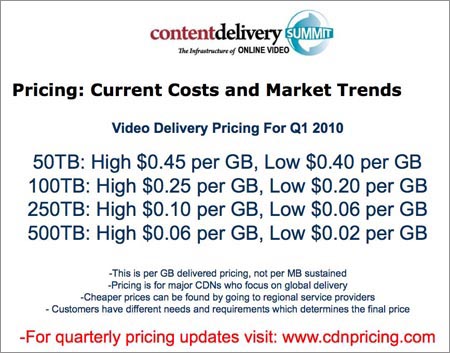
Last month, at the Content Delivery Summit, I presented my latest pricing data from Q1 for video delivery services amongst the major content delivery networks and had the chance to meet with dozens of large content owners in the M&E space. (You can see the video of my presentation here.)Overall, pricing remained pretty stable and from everything I have seen so far in Q2, 2010 should be a pretty stable year for pricing when compared to 2009. Now halfway through the year I am willing to bet that the average pricing decline for video delivery will be between 20%-25% for 2010 compared to a average decline of 40%-45% for last year. (note: you can always find my latest pricing post at www.cdnpricing.com – Previous Quarters: Q4 09, Q1 09, Q4 08, Q3 08, Q2 08, Q1 08.)

At the same time, content owners I spoke to have some realistic expectations of growing traffic 40%-50% this year which means for the first time in five to six quarters, the CDN vendors in this space have a real good shot at improving their margins. While we have seen Akamai reducing pricing for video delivery services in the M&E vertical over the past two quarters, most of their re-pricing appears to have been completed. On new deals, Akamai is still being aggressive and coming close to Limelight and Level 3’s pricing or tend to be just a little higher. Without a doubt, they have made their competitors jobs much harder when it comes to competing on price.

While it is impossible to know just how much market share the vendors have and who’s taken the most share from one another, in the first half of this year I have seen Level 3 have more momentum in the market than Limelight. While Level 3 does not do as many press releases and is not as vocal as some of their competitors, I continue to see them growing quietly in the market. Akamai’s been able to retain their market share only due to their re-pricing strategy and while Limelight hasn’t gone anywhere, we have yet to see them really ramp their revenue and take the business to the next level. For Limelight, 2010 is going to be a make or break year for the company and I’ll have more thoughts on that is a separate post shortly.

Pricing
While I know some vendors don’t like it when I always talk about Akamai, Limelight and Level 3, one can’t argue with the fact that these three CDNs account for probably 70% of the entire market, specific to video delivery. Smaller guys like EdgeCast are still going strong, CDNetworks is rolling out new app services and guys like Amazon and others are making good traction in the SMB size of the business. But that fact remains that for all of the CDNs that have raised money and come to the market saying they will challenge the big boys, none of them have yet been able to even put a dent in the big three.

Part of that is simply due to the economics of scale. It’s hard for a smaller CDN to compete with someone like Akamai on volume or with a Level 3 who owns the network. Of course this also makes many ask when the telcos and carriers are going to enter the space with their own CDN offering, but those days are long off. At the Content Delivery Summit, we had over a dozen carriers and telcos who all said the same thing on stage, that being that the market for video delivery service simply is not big enough. They didn’t see the need to have to own the CDN product for another 2+ years. While some want to always disagree with me when I say the carriers won’t be competitors anytime soon, you don’t need to believe me, the carriers were very open and vocal about this on stage at the conference.


So much went on during the Content Delivery Summit that there is now way for me to recap it all but we now have all of the session online and available for viewing at www.streamingmedia.com/videos

I’ve been getting a lot of questions since the summit about traffic growth, pricing trends, value add services, app acceleration, device penetration, dual-vendor sourcing etc. and I still have not had the time to write up all the posts I wanted to. So in the mean time, while I try and get to all of these, please feel free to put any questions you have in the comments section and I’ll try to answer them the same day.

In the second half of this year Frost & Sullivan will be releasing our annual report on the size of the content delivery market for video and I’ll have more data and details to share about that shortly.

Stifel Nicolas Analyst Has It Wrong, Hulu Is Not A Threat To Netflix

This morning, Barron's published a post about Stifel Nicolas analyst George Askew who cut his rating on Netflix's stock to hold from buy, saying that Hulu could be a serious rival to Netflix. When it comes to stock prices, I'll be the first one to say I don't know anything about them. I could care less about stocks as I have never bough, sold or traded a single share in any public company ever.

But when it comes to the reason why the stock was cut, that's where the logic is bad. Of course anyone can say that someone "could" become a competitor to another company, but instead of speculating, lets look at the facts as to why Hulu won't be a competitor to Netflix anytime soon.

For over a year we've been hearing about a premium based subscription service for Hulu. Yet in that time, Hulu has yet to roll out a pay service for any device. While Hulu has said from day one that a subscription service was always part of their plan, there is still no offering in the market. At the same time, by the end of this year, Netflix says they will be on over 100 different devices in the market and quality wise, they have one of the best streaming offerings on the industry today.

Of course, none of that happened over night. It's taken Netflix three years and hundreds of millions of dollars to make this happen. Since Netflix does not rely on their streaming service to generate direct revenue, they can afford to spend the money and invest the resources to make their streaming offering as good as it is. Hulu on the other hand doesn't even encode their videos on the web for 720p and are still doing 480p with some really low quality bitrates. That's not to say Hulu could not increase the quality of their videos, but considering the company only just turned a profit for the last two quarters, simply moving from 480p to 720p streaming, or even to 1080p like Netflix has, would put Hulu back in the red overnight.

Hulu did just over $100M in revenue in 2009 and half of that money went back to the content owners. Compared to Netflix, Hulu has very little money to spend on R&D and can't dedicate the resources needed to work with dozens of consumer electronic manufactures to get their platform embedded into devices. Even Blockbuster, who is much larger than Hulu admitted they don't have the resources to work with all the hardware providers that they want to. Not to mention, Hulu would have to design apps for all these devices and none of that happens overnight. Just look at the amount of resources Netflix has put into this and it's still taken Netflix three years to get to the point they are at today. Hulu simply doesn't have the money or resources to replicate what Netflix has done anytime soon.

The other big differences between the companies is the rate at which they move. Even though Netflix is much larger than Hulu, Netflix is very nimble. Talk to any of their hardware partners and they will tell you how easy it is to work with Netflix, how fast they get things done and how well their service works. Compare that to Hulu who is smaller than Netflix, yet moves at a snails pace. Ask any syndication partner of Hulu's how easy it is to work with them and you'll see them roll their eyes or tell you in detail just how hard it is to get things done. One content owner even forwarded to me a document that outlines how Hulu works with content owners and it's was 25 pages in length. And that was just the overview document, nothing to do with any technical implementation. Could Hulu be a competitor to Netflix further down the road? Sure. But they won't be any real competitor over the next 18 months.

Another point mentioned in the note talked to the number of videos that the analyst estimates Hulu would have with a subscription based service. He writes, "we estimate that  the Hulu service will feature a total of 24,472 streaming movies and television episodes – including 20,125 available only through Hulu Plus – compared with an estimated 18,522 titles in the Netflix streaming library." Where on earth does he come up with those numbers? By their own omission, not even Netflix knows exactly how many pieces of content they will have available for streaming in any given week. As Netflix has explained, the licenses to a portion of their inventory for streaming constantly changes with some titles dropping out, others getting added after licensing renewals as well as new content coming online. For anyone to suggest they can predict how many pieces of content Hulu may or may not have, for a service that is not even out in the market, is just ridiculous. Anyone can pull numbers out of the year.

If anyone is a possible threat to Netflix, it's not Hulu or Blockbuster
but rather Apple. If Apple came out with a subscription based service
for iTunes, then Netflix would have to be worried. Apple not only has
the eyeballs to iTunes, but it already has great relationships with the
studios and owns the hardware. Of course they would still need to go out
and get the iTunes platform embedded into a lot of non-Apple devices,
but Apple could make that happen. I don't believe Apple will come out
with such a service anytime soon, but it would be a natural progression
for iTunes and they have everything Hulu doesn't have including money, resources,
content relationships and hardware. While some have suggested that Redbox may
also compete with Netflix for streaming, Redbox has not yet finalized
their digital media strategy.

I'm all for other opinions being presented by analysts, but those opinions should be formulated based on the data and facts in the market. I don't personally know the analyst who wrote this note, but one thing I tend to find with analysts who cover Netflix in particular is that they know very little about the actual service. Many of them have never even used the streaming service, don't own a Xbox 360 or PS3, don't know how the the videos are encoded, what the settings are and haven't used other services by Apple, VUDU or others in the market to compare Netflix to. There are dozens of devices in the market that can stream Netflix content, how many of them have these analysts actually gotten hands on with?


Netflix Search Coming To Xbox 360, Computer No Longer Needed For Queue

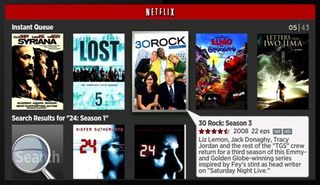
Roku_Netflix_UI_2010_version_1 While not announced during Microsoft's E3 keynote, the company did mention in a press release that come November, users of Netflix's streaming service on the Xbox 360 will now be able to search and add movies to their queue without having to use a computer.

This is the same functionality that Roku rolled out about two weeks ago and works really, really well. I started using this new feature in the new Netflix channel on Roku at the end of May and it makes using Netflix even easier. Not having to be tethered to the computer to find and select Netflix movies to add to your queue for playback on the Roku and Xbox 360 is a much better Netflix experience.

No Premium Hulu Service Announced For The Xbox Platform

For all the rumors that speculated that Microsoft would announce at their E3 keynote today that Hulu would be coming to the Xbox platform, that does not appear to be happening. While Microsoft did announce a deal with ESPN to bring over 3,500 live events in HD to the Xbox, there was no mention at all of Hulu. Considering how difficult it is to work with Hulu and get their content owners to agree to syndicate their content, I'm not surprised we didn't see a deal announced. Maybe further down the line something can take place and as Microsoft does more deals with the likes of ESPN, that's going to force Hulu to have to do syndication deals with CE manufactures at some point, whether they really want to or not.