Comcast Says Their Dispute With Level 3 Is “Not About Online Video” – Yeah Right

Yesterday, Comcast posted another entry on their blog entitled, "10 Facts About Peering, Comcast and Level 3". Amongst some of the points that Comcast wants us to believe is that this entire debate with Level 3 is "not about online video". Comcast says that it is simply an, "old-fashioned commercial peering dispute." If that's the case, why is Comcast imposing this new fee to Level 3 only a few short weeks after Level 3 announced a new contract with Netflix? We all know that the growth of traffic on the net is coming from video and for Comcast to say that this is "not about online video," is laughable. Companies like Comcast are struggling with trying to combat over-the-top services like Netflix. That's exactly what this debate is about – video.

Another one of Comcast's points is the idea that Level 3 is forcing the burden and cost onto Comcast's customers, which again, is absurd for them to suggest. Comcast says, "This is all about Level 3 gaining an unfair advantage over its competitors by gaining enormous additional capacity at no cost to itself, instead shifting the financial costs to Comcast's high speed data customers."

Level 3 has spent billions building out a network. The idea that there is no "cost" to Level 3 to support all of the additional video traffic they have to deliver is just wrong. Did Comcast listen to Level 3's last earnings call when Level 3 said they expected to spend $14M in capex, in the fourth quarter, just to support Netflix? Of course there is a cost to Level 3. In addition, how can Comcast say that Level 3 is "shifting" the costs to Comcast's "customers"? The customer is the one who is demanding this content. The customer is the one who is paying Comcast for the ability to get the content. Next thing you know Comcast is going to raise their rates again, and then blame Level 3 for it. Does Comcast really think we are this stupid?

Comcast also says that, "our customers can and do watch video from any online video provider, including Netflix and dozens of others, on our high-speed Internet service." Only if Level 3 agrees to Comcast fees they can. If they don't, it's going to be hard for Comcast customers to get Netflix content unless all of the requests from Comcast's network gets delivered by Limelight Networks or Comcast caches Netflix's entire library inside the Comcast network, which I don't see them doing any time soon. Comcast also makes a point to say that, "our agreement with Level 3 is no different than our agreements with its competitors." Really? What CDN, that owns their own network, does Comcast have this kind of agreement with? Akamai and Limelight don't count.

And finally, Comcast says that, "we charge a flat fee for our high-speed Internet service and do not charge any additional price to consumers to watch these online video services." So when Comcast says only four months ago that they are raising rates to help offset the costs associated with their Xfinity streaming service amongst other digital products, that's their idea of calling the service free? I don't think so.

Comcast is trying to treat the industry and consumers like we're all a bunch of idiots and don't know what type of content is growing or what we're consuming. Not a smart move on Comcast's part.

Sponsored by

The Real Issue In Comcast’s Dispute With Level 3 Is About Power, Not Money

Updated post: Level 3’s Lower Cost Comes From Owning The Network, Not Free Peering

Yesterday, Level 3 went public with a statement saying that Comcast was for the first time demanding, “a recurring fee from Level 3 to transmit Internet online movies and other content to Comcast’s customers who request such content.” Level 3 is saying such actions by Comcast are at the heart of the network neutrality debate and as one would expect, we’ve seen a great deal of thoughts, posts and comments about this whole subject in the past 24 hours.

Some posts have done a really good job of educating readers on how things like settlement free peering work and have brought to light how content is delivered on the Internet and what some of the relationships amongst carriers and MSOs look like. Other posts I have read have strayed far off the subject, in some cases accusing Level 3 of “stealing” bandwidth from Comcast and many other posts simply want to make this whole issue out to be about money, or Netflix. There are a few points that I think are important that I haven’t seen addressed and are what I feel the real discussion should be about.

For starters, this is not simply about money. While Level 3 said that have, “agreed to [Comcast’s] terms, under protest, in order to ensure customers did not experience any disruptions“, the actual terms of the deal and the money being exchanged between the companies is not substantial. Everyone assumes we’re talking big dollars here, but we’re not. The real argument by Level 3, which in my mind is fair, the idea that last mile providers are asking for a payment when there is absolutely no competition and no other options for Level 3 if they say no. There is no one else that Level 3 could buy something off to get access to Comcast’s eyeballs. Comcast could make any rules they want, and if Level 3 wants to continue to distribute their customers content to Comcast eyeballs, Level 3, or any other carrier, would have to agree to Comcast’s demands.

This isn’t two commercial companies having a commercial discussion because the discussion is completely lopsided. And while Comcast is not gouging Level 3 today and the two companies aren’t really fighting as many make it out to be, Level 3’s point is that this could become a problem down the road and they feel someone has to stand up to it. Level 3’s argument is that the FCC should establish guidelines on how these relationships should work. Also, Level 3 is not “pushing” traffic to Comcast. This is content being requested by Comcast’s own subscribers, and being pulled from Level 3. The idea that Level 3 is simply trying to dump all of this traffic onto Comcast’s network is laughable. It’s Comcast’s traffic.

I’ve seen some suggest that Level 3 should just say no to Comcast, but that’s not a realistic approach since that immediately puts all of Level 3 customers, who are the content owners, in jeopardy of not being able to get their content to the consumer, who is Comcast’s customer. Of course some are making this whole story out to be about Netflix, but that’s not what this is about. If Level 3 had not announced their new contract with Netflix to distribute their content, no one would even be mentioning Netflix in this story. This about the underlying principle of just how much control any last mile provider should be allowed to have and whether or not they should be allowed to prioritize traffic.

Of course when you bring the whole NBC subject into the picture, then this gets even more interesting with some suggesting that if the deal with NBC goes through, Comcast could give the delivery of their content more priority over another content owner, from another carrier. On Comcast’s blog, the company was quick to say that, “Level 3 has inaccurately portrayed the commercial negotiations between it and Comcast. These discussions have nothing to do with Level 3’s desire to distribute different types of network traffic.” That may well be the case – today. But the real explosion of traffic on the Internet is from video, so while Comcast is not specifically calling out video related content from Netflix or anyone else, that’s really what we we’re talking about.

Another really big issue that seems to be missed in this whole discussion is that for the traffic that’s moving, there is no change to Comcast’s cost base. Level 3 may be sending Comcast more traffic, due to Comcast’s customers demanding it, but that does not mean it costs Comcast more money to deliver it. I simply see Comcast as using this as an opportunity to try and charge Level 3 money, hoping that folks won’t really ask what the real cost impact is on Comcast. You will notice that in the Comcast post on their blog where they commented on Level 3’s statement, nowhere did Comcast say that the additional traffic from Level 3 was costing them more money. And if it does, it’s Comcast’s burden to bear as it’s content that their customers are demanding. Comcast is basically asking Level 3 to subsidize their service by charging Level 3 a fee and this is where things become scary if Comcast is allowed to get away with this.

What I don’t see Comcast talking about, or anyone else suggesting, is the multiple ways that Comcast could work with Level 3 to help alleviate the traffic and cost on Comcast’s network. One way to do this would be for Level 3 to deploy deeper into the Comcast network, which would help alleviate the issue, yet I’m hearing that Comcast isn’t looking at this as an option. If Comcast expanded its peering and improved its internal network and worked with Level 3 to allow them to be deployed deeper in their Network, Comcast could even deliver better service while lowering its costs. The idea that they only way Comcast can combat this is to charge Level 3 is simply not the case. If there is an imbalance in traffic, like Comcast suggests, then why isn’t Comcast allowing Level 3 to carry the traffic further into their network to equalize the cost? No one at Comcast seems to be willing to answer that question.

Due to Comcast’s actions, Level 3 says it is, “approaching regulators and policy makers and asking them to take quick action to ensure that a fair, open and innovative Internet does not become a closed network controlled by a few institutions with dominant market power that have the means, motive and opportunity to economically discriminate between favored and disfavored content.” From my perspective, I’m glad to see Level 3 making this issue public and bringing it to everyone’s attention, as the topic needs to be debated. The discussion should not be about Netflix or the CDN business as that’s not what the crux of this is about. Net neutrality is really the heart of this debate.

Special Over-The-Top Device Event For Wall Street Investors, Dec. 8th, NYC

Devices On Wednesday December 8th, I'll be hosting a special event for Wall Street investors demonstrating the leading over-the-top devices and content platforms. The event takes place in NYC, (midtown) and starts at 5:00pm with cocktails and hands-on Q&A at 6:30pm.

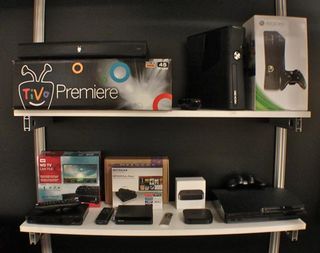
Device demos will include the Roku, Apple TV, Boxee, Xbox 360, PS3, TiVo Premiere, Google TV and will showcase content platforms from Netflix, Hulu Plus, iTunes, Amazon Video On Demand, Blockbuster and Walmart (VUDU).

If you are a financial analyst and would like to attend the event, please email or call me and I will give you the details. Also, I will be doing more of these special device presentations in 2011 so please contact me if you want to be notified of when they take place.

Q4 CDN Pricing Detailed, Down 20% In 2010, Expected To Remain Stable Next Year

Two weeks ago, at the Streaming Media West show in LA, I presented the latest video CDN pricing data from Q4 and also gave out numbers on the size and growth of the video market along with the expected rate of pricing decline for 2011. Video of my presentation will be up by the end of the month, but in the mean time, here are my year-end thoughts on CDN pricing as well as my predictions on what the industry could see next year. (note: you can always find my latest pricing post at www.cdnpricing.com – Previous Quarters: Q1 10, Q2 10, Q4 09, Q1 09, Q4 08, Q3 08, Q2 08, Q1 08.)

For the average customer delivering video via a third party CDN they saw their pricing decline by 20-25% in 2010. Compared to 2009, when pricing fell on average of about 45%, 2010 was a good year for the CDNs. The rate of decline for pricing was much more stable and traffic volume on average grew about 50% in 2010, compared to about 35% in 2009. This would explain why as a whole, CDNs including Akamai and Limelight reported growth to their CDN business this year. Even though the growth was small, 2010 was a much better year for the CDNs than last year when vendors reported their CDN business to be flat or down for all four quarters.

For all of this year, CDN pricing was very stable. In fact, I didn’t even release pricing in Q3 as really, there was nothing to report on. So for the pricing you see below, this is comparing CDN pricing from Q2 to Q4. As you can see, there was not much drop in pricing except at the lower volume tiers. Starting next year, the buckets of volume that I report on are going to change quite a bit as many CDN contracts are now in the petabyte size, not gigabytes. For the lower tiers of traffic like 100GB a month, those deals sizes are considered so small now that pricing is all over the map. The largest CDNs won’t even take on a customer of that size anymore unless they expect them to really grow their traffic over time.
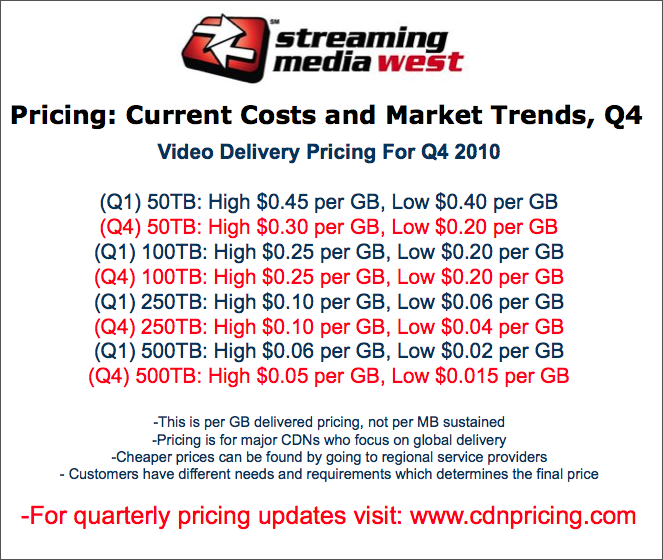
Screen shot 2010-11-18 at 7.25.37 PMThe pricing listed is based on yearly commit contracts, but the commitment rate could be on a monthly, quarterly or yearly basis. It could also be contracts that have a commit based on revenue and this pricing is for video delivery only and does not reflect the wide range other CDN services offered i.e. site acceleration, DNS/SSL etc.

While some have suggested that a new pricing battle may emerge and want to use the recent Netflix contract with Level 3 as an example, I see no data in the market to support this. As popular as Netflix, Apple and Microsoft are, the contracts those customers have with CDNs should not be used as an example of what’s taking place on a wider scale in the market. Why some keep using those customers as an example or want to point to them as evidence of a trend makes no sense, since those contracts are so unique. A trend in the market is based on data that comes from a lot of customers that make up the vast market share, based on revenue, not one or two customers who simply have a lot of traffic.

In January of 2010 I predicted that pricing for the year would be down 20%-25% on average and that seems to the be the case. My prediction comes from all of the data I see, the surveys we do and all the customers I speak with. Based on the data I have collected, the customers I have spoken to and the CDNs who talk to me about their costs, I am expecting CDN pricing for video to remain very stable and only be down 15%-20% on average for next year.

I’m sure that prediction may shock some readers, but if we look at all of the signs in the market, there is nothing I see that shows the CDNs are ready to begin slashing prices. It is also important to keep in mind that even if someone like Level 3 offers lower pricing than a competitor, they own the network and their costs are different. It’s not accurate to report that one company is slashing prices when internal costs from one vendor to another can vary quite a bit and can be the difference in pricing.

Keep in mind, operating a CDN is about the economics of scale. The more traffic a CDN can get on their network in as short a period of time as possible, the quicker their internal cost per bit goes down. The quicker it goes down, the quicker they can reduce pricing in the market to try and get more traffic. This is the never-ending cycle for any vendor in the CDN business. Increase scale, add more bits, reduce internal costs and drive more volume.

I am always asked what’s the catalyst for growth in the market and while many expect there to be one driver, their isn’t. I don’t see anything happening in 2011 that will make traffic growth on the CDNs explode. No one item like HD video, mobile, broadband devices etc. have enough of an impact by itself to cause a huge growth in the market. But taken all together, these items are the real catalyst for growth, and I expect we will see that surge in traffic on the CDNs in 2012. Devices are cool, but neither the Roku, Apple TV, Boxee, Logitech Revue (Google TV) or TiVo have even sold a million devices in the market as of yet. Adoption rates will continue to grow for these devices, but not at the rate some may think or suggest.

For next year, I expect video pricing to decline only 15%-20% on average because for many CDNs, pricing has already come close to hitting rock bottom. CDNs can’t afford to give this away and while some think this is about the “low cost leader”, it isn’t. CDNs have to make money and they know they can’t become profitable based purely on CDN services. That’s why all of them are working very hard to diversify their revenue to come from more services outside of just CDN. When we see that happen in the market, for any service, we know pricing is at a point of where it can’t get too much lower, without a substantial new volume of traffic.

In addition, as more CDNs offer what they call value add services, more contracts are going to be written in the New Year for a wider range of services that have higher margins. That means CDNs won’t have to list out pricing for just one product like CDN, but rather can bundle in multiple products for one price. This enables the CDNs to make more on CDN services than they have in the past without having to be so focused on the lowest price possible, for only one kind of delivery. The price for video will be bundled and basically hidden with contracts that encompass multiple services and bundled pricing is going to have a very positive impact on the market, enabling it to move away from the idea that the CDN business is all about price. It is laughable that some are suggesting that Netflix is using Level 3 to get a low price and giving up performance for cheaper delivery. Netflix and other customers care about price and performance all as part of one unified service.

In 2008, video delivery made up 39% of CDNs total revenue, as a collective industry globally, and in 2010, that number only increased to 42.8%, even though traffic volumes grew quite a bit. The size of the video delivery market for CDNs was $400M globally in 2008 and increased to just under $600M in 2010 which is about a 13% CAGR. (Compound Annual Growth Rate) I’ll have more on these numbers shortly when I outline some of the latest findings of the video CDN market sizing report that Frost & Sullivan will release in December.

For now, it is too early for me to predict what the average traffic growth for video will be next year. While I had the chance to talk to a lot of content owners two weeks ago in LA, most of them said it was too early for them to have any guidance. I’ll be doing a CDN survey in the New Year and will share those data points once I collect them, but for now, I do expect traffic growth to accelerate in 2011.

If you’re looking to learn more about the CDN market or industry, here are some useful URLs that will take you directly to some specific posts I have on the topic and I will also be hosting the third annual Content Delivery Summit in NYC on May 9th, 2011. (www.cdnlist.com, www.cdnpricing.com, www.cdnmarket.com, www.cdnpatents.comwww.contentdeliveryblog.com)

In the coming weeks I’ll have more posts about the size and growth of the video CDN market, details on what transit costs look like for CDNs and a post discussing how owning the network could give some vendors a leg up in the long run. And next year, I will start giving pricing examples of what some of the value add services cost from the CDNs and how those services are sold. If you’re looking to learn more about some of the value add services CDNs offer, check out this post I did on dynamic site acceleration.

Whenever I publish pricing numbers I tend to get a lot of specific questions afterwards, which I am happy to try and answer. So if you have a specific question on pricing, trends or any of the data I have presented, simply put your question in the comments section and I’ll respond. You can also call me anytime at the number listed on my blog.

Amazon’s CDN Gets More Competitive, Adds SLA, New Edge Locations, Lower Pricing

Logo_aws Almost exactly two years ago to the day, Amazon Web Services (AWS) launched their CDN service called CloudFront. The initial offering targeted developers and small content owners with a service that was very bare-bones and classified by Amazon as a beta offering. However only two short years later, CloudFront is fast becoming a service used by more of the mainstream market and while CloudFront won’t displace any of the big CDNs anytime soon, Amazon’s service is quickly becoming more competitive.

Last week, Amazon announced that CloudFront has officially come out of beta and has now entered General Availability (GA). The company also announced an SLA for the product and if availability of customers content on CloudFront drops below 99.9% in any given month, customers can apply for a service credit equal to 10% of their monthly bill. If the availability drops below 99% customers can apply for a service credit equal to 25% of their monthly bill.

Naturally one might wonder how Amazon’s new SLA stands up to other CDNs in the market, but none of the other CDNs in the market make their SLA’s available on their website. I’ve seen SLAs from all the CDNs but that’s only because customers send them to me and CDNs seem to go out of their way not to share details on their SLA on their website. I’ve always found that approach odd considering all of the CDNs talk about the quality of their network, yet none of them share their SLA in public. One of the great things about Amazon is they make both their SLA and pricing available to everyone on their website and have made the process of buying CDN services a lot more transparent. (Update: Someone pointed out to me that the Windows Azure service has a public SLA)

In addition to the news about the new SLA, Amazon also announced last week that CloudFront now supports third party origin storage. In the past, in order to use CloudFront customers had to store all of their objects on the Amazon network using Amazon’s S3 storage service. Now, content owners who have their own origin storage or even have their content stored at another CDN can use CloudFront.

For those that follow the CDN space, if you haven’t been keeping an eye on Amazon you need to. In just the past 18 months or so, here is a partial list of functionality that Amazon has added to their CloudFront offering:

  • Streaming and Flash Media Server support: the ability to use RTMP, RTMPT (HTTP tunneled), RTMPE (encrypted), and RTMPTE (tunneled and encrypted) flavors of RTMP.
  • HTTPS Access: provides encrypted communication and secure identification of a network web server
  • Invalidation: The ability to remove your content from all of the edge locations within minutes
  • Default Root Object: create a distribution that acts just like a static web site
  • Private Content: allow viewing of private content based on certain access controls
  • Private Streamed Content: support for customers who want to sell or to secure their video content
  • Management Console: support for CloudFront in the AWS console
  • Request Logging: the ability for customers to generate usage reports using reporting tools
  • LogAnalyzer: generate usage reports containing total traffic volume, object popularity, a break down of traffic by client IPs and edge location

In addition to the above, Amazon has also added a total of 16 edge locations in North America, Europe and Asia, has lowered their pricing at least twice in the past two years and built out a dedicated sales force for CloudFront services. The company also offers telephone support around the clock for customers who sign up for Amazon’s Gold Support plan and Amazon has also announced that they plan to add support for live streaming in the future. Make no mistake, Amazon plans to continue to improve on their CDN offering and more features and functionality are on the way.

On the pricing front, Amazon charges three cents per GB for customers who transfer 1000TB or more a month in North America and Europe and on average, seven cents for transfer out of Asia at the same volume level. Amazon has no minimum fee, customers pay only for what they use without overages, and for customers who have high-volume traffic, they can contact Amazon to get even lower pricing than what Amazon lists on their website. If there is one major thing Amazon has done to help the CDN space in general, it’s the transparency they have brought to the market. You can see the breakdown on all of Amazon’s pricing here.

Last year around this time, when Amazon announced they were adding support for Flash streaming I wrote that Amazon, “Will Disrupt The Market“. Exactly when we start to see that disruption on a wide scale is up for debate, but I would expect that come next year, we start to see a lot more large scale content owners looking at Amazon as a potential option for high-volume bit delivery of small and large objects, including video.

The barriers to entry in the CDN market are high, especially if the goal is to become a leading vendor in the space, based on revenue. Most CDNs who try are subject to the usual pitfalls of not having enough capital to see their plan to fruition, trying to do too much too soon, not having the technical resources and R&D to be successful and trying to be everything to everybody. With Amazon, they don’t have any of these problems and are in a very comfortable position of being able to continue to add more functionality to their CDN service each year without having any of the usual headaches that most other CDNs have.

To be clear, I am not predicting that Amazon takes a huge share of the CDN market overnight from Akamai, Limelight, Level 3 or AT&T. But Amazon will take some share for certain CDN services in a steady process over time and their CloudFront and Amazon Web Services (AWS) should not be underestimated.

Related Posts:

Amazon’s CloudFront Now Offers Flash Streaming, This Will Disrupt The Market

Amazon Slowly Turning Into A CDN For Video

Amazon’s New CDN “CloudFront” Launches With Pricing As Low As $0.09 Per GB

Amazon Lowers CDN CloudFront Pricing Down To $0.05 Per GB For Volume

Amazon Building Dedicated Sales Force For CloudFront Delivery Services

Netflix’s Recent CDN Deal With Level 3 Is Not An Indication Of New Pricing Declines

When Level 3 officially announced last week that they had signed Netflix as a new customer, some on Wall Street have started speculating that a new pricing battle amongst the CDNs is going to ensue. As a result, Akamai and Limelight’s shares are down this morning on the news that Oppenheimer has downgraded the companies based on the fear that, “the recent NFLX news could generate renewed CDN price competition.”

While Oppenheimer is not the first to suggest or worry about CDN pricing, you can’t use the Netflix deal as an indication of anything taking place on a wider scale. Netflix is the largest customer of video delivery on the Interent today across third party CDNs. Their traffic is so unique and so large that no one else even comes close to their volume. As a result, the pricing Netflix receives, the volume they commit to and the terms of their contract are not like any other video customer the CDNs have.

In order to predict or worry about a change in pricing industry wide, you need more than one data point from one customer, especially when the data from that customer can’t be counted towards the industry norm. For 2010, based on all of the data I collected, pricing on average for video CDN services fell 20%-25%. I presented all of this data two weeks ago at the Streaming Media West show and will publish it on my blog this week have published it here. By contrast, CDN pricing for video fell on average of 40%-45% last year. And next year, I also expect the decline in pricing to be along the lines of this year with no major declines.

It should also be noted that Level 3 is using the new deal with Netflix as a catalyst to spend at least $14M in CAPEX in Q4 to add capacity to their network. Limelight on the other hand isn’t spending any CAPEX to support the additional Netflix traffic they expect to receive. Some have suggested to me that the CDNs will have to slash their pricing in the market in order to see higher traffic growth in order to help offset the money they just spent on upgrading their network, yet that would really only apply to Level 3. And since Level 3 owns the network, they should have a much lower costs to operate it, which means that they should be able to offer lower pricing to begin with. But that’s a difference in their core business versus the other CDNs and has more to do with their direct costs and how they are setup as a company as opposed to it being any kind of sign that they are starting some sort of pricing battle.

So for those that may be worried that Netflix’s new deal with Level 3 is the start of some widespread and renewed pricing competition amongst the CDNs, it isn’t. Of course pricing will always be one of the many elements that all of the CDNs compete on, and while I am not a financial analyst and I don’t know why stocks go up and down, I don’t see how Level 3’s contract news with Netflix’s is any reason to predict that Akamai and Limelight’s core business will take some sort of negative hit as a result.

Free Giveaway: Win A NETGEAR Roku Player

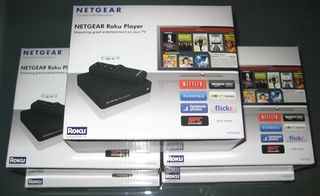
Netgear Thanks to the folks at NETGEAR, I have five Roku NTV250 players to give away to some lucky readers of my blog. The Roku platform supports content from Netflix, MLB and Amazon On Demand amongst others, with support for Hulu Plus and the NHL coming soon. To enter the drawing, all you have to do is leave one comment on this post and make sure you submit the comment with a valid email address. The drawing is open to anyone with a mailing address in the U.S. and I will select one winner at random on November 22nd December 3rd. I’ll then give away the other four in further drawings each week. Good luck!

Here’s my review of the Apple TV and how it stacks up to the new Roku’s: Apple TV and Roku Go Head-To-Head, Here’s The Winner