Ignite Technologies Acquires Live Peer-To-Peer Technology From Abacast

On Monday I mentioned that I knew of one company selling some P2P assets and now I can officially talk about the deal. Ignite Technologies has acquired the live peer-to-peer technology from Abacast along with two patents (6,970,937 and 12,265,581). Terms of the deal were not disclosed but I can confirm that the sale price was under $500,000 dollars.

Ignite, which was already working with Abacast for a few years, will leverage the peer-to-peer technology to enhance the peering capabilities of Ignite's client technology for their enterprise customers. Abacast has been out of the peer-to-peer video space for a few years now and is primarily focused on providing streaming, ad insertion and management and analytics for radio stations. With their business so focused on the radio vertical, it's not surprising to see Abacast sell off their peer-to-peer technology. The sale to Ignite is specific to Abacast's live peer-to-peer platform, but I expect they wil also sell off their on-demand peer-to-peer platform as well.

Sponsored by

New Data Released On The Performance Of Adaptive Streaming Over HTTP

Image Adaptive streaming over HTTP is gradually being adopted by content owners as it offers significant advantages in terms of both user quality and resource utilization for content and network service providers. To understand whether today's existing commercial players perform well, especially under dynamic network conditions, Cisco and The Georgia Institute of Technology just released a technical white paper on the subject. Their experiments covered three important operating conditions:

  • First, how does an adaptive video player react to either persistent or short-term changes in the underlying network available bandwidth? Can the player quickly converge to the maximum sustainable bitrate?
  • Second, what happens when two adaptive video players compete for available bandwidth in the bottleneck link? Can they share the resources in a stable and fair manner?
  • And third, how does adaptive streaming perform with live content? Is the player able to sustain a short playback delay?

The paper identifies major differences between Microsoft's Smooth Streaming, the player used by Netflix, and one open source player (Adobe OSMF). Their findings report that the Smooth Streaming player is quite effective under unrestricted available bandwidth as well as under persistent available bandwidth variations. It quickly converges to the highest sustainable bitrate, while it accumulates at the same time a large playback buffer requesting new fragments (sequentially) at the highest possible bitrate.

On the negative side, the paper says that the Smooth Streaming player reacts to short-term available bandwidth spikes too late and for too long, causing either sudden drops in the playback buffer or unnecessary bitrate reductions. Further, the experiments with two competing Smooth Streaming players indicate that the rate-adaptation logic is not able to avoid oscillations, and it does not aim to reduce unfairness in bandwidth sharing.

The Netflix player is similar to Smooth Streaming as they both use Silverlight for the media representation. However, the paper reports that the former showed some important differences in its rate-adaptation behavior, becoming more aggressive than  the latter and aiming to provide the highest possible video quality, even at the expense of additional bitrate changes. Specifically, the Netflix player accumulates a very large buffer (up to few minutes), it downloads large chunks of audio in advance
of the video stream, and it occasionally switches to higher bitrates than the available bandwidth as long as the playback buffer is almost full. It shares, however, the previous shortcomings of Smooth Streaming.

The paper says that the OSMF player often fails to converge to an appropriate bitrate even after the available bandwidth has stabilized. This player has been made available so that developers will customize the code including the rate-adaptation algorithm for HTTP Dynamic Streaming for their use case.

There is a lot of technical details in the paper and it makes for a good read if you are interested in the adaptive streaming topic. If you have a question on the paper, leave it in the comments section and I'll ask one of the authors to answer them.

Global Crossing Asks FCC To Regulate Intercarrier Fees, Disagrees With Verizon

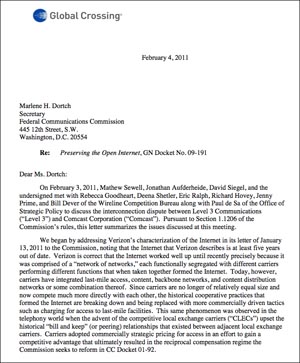
GC Last Friday, in a letter sent to the FCC, Global Crossing urged the commission to regulate the pricing for connections between last mile providers and network service providers saying that “broadband ISPs are distorting the economics of the historical peering relationships that existed between carriers“. Global Crossing also disagrees with a letter Verizon sent to the FCC in January saying that, “the Internet that Verizon describes is at least five years out of date.”

Global Crossing argues that today, the Internet is no longer comprised of networks isolated to one purpose and that many carriers networks are now integrated with last-mile access, content, backbone networks and CDNs. They go on to say that since carriers are no longer of equal size and now compete much more directly with each other, “the historical cooperative practices that formed the Internet are breaking down and being replaced with more commercially driven tactics such as charging for access to last-mile facilities.”

Global Crossings argument, which I think is a good one, is that this was the same problem that happened in the telephony market when the competitive local exchange carriers (CLECs) upset the peering relationships that existed with local exchange carriers. And while Global Crossing says they recognize that Comcast has not attempted to impose tariff-based access charges in the traditional sense of how telephone companies have imposed access charges, “the assessment of a fee for the delivery of traffic over last-mile facilities is the functional equivalent of an access charge“.

If this were to take place, Global Crossing says, “the ultimate result would be to skew the development of broadband competition while undermining the interests of consumers in obtaining the Internet content that they want, when they want it.”

In the Implementation of the Local Competition Provisions in the Telecommunications Act of 1996; Intercarrier Compensation for ISP-Bound Traffic, Global Crossing points out that the FCC specifically “sought to guard against carriers’ improperly shifting all of their costs to other carriers by charging them excessive rates for the use of their networks“. The Commission invoked that general principle in addressing the terminating access rates charged by CLECs, which Global Crossing argues is a scenario that is, “substantially similar to the one presented here“.

Global Crossing’s real argument is that the predicament faced by parties that send traffic to a broadband ISP’s subscribers today is substantially similar to those which the Commission has not hesitated to remedy in the past. Global Crossing says that, “the Commission has refused to tolerate such practices in the past” and that, “the application of access charges without any regulatory oversight would thoroughly undermine all of the Commission’s efforts in the instant docket to preserve an open Internet.

While many have been quick to argue that they don’t want the government involved in this disputer, Global Crossing ends the letter by saying that, “the Commission can ameliorate the problems associated with terminating monopolies in today’s Internet and preserve an open Internet without complex and extensive regulation. The Commission need only apply its existing, long-held principles of cost-recovery and safeguards for terminating monopolies in the context of the instant dispute.”

This topic is a hot debate in the industry right now and each time it comes up, many networking and technical people want to weigh in on how the Internet and peering works or want to explain the complexity of the Internet. But the bottom line is we need more business people weighing in on the topic as the heart of this debate is not about technology or network architecture but rather the impact this could have on business models and consumers.

Similar Posts:

The Real Issue In Comcast’s Dispute With Level 3 Is About Power, Not Money

Comcast Says Their Dispute With Level 3 Is “Not About Online Video” – Yeah Right

Level 3’s Lower Cost Comes From Owning The Network, Not Free Peering

I Think Cable TV Is The Best Value and Experience For The Money Spent, Here’s Why

While many will call me crazy, (it wouldn't be the first time) I do in fact think that the $65 I spend on cable TV each month provides me with the best choice and video quality for the money spent. Of course, that's not fashionable to say as these days, the media and many in the online video industry take advantage of every opportunity they get to complain about how expensive their cable bill is or their perceived lack of content choices. But the fact is, cable TV provides an experience online video will never replace.

Of course some will be quick to comment that I sound like an out of touch cable exec or someone not watching what's taking place in the market. But the fact is, I routinely consume online video via almost thirty devices, use every online video subscription and pay-per-use service in the market and test many of these products, platforms and services before they even come to the market. I eat, sleep and breathe over-the-top video. But right now, I don't see any combination of devices, services and platforms that are even going to come close to replacing cable TV in the next few years. Disruption? Yes, but only to a limit and not replacement.

Of course some are going to point to the number of "cord cutters" and will be quick to point to stats that show these cord cutters to be in the six-figure range. Yet these same people never talk about what percentage of the overall market these cord cutters make up, which is well less than 1% of cable TV subscribers today. Of course cable TV is not for everyone and in some cases, it is a waste of money if you don't watch a lot of TV, care about sports, live news or only care about watching one or two shows. But for the vast majority of the 100 million plus cable subscribers in America, who pay on average $75 a month for their cable, they do find it worth the money.

Of course I know many will disagree with me and that's fine. I love hearing people's opinions on the topic but I can't stand the fact that right now, anyone who says they like paying their cable TV bill is thought of as someone who does not "get it". This was the same mentality that permeated the market when in 2000, the entire industry was talking about "convergence" and how in a few years the TV and Internet would be one platform. And if you didn't agree with that consensus back then, you were though of as an idiot. Yet eleven years later, all we have is a fragmented TV platform with many, many years of work ahead of us before it really comes to fruition. Lets stay grounded in reality this time.

The fact remains that for $65 a month, cable TV provides me with more content choices and better video quality than I can get online, over-the-top or via any of the online video subscription and pay-per-use services. I pay Verizon $95.99 a month for a FiOS triple play bundle of phone, 25Mbps Internet service and cable. Of that $95.99 a month, the cable portion of my bill is $57.99 a month and rounds out to around $65 with taxes. When I turn on my TV I never have to wonder what the quality will be or if I can find the show in HD. The fact is TV is convenient, it always works and that's why so many people pay for the service each month. The same can't be said for over-the-top services and other forms of online content.

The last time I went to the movies it cost $28 for two tickets. At that rate, I could go to about two movies a month with my wife, or have cable TV for 30 days. Of course lots of folks talk about over-the-top services replacing cable TV, but if I got subscriptions to Netflix, Hulu, MLB and bought two shows a week on iTunes, that would cost almost $64 a month, the same as my cable bill. And I still would not be able to get local MLB games, other live sports, news or many of the shows I want in HD.

Over-the-top video services will always be subject to potential quality issues, buffering, lack of an HD source or many of the other things that plague these Internet based services. The Internet is not capable of supporting the kind of quality and viewership that cable TV supports, period. Of course that's something that many want to debate by saying that P2P protocols or some other kind of technology will fix the problem, but it won't.

Cable is all about convenience. I have dozens of channels and hundreds of shows all in one place and many stored on my DVR. I don’t want to have to buy shows from multiple sites, or subscribe to multiple services, nor do I want to have to use my PC to find shows to send to another box connected to my TV. I want to sit down on the sofa, pick up a remote to navigate through a simple program guide and DVR interface (TiVo) to choose the shows I want to watch. Easy. I also don’t like the idea of buying or leasing episodes of a show from iTunes that I may or may not like. With cable I can simply change the channel.

I watch a lot of TV, have about 50 season passes in my TiVo and for the money I spend each month, there is no other video service that even comes close to what cable TV offers in the way of choice and quality. Some in the industry are going to say that my role in the industry is to promote the adoption of online video and the value it provides in the market. And while they are right, my first job is to set expectations properly. And today, for the average consumer, cable TV is still one of the best choices in the market for quality and convenience.

Cisco’s Acquisition Of Inlet Probably Not The Last, Expect Analytics Platform Next

Last Friday, Cisco announced it would acquire privately held Inlet Technologies in a deal valued at $95M. With so many companies getting acquired lately for far less than the money they raised, it great to see that there are still companies in the industry that are worth something. While one of the print newspapers covering the deal called Inlet a "startup", the company has been around for almost ten years and the deal valued Inlet at about two and a half times revenue. Co-founder and former CEO Neal Page, who passed away in 2009, would of been very happy to see Inlet's technology be brought under the fold of Cisco.

Similar to the acquisition Cisco made of Extend Media, valued at around $80M last year, Cisco plans to use Inlet's technology for Cisco's recently announced Videoscape platform. Cisco is betting big on Videoscape with the intent of getting service providers and MSOs to use their platform to deliver video, both on-demand and live, along with social features and other applications. Cisco's big play is to enable MSOs to build their own cloud-based CDN to enable the delivery of all kinds of content, for multiple devices including TV and mobile. It's too early to say if Cisco can be successful with Videoscape, but with the solutions they already offer from their service provider group and the combination of Extend Media and Inlet's technology, Videoscape is clearly going to compete in the market.

The big question is, who will Cisco acquire next? In a call I had with the company last week, Cisco would not comment on what other pieces of the ecosystem they are looking to fill, but if I had to guess, I would think the next acquisition would come from the analytics space. Videoscape has all the functionality it needs when it comes to enabling content owners to ingest, transcode, store, manage and deliver video, but the tracking and analytics piece of the platform still needs to be addressed. Maybe Cisco will just end up building that in-house, but I would not be surprised if they bought someone to fill that need instead.

Did A P2P Company Just Get Acquired?

Over the past week, I got a few calls from industry people telling me that a P2P company has been acquired. The name of the company I keep hearing is Octoshape, but I have not been able to confirm that and as expected, Octoshape had no comment on the rumor. Octoshape has been trying to sell the company for a few years, but so have many of the other P2P vendors. I know of one company selling some P2P assets, but not their entire company. If anyone has any details on the news, you can put it in the comments section below.

Copy Of Google Presentation On Building A Content Delivery Network

Google-cdn-image Google's Program Manager for Peering and Content Distribution in EMEA did a presentation last month where he outlined some of the challenges of scaling a CDN, talked about how peering fits in and what some of the trends in content delivery are today. The presentation also included some details on Google Global Cache and what different CDN platforms look like. You can download a PDF copy of the presentation here. Updated Feb 3rd: At the request of the presenter, the slides have been removed. While earlier permission was given to post them, since it was a presentation in public, I feel that the person who actually did the presentation overrules that if they don't want it available for download.