AT&T Building Out Their Content Delivery Network Using EdgeCast’s Software

Here's an interesting development in the CDN space. Back in November I was hearing that AT&T was looking at possibly stopping development of their own in-house CDN platform and looking to license EdegCast's software to run AT&T's CDN. While both companies declined to comment for this post, I have been able to confirm that AT&T has in fact done a deal with EdgeCast and is in the process of using EdgeCast's CDN software to build out AT&T's retail CDN offering.

This is an interesting shift in thinking for AT&T but one that I think is really smart. It is similar to AT&T's recent reseller deal with Cotendo where AT&T decided they could get to market much faster by working with a partner as opposed to spending the time and money trying to build everything in-house. While EdgeCast might technically be considered a competitor to AT&T, the two companies are really going after different sized CDN customers and an increasing portion of EdgeCast's business over the coming years will not be just CDN delivery, but rather the licensing of their platform to other telcos and carriers.

AT&T has been making some interesting moves over the past couple of months and I do think that in the long term, they have a real chance at competing with Akamai for a good portion of Akamai's business. It won't happen over night, but AT&T does have all the pieces they need to compete with Akamai if they execute properly. In the past, I didn't think AT&T was capable of executing fast enough in the market since they were trying to build out everything themselves. But with their recent deal with Cotendo, and now their new deal with EdgeCast, AT&T is going to be bringing products and services to the market a lot faster and these services are going to be built on top of platforms that have already proven themselves in the market.

Sponsored by

Roku Adds Official Support For Video Playback Via USB Drives

IMG_0293 There's not much to not like about the Roku, but one of the big missing pieces was support for playback of local content via USB drives. While it was technically supported in beta mode, it wasn't the easiest to implement and the avergae user probably didn't know how to do it. That all comes to an end today as Roku has rolled out a new firmware version (2.9 build 1529) giving users the official "Roku USB Media Player" channel. In addition, Roku has also added support for the MKV format and the company plans to add support for additional formats later this year. The Roku USB Channel currently supports drives formatted in FAT16, FAT32, NTFS and HFS+. I'm giving away a free NETGEAR Roku, the drawing ends today so enter quickly if you want a chance to win.

Related Roku Posts:

Apple TV and Roku Go Head-To-Head, Here's The Winner

Device Comparison: Apple TV vs. Roku vs. WD TV Live Plus vs. Sony SMP-N100

In Case Santa Didn't Bring You A Roku, I'm Giving One Away

HTML5 Video FAQ: Answers To The Most Common Questions

Two weeks ago, StreamingMedia.com hosted a live webinar on the topic of HTML5 video and we had more than 900 attendees to the event who asked well over 100 questions. Of course we couldn't get to all of them in the hour, so I followed up with the webinar presenter, Jeff Whatcott, SVP of Global Marketing from Brightcove, to provide answers to some of the of the most commonly asked questions about the current state of HTML5 video.

Webinar materials are available here: Slides and Recording. StreamingMedia.com also recapped the event here. These were some of the most common questions we received:

Question: Do I really need to worry about supporting HTML5 today? What's the rush?
Whatcott: Today, HTML5 is essential to serving video to audiences browsing the mobile Web. HTML5 doesn’t apply to mobile app development, but if you are hoping to reach viewers on iPads and iPhones that are landing on your website, HTML5 and H.264 are the runtime/format combination that you have to support. And while the mobile market is fragmented, those iPhone and iPad users represent an attractive audience demographic of early-adopting, technologically-savvy users that tend to fall into higher income brackets. So yes, if you care about mobile Web video at all today, you’ll need to consider an HTML5 support strategy.

Question: What encoding settings should I be using for HTML5 video?
Whatcott: HTML5 video tags work with the following: H.264 video created with the MPEG4 codec, WebM video made with the VP8 codec, or Ogg Theora video. H.264 and WebM offer better video quality, and WebM is open source. At Brightcove, we recommend encoding in H.264, with 2 pass H.264 encoding with keyframes at least every 6 seconds. For more detail, check out our video source file specifications and recommendations.

Question: What are the current limitations of HTML5? Are there features that work in Flash that won't work in HTML5 playback?
Whatcott: We're still very early on in the adoption cycle, so there are a number of advanced features that are fully integrated in Flash that still need to be built into HTML5 playback environments. Because HTML5 video is still in its infancy, the following holes remain for the time being:

  • Analytics: We have basic viewership reporting today, but drill-down in to engagement and social sharing and geography are still to come.
  • Ad Integration and Ad Rules: Ad servers and ad networks are gradually adding support for HTML5 experiences, but it is taking a while to get everything working.
  • DRM: The HTML5 spec does not cover or contemplate DRM to prevent content theft.
  • Live Streaming:  The HTML5 spec does not cover or contemplate live streaming.  Apple offers a proprietary method, but that only works for iOS devices. 
  • Captions: A workable solution for captions is not covered in the spec, and so it falls on developers and online video platforms to implement this as a feature.

In many ways, HTML5 is today where Flash video was in 2002. Replicating the massive industry ecosystem of ISVs, tools, services, and developer communities that have grown up around Flash will not happen over night. That being said, integration of these features is a top priority on our roadmap at Brightcove. Until then, Flash will remain the preferred default platform for desktop experiences, and HTML5 is really just an immediate solution for reaching mobile audiences on devices that do not support Flash, which is how our Smart Players are designed today.

Question: Will HMTL5 increase the cost of supporting video for publishers?
Whatcott: Generally, building a webpage with video that will playback on the Web and on mobile devices for every OS will require some duplication of efforts. If you wanted to do it by hand, you would need to build something that right now would probably default to Flash and then switch to HTML5. It's doubling the transcoding work, and increasing the complexity of a build for developers.
The good news is that the cost of doing that for Brightcove customers is nothing. Our Smart Players do all that development work for you by reading an end-user environment and sending the appropriate file type, codec and rendition. And Smart Players are available to all levels of our service, even down to the Express product which is targeted at lower budgets for smaller publishers.

Question: How will Google Chrome's announcement that it longer plans to support H.264 codecs for HTML5 playback impact HTML5 adoption?
Whatcott: I read this as an indication that online video is going to continue to get more complicated and fragmented before it gets easier. Because HTML5 in Chrome will require WebM codecs, we believe you'll see a lot more folks defaulting to Flash for the time being (which will still be able to support H.264 video files). The net-net of it is: this WebM announcement will result in further entrenched use of Flash for Chrome desktop and mobile environments because it works today, and will continue to work for the time being.

Question: What effect does this fragmentation of standards and codecs have on the online video ecosystem?
Whatcott: The fact that practically each major browser is supporting a different format (Chrome:WebM; Firefox, Opera:Ogg; Safari,IE:H.264) isn’t making online video delivery any easier for publishers today. However, we at Brightcove are energized and motivated by this news, because our goal has always been to shield publishers from the complexity of delivering video to an diverse ecosystem of devices, codecs, variable bandwidth profiles etc. In the near future, that will mean a publisher can continue to upload one source file to Brightcove, and we'll transcode it to multiple rendition sets in both H.264 and WebM formats to be used wherever appropriate. Our aim is to prevent customers from having to make risky either/or technology bets, and instead allow them to focus on their business strategy for video. So we're ready for the challenge, and we will continue playing that role in online video delivery.

New Logitech and Google TV Product Display Shows Up At Costco, Still A Hard Sell

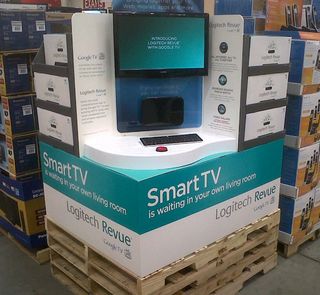
Costco-GoogleTV I'm a big fan of Costco stores and over the past few months they have added more broadband enabled devices to their shelves, aside from just their large selection of TVs. On a recent trip to my local Costco, a new product display for the Logitech Revue powered by Google TV had been setup, allowing shoppers to test out the device. Of all the broadband enabled devices Costco sells, the Logitech Revue is the only one I have seen where consumers can try out the device in the store.

The Costco store was crowded when I went so I hung around the Revue demo area and spent time asking people a lot of questions about the unit when they were using it. Of the few dozen people I spoke with, almost all of them had no idea what the Revue does. Many said it puts the web on your TV, but they didn't know what that really meant, what kind of content it enables or how they go about using it. The Costco person who manages the electronics area didn't know much about the device and could not answer any questions and while a lot of people came by to play with it, not a single person I spoke with bought the device during their visit.

The biggest thing I heard from the consumers I spoke with is that they don't know what the value of the device and the Google TV platform is. Many asked why they would need to put the Internet on their TV when they have a computer for that already. Some asked what kind of programs the device comes with and many commented that they don't understand what exactly it gets them besides a browser on a TV and a keyboard. One person commented that the wording on the packaging of the device says "if you can think it, you can watch it", yet as we all know, to date, every major network has blocked their content from the device. Even today, the landing page for the Revue on Logitech's website says "you can watch what you want, wherever it comes from". Talk about setting wrong expectations with customers.

I don't believe a stand alone product like the Logitech Revue is needed in the market because the only way Google can have success with their platform is to get it embedded into TVs, which we're already starting to see them do. But if Logitech does want to try and sell a lot of Revue units, a store like Costco is not the place to try and push them as potential customers have a lot of questions and need a lot of hand-holding. The success or failure of Logitech's Revue unit really won't have much of an impact on Google as Google TV is long term play for the company, by my estimates five plus years.

Amazon Leaks Details About Their Netflix-Like Movie Subscription Service, Free For Prime Members

Not much news usually takes place on the weekend, but on Saturday afternoon, Engadget.com posted multiple screenshots of an Amazon page offering free unlimited streaming of movies and TV shows. Amazon wording on the page said, "Your Amazon Prime membership now includes unlimited, commerical-free instant streaming of 5,000 movies and TV shows at no additional cost". Shortly after it was reported, the Amazon user who found the page could no longer access it, but multiple screenshots at Engadget.com clearly shows the details and is the best proof yet that Amazon is getting ready to challenge Netflix with a subscription based streaming service.

Offering free streaming to Amazon Prime members would be a really interesting way for Amazon to enter the content subscription market, which was something the WSJ first reported rumors about in August of last year. For $79 a year, consumers can sign up for Amazon Prime giving them free two-day shipping from items on Amazon.com. Free shipping is good to begin with, but offering free unlimited streaming of movies and TV shows on top of that would make Prime extremely valuable and would drive a lot of people to sign up for it. At $79 a year it would be cheaper than Netflix and while Amazon would only have about 25% of the inventory Netflix has today, if they do in fact launch with 5,000 titles, one would expect Amazon to build up their inventory pretty quickly.

While I would not expect Amazon to make money from the streaming service initially, they could make up for that with the physical goods people will end up buying because they have the Prime membership. Amazon has a big advantage over Netflix of being able to allow their core business drive the growth of their streaming service without having to worry about how many members they sign up each quarter, which is exactly what Netflix is so dependant on.

Amazon's core business could essentially subsidize the streaming service for quite some time, allowing Amazon to spend money on licensing more content and quickly expanding their inventory. In the last two years, Netflix has added about 8,000 titles at any given time to their watch now catalog and today, it is estimated they have around 20,000 movies and TV shows. So if Amazon launches with 25% of Netflix's inventory on day one, that's not a bad start.

The other big advantage Amazon has over Netflix is that they also sell and rent digital copies of movies. Adding a subscription service now gives Amazon three different ways to get in front of the consumer and multiple ways to generate revenue. Netlfix does have a huge head start when it comes to the number of devices they are on, but Amazon can catch up and since they already have their Amazon Video On Demand platform working on devices like the Roku and TiVo, they aren't starting from scratch.

The fact Amazon also sells so many of these broadband enabled devices from their website also allows them to push the distribution of devices and they could even potentially subsidize the cost of them if they wanted. Amazon could make it so that anyone who buys a Prime membership also gets a free streaming device of some kind. Considering that the Roku HD only costs $59.99 retail, it's not unrealistic to think that Amazon would give Prime members some kind of incentive to consume more movies and TV shows. And just imagine the disruption Amazon would create in the market if they released a Kindle capable of playing video?

Now that details of the offering have leaked out, I'm sure we'll hear more from Amazon on this pretty soon. In the mean time, the landscape for buying, renting and subscribing to TVs and movies continues to get crowded with Amazon getting ready to join Netflix, Hulu, Apple (iTunes), VUDU, Microsoft (Zune Video), Sony (PlayStation Network), BestBuy (CinemaNow.com), Blockbuster, Intel and others who are all competing for the living room.

Streaming Media East Program Done, See The Agenda – Now Placing Speakers

I've been quiet on the blog lately as I have been working hard on the Streaming Media East conference agenda. I am happy to say that the Advance Program for the show is now complete, including the new dedicated track on the subject of HTML5 video. You can view the entire agenda here.

I am going to begin placing speakers today and if you want to recommend a speaker for the program, please email me the details. I will begin looking through all of the speaker submissions this weekend that I have already received.

I'm also excited to announce that we have some great moderators lined up to help lead the discussions at the show including Peter Kafka from All Things Digital, Greg Sandoval from CNET, David Kaplan from PaidContent.org, Dan Frommer from The Business Insider, Ashkan Karbasfrooshan from WatchMojo.com, Andy Plesser from beet.tv, Jonathan Hurd from Altman Vilandrie & Company and others.

Here is a list of the session titles:

  • Device Demos: Boxee, Western Digital, Logitech
  • Winning With Ad Buyers: What Makes Your Video Inventory Valuable?
  • How-To: Technical Set-Up of Live Streaming Production
  • Online Video Platforms: Simplifying the Content Publishing Workflow
  • Strategies for Preparing Your Video for Tablets and Mobile Devices
  • Winners and Losers in Over the Top Video
  • Enterprise Video: Phase Two
  • Device Demos: Apple, Roku, Sony, Western Digital
  • Transcoding: In-House Or In The Cloud?
  • How Streaming Video Is Changing The Television Landscape
  • Challenges, Opportunities, and Best Practices of Enterprise Social Video
  • Internet-Enabled TVs And Their Content Platforms
  • How Video News has been Transformed by the Web and Mobile
  • The Future of Video In Education
  • Cutting The Cord On TV: Will Online Video Really Lead To Cable's Demise?
  • Cost Savings From Enterprise Streaming: How The Conversation Has Changed
  • The Potential For Monetizing Over-The-Top Video
  • If Audience Buying is the Future, Why is Video Still Sold by the View?
  • How To: Enterprise Video Case Studies
  • The Impact Of Broadband-Enabled TVs, Gaming Consoles, And Devices
  • Open Distribution vs. Premium Monetization: Striking the Right Balance
  • Building A Content Brand Using Social Media
  • Monetization And Video Advertising Formats
  • How To: Encoding For Adaptive Streaming
  • Friend or Foe? MSOs, ISPs, and the Impact of TV Everywhere
  • How Old Media Is Embracing Online Video and New Media

And here are the HTML5 video based sessions:

  • The Business Case for HTML5 Video
  • How To: Encoding Video for iDevices
  • HTML5 And Web Video Standards
  • How To: Building an HTML5 Video Player
  • How Flash and HTML5 Can Work Together
  • Debunking HTML5 Video Myths: A Guide for Video Publishers
  • How To: Encoding Video For HTML5
  • HTML5, the iPad, and the iPhone: What You Need to Know
  • Demos: New Products For Encoding and Delivering HTML5-Compatible Video

In addition to the new HTML5 video track, we're also going to have a new device pavilion on the show floor where attendees will be able to get hands on with more than two dozen broadband enabled devices. I'll give more details on that soon. In the mean time, online registration is now live and you can get a free Roku HD if you register early.

Moderating Webinar Today: “Delivering Live Events with the Adobe Flash Platform”

Today at 2pm ET I'll be moderating a webinar with Adobe and Juniper Networks on the topic of "Delivering Scalable On-Demand and Live Events with the Adobe Flash Platform". In this webinar you will learn how you can achieve superior media delivery with the Adobe Flash Platform; discover how Juniper's Media Flow caching and delivery dramatically scales video at TV like quality, across all formats and devices; and more specifically you will learn how Juniper's Media Flow platform dramatically enhances delivery of Flash Media Server.

After the presentations we'll have a live Q&A session so bring your questions and register here for the free webinar.