Best Practices For Managing Adaptive Bitrate Resolution And Encoding Profiles

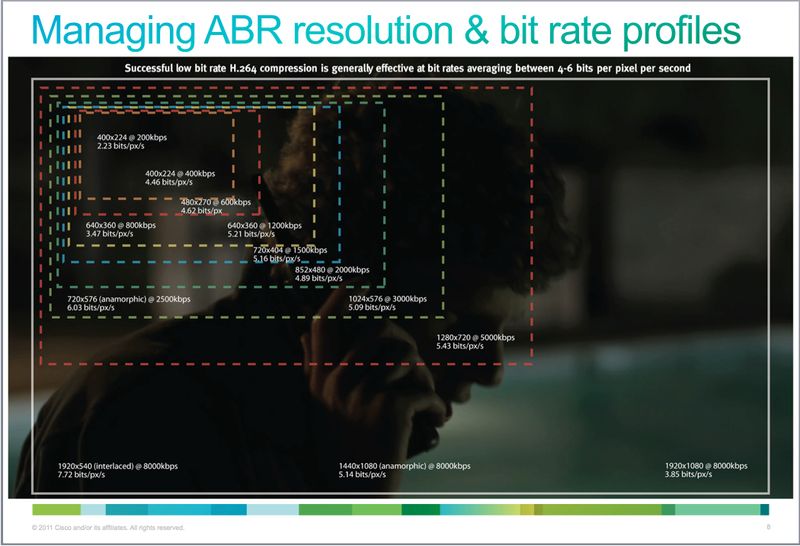
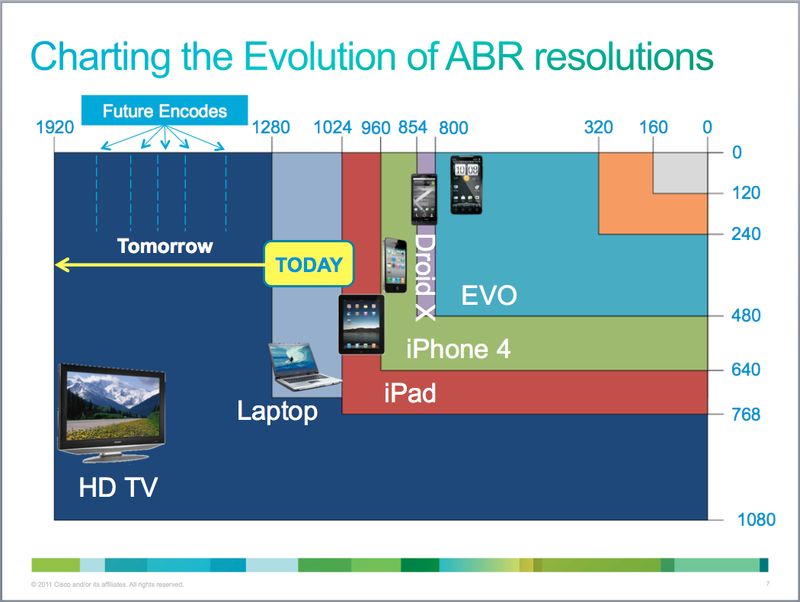
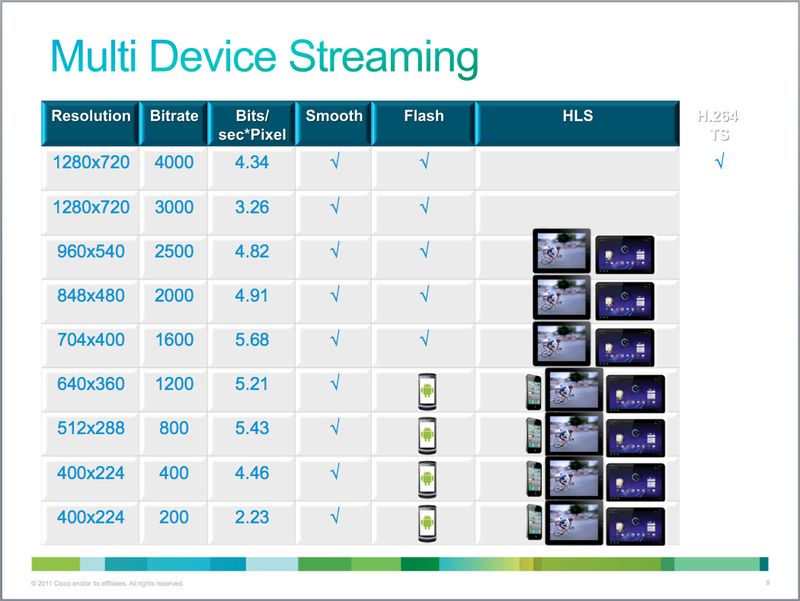
Two weeks ago, during a StreamingMedia.com webinar I moderated on the topic of Adaptive Streaming & HTTP Delivery, Cisco gave out some great details on managing adaptive bitrate resolution and encoding profiles. While I've included three of their slides below, the first slide really gives a great visual on what the aspect ratio or size of the video window should be based on the encoding bitrate and bits per pixel.

You can download all of Cisco's slides from the webinar as well as the slides from all the other presenters here.

1
2
3

Also check out these posts on the subject, "Comparing Adaptive HTTP Streaming Technology From Apple, Microsoft and Adobe" and "New Data Released On The Performance Of Akamai's HTTP-Based Adaptive Streaming Technology."

Sponsored by

All Signs Point To Limelight Networks In Discussions To Be Acquired

Over the last few weeks, numerous signs in the market point to Limelight Networks trying to finalize a deal to be acquired, or raise a large round of funding. While I don't have all the specifics, over the weekend I was able to confirm via a third party that Goldman Sachs, the largest shareholder in Limelight Networks, is working on a deal with Limelight that will drastically change the company and I expect it is an acquisition.

Within the past 2-3 weeks, Limelight has basically stopped talking to Wall Street and the company has yet to say when they plan to announce earnings. The company must put out earnings by August 9th, but as of now, still has not said when they plan to release. Limelight has been stalling as long as they can and while I'm hearing that a deal for the company is not done and no letter of intent has been signed, it sounds as if Limelight is close to a deal.

There is speculation that the company may raise another round of funding instead of being acquired, but my bet is on an acquisition. If Limelight reports good second quarter earnings and increases the percentage of their revenue that comes from value add services, it would not be a stretch for them to be able to get a high evaluation on that revenue. Companies in the industry that offer SaaS based platforms, like SalesForce.com, are currently valued at about 10x revenue. Last quarter, Limelight said 38% of their revenue was from value add, so if that number continues to grow, they could raise another large round based on that segment of their business.

If they raised enough money, they could acquired a leading company in the Data Management Platforms (DMP) market or a company that offers an end-to-end platform for managing data-driven digital advertising, which is essentially a targeting audience management platform. There are a handful of companies in the space doing this (Turn, Collective Media, eXelate, BlueKai) and some are on track to do more than $100M in revenue this year.  A platform like this would fit nicely into Limelight's offering and would add a lot of top line revenue to the company overnight.

While it's not unreasonable to think the company could raise another round, my bet is on Limelight getting acquired. Of course there have been rumors for years that both Limelight Networks and Akamai would be acquired by Google, Facebook, IBM and a whole host of other players, but most of the companies like those mentioned don't make any sense. What does make sense is for Verizon, Microsoft or AT&T to acquire Limelight for the following reasons.

Verizon recently launched their new Verizon Digital Media Services (VDMS) business and is focusing on the entire ecosystem for creating, ingesting, storing, managing, protecting, monetizing, delivering and tracking of content. The company recently said they don't plan to have the delivery component of their offering ready to go until Q2 of 2012, so acquiring Limelight would bring them to market much faster, not to mention give them access to a large library of content owners. Verizon would also get a whole host of technology around advertising and content management that their solution is currently missing. They could also take some of Limelight's service based platforms and re-position them within multiple segments of Verizon's business from wireless to enterprise. On many levels, Verizon would be one of the best fits for Limelight's current product offering.

While I don't think AT&T is involved in the discussions, the company could decide to stop spending the time and money to build up their offerings and instead, acquire Limelight and have what they need overnight. I don't think this will happen, but it's always possible. The company has changed their go-to-market strategy as of late and it's always possible they could take an even bigger approach. As for Microsoft, I'm limited in what I can say as I know some details that can't be made public, but I can reveal that Microsoft has been in discussions recently with Limelight about possibly licensing a newer version of the technology that Microsoft licensed from Limelight many years ago. And based on some other stuff Microsoft is working on, it might just make more sense for them to spend the money to acquire Limelight if they are going to have to pay for a license any way.

Of course some are going to suggest that these companies should just acquire Akamai instead since Akamai's has five times the revenue Limelight has. While that is always possible, Limelight could probably be acquired for around $700M and even with Akamai's share price being at about an 18-month low, anyone acquiring Akamai would have to pay in the billions for Akamai who currently has a $4.5B market cap. Limelight is much, much cheaper to acquire and their share price is also getting close to their 52-week low, so it's a good time for any potential acquirer. Many years ago AT&T offered $8 a share to acquire Limelight, but I was told Goldman turned it down. I get the sense that in today's market, Goldman would be more open to selling the company.

Last Tuesday was the biggest day for the acquisition rumor and Limelight's stock closed up $0.56 to $5 a share on more than 4M shares traded. Limelight has not had more than 4M shares traded in the company in more than three months. That alone is not evidence that something is about to take place, but clearly I'm not the only one hearing some details. I don't expect to hear Limelight announce anything relating to this on their Q2 earnings call, but I do think news will break in the next few weeks and we'll know for sure what they are up to.

Note: Even though I know Limelight would not comment, I did ask them for a response and was told, "Limelight does not comment on rumors or speculation."

Updated Aug. 2nd: Limelight says they will report earnings on August 8th

CDN Provider EdgeCast Says They Now Carry 4% Of All Worldwide Internet Traffic

Content delivery network company EdgeCast announced yesterday that they are now powering more than 3,000 customers, serving more than 1.5 billion objects per hour and carry approximately 4% of all worldwide Internet traffic. I'm not sure how exactly these percentages are measured, but the last time I heard Akamai use the same metrics, Akamai said they were serving about 25% of the total Internet traffic.

Of course comparing Akamai to EdgeCast is not really fair since Akamai is doing over $1B in annual revenue and EdgeCast is slated to do between $50-$100M this year. However, EdgeCast is doing very well in the market when it comes to targeting mid-sized customers and carriers who license their CDN software. The company has grown very nicely in exactly three years and to date, and has only raised under $20M in funding. EdgeCast became cash flow positive in 2009 and confirmed for me today that they are still profitable.

I like to think of EdgeCast as the current "Speedera" of the industry and those of you who remember Speedera from many years ago will recall how the company was known for having great performance, great support and really affordable pricing.

Related Posts:

AT&T Building Out Their Content Delivery Network Using EdgeCast's Software

Telus Enters CDN Space With An Exclusive Reseller Deal With EdgeCast

EdgeCast On A Roll, Launches In Latin America With Samba Tech

Deutsche Telekom Enters The CDN Market, Partners With EdgeCast

NaviSite To Resell CDN Services From EdgeCast

Google Plans To Enter The CDN Space With New Website Delivery Service

This morning, Google announced via their Google code blog that the company plans to offer a new product called Page Speed Service, which will help customers load and deliver their web pages faster. Google's Page Speed Service fetches content from the customer's server, rewrites their pages by applying web performance best practices, and serves them to end users via Google's servers across the globe. Google says while its Page Speed Service is currently being offered to a "limited set of webmasters free of charge", the company plans to charge for the service and says "pricing will be competitive". There are no details on when the service will launch, but I'm hearing it will be sometime in the fourth quarter.

How this will impact traditional CDNs in the market is too early to know without more details from Google on what exactly the service will support, but Akamai, Limelight, Level 3 and Cotendo in particular can't be too happy to see this. Google's service might not support content that's generated dynamically and we don't know what features and functionality will be missing, but clearly when Google plans to offer a service like this, they have the ability to disrupt the market.

I will update this post with more details when I get them.

Logitech Slashes Pricing On Google TV Box To $99, But More Content Is Needed

Logitech_revue_google_tv This morning, Logitech announced their first quarter results and in addition to their CEO leaving, the company said they were cutting the price of their Revue unit to $99, down from the original $249 price tag. (As of the writing of this post, Logitech's website is still selling the Revue for $249 when you add it to your cart.) While Logitech has never said exactly how many units they have sold to date, the company did say that sales for the device totaled $5M in Q1 of this year, which would mean about 15,000 units sold in that quarter. Someone from the company also told me that they sold less than 40,000 units last year, so if you combine Q4, Q1 and Q2 sales, it looks as if the company has sold around 60,000 units to date.

While cutting the price of the Revue down to $99 now makes the device affordable, there still is not enough content available through the Google TV platform to make consumers really need the box. Google hasn't added a lot of new content to the Google TV platform since it launched and until they do, there is not a lot of incentive for consumers to use it. Currently, you can get Netflix, Amazon Instant Video (not Prime streaming), NHL, HBO Go and YouTube, but that's about it for mainstream content. Even the Google TV website doesn't really highlight what content is available for the platform, you have to go under the "spotlight" section to find a list.

If Google were to buy Hulu and start offering a YouTube Premium subscription service, that would make their Google TV platform a lot more valuable and bring some much needed content to the system. But until Google does something to bring a much larger selection of content to the platform, it's going to be very hard for Google to get a lot of traction in the market and Logitech is not going to sell many Revue units, even with the price being reduced to $99.

The real play for Google TV and the future of the platform is embedding it into TVs, something Google is well aware of and is working hard at. When that happens and more TVs on the market have Google TV built it, Logitech's Revue unit will really no longer be needed.

Related Posts:

New Logitech and Google TV Product Display Shows Up At Costco, Still A Hard Sell

Google And I Agree On One Thing: TV Is Not Dead

Webinar 2pm ET: How Service Providers Can Optimize Video Delivery With Caching

As Internet video traffic continues to grow, service providers are doing what they can to keep pace-but they face a variety of challenges, including dealing with network congestion, having less control over their networks, and striking the right balance between improving end-user quality of experience and reducing infrastructure and bandwidth costs. One way service providers can solve many of these problems is by deploying intelligent, transparent content caches throughout their networks.

On Thursday at 2pm ET,  I will be moderating a live webinar with presenters from BTI Systems, Blue Coat Systems and Verivue focusing on how transparent caching works and the benefits it providers to
service providers. Attendees will learn how transparent caching solutions can:

  • improve subscribers’ experience
  • deliver rich content like video & contain network costs
  • create new business models for network operators
  • improve response times and alleviate bandwidth bottlenecks
  • reduce peering costs
  • scale economically to thousands or even millions of subscribers

Register here and bring your questions for the presenters for the live Q&A portion of the event.

Learn more about this topic from these posts:

An Overview Of Transparent Caching and Its Role In The CDN Market

A Summary Of Transparent Caching Architectures

Updated List Of Vendors In The Content Delivery Ecosystem

Here’s How Vendors Can Speak At Our Streaming Media Shows

I get a lot of emails from vendors asking to speak at our Streaming Media East/west conferences and I appreciate so many companies wanting to speak and taking an interest in our show. Unfortunately, I simply can’t fit everyone into the program with all the requests I get so with that in mind, here is how I select which vendors get to speak and how the selection process works.

I have about 120 speaking/presentation spots at each show and usually get more than 500 speaking requests. About 75% of all the speaking spots go to customers, which I classify as end-users who buy and deploy online video services as well as content owners. Since there are so few spots for vendors, I pick vendors who help bring their customers to speak at the show. The way we get so many top notch content owners and enterprise users to speak at the show is with vendor’s help. They invite customers, introduce us to them and try to bring them to speak on a particular topic.

So if you are a vendor and want to speak at the show, you have to submit your speaking request with a customer. For now, all you have to do is send me an email and list a few potential customer (company) names. I don’t need individual speaker names, unless you have them, and you don’t have to confirm that any of the companies are available yet, just offer some suggestions.

Once I have that I will cross check it against companies who have already asked to speak or are confirmed speakers and will look to see what sessions these companies may fit into. Once I figure that out, we’ll try and confirm one of them and it they agree to speak, then your company gets a speaking spot as well, usually on a different session that the customer is on.

That’s the process I have been using for 12 years now to keep it as fair as I know how. We don’t sell speaking spots with the East and West shows and companies can’t buy their way in via sponsorship. I know that’s not how other shows do it, but it’s also one of the reasons the StreamingMedia.com shows has been around for 15 years. Think of all of the other online video related shows that have come and gone over the past ten years because they gave all the speaking spots to the sponsors and never focused on creating value to attendees.

So that’s the selection process  for vendors and if you have questions, ideas or suggestions, I’m always reachable via email and phone (917-523-4562) and I am happy to speak to you at any time.