Smart Phones Made Up 59% of All Video Consumer Devices Sold in 2012

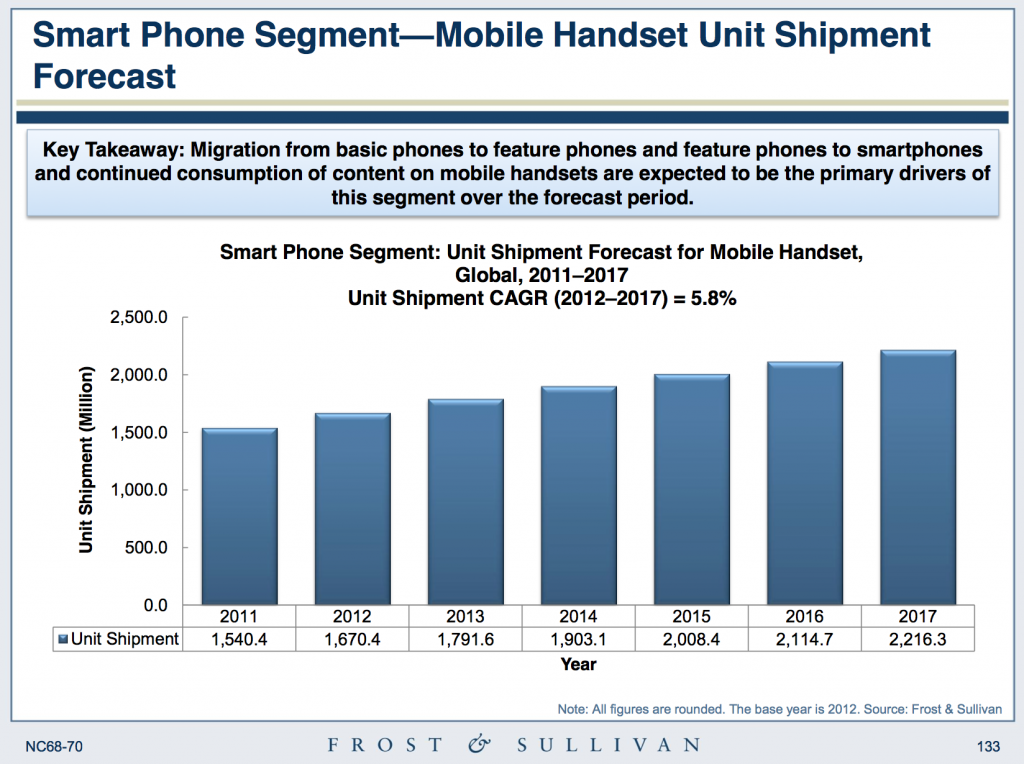
Screen Shot 2013-07-11 at 11.02.26 AMOf all the video device classes covered in our latest Frost & Sullivan report on the size of the Consumer Video Devices Market, smart phones arguably represent both the most mature market in terms of penetration and the most energetic market in terms of ongoing disruption and expected growth rates. In fact, of the more than 1 billion consumer video devices sold globally last year, smart phones made up 59% of the market. Migration from basic phones to feature phones and feature phones to smartphones and continued consumption of content on mobile handsets are expected to be the primary drivers of this segment over the forecast period of the report.

The total mobile handset market is expected to be mostly static as the high level of saturation of the market limits new sales predominantly to unit replacements and upgrades. That said, sales of both smart and feature phones are expected to grow as they continue to account for a growing percentage of mobile handset sales. In terms of units sold, smart phones are expected to surpass feature phones in 2014, although feature phone sales will still grow over the entire forecast period.

Greater competition among device manufacturers and service providers has led device manufacturers to reduce handset prices with the ASP for smart phones forecast to decline by a CAGR of 8.5 percent over the forecast period. Continued carrier subsidies and dumping of older models at fire sale prices is expected to drive affordability and reach of smartphones.

Copies of the report are available to any customer who has a subscription to Frost’s Digital Media research service and anyone interested in getting a subscription can contact me for more details. Also, while many research analysts at other firms won’t talk to someone unless they are a customer of that firm, I have and always will talk to any company who is interested in getting more details on any aspect of the video, streaming and content ecosystem. You don’t have to be a customer of Frost & Sullivan for me to take your call and do a briefing with you, so call anytime.

Sponsored by

Presentation: How Comcast Built An Open Source CDN (video)

At the Content Delivery Summit in May, we had a lot of great presentations from MSOs and carriers on their build out of content delivery services. One of the more interesting ones was from Comcast, who showed how they built out their CDN using mostly open source technologies.

To optimize delivery of its content to their customers, Comcast designed and deployed a large CDN based on open source tools and common off-the-shelf hardware. Comcast detailed the challenges they faced, the options they considered and discussed the good and bad of using open source technologies. Watch the video below to learn about Comcast’s real life experiences operating their CDN and how they handle support issues when using open source platforms. You can also download the slides from the presentation here.


Latest Backbone Data: 50% Of Internet Traffic Comes From Only 35 Sites/Services (video)

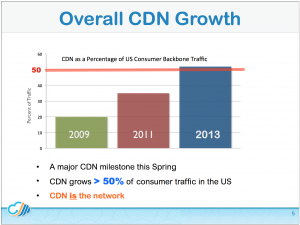
Screen Shot 2013-07-07 at 3.17.17 PMAt the Content Delivery Summit in May, we had a lot of information shared by those who collect data on the type and volume of content being distributed over the Internet. One of these companies, DeepField, presented their latest findings on the massive ongoing changes in content distribution. Check out their video presentation below for details on overall CDN traffic growth and market share, a list of content services driving the most volume and trends they are seeing across backbone networks. You can also download their slides from the presentation here.


Many Mainstream Media Outlets Still Clueless About What Aereo’s Service Supports

There are a lot of news stories that come out each week about Aereo and nearly every day, Google Alerts notifies me of yet another mainstream outlet doing a story on the company or mentioning their service. While I get that some are excited by Aereo, I’m still amazed at how many people write about the service, having no clue what it does or does not support. The latest is a story by USA Today, which talks about cord cutting options, and mentions that Aereo “lets you watch regular TV on any device“. Really, any device?

For a news outlet like USA Today, let alone one that is doing a four-part series on cord cutting, you’d think they would get the basics right. Clearly they haven’t even tried the Aereo service, let alone looked at their website to see what it supports. Aereo has no support for Android devices, is not on game consoles, smart TVs, Blu-ray players or any dedicated streaming box outside of the Roku. And even on the Roku, Aereo is a “private channel” and isn’t promoted by Roku. And while Aereo lists support for Apple TV, they have no app on the box, it only works if you have an iPhone or iPad and use Airplay. The reality is that Aereo does not have a single native app on any device, outside of the iPhone and iPad. But these facts don’t stop USA Today from saying it works on “any device“.

In another article I read this week the author said, “Aereo allows subscribers to watch broadcast TV on Internet-connected devices”. Could you be any more generic? That makes it sound like Aereo is available everywhere. Is it too much trouble to have to actually research the topic you are writing about, let alone use the service? Sloppy reporting by those who are so quick and eager to write about Aereo because it’s a “hot” topic and company name now, rather than wanting to write someone that’s actually accurate and useful.

I expect more from someone like USA Today. Maybe I shouldn’t, but they are a mainstream outlet, they reach a lot of people and they have the responsibility to educate them properly. But clearly they aren’t worried about the content they are producing. They are currently doing a four-part series on cord cutting, with videos, and it’s terrible. The first video tells you to get an antenna so you can get channels over-the-air, and then shows devices from Roku, Apple TV and Netgear. None of which support antennas, something they probably don’t even know. They don’t say to plug the antenna into any of the boxes, but they talk about antennas and show streaming boxes all in one segment. Poorly scripted and poorly produced. Just another media outlet trying to jump into reporting on a hot topic, even though it’s clear thay have ZERO experience with the subject the are reporting on. But worse yet, they are doing a four-part series on the topic, trying to convince readers they know what they are talking about. How can you possibly give recommendations to readers on what products they can use to replace cable TV when you yourself don’t use the services you are talking about or know the details of how they work!?

Sadly, USA Today is not alone in their poor reporting. The AP did a story on Aereo last month saying the service, “allows computers and all mobile devices to receive local channels”. All mobile devices? No. And which “channels” specifically? They don’t say. The AP piece also went on to say that, “federal courts have ruled against claims that Aereo’s service constitutes copyright infringement, ” saying “Aereo’s service has now been validated”. The courts have not “validated” the service at all. So far, all the courts have denied is the broadcasters request for a preliminary injunction against Aereo. Whether or not Aereo’s service is legal has not yet been determined and will still have to be played out in court.

I also see many media outlets mention that Aereo has a “large” selection of channels, but very few ever mention what “large” means. Of the 32 channels Aereo has today for those in the NYC area, 10 of them are Spanish and Asian language channels. Of the 22 remaining, half of them I guarantee most have never heard of. So are less than a dozen channels, with content anyone actually cares about, really considered a “large” selection? Absolutely not.

I wish there was a rule that no member of the media could write about a consumer service, without actually using the service themselves and making the effort to get the facts right. No wonder why there is this misconception out in the market that Aereo will kill off cable TV. Many who are writing about the service make it sound like Aereo has all the content you could ever want, on any device you want, at any time, for only $8 a month. That false notion couldn’t be further from the truth. But why bother with facts.

More Than 35M Video Game Consoles Expected To Be Sold in 2013, 60% Used For OTT Video

Screen Shot 2013-07-08 at 9.13.58 PMWe’ve just released our latest Frost & Sullivan report on the size of the Consumer Video Devices Market, which details the market drivers, restraints to market growth, product and pricing trends, competitive landscape, and market forecasts and trend analysis broken out by region of the world for the next five years. Our report details why we believe that the video game console market will grow at a CAGR of 16.8% over the next five years and that more than 35M video game consoles are expected to be sold globally this year.

2012 saw a slump in sales as the Wii U disappointed and buyers waited for next-gen consoles from Sony and Microsoft, but the market is expected to recover to stronger growth levels on continued demand for the gaming and OTT experience. Gaming revenues from the sales of games, accessories and related goods have shown consistent declines over the last two years under the combined onslaught of rise in social and cloud gaming, and diminished consumer spending in response to economic certainty. It is widely believed that these symptoms portend a dire future for the console segment, however Frost & Sullivan does not believe this is the case.

Microsoft, Nintendo and Sony are all reinventing their current generation consoles in 2012-2013 with the goal to provide a multi-screen immersive gaming experience while also competing effectively on OTT services. As price margins on the hardware itself continue to fall, vendors are also devising complementary strategies to drive total revenue. As consoles are increasingly used for OTT video experience, support for a range of OTT apps – free, online video subscription and Pay TV companions – is increasingly critical.

Copies of the report are available to any customer who has a subscription to Frost’s Digital Media research service and anyone interested in getting a subscription can contact me for more details. Also, while many research analysts at other firms won’t talk to someone unless they are a customer of that firm, I have and always will talk to any company who is interested in getting more details on any aspect of the video, streaming and content ecosystem. You don’t have to be a customer of Frost & Sullivan for me to take your call and do a briefing with you, so call anytime.

Encoding for Multiscreen Delivery: Presentation Available For Download

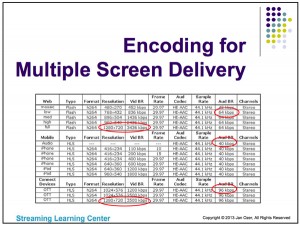
jan-0zerDuring his three-hour workshop at the Streaming Media East show in May, Jan Ozer did his usual great job of presenting best practices and tips on the topic of, “Encoding for Multiscreen Delivery“. While we don’t video tape the workshops, we do make the presentations available for download. Jan’s presentation of 79 slides will teach you how to create a set of video files that will play on all devices, from smartphones to computers and OTT devices. It also outlines:

  • key concepts like protocol and container format and technologies like HTTP Live Streaming, DASH, and Dynamic Streaming
  • technical overview of the H.264 specification to identify those configuration parameters that impact quality and those that don’t, and how they affect playback compatibility
  • technical requirements for single and multiple file delivery to Flash, HTML5, iOS, Android, Windows Phones, Windows 8, and the Apple TV, Boxee, Roku, and other OTT devices
  • learn the current encoding and delivery practices used by high-profile broadcast and corporate sites to help refine your technology decisions

You can also pick up a copy of Jan’s new book on this topic here.

Netflix Presentation Shows a Brief History of Their Streaming Technology (video)

Netflix started streaming in 2007 with an Internet Explorer plugin that hosted Windows Media Player. Today, there are more than 80 million active Netflix devices including smartphones, tablets, game consoles, and connected TV’s. At the Streaming Media East show in May, David Ronca, Manager of Encoding Tools at Netflix, walked through the technical history of the Netflix streaming service, looking at some of the key engineering decisions, codec and packaging, and a few key hacks. Some of topics he covered included Netflix’s first adaptive streaming client, their most unusual project, the BD-Live adaptive streaming client, and how Netflix developed their iPad app in just 60 days. You can download David’s slides from the presentation here.