Industry Executives Say QoS And Bandwidth Limitations Are Leading Technical Obstacle To OTT Adoption

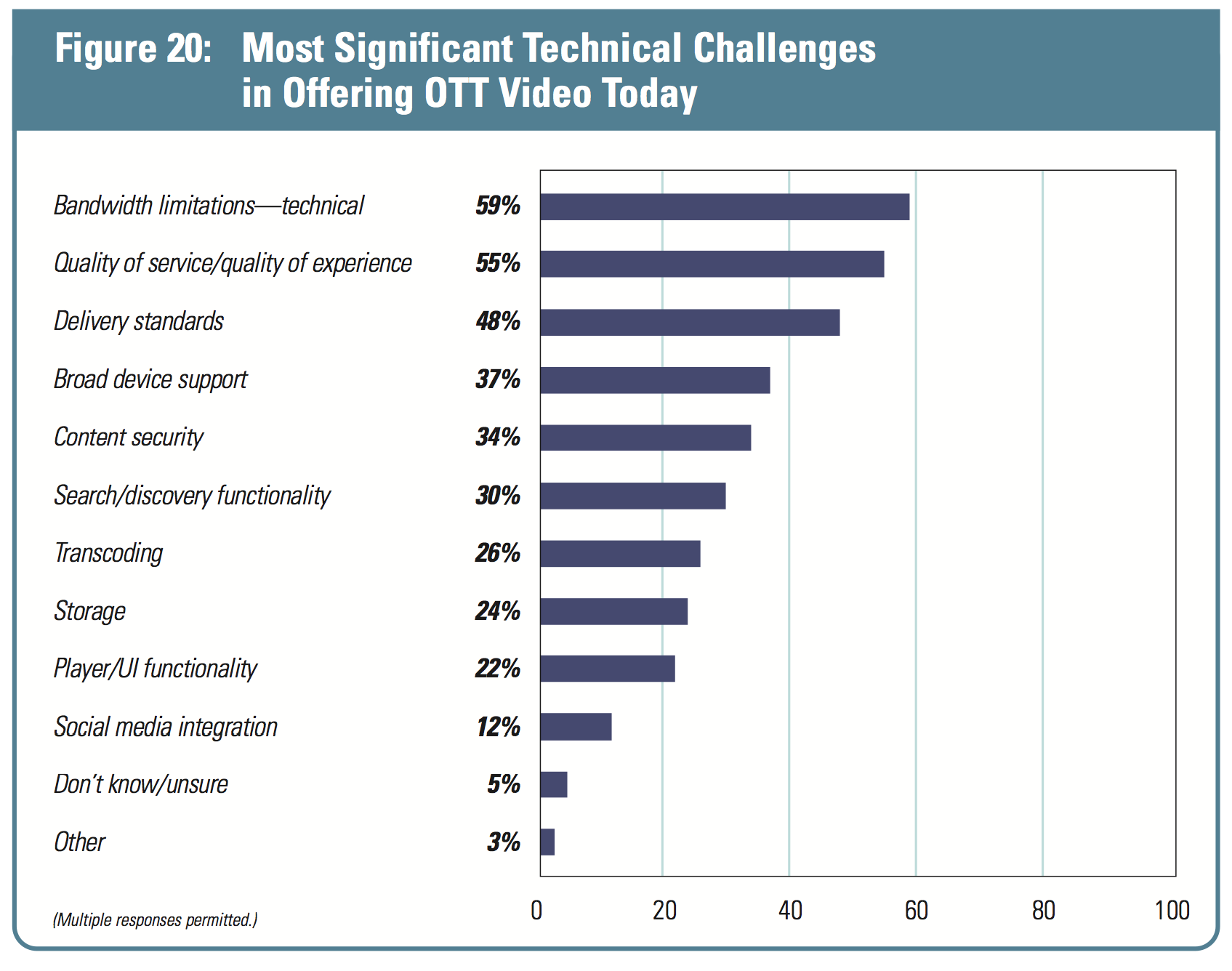
A majority of executives, 59%, say bandwidth limitations are currently the leading technical obstacle to OTT adoption. Quality of service and quality of experience—which may also be related to bandwidth issues—is also seen as an obstacle by 55%. “OTT services need to be able to consistently provide content that is high quality, doesn’t cut out, break up, or freeze,” says one respondent. “Consumers want to be able to watch content without these distractions that can ruin the entertainment experience.”

Screen Shot 2013-09-02 at 10.02.34 PMTo a large degree, this may tie in with bandwidth capabilities as far as achieving video quality, but also extends to the quality of the viewer’s experience as well. Quality of experience (or quality of mobility) also addresses the personalization, brand and user-interface experiences of the video delivery, in tune with consumer preferences by the devices they use.

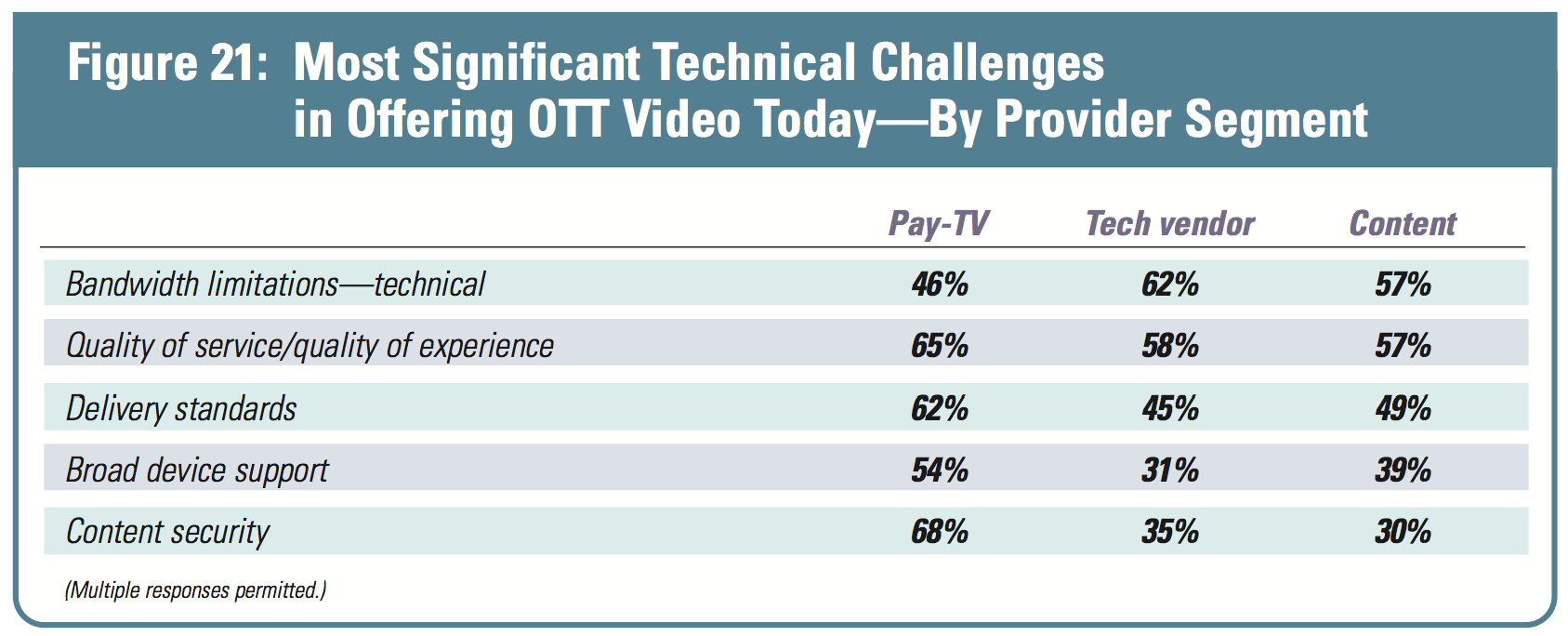
When looking across the primary industry segments, pay-TV operators tend to downplay the impact of bandwidth as a technical limitation. Many offer their own broadband networks, and thus are simply able to piggyback OTT offerings directly through this channel. Of most concern to pay-TV operators is being able to technically manage content security. Ironically, only 30% of content providers surveyed are experiencing any technical limitations in terms of content security. At the origination end of content, there may be less concern or involvement with downstream security requirements.

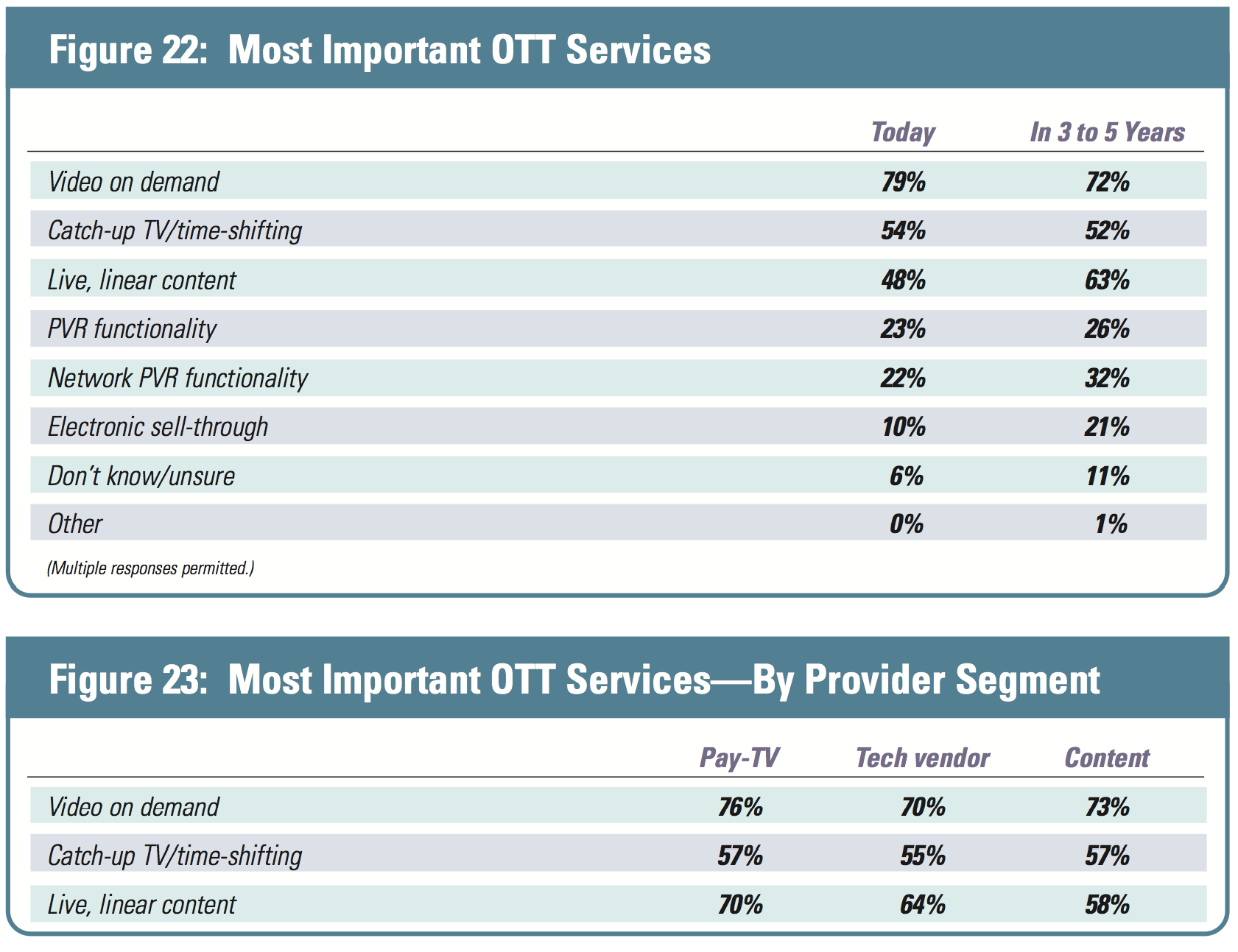
Screen Shot 2013-09-02 at 10.02.43 PMOTT services can be delivered in a linear fashion, meaning the live streaming of channels, or video on demand, in which users can download and view libraries of videos and other content. When asked about the types of services that are most important to offer for OTT video delivery, most respondents see the potential in video on demand (VoD). VoD leads the list by a wide margin, cited by 79% of respondents. In addition, looking a few years down the road, live, linear content—a metered approach measured in minutes per day—will increase in importance, rising from 48% to 63%. A majority, 54%, also see it as a market for those seeking catch-up TV and time-shifting. The view that video on demand is the sweet spot of OTT is shared across the major industry segments covered in the survey.

Screen Shot 2013-09-02 at 10.07.30 PMFull results from the report, entitled “OTT Video: Coming to a Paid Channel Near You” is available as a free download from the StreamingMedia.com website.

Sponsored by

Here’s How Much Broadcasters Can Save By Implementing Media Asset Management Into Their Video Workflow

An average broadcaster today has to balance two contrasting realities to make its business work profitably. One is transitioning to digital, tapeless, file-based and IP workflows – simultaneously or in lock-step with each other – and the other is to manage the business side and make content available for a variety of screens, device types, and networks, on-demand and anywhere. These two imperatives are seemingly disparate, yet highly intertwined. Most often, restrained by limited budget and resources, companies focus on specific point solutions that help them take care of immediate needs, forcing them to scramble to build and/or buy components sub-optimally just to keep their heads above water.

However, in doing so, these companies, though taking care of a tactical challenge, actually add more complexity and miss the strategic business imperative. Such siloed deployments aimed more on certain aspects of the underlying production workflow, are often isolated from the larger organizational perspective, inevitably hampering collaboration and interoperability between different functions, systems, and knowledge workers.This leads to longer cycle times, resource redundancy and effort duplication around the workflow, and sub-optimal investments in unviable products as well as processes – something that a media company can ill-afford.

Many broadcasting companies have implemented media asset management (MAM) to manage the content assets within a highly collaborative production workflow, and facilitate content discovery, production and repurposing, and, in so doing have experienced tangible benefits. MAM can eliminate redundancies as well as ensure higher level of quality check (QC) at every step of the process. Importantly, it can help achieve cost savings and efficiencies by empowering collaboration, cycle time acceleration, intelligent discovery while reducing redundancies, and the cost of lost or misplaced work among others.

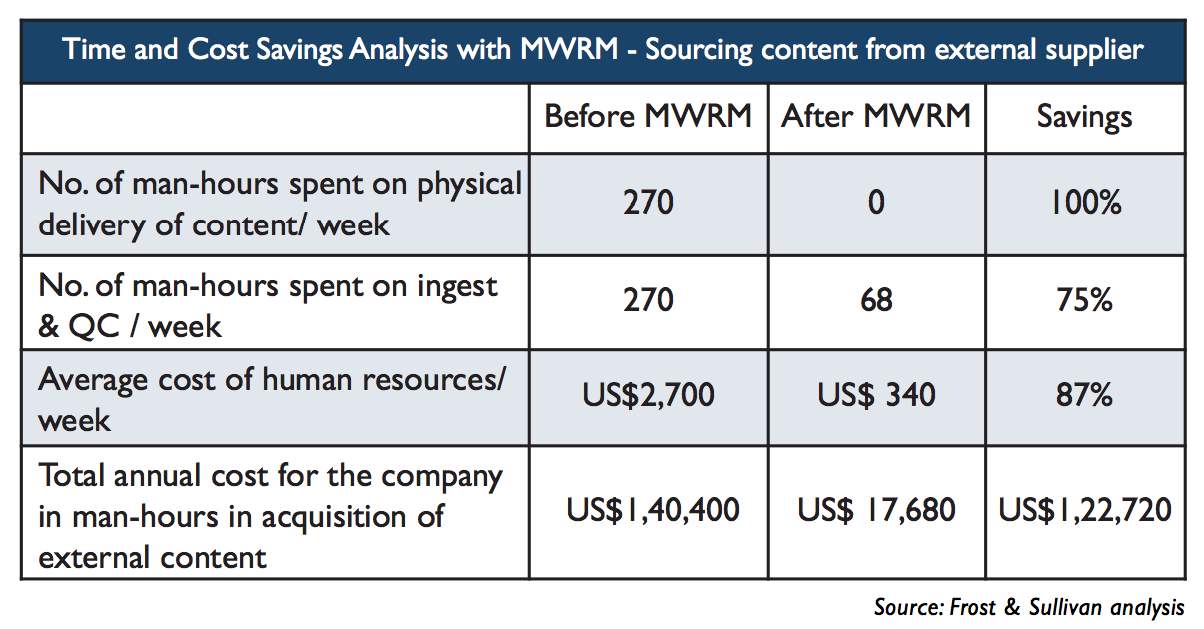
Frost & Sullivan did an analysis of the time and cost savings for just content acquisition from external suppliers for one program series per week. Needless to say, such tasks and similar ones, repeat through the workflow. Hence, if applied, MWRW multiplies the benefits several times over, especially for a programmer who collates and distributes numerous programs.

Screen Shot 2013-09-04 at 1.32.30 PMThis recently released white paper, entitled “Media Workflow and Resource Management: The Roadmap to Revenue Growth and Reduced Complexity,” analyses the key challenges faced by media companies, especially television programmers, to not only manage their growing content bank but also the business processes and ecosystems tied to the same. This paper also, using illustrative examples, explore feasible solutions that can enable content companies to alleviate enterprise-scale workflow concerns, while reaching the widest audience possible and reap profits.

You can download the white paper for free from the Frost & Sullivan website.

Speakers Announced For Streaming Media West Show: Spots Closing Fast

Nearly half of the speaking spots for the Streaming Media West show, taking place November 19-20 in Huntington Beach California, have already been filled. We’ve got confirmed speakers and presenters from Starz, A+E Television Networks, Google, Roku, Comcast, YouTube, The Tennis Channel, LG Electronics, DIRECTV, Redbox, HBO, Vevo, CNN, BBC, Fox Networks Group, CBS Interactive, University of Texas at Dallas, Oregon State University, University of Utah, Oracle, TechCrunch, CBC, Adobe, Cisco, Elemental Technologies, Haivision, Dolby, Ooyala and Ericsson amongst many more. We’ve also got analysts from firms including MRG, Frost & Sullivan, TDG Research and others.

The Streaming Media West website has been updated and now has the latest program details and list of confirmed speakers with another dozen or more speakers expected to be added this week.

The program is filling up even faster than it did last year, so if you owe me some kind of follow up regarding your speaking submission, or I am waiting to hear from you on next steps, please note that the program is closing fast. Once is it filled, it’s too late. I know some will be upset when they contact me six weeks before the show and want to know why they can’t speak, but I have a lot of speaking submissions and spots get filled based on who confirms first. So please contact me ASAP if I am waiting to hear back from you.

Some people want me to chase them down for weeks, which I will not do. If you are offered a speaking spot, and two or three emails from me later you still have not followed up, I will_not_wait for_you, and will move on to the next company. So please, be responsive with emails and thorough with follow-up or your opportunity will go to someone else. I know some shows place speakers last minute, but I don’t do that, unless there is a cancellation. I plan to have all speakers place by October 9th, which is exactly 4 weeks from today.

Recent Survey on OTT Video and Security Trends Offers Insight into Current and Future State of OTT Video

As it moves into the mainstream, over-the-top (OTT) video is maturing towards a pay environment, with sustainable business models. Premium content delivery is becoming both a more significant component of the overall online video business and a more dominant mode of video delivery.

Video content is not just consumed within the confines of the home either—increasing numbers of consumers are demanding more of the “everywhere” aspect of TV—watching live or catch-up programs on-the-go. The traditional set-top box tethered to the television set, once the center of consumer home-based entertainment, is now but one shared video device in a multi-screen world of personal delivery options.

These are some of the findings of a new StreamingMedia.com survey of 758 media industry executives, which sought to uncover their views on the current and future state of OTT video from inside the trenches. Respondents provided new details about the business, highlighting shifts in models, commercial and technical challenges and security implications for the growing business sector. These respondents in the three key sectors of this industry —pay-TV operators, content providers, and technology providers —already see significant parts of their businesses influenced by the OTT model, in which programming, both live and on-demand, is delivered directly to consumers’ devices, piggybacked on broadband networks.

Key findings of the survey include the following:

  • Over-the-top delivery is a growing business driver for the industry—Perhaps in large part because of the trend above, both the number of companies involved in OTT delivery will grow and the proportion of those businesses substantially invested in OTT technologies will more than double over the next three years.
  • TV is taking over the Internet (not vice versa)—The pay model for OTT services is seen as growing in dominance compared to a free or advertising-supported model. This is a very significant change of perception for Internet video, which was initially interpreted as a free alternative to traditional TV services.
  • There’s a new big screen in town—The tablet has established itself as the new viewing device of choice, according to respondents, although executives are aware that device preferences are changing rapidly, and that many types of technologies and formats will need to be supported within today’s multi-screen environment.
  • The Internet is not big enough yet—Bandwidth and quality issues are still seen as significant technology challenges by respondents. Video on demand, using HTTP Live Streaming (HLS), is now the most prevalent type of service, but executives expect to see more services focusing on linear content—the streaming of live events, especially where social networking capabilities are seen as a key piece of OTT offerings.
  • Challenges with gaining multi-screen content rights— Obtaining broad content rights to stream video to multiple screens is felt to be a significant business growth obstacle. The legal and legislative tangle is especially thorny in the U.S. market where there is ambivalence to breaking traditional business models.
  • OTT video security—Encompassing stream protection and digital rights management (DRM) is a murky area for many organizations to navigate. A transition away from proprietary technologies, such as Flash, has created a landscape of options. It appears too early in the life cycle of MPEG-DASH to see how this might help unify infrastructure and consumer electronics configurations.

Full results from the report, entitled “OTT Video: Coming to a Paid Channel Near You” is available as a free download from the StreamingMedia.com website.

Survey Results: Content Owners Say Tablets Are Most Important Device For Success Of OTT Services

The challenge for OTT video delivery is to be able to provide consistent, secure, and high-quality content to this ever-increasing number of device types, and to be open and flexible enough to accommodate changing consumer preferences. There’s no question in the minds of executives that recently participated in a StreamingMedia.com survey that the prevalence of so many consumer devices from which they can view videos—not only PCs and tablets, but also smartphones and game consoles—means being able to meet a bewildering array of both open and proprietary technical specifications.

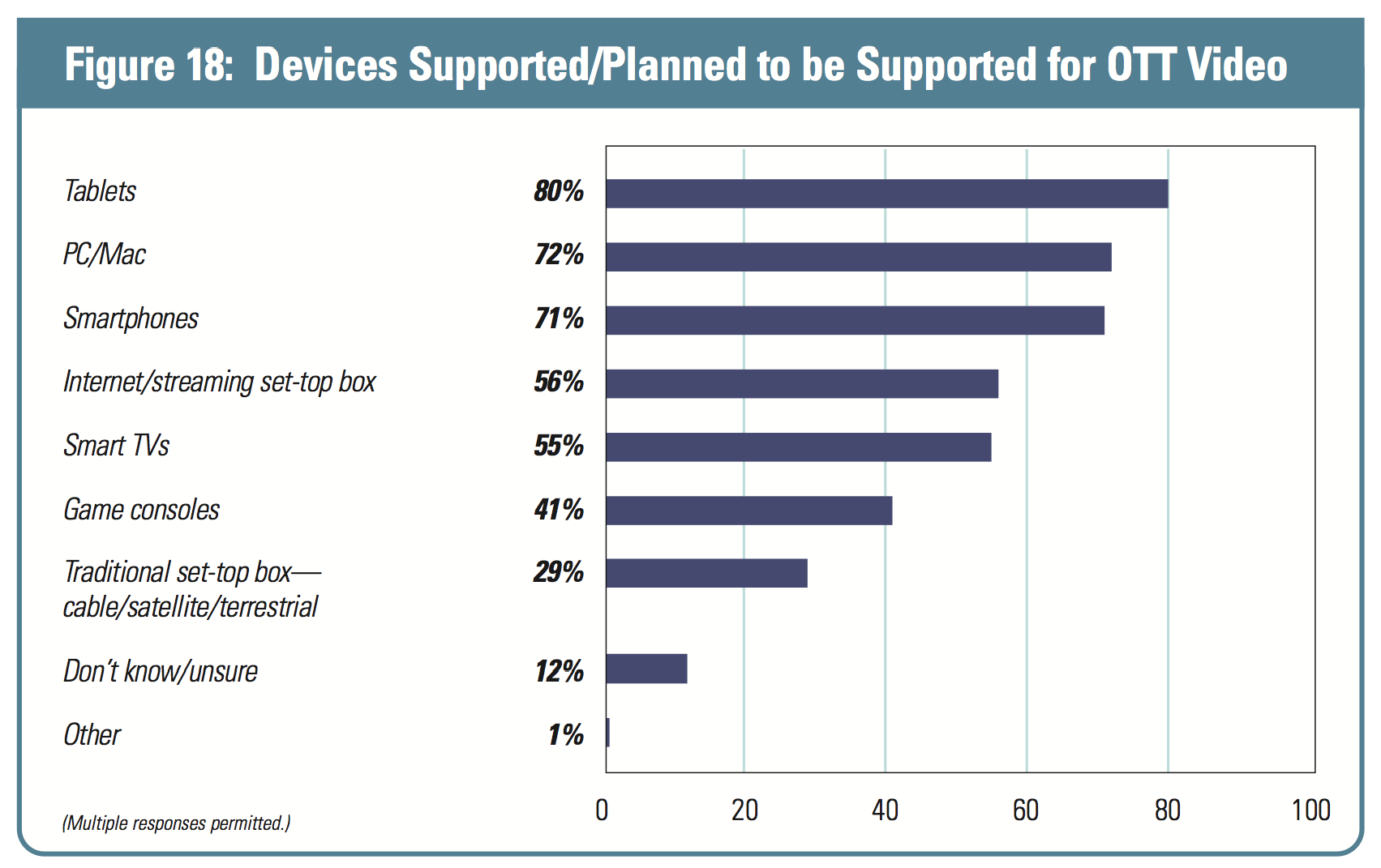
To illustrate how quickly hardware changes, the leading viewing device of choice in this survey did not exist three years ago. The survey shows that tablets rapidly have become the most important choice for OTT delivery. 80% of respondents say they are targeting delivery to tablets. 72% are also streaming to PCs/Macs, while 71% are also targeting smartphones. 80% agree that targeting multiple devices for video delivery is a key implementation challenge at this time.

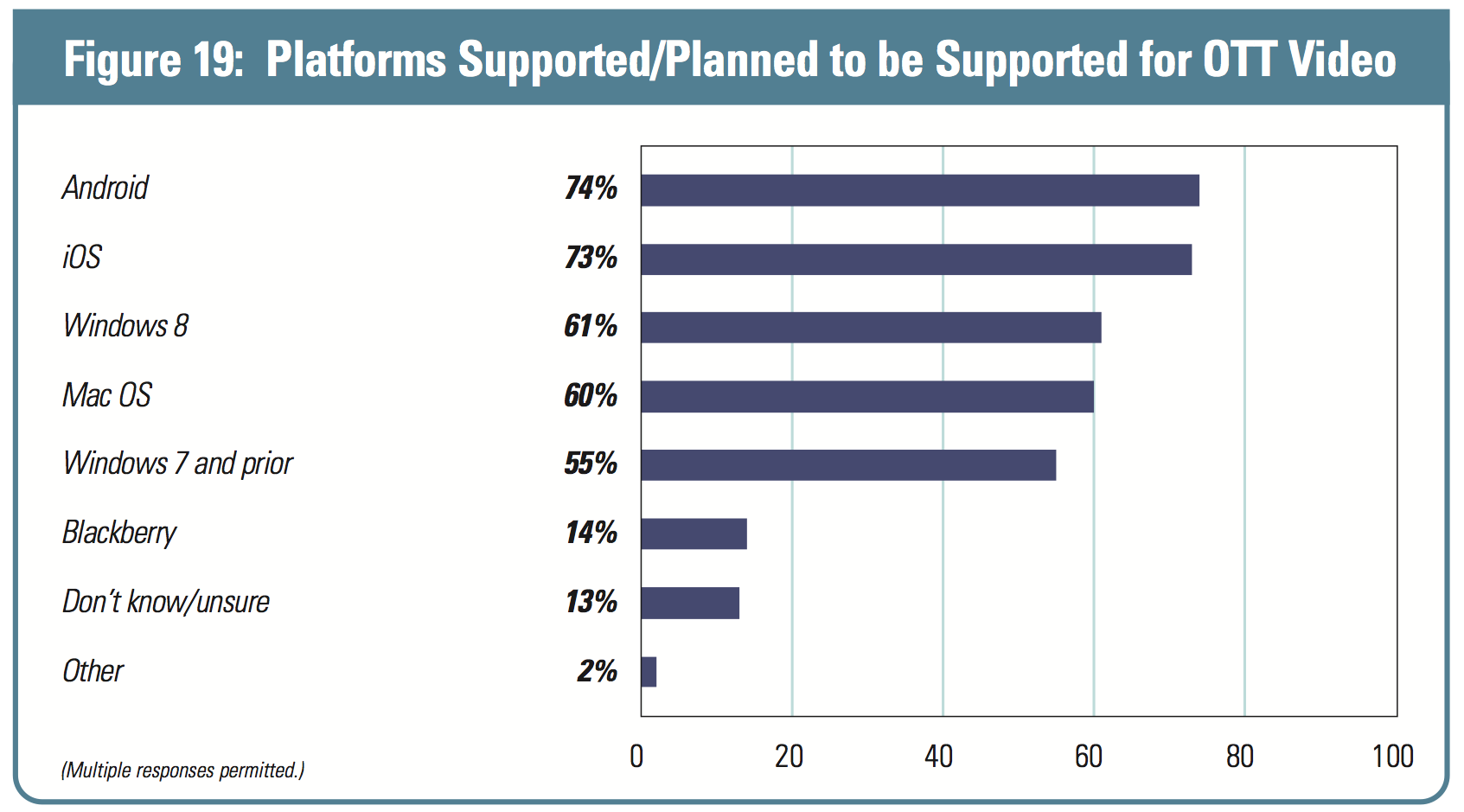
Screen Shot 2013-09-02 at 9.40.48 PMThe survey also looked at the most popular operating systems underpinning consumers’ viewing devices. The two leading mobile platforms—at least, leading at the time the survey was conducted—represent the systems most likely to be supported
by OTT providers. Android barely edges out Apple as the most popular target platform for OTT initiatives at this time, with 74% of respondents saying they support this platform. An extremely close second is Apple’s iOS platform for smartphones and tablets, supported by 73%. The PC platform—once the dominant second-screen viewing device—ranks in the second tier of respondents’ platform choices, with another 61% targeting Windows 8 as a target platform, and another 60% targeting MacOS.

Screen Shot 2013-09-02 at 9.43.34 PMWhile consumers have a wide array of choices in terms of viewing devices, this also continues the fragmentation of the OTT space, in the view of one respondent. “At the moment, you need several different devices to view content from competing companies,” the respondent points out. “You need a Roku, Apple TV, Amazon streaming, and several others, and you still don’t get the full spectrum of available content. There needs to be a way to have all these outlets in one place so the TV area isn’t cluttered with nine different types of content boxes.”

Full results from the report, entitled “OTT Video: Coming to a Paid Channel Near You” is available as a free download from the StreamingMedia.com website.

Why MSOs Should Not Consider Switching Directly from MPEG-2 to HEVC

imagesWith all the excitement around HEVC and all the reports we have put out at Frost & Sullivan on the topic, we get asked all the time if MSOs should skip AVC and directly switch from MPEG-2 to HEVC. Why is this such an enticing notion and does the idea actually bear merit? To answer that question, first, some history is in order.

Back in the nineties as North America transitioned to digital cable, MPEG-2 was the state of the art compression technology at the time. North America was ahead of the game even with HD and thus nearly all cable applications relied on MPEG-2 for SD and HD alike. But the industry paid a price for that early innovation – no sooner were they done with HD deployment than AVC broke onto the scene and fundamentally disrupted the video compression equation. Faced with a weak economical outlook (remember the dot com crash of 2002, anyone?), and having just made major investments in HD rollouts, the cable industry was unable to take advantage, in a meaningful way, the benefits offered by AVC. In contrast, as Europe began to transition somewhat later in the game, they did use MPEG-2 for SD digital cable but predominantly use AVC for HD.

Fast forward to 2013, when the growth of North American cable subscribers slows and IPTV is surging in popularity with its vast array of content and the lure of rich applications enabled by bi-directional connectivity. The writing on the wall is clear to MSOs –they can transition their primary business to broadband services, or they must dramatically reinvent themselves and the user experience they offer to remain relevant as mainstream Pay TV service providers. Wherein lies the rub – how do MSOs meaningfully and strategically invest in infrastructure that will ensure they are at state of the art over the next decade?

AVC has matured since its early days, and state of the art AVC encoders can themselves offer twice the compression efficiency of first generation AVC encoders. Transitioning to AVC is the most obvious route to grow quality and/or quantity of Pay TV content without expensive expansions of bandwidth. (Arguably technologies like Switched Digital Video are also options, but let’s not complicate the discussion). The problem is, this is easier said than done. Consider the USA has approximately 56 million cable subscribers, with approximately 2 set top boxes per subscriber. Multiply that by a conservative $100 per replacement set top box, and the cost of transitioning end user clients alone exceeds a staggering $11B. Add to that the costs of truck rolls, upgrading head-ends, overhauling quality monitoring infrastructure, and more, and it’s easy to see why no MSO wants to do this type of systemic upgrade twice. Which brings us to HEVC.

In theory, HEVC promises twice the efficiency of AVC. Why, MSOs might ask, should we allow history to repeat itself and spend so much on one systemic upgrade when another disruptive technology is right around the corner? It’s a fair question, but let’s take a look at three of the key assumptions it is predicated on:

  • HEVC offers twice the compression efficiency of AVC: Well, yes and no. That’s the theoretical advantage, but practical encoders are only offering about 20-30% improvement on HD content and even less on SD content. That, by the way, is the same level of improvement that state of the art AVC encoders can offer over legacy MPEG-2 encoders at this point in time. Moreover, they can do this at a fraction of the cost, a fraction of the power consumption and a fraction of the rack space. Given that a large number of modern encoders are built-in software (even if they are appliance form factors) rather than rigid hardware, CAPEX is not in jeopardy if a service provider upgrades to an AVC encoder immediately and eventually soft-upgrades it to HEVC when that ecosystem is mature and ready.
  • HEVC products are being released very quickly, and if I do not transition I will fall behind the curve: There’s certainly plenty of buzz around HEVC; it’s arguably the hottest hash tag at IBC this year. However, there is a difference between first generation products that are a must-have for pilot testing, and a mature product ecosystem that enables mainstream creation, monitoring, delivery and storage of a compression format form end to end. The AVC ecosystem is ready and available today, and costs are falling rapidly as commoditization sets in. The opportunity cost of waiting three years for HEVC products to mature needs to be weighed against the ability to cost-efficiently purchase and deploy AVC infrastructure immediately.
  • UltraHD is coming, and HEVC is the key enabler: Again, yes and no. Certainly twice the compression efficiency is critical if you are quadrupling resolution. HEVC’s flexible transform unit size is ideally suited to compressing UltraHD content. However, there are catches. First, if a service is only deploying one or two channels in the short-term, there is usually enough bandwidth already available to achieve this via AVC. Second, there’s not enough UltraHD source content available yet to justify the deployment of content beyond – most likely – nature, sports and movies. If that. With global penetration of HD itself at under 33% despite the age of the technology, expecting a more rapid pace of deployment for new UltraHD technology is, well, optimistic. Third, there are gaps in the technology ecosystem – for example HDMI 2.0, which is necessary to enable full UltraHD rendering, has not yet been finalized. So UltraHD may be coming, but it’s not something that will happen as a mainstream movement tomorrow morning.

The metrics behind these assumptions will definitely change over time, and the ROI that HEVC can deliver will definitely improve over time. While it’s clear that HEVC is a solid technology advancement and no mere flash in the pan, it is important to keep in mind that a mature ecosystem takes time to develop. By all means, MSOs must begin evaluating HEVC as a key technology component for future infrastructure. However, there’s little reason to consider jumping straight from outdated MPEG-2 to unproven HEVC. AVC offers concrete benefits immediately, and by selecting software-based products during this upgrade, MSOs can ensure long-term, future-proof returns on infrastructural investments.

We’ve done a lot of work at Frost & Sullivan on the topic of HEVC and in addition to three reports analyst Avni Rambhia has already published, we’ve done a lot of private research on HEVC for clients. If you’re looking to get more details on HEVC technology, get copies of our reports, or need any custom research on the HEVC market, please feel free to reach out to me for more details.

More HEVC related posts:

Cutting Through The Hype Of HEVC (H.265)

HEVC (H.265) Adoption Is At Least Five Years Away For Consumer Content Services

Thursday Webinar: Best Practices for Enterprise YouTube Deployment

Most enterprise organizations use some kind of a “YouTube like” social video platform for streaming on-demand video and live webinars inside their firewall. As global enterprises seek to leverage video to improve communication, engagement and collaboration, the need has arisen for an enterprise quality video portal that solves the challenges of governance, security and delivery, with all the functionality employees have grown to expect from exposure to consumer technologies. On Thursday September 5th, at 2pm ET, I’ll be moderating another StreamingMedia.com webinar, this time on the topic of, “Best Practices for Enterprise YouTube Deployment.”

Join this streaming webinar to learn best practices from recent enterprise YouTube deployments at medium and large enterprises across various industries. Some of the challenges examined will include:

  • Delivering HD video to a globally distributed workforce
  • Creating multimedia presentations for internal and external viewers
  • Delivering video to audiences with varying bandwidth requirements

We’ll have a full Q&A session in which your questions will be answered and as always, all StreamingMedia.com webinars are free. So register here and save the date for this instructional webinar.