Apple, Microsoft & Facebook Bring More Traffic To In-House CDNs, Impacting Akamai’s Media Business

Yesterday, Akamai reported Q3 earnings and announced that revenue from their media delivery business would be flat or down for Q4, year-over-year. For Q3 their media revenue was up only 5% year-over-year and the company said, “traffic and revenue growth slowed considerably in some of our largest media accounts.” Following guidance that was well below expectations, Akamai stock dropped $9.76 a share in after hours trading. It was an odd earnings call as Akamai suggested the reason they expect media growth rates to continue to moderate in the “near term” was due to customers having “less traffic growth overall”. Except that’s not what’s happening.

The cause of what Akamai is seeing is a result of Apple, Microsoft and Facebook moving a larger percentage of their traffic to their in-house delivery networks. This is a trend that all three companies, especially Apple, have been doing for some time, but in the past 45-60 days, Microsoft specifically has taken a lot of their traffic in-house, which is lost business for the CDNs. Akamai said the impact of what they are seeing is “expected to be magnified by their do-it-yourself efforts” but then said “most of the impact is from less traffic growth overall”. Apple, Facebook and Microsoft aren’t seeing “less traffic” and certainly aren’t seeing lower traffic growth rates overall, compared to the past few quarters. So Akamai’s explanation really makes no sense.

All you have to do is trace where their content is being delivered from to see less of it is coming from third-party CDNs. Akamai said they,” believe kind of the bigger slowdown in traffic here is that traffic overall is slowing.” And why do they “believe” that? What data do they have to show that Apple and Microsoft’s overall traffic is slowing? I haven’t seen any such data in the market, from third-party companies that track traffic growth amongst consumer services. And when Akamai was asked why customers traffic is slowing, like Akamai claims, they responded to the question by saying, “why it’s slowing for our customers is difficult for us to access.” Confused yet?

In the Q&A potion of the call, Akamai said, “if the overall traffic is less growing at a slower rate and less than expected well, there’s a tendency to fill up the do-it-yourself effort first, and then we would get the remainder which leaves us with even slower traffic growth.” Earlier Akamai said the overall traffic was slowing, but then later they say “if” it was slowing, and when they say “less than expected”, less than who expected, Akamai or the customer? Because if Akamai simply overestimated the percentage of traffic a customer who owns their own CDN is going to give Akamai, that’s not a “slower rate” of traffic growth, that’s just bad estimating on Akamai’s part.

Heading into 2016, Akamai expects media growth rates to continue to moderate in the “near term”, which isn’t good news for them, especially considering how much they continue to talk about the impact OTT services have on their business. One thing many may not realize is that while OTT services are growing, the ones that are seeing the most growth, don’t have their content being delivered via third-party CDNs. Akamai also said it was “worth noting that media pricing overall has continued to decline at normal historical levels”, but they didn’t say what those levels are or give out any numbers. For most customers, that is true, and the decline in pricing is stable, down about 20% this year. But for the largest handful of customers, who push the most traffic, pricing is down more this year than last, in the 40%-50% range.

Akamai also said that, “competition in the media business remains constant but is not expected to be a significant factor in our traffic and revenue estimates.” This also is suspect as the term “significant factor” could mean a lot of things and doing some traceroutes on those who have lots of traffic growth, shows competition impacting Akamai. To highlight one example, looking at Sony’s traffic for the PS4 now shows that Level 3 has been added as another delivery network, in addition to what Akamai and Limelight Networks are already delivering. So while Level 3’s share of traffic may not be taking away traffic Akamai and Limelight already have, it is less traffic they would have gotten, with Level 3 now being included.

Note that when Akamai says “media” they don’t necessarily mean “video”. Media includes video but also non-video content and software downloads. So there could be other media customers involved, that aren’t video related, that is also impacting the growth of revenue from Akamai’s media customers. The company also said they have, “purposefully slowed down the rate and pace of head count additions and discretionary spending to align with our near-term top line growth expectations,” which isn’t surprising.

One thing Akamai is still doing well is using vague and high-level statements, without actually saying anything. The company mentions their new deal with Microsoft Azure saying, “Microsoft sales force is also planning to sell Akamai’s market-leading acceleration and security solutions.” While that is true, what they don’t say is “when” Microsoft plans to start selling it. Because when I asked Microsoft, they said they would only be re-selling Akamai’s CDN services and would not be re-selling value add services any time soon. Akamai also said their, “overall media traffic is still projected to grow at a substantial pace” but again, substantial is a useless word without definition.

As usual Akamai also went on to mention how many “edge servers” they have, which is a useless stat since we all know that capacity and performance is measured by more than just the number of servers a CDN has. No customer buys CDN services based on a server number from a vendor. Some parts of Akamai’s business are still being marketed like it’s 2002, when customers focused on server count and the simultaneous number of streams a CDN could support. Akamai also called out their, “superior communication and video transport protocols which are designed to deliver the kind of higher-quality picture that is expected by users and broadcasters alike”, except that Akamai had problems delivering the 60fps stream for Yahoo’s NFL stream this past Sunday.

Akamai needs to focus more on data, numbers and giving the market real insight into their business, as opposed to lots of generic, vague and high-level words and phrases. At the end of the call Akamai said, “media growth rates are going to be effectively flat to up very significantly, or down very significantly.” Flat, up, or down. There aren’t any other options.

Sponsored by

Thursday Webinar: Live Video No Fail Best Practices

Thursday at 2pm ET, I’ll be moderating a StreamingMedia.com webinar on the topic of “Live Video No Fail Best Practices“. You get one shot at a live event, so there’s no room for failure. Everything—from the video and audio quality to the delivery to the player functionality to social media integration—must work seamlessly, or viewers won’t stick around. This panel of seasoned speakers will share their wisdom of how to produce and manage live webcasts of all sizes, whether a high school football game, church production, concert, or major league sporting event. Professionals will be on hand to answer your questions and help make your live event business easy to scale and easy to manage. Topics to be covered will include:

  • How to eliminate problems related to the inherently poor signal path in internet-based video acquisition
  • Considerations when using cloud transcoding for HD broadcasts in lower bandwidth environments
  • Solving the challenges of live video distribution to mobile devices
  • Make use of pre-configuration, presets, and live monitoring to ensure an error free event

Register Now to attend this FREE live webinar.

Yahoo To Keynote Streaming Show, Detail Their Streaming Of NFL Game

1000px-Yahoo!_logo.svgOmer Luzzatti, Senior Director and Head of Yahoo’s Video Platform will be the keynote speaker on day two of the Streaming Media West show, taking place November 17-18 in Huntington Beach, CA. Yahoo was selected by the NFL to stream the Buffalo Bills vs. Jacksonville Jaguars game from London, live and for free. This marked the first time an NFL game was delivered only via OTT outside of the teams’ local markets. Omer’s presentation will describe Yahoo’s platform, its ability to select CDNs according to stream quality and differentiate quality per device, along with collaboration with the ISPs, performance metrics, ABR, and other details of how Yahoo pulled off the live event.

Access to the keynotes, reception, networking events and exhibit hall is free if you register online using promo code 15DR200.

Yahoo Pulls Off Successful NFL Webcast With Very Minor Hiccups

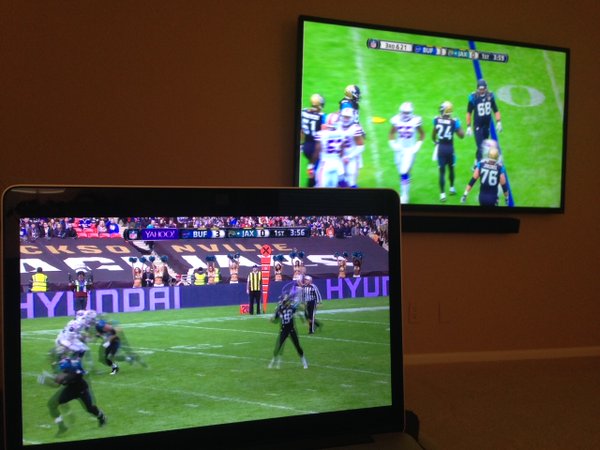
CSKxaJaUEAA6zLrYahoo’s stream of the NFL game between the Bills and Jaguars kicked off at 9:30am ET this morning and from a quality and technical standpoint, appears to have been very successful. I tested the stream being played back via TiVo, Roku, Xbox, Fire TV, Apple TV, MacBook, iPhone and iPad and experienced very few problems. The stream was split between multiple content delivery networks including Akamai, Limelight, Level 3 and Verizon amongst others. Streams started up fast, within 1-2 seconds at most and I never experienced any buffering or stuttering, aside from the stream to the TiVo. That stream, being delivered by Akamai, had multiple issues with the stream being in fast-forward mode, freezing or having to re-buffer multiple times, for more than half the game. When the stream did work correctly, it looked like cable TV quality on an 80″ TV.

Taking a look on Twitter there were some users complaining of problems with the Internet stream, but not many and while we don’t know how many simultaneous streams Yahoo had, there will always be some users who experience problems when streaming via the Internet. While many want to compare a webcast like today to broadcast TV, you can’t compare the two when the delivery mechanism is so different. Video broadcast via the Internet can’t compare to cable TV distribution, when it comes to reliability and QoS. [See: Streaming Video Can’t Scale At Cable TV Quality, Will Never Replace Traditional TV Distribution] Yahoo hasn’t broken out any of the usage numbers yet, but I would bet that 5% or less of all the streams consumed were via OTT streaming boxes. We also need Yahoo to confirm this, but it looks like the higher bitrate streams on OTT devices were at 60fps.

I don’t know how many details Yahoo will give out in the coming week, but next month at the Streaming Media West show on November 18th, Yahoo will keynote the event and discuss how they selected CDNs according to stream quality and differentiate quality per device. They will also discuss how they collaborated with the ISPs, performance metrics, ABR, and other details of how Yahoo pulled off the live event.

Corey Smith, Engineering Manager of Xbox Live To Keynote Streaming Show

Screen Shot 2015-10-15 at 1.37.51 PMCorey Smith, Senior Service Engineering Manager for Xbox Live will kick off the Streaming Media West show, taking place November 17-18 in Huntington Beach, CA, with a keynote on day one of the event. Corey’s presentation will walk the audience through the world of live broadcasting for Xbox events and will discuss their approach to linear and live broadcast streaming. Audiences will get to see firsthand the power of the Xbox broadcast services platform, how they deliver live events that engage viewers and see a demo of interactive TV on the Xbox One.

Attendees will also have the chance to win an Xbox One bundle. Access to the keynotes, reception, networking events and exhibit hall is free if you register online using promo code 15DR200.

Few Speaking Spots Open At Streaming Media Conference

The program for the Streaming Media West show, taking place November 17-18 in Huntington Beach CA, is 99% done, but a few speaking spots remain open. If you are interested in being considered, I have a few spots left on two round tables. Please contact me ASAP.

    1. Tuesday, November 17th 2014
      Predicting The Winners and Losers Of The Streaming Device Market
      This session will focus on the popular streaming devices in the market today, including dongles, smart TVs, consoles, and mobile devices. Panelists will discuss the crowding of the streaming device market over the past two years and touch on the devices that are gaining more consumer traction than others. Hear what viewer habits are driving some streaming devices to outgrow others, especially for millenials who value the social aspect of watching premium content with friends as much as they value their ability to cut the cord. Learn what the future of digital entertainment in a multiscreen world will look like and which devices will dominate the market.
    2. Wednesday, November 18th 2015
      Bye-Bye Browser: Product Strategy For OTT and TVE In The Post-PC Era
      This session will discuss how TV Everywhere and OTT providers are adapting their product roadmaps to meet changing consumer behavior. The discussion will focus on how to manage PC-centric services that are in decline, mobile services that generate high traffic, but low monetization, and fragmented connected TV devices where there is no clear winner. We will discuss apps vs. web, single vs. multiple apps, hybrid billing models, in-app upgrades and why competition is a good thing.

Content Owners Say Amazon Is Considering A Live OTT Streaming Service

Over the past few months, multiple content owners have told me that Amazon has been quietly asking them about licensing content for a live streaming service. While none of the content owners want to go on record, or will discuss how far along Amazon is with their plans, other companies involved in the video ecosystem also confirm that Amazon is looking at potentially offering a live OTT video service of some kind.

Considering Amazon already offers an on-demand Prime Video streaming service, it’s would not be surprising that they would also look at the economics of offering live content, just like every other OTT provider is probably doing. But what makes this Amazon story even more interesting is that Amazon recently agreed to acquire Elemental Technologies, a company that offers a cloud-based platform for ingesting, encoding, protecting and packaging live linear streams. While Amazon has already confirmed they plan to integrate Elemental’s live linear platform into their AWS platform and offer it as a service, acquiring Elemental will also give Amazon their own in-house platform needed to make an Amazon branded live OTT service possible.

This also might explain why Amazon would pay so much for Elemental, with rumors of the sale price valuing Elemental at $500M. (Note, I haven’t been able to confirm the $500M number is accurate) Updated Oct. 23: Thanks to an SEC filing, we now know Amazon paid $296M for Elemental, not $500M like The Information was reporting. In 2012, Elemental disclosed they did $21M in revenue. In 2013, revenue grew to $32M and in 2014, revenue was projected to be over $50M. Insiders say Elemental is on a run rate to do close to $100M in 2016. So if the rumors of Amazon valuing Elemental at $500M are correct, Elemental is getting about 5x projected 2016 revenue, a rather high valuation, unless Amazon is also placing value on them for other reasons, like the ability to power their own live OTT service.

Those I have spoken with haven’t disclosed how far along Amazon is with regards to a live OTT service and it’s possible Amazon is simply looking at the economics of the business, which would involve them talking with content owners about costs. That alone is no proof that they plan to bring a live OTT service to the market anytime soon, but the purchase of Elemental adds to the intrigue and it could be that Amazon is doing more than just thinking about a live OTT service.