Archives

Netflix Doubles Video Quality Making 6Mbps SuperHD Streams Available To Everyone

Consumers using ISPs that aren’t in Netflix’s Open Connect program, have to date, been shut of out getting Netflix’s best video quality, dubbed “SuperHD”. But starting today, Netflix announced that all consumers can now get SuperHD quality, on limited devices, even if their ISP doesn’t participate in Netflix’s Open Connect initiative. Netflix only has a limited amount of content available in SuperHD and not all devices support it, but for the ones that do, SuperHD content will now be streamed at double the quality before.

Previously, Netflix highest quality video, available to those with ISPs not in the Open Connect program, was encoded at 3850Kbps. With SuperHD, video is encoded at 4300Kbps and 5800Kbps and adding the audio bitrate brings SuperHD encodes to about 4.5Mbps and 6.0Mbps. Netflix is essentially doubling the quality of their video, for a limited amount of their content. Currently any 1080p version of Apple TV and Roku supports SuperHD as well as the PS3, Nintendo Wii U, TiVo Premiere and Windows 8 app. Note that SuperHD is not available via computer browsers and can only be seen on the PC for those that use the Windows 8 app.

This is great for consumers and maybe it will also stop some ISPs, like Time Warner Cable, from complaining that Netflix was holding SuperHD content “hostage” from their network. Back in January TWC said Netflix was, “seeking unprecedented preferential treatment from ISPs”, when at the time, Netflix simply wanted to make sure that ISPs could handle delivering the increased level of video quality on their network.

While Netflix’s website says that SuperHD streams are available up to 7Mbps, Netflix says the site will be updated to reflect a max bitrate of 6Mbps. Netflix won’t say how many titles are available in SuperHD quality, but more than half the titles they have now are already available in regular HD. If you have one of the supported devices fire it up and check out the SuperHD quality, it’s really, really nice on a large screen.

Sponsored by

Thursday Webinar: Creating an Internal CDN to Support Video

Enterprise network administrators are famous for saying no to corporate video out of fear of a negative impact on their network. However, the demands for live and on-demand streaming are stronger than ever and corporations need to determine a strategy for supporting it. For enterprises concerned with high security and control over proprietary content, this means building out an internal CDN to support live and on-demand video streaming.

On Thursday September 26th, at 2pm ET, I’ll be moderating another StreamingMedia.com webinar, this time on the topic of, “Creating an Internal CDN to Support Video.” In this webcast we’ll look at some best practices for building a highly secure, fault tolerant video delivery network with advanced streaming and caching features to provide outstanding streaming performance for users.

We’ll have a full Q&A session in which your questions will be answered and as always, all StreamingMedia.com webinars are free. So register here and save the date for this instructional webinar.

iOS 7 Download Traffic Overtaking Netflix Inside Carrier Networks

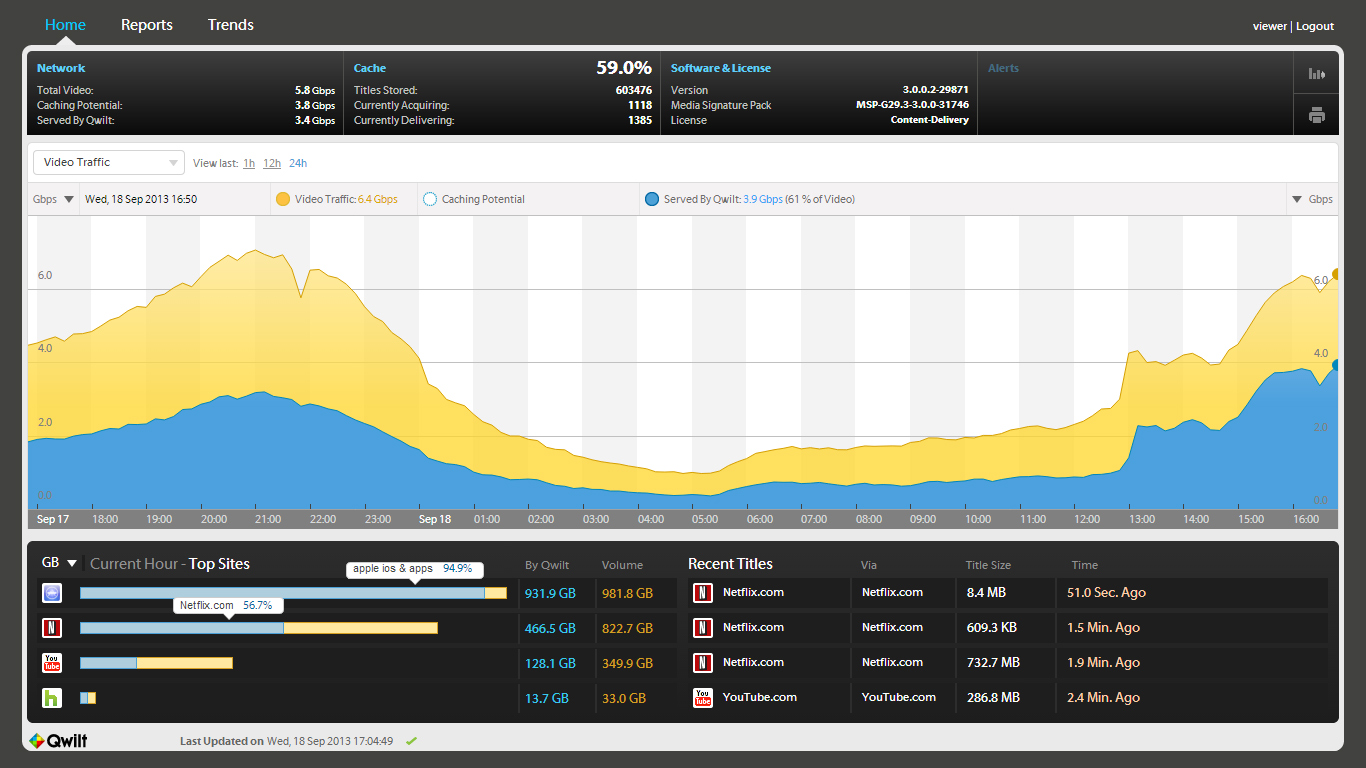
We all know that Apple’s iOS 7 download is making up for a large percentage of the overall traffic going across the public Internet, but what about the impact this is having on last mile providers? According to data that transparent caching provider Qwilt has shared with me, some of their carrier customers are seeing iOS 7 and app downloads account for nearly 40% of all the traffic inside their networks. Below is a chart from one node, inside a North American based carrier showing that Apple downloads surpassed what Netflix videos were consuming in the way of bandwidth, last night.

Apple iOS Updates Transparent Caching by Qwilt - Major US OperatorIt also shows that for service providers that have deployed transparent caching inside their network, much of the traffic surge can be alleviated, with the chart showing that in this case, Qwilt’s caching platform is handling 61% of all the traffic and even more important on a day like today, 95% of all Apple iOS downloads.

This is the whole reason why network operators are evaluating and deploying transparent Internet caching inside their networks to address a broader range of Internet content. The intent is two-fold. The first is to reduce the network infrastructure and bandwidth costs associated with over the top (OTT) content and large file delivery and the second is to differentiate their consumer broadband service and deliver better user performance. By eliminating any potential delays associated with the Internet or even the content origin, caching allows the operator to highlight their investment being made in the access network and deliver more content at top speeds.

One carrier using Qwilt’s transparent caching solution said the performance has been fantastic in response to this latest iOS release. When iOS 6 was released they got hammered at the edge for several days, but with Qwilt’s solution this time around, they saw a spike of about 25 minutes on their edge and then it dissipated, since it was being served it up from the cache. They also said they tested the download direct from Apple which took one hour, versus the 12 minutes it took to download locally from their cache.

Transparent caching technology probably isn’t something many have heard about, unless you work for a network operator, but the technology is crucial in allowing last mile providers to deliver content by Apple, Netflix and other major content owners and distributors to consumers quickly and with quality. The market for transparent caching services will grow to $350M in the next three years and this article will give you an overview of how transparent caching works and it’s role in the CDN ecosystem. You can also check out transparentcaching.com for all my articles on the subject.

By My Estimates, Apple’s iOS 7 Download Business Is Worth About $10-$12M To Akamai

ios7-bannerI’ve been getting a lot of questions over the past two weeks asking me how much revenue Akamai could get in Q3 and Q4 of this year, due to the new iOS 7 update from Apple. Akamai is not the only CDN that does software downloads for Apple, Level 3 does them as well, but Akamai still has the largest percentage of Apple’s download business. While we don’t know how many iOS 7 downloads will take place, over what period of time, you can make some estimates and get a range on what the business is worth to Akamai.

Based on data Apple has given out, Apple has about 750M iOS devices (iPhone/iPad/iPod), in the market globally. From that number, lets figure that 500M of the devices will be capable of getting the new iOS 7 software and will be updated. For the sake of estimating numbers, lets assume that every single one of those 500M devices will be updated by the end of this year and that Akamai will do 100% of the downloads.

Apple’s new iOS 7 download, on my phone at least, is 754MB. If Akamai delivered 500M downloads at 754MB they would have delivered a total of 377,000,000,000 MB, which converts to 377,000,000 GB. If Apple was paying $0.015 (one and half cents) per GB, the total value to Akamai would be $5.65M. Apple pays based on a per Mbps sustained model, not per GB delivered, but per GB at least gives us an estimate. While this seems simple to calculate, there is one variable you have to factor in.

CDN delivery in the U.S. is cheap, but that’s not the case in many other countries where iOS devices are located. So using a per GB delivered price of one and half cents does not work when you’re talking about delivering iOS 7 downloads in countries where bandwidth is more expensive, especially in Asia. So you have to factor in a percentage of the 500M downloads costing more than they do in the U.S. to deliver. You also can’t expect 500M devices to all be updated within three and half months. So there are some variables that skew the final numbers.

Based on my calculations, and factoring in some other details I know of Apple’s business, I estimate that on a low-end, Apple’s iOS 7 download business is worth about $10M to Akamai, over the course of iOS devices being updated. Realistically, that’s a couple of quarters. That $10M estimate could go a bit higher depending on the percentage of downloads that come from countries where delivery charges are more expensive, so I would estimate it at $12M on the high-end.

Coming up with estimates is not an exact science, there are a bunch of variables, but we have enough data in the market on file size, number of devices, and the going rate for CDN pricing in the U.S. to be able to come up with pretty realistic estimates on what business like this is worth is today’s market.

Free Blog Giveaway: Win A Google Chromecast

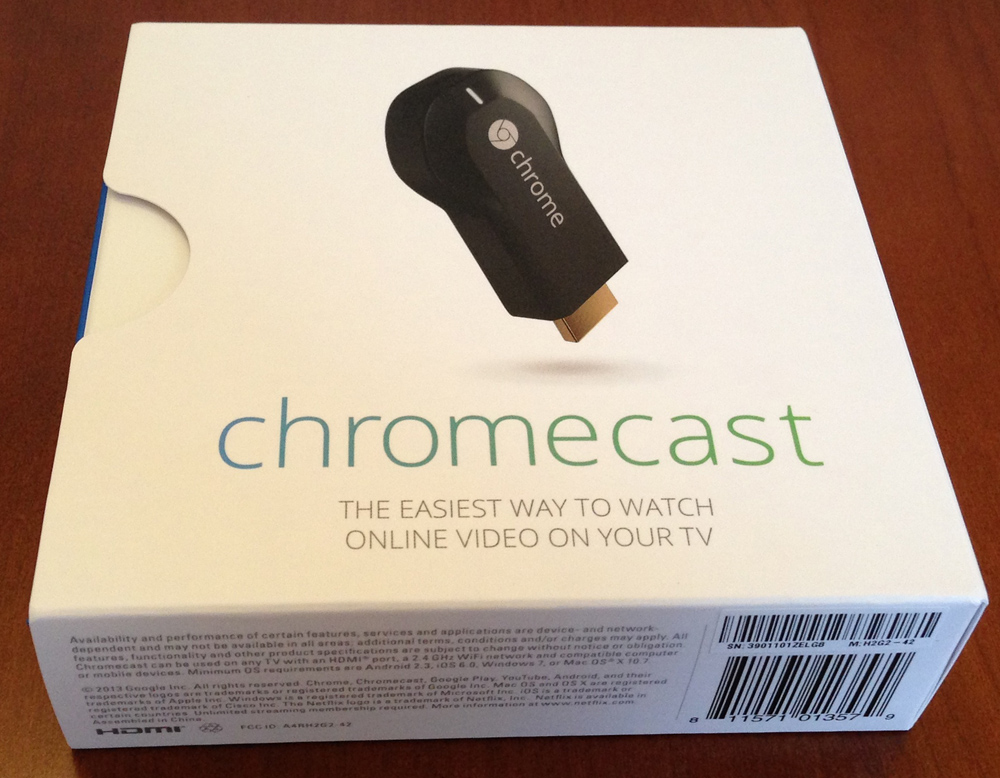
photoI’ve gotten my hands on some extra Google Chromecast’s and will be giving them away to some lucky readers of my blog. We’ll also be giving them away at the Streaming Media West show in November as well. To win one from my blog, simply add a comment to this post and I’ll pick three random winners in two weeks. I will only ship these within the U.S. so you must have a U.S. based address if you want to win. Good luck!

EdgeCast Announces Big CDN Deal With Chunghwa Telecom In Taiwan

EdgeCast continues to expand their network and sales reach with a new telco managed CDN partnership with Chunghwa Telecom’s data communications business group (HiNet) In Taiwan. HiNet will use EdgeCast technology to build a high-performance CDN within Taiwan and provide caching, streaming, acceleration and security services to Taiwanese media and content providers. HiNet will invest from a hardware, colocation and bandwidth perspective and EdgeCast will contribute their software and manage the newly built CDN.

This is a big deal for EdgeCast as Taiwan is one of the most difficult markets to reach, has a very high population of Internet users, is a tremendously desirable CDN market for traffic termination, and is a fast growing market for CDN customers. Once built, HiNet will be EdgeCast’s local reseller and will take their new offering to all of HiNet’s enterprise customers, where they are a major market leader for IP infrastructure in Taiwan. It will also give HiNet an excellent domestic CDN to service all their big enterprise and content customers.

This is another example of EdgeCast once again beating out other larger CDNs whom offer licensed/managed CDN services, as multiple CDN vendors were competing for Chunghwa Telecom’s business. EdgeCast has the most licensed/managed CDN deals in the market, and this deal structure with Chunghwa Telecom is very similar to ones they have done with PT Telecom in Indonesia and Telia in the Nordics.

EdgeCast says they now carry more than 5% of all worldwide Internet traffic, have 4Tbps of egress capacity deployed, and at their current rate of growth, is on a run rate of over $140M in revenue by the end of 2014. Based on my estimates, EdgeCast’s managed/licensed deals will account for about $15M in total revenue for the company in 2013.

Industry Executives Say QoS And Bandwidth Limitations Are Leading Technical Obstacle To OTT Adoption

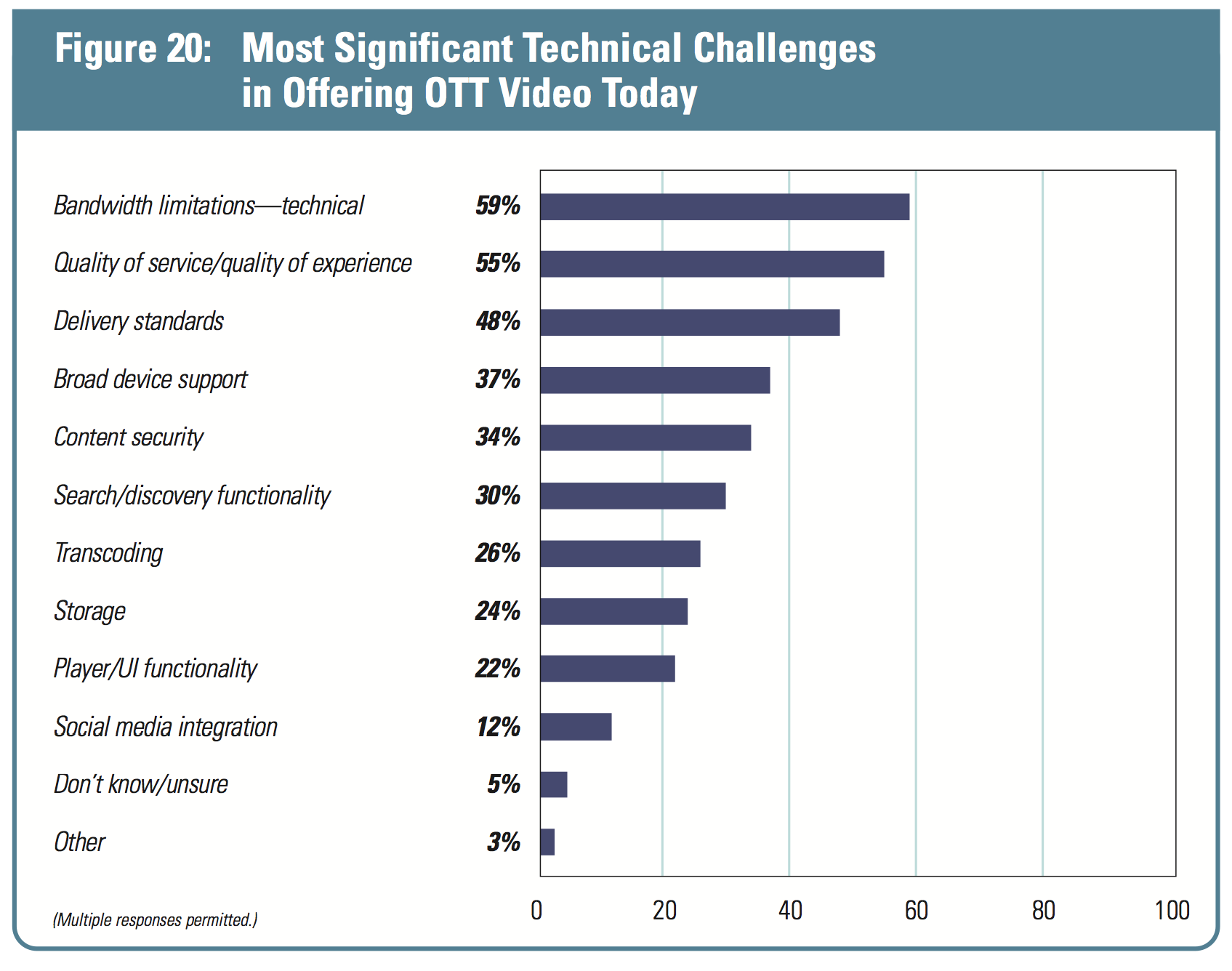
A majority of executives, 59%, say bandwidth limitations are currently the leading technical obstacle to OTT adoption. Quality of service and quality of experience—which may also be related to bandwidth issues—is also seen as an obstacle by 55%. “OTT services need to be able to consistently provide content that is high quality, doesn’t cut out, break up, or freeze,” says one respondent. “Consumers want to be able to watch content without these distractions that can ruin the entertainment experience.”

Screen Shot 2013-09-02 at 10.02.34 PMTo a large degree, this may tie in with bandwidth capabilities as far as achieving video quality, but also extends to the quality of the viewer’s experience as well. Quality of experience (or quality of mobility) also addresses the personalization, brand and user-interface experiences of the video delivery, in tune with consumer preferences by the devices they use.

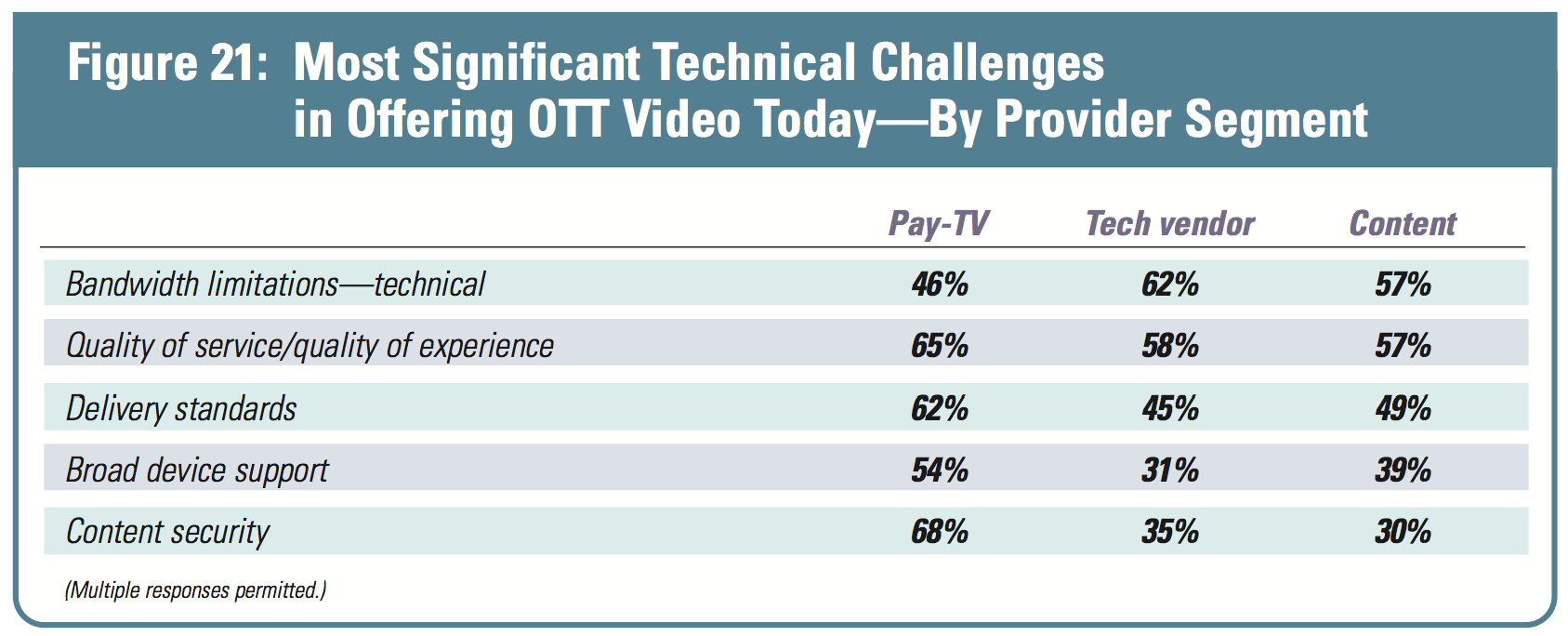
When looking across the primary industry segments, pay-TV operators tend to downplay the impact of bandwidth as a technical limitation. Many offer their own broadband networks, and thus are simply able to piggyback OTT offerings directly through this channel. Of most concern to pay-TV operators is being able to technically manage content security. Ironically, only 30% of content providers surveyed are experiencing any technical limitations in terms of content security. At the origination end of content, there may be less concern or involvement with downstream security requirements.

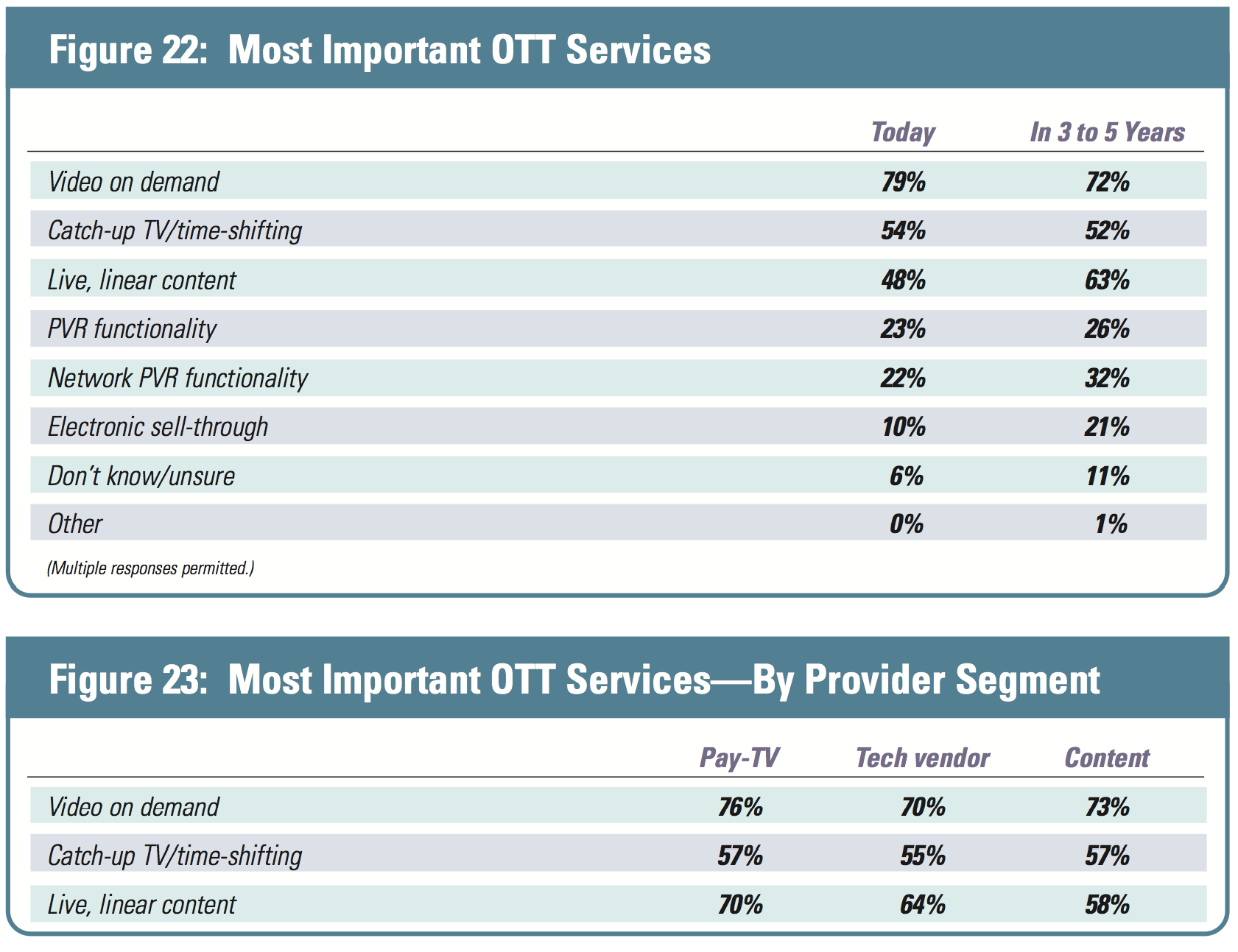
Screen Shot 2013-09-02 at 10.02.43 PMOTT services can be delivered in a linear fashion, meaning the live streaming of channels, or video on demand, in which users can download and view libraries of videos and other content. When asked about the types of services that are most important to offer for OTT video delivery, most respondents see the potential in video on demand (VoD). VoD leads the list by a wide margin, cited by 79% of respondents. In addition, looking a few years down the road, live, linear content—a metered approach measured in minutes per day—will increase in importance, rising from 48% to 63%. A majority, 54%, also see it as a market for those seeking catch-up TV and time-shifting. The view that video on demand is the sweet spot of OTT is shared across the major industry segments covered in the survey.

Screen Shot 2013-09-02 at 10.07.30 PMFull results from the report, entitled “OTT Video: Coming to a Paid Channel Near You” is available as a free download from the StreamingMedia.com website.