We Need Synced Live Streaming: It Enables A Better Experience And More User Engagement

logo-net-insight thumbnailIt’s amazing how many live sporting events are now broadcast online every day and I recently made a list I shared on Twitter. However the downside to many live events is the long delays that can vary from tens of seconds to minutes, which at times, can ruin the experience and hamper the social and interactive experiences that many live events now contain. I’m a Mets fan and stream games online and can’t be on social media at the same time as big plays are routinely shared on social platforms, before I see it take place via the live stream. You almost can’t communicate with the outside world during a game if you are following the game via you phone or smart TV app.

As an industry, we keep focusing on the word “quality” to describe the clarity of the stream, but we should also realize that many factors impact the quality of the overall “experience”. I want good quality video, but that’s not the only way to determine the QoE. And as live events become more important on the web, and especially for sports, syncing streams across devices is going to become a requirement, not a nice-to-have. Recently I got to test a new solution from Net Insight called Sye, which targets these problems. The solution allows live content to be streamed with frame-accurate synchronization across any type of screen be it mobile, desktop or to the TV. The delays were at the same level or even faster than for regular TV, which opens up a new type of seamless viewing using both regular TV and your favorite mobile device. But it’s not just live sports this can be applied it. Any other live show where you want to enhance the social interaction can benefit with such a solution.

The Net Insight solution also synchronizes OTT with broadcast TV and it made me think of the applications this could be applied to. Television audiences viewing the same content at the same time opens up an array of new and exciting possibilities for broadcasters, content owners and service providers. They can produce different types of content for primary screens compared to that created for companion apps or smart apps, depending on the application. For example, events like the Olympics or car racing could take advantage of such a solution as the synchronization would allow viewers to watch related content, such as a driver cam, on their second screen while at the same time watching the full action unfold on their primary screen in parallel, and all in perfect sync. This not only extends user experiences but also allows media operators to engage with audiences in unique ways and improve the user experience. It adds more value to the live event and provides new opportunities to monetize content more effectively. Tata Communications is now the first CDN to enable Net Insight’s solution across their network, allowing content owners to take advantage of it for live streaming.

Think of the new business and advertising models that could be created based on more than one screen being used, with the content being synced. It’s compelling, which is what “live” is supposed to be all about. As an industry, we keep talking about live events, but very little has been done to really take live streaming to the next level. Yes, bitrates keep going up, startup times are going down, but not much else has been done. We need to think about how we open up new opportunities for content owners and what the future looks like for live experiences on the web. So I am always looking at new solutions in the market, ways data can get overlaid, how second screen content can be added and I think what Net Insight’s solution offers to the market is very unique. I haven’t seen anyone else offering this or thinking about ways of changing the experience for users when it comes to live streaming on the web. Net Insight has customers using the solution today for live OTT applications and says they will be able to share some of those case studies soon.

Sponsored by

NYC DASH Workshop, Aug 22nd: Comcast, MLBAM, Akamai, Adobe & More

dashif-logo-283x100_newThe DASH Industry Forum in conjunction with Comcast is organizing a free workshop on MPEG-DASH taking place Monday, August 22nd at 30 Rockerfeller Plaza in New York City. There will be presenters from Adobe, Akamai, Brightcove, Comcast, Microsoft, Major League Baseball, JW Player, Qualcomm and INISOFT. You can see the full program schedule here. Attendance is limited and is by registration-only at the following link: https://www.eventbrite.com/e/dash-workshop-tickets-25962250791

New Security-as-a-Service Company StackPath Launches, Acquires Four Companies, Raises $150M

stackpath-logo-s-cyanThis morning, the founder and former chairman and CEO of SoftLayer Technologies, which was acquired by IBM in 2013 and is now the foundation of IBM’s Cloud Computing division, launched a new Security-as-a-Service company called StackPath. In addition to the company coming out of stealth mode, StackPath has also acquired four companies in the market including MaxCDN, a leading CDN company, Fireblade, an Israel-based company with patented cloud based WAF technology, Cloak, a leading VPN technology company and Staminus, one of the leading anti-DDoS providers. StackPath has raised over $150M from ABRY Partners, a $4.3 billion private equity fund focused on investing in information and business service companies.

StackPath says their platform uses a “machine learning engine that becomes smarter and more threat-aware with each recorded event”. It effectively deputizes each service on the host network with the authority to identify and communicate real-time threats against it to an intelligent data repository, which is actionable not only for StackPath subscribers, but also via an API for application developers, microservices, connected devices and the global Internet of Things.

Unlike most security solutions today that are bolted on as a feature to upsell, like Akamai’s, all of StackPath’s products will have security built-in. Services like secure content delivery will include DDoS mitigation and Web Application Firewall (WAF) in every plan. As StackPath launches, it already counts more than 30,000 customers ranging from Fortune 100 companies to early-stage startups, across all of the companies they acquired. StackPath is coming to market with Secure Content Delivery first, and will be launching several more services over the coming months including; Monitoring, Logging, Storage, Compute, Video streaming, DNS and many other business services. StackPath was the first company they acquired and has already added a lot of capacity and features to the network in the past 90 days. MaxCDN was originally deployed in 13 POPs and since the acquisition, has expanded their network to 25 POPs globally and refreshed all of the hardware.

In a conversation last week with StackPath’s CEO Lance Crosby, he pointed out that unlike legacy players’ expensive managed services model for security, StackPath will be highly competitive with pricing across the board. From hourly to monthly plans StackPath will be the first to market with consumptive based security services and APIs. StackPath has already signed up IBM and CenturyLink as white-label channel partners, which gives them access to banking, retail and healthcare customers via IBM and smaller telcos via CenturyLink. The company also says they have an impressive array of IP with patented WAF and DDoS mitigation technology. (I’ll add to the post any further details I get on patent numbers.)

I’ve been tracking security solutions a lot more lately and I like what StackPath is building. StackPath has designed their service to be able to deploy on top of Amazon, Google, Azure etc. and the goal is to simplify security so that companies can use the same security policy across multiple cloud providers, either via their own private cloud or public ones. I’ll have more details on StackPath’s technology in a follow up post.


If You Don’t Have Pay TV, NBC Will Only Let You Watch 30 Minutes Of Summer Olympics Online

Screen Shot 2016-07-18 at 1.47.03 PMLast week NBC shared some details around their plans for streaming the Summer Olympics and while they are quick to highlight that NBCOlympics.com and their NBC Sports App will stream 4,500 hours via TV Everywhere, you have to be a subscriber to pay TV to be able to see it. Users who can’t authenticate via a cable subscription will only be able to stream 30 minutes of coverage prior to authentication on their first visit, and 5 minutes each subsequent day. I guess we shouldn’t be surprised by the fact that the Olympics content is restricted to pay TV subs, but it would be nice if NBC allowed viewers to see more than just 30 minutes without needing to be a cable subscriber.

This year, NBC is using the newly launched technology service from NBC Sports called Playmaker Media to manage the Olympics workflow and they have pulled in partners Adobe, Akamai, Microsoft, iStreamPlanet, and Comcast Wholesale to make it all work. Every year we have an Olympics many in the streaming industry want to highlight how big of a deal the Olympics are for the technology space, but we have to keep things in perspective. It is a good way to show off the technology and what can be accomplished with video, it’s not a big revenue driver for the companies involved. For all of the content delivery Akamai will be doing for the event, the company is only expected to generate around $5M from the Olympics.

And the traffic to the event is never as big as some predict it will be. The 2014 Winter Olympics peaked at just under one million simultaneous users, which isn’t very big at all. I don’t expect we will see a huge traffic increase this year, even with all the additional devices and platforms NBC is making the content available on. The next World Cup will easily surpass the Olympics in terms of the number of simultaneous streams that are concurrent at any given time. But from a feature standpoint, the Olympics do get better each year and I’m glad to see that NBC is adding support for connected TVs and closed captioning in English.

What I care about most with large-scale live events like the Olympics, and what the industry is just starting to focus on, is measuring the quality of experience (QoE). Number of streams delivered is just one metric that should be used to determine the success of any event, but it should not be the only metric. I’m hoping that this year, NBC will share out QoE data on how the stream was delivered and what kind of user experience the viewer had so we can truly judge the success of the event. While it’s great that guys like Sandvine, Cedexis and others provide us with details on the infrastructure side of things, no data from any of these kind of large events is ever shared that shows how the stream really did, down to a user level. Having high-level data that shows a cloud provider or ISP had a problem is nice to know, but it doesn’t tell us what the problem was or the true impact to the viewer. So hopefully NBC can set the trend for the rest of the industry this year by putting out real QoE data during the Olympics, or give their partner Akamai the permission to do so.

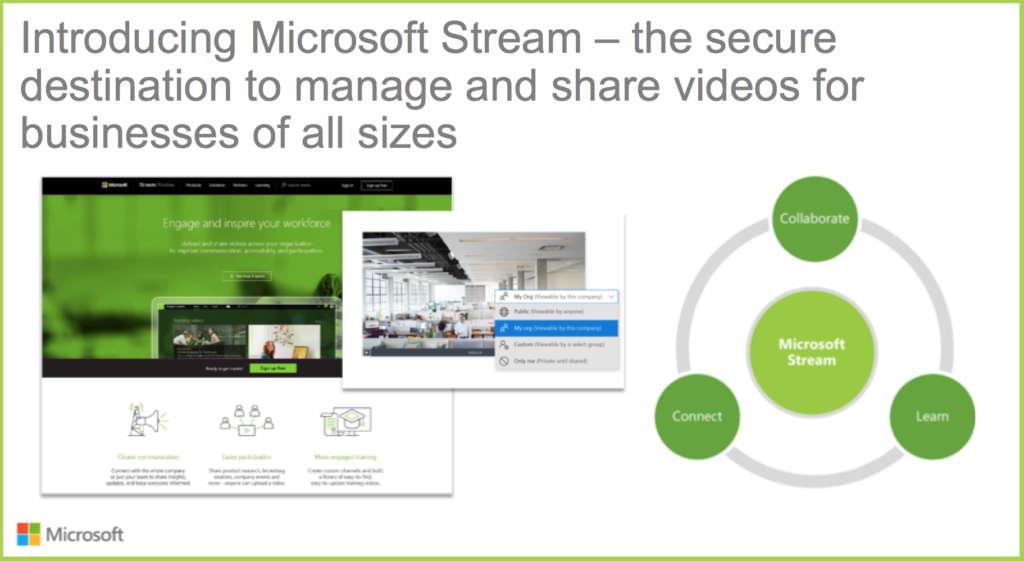
Microsoft Announces New Business Video Platform Called Stream, Will Replace Office 365 Video

Screen Shot 2016-07-18 at 12.17.46 PMThis morning, Microsoft announced the preview of a new business video platform called Microsoft Stream. Geared towards business communication, Stream builds upon the learnings of Office 365 Video, and over time the two experiences will converge, making Stream the de facto video experience in Office 365. I got to see a demo of the new Stream offering and overall, was quite impressed. While Stream has some limitations today, Microsoft envisions Stream as a unified communications platform and plans to add a lot more functionality, making it a true end-to-end enterprise video platform. Anyone with a business email can sign up today and use Stream for free to upload, share, discover, tag, secure and playback their video.

Microsoft isn’t saying when they plan to start charging for Stream, or what it will cost, but did say they will always have a version of Stream that remains free. The company told me they will give out more details on different pricing packages by the end of the year.

While Stream has a good start in terms of features, a lot more needs to be added to the platform to make it on par with some of the other solutions in the market. In my conversations with Microsoft, they are already well aware of what they need to add and here’s how they see Microsoft Stream evolving:

  • Deliver corporate broadcast seamlessly: Increasingly the way organizations are communicating and connecting is through live video. We believe that Microsoft Stream portal should be the destination for both live and video on demand.
  • Intelligent video search: We believe true power of video will be realized once we are able to search within the video. Leveraging capabilities such as audio transcription and face detection, we can enable deep search, empowering employees to find relevant content faster.
  • Make video part of your business apps and workflows: With the ability to integrate Microsoft Stream with other business apps like PowerApps, Microsoft Flow, SharePoint and other line of business applications, we see great opportunity to leverage the richness of video across apps.
  • IT management capabilities: We recognize the critical role IT plays in managing content and user access to internal content. We plan to enable IT to manage access and settings like granting and assigning channel and video access, remove and monitor content and manage what is viewable to specific groups in the organization.
  • Microsoft Stream App Ecosystem: We believe our partners will take Microsoft Stream experiences to the next level. Using Microsoft Stream APIs, partners will be able to create custom applications and make them available in AppSource, Microsoft’s marketplace for business applications we announced earlier this month.

While Microsoft hasn’t said the timing on when these new features will be coming to the market, customers will also be able to automate business workflows through Microsoft Stream’s planned integration with Microsoft Flow, a business application to automate workflows among customer’s favorite apps and services. So we can expect to see Stream turn into quite a robust enterprise video platform over time, with a lot of functionality. And by tying Stream into Microsoft’s cloud services, especially Azure Media Services, which lets you ingest and encode live video, it’s clear that Microsoft wants Stream to become the standard platform enterprises use for both live and on-demand video. You can see a marketing video of the platform here.

The Pokemon Go Craze Is Having No Material Impact On CDNs & Wireless Carriers

Last week, someone put out a note on Wall Street suggesting that the whole Pokemon Go craze would be positive for CDN provider Akamai. But in reality, Pokemon Go is built on Google App Engine’s platform as a service, which provides the game with a mobile backend. Google’s Cloud platform is powering Pokemon Go, not Akamai. Niantic Labs, which made the Pokemon Go game with backing from Google and Nintendo, stores and indexes Pokemon Go’s data from the game using Google Cloud Datastore’s NoSQL database. Pokemon Go also uses the game engine product Unity to help create the online game world and also uses Google Analytics.

The confusion for some probably stems from the fact that Akamai put out a press release in April, announcing Nintendo as a customer. I think it is possible that Akamai might see a small bump in traffic from other Nintendo related content thanks to Pokemon Go, but it’s not going to materially affect their revenue. It’s also interesting to note that Sandvine has put out some numbers on the usage and the traffic from Pokemon is quite small, averaging just 8MB used per hour.

Some have also suggested that the wireless carriers are seeing a ton of traffic because of Pokemon Go, but that’s not the case. Last week, Verizon Wireless said that Pokemon Go makes up less than 1% of its overall network data traffic. I checked with someone from T-Mobile, who didn’t want to be quoted, but said they also were seeing less than 1% of total traffic from Pokemon Go usage. No doubt about it, Pokemon Go is having a big impact on a lot of consumers right now, but it’s not having a material impact on CDNs or mobile operators.

Updated Chart Lets You Compare All Of The Streaming Boxes and OTT Platforms

With all the options in the market for getting your streaming media fix, trying to keep track of which box supports 4K, has support for HDR or which content services are available can be confusing. So I’ve just recently updated our streaming media devices chart which will make it easier to compare specs on each box. The latest version of the chart can always be found at www.streamingmediadevices.com and in the lower right hand corner is the date the chart was last updated. [Latest update: August 30, 2016]

Thanks to Amazon, Roku, Microsoft, TiVo, Sony and NVIDIA for fact checking and confirming all the specs you see on the chart. But if you find an error, or have any questions on which box to pick, email me anytime mail@danrayburn.com

Screen Shot 2016-07-12 at 10.53.30 AM