Bloggers Need To Cover More Than Just YouTube And UGC Companies

With all that is going on in the online video world today, why is it that most of the blogs and news sites only seem to focus on YouTube or user generated content topics? This week is typical of most. Over the past four days, I have read about 450 posts from 54 sites that I have in my RSS reader. Of those 450, nearly 60% of them are about YouTube, user generated content, video and social networking sites and topics all pertaining to user generated content in some form.

What about all of the other exciting subjects pertaining to the online video world? Why aren’t more bloggers talking about video in other markets like the enterprise, broadcast, mobile and education markets? Or what about the infrastructure side of the business. Servers, encoders, formats and tools. Yes, some cover these subjects but literally just a handful. If user generated content sites did not exist, I really wonder if a lot of these bloggers and news sites would have anything to talk about?

Am I the only one who is tired of reading a few dozen stories a day about YouTube and other UGC sites that to date, have shown no successful business models? Yes, I understand the role UGC will play in our industry and I understand the excitement around these tools that enable anyone to get video online. But our industry has been around for the past 14 years now and user generated sites have been around for only a few. There was an entire industry and business before the UGC sites were even around, but you wouldn’t know of it the way many of these sites only talk about YouTube.

Sponsored by

Microsoft’s Internet TV Strategy

Last100.com has a detailed two-part story that outlines Microsoft’s current and future strategy for Internet TV posted by Mack Male who also runs the WindowsMediaBlog.com site. It’s a good read that gives insight into Microsoft’s history in the space and covers many of the products and platforms that have had over the years including WebTV, UltimateTV, Windows Media Center, Microsoft TV Foundation Edition, MSN TV2, Xbox Live Video Marketplace and Microsoft Mediaroom.

Speaking of Internet TV, I’d be interested to hear readers feedback on whether or not the phrases Internet TV and IPTV are interchangeable in your eyes and mean the same thing?

MSNBC.com Needs To Dump MSN’s Lousy Video Platform

MSN Video
I first wrote about this back in March and I am amazed that even since then, MSNBC.com still can’t get it’s live video streaming to work for anyone with a Firefox or Safari browser. And the worst part, they have no problem delivering you a 15 second ad in the player first, BEFORE they tell you that your browser does not currently support live video. So I have to sit through a video ad only to then be told that I can’t see the live stream I clicked on.

MSNBC’s video player has said it is in "beta" ever since it launched, which was at least a year ago. And it’s still in beta? The technology behind MSNBC.com’s video offering is "powered by MSN" which in my eyes is even worse. If MSN can’t provide the video functionality MSNBC.com should have, then MSNBC.com should fire MSN and use a platform that actually works. But of course that won’t happen.

MSN is completely clueless when it comes to its video offering if they think users are going to stay loyal to MSNBC.com as their news source when every other news site does it better. If MSNBC.com was smart, they would dump MSN video immediately and or fire whoever manages their video offering. But they won’t do that as Microsoft wants to push their IE browser on you, except that they don’t make IE for the Mac, so Mac users are basically just screwed as well as PC users who don’t want to use IE and prefer to use Firefox instead.

Last time I posted about this, some readers wrote in to say:

– "It’s not just Mac users. I have a PC as well, and many of MSNBC’s videos won’t play on it either if I’m using Firefox. If I use IE, then I’m okay."

– "I’ve also enjoyed using Firefox on my laptop, but i can NEVER get MSNBC video to work with Firefox on my laptop – it is so frustrating!"

– "Come on MSNBC, get your stuff together. If amateur webmasters can make this stuff work, so can you. You just don’t want to."

2007 marks the 14th year that streaming media technology was first used on the Internet and it’s sites like MSNBC.com that make the technology look like it has barely evolved in that time and gives the entire industry and technology a black eye. As much as MSN says video is an important part of their business, clearly their lack of interest in making their videos work properly says otherwise. It’s as simply as being greedy and wanting to push IE on us, including those platforms they don’t even make IE for.

Microsoft as a company has been late to the game when it comes to all
aspects of the Internet and video is no different. MSN, MSNBC.com,
Soapbox etc… are all behind the times when it comes to their video
offering. You’d think they would want to prove the opposite by having a
quality video offering but they are stuck in the politics and red tape
of a company that can’t get out of it’s own way.

My suggestion to MSN, get out of the video business. You have no
concept of what a good user experience is, you can’t provide basic
functionality that ever other major news outlet has been providing for
years and you’re insulting users by making them sit through ads when
they can’t get to the content they want. You can’t even provide a basic
player check to see if the user has the system requirements that are
needed – which companies were doing back in 1998.

Give up MSN. Throw up your hands and move on. You can’t win in the video game.

Yahoo! Video Shows Us The Problems With Online Video Advertising Today

Online Video Advertising
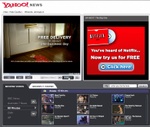
You’d think by now content companies, especially the large portals, would have figured out a better way to deliver online video ads in a compelling manner. But if Yahoo! News is any indication, the world of online video advertising has a long way to go before this business grows like we all want it to. Delivering online video ads is still a terrible user experience with un-targeted ads, of different lengths, too often in the content whilst taking away all of the user control.

If you want to see clips from the show 60 Minutes, Yahoo!, through a deal with CBS, has created a portal at http://60minutes.yahoo.com. While the interface of watching and finding videos is decent, the entire business and delivery of online video ads is horrible.

I chose to watch the story about online gaming and a window popped up with the video and nine thumbnail videos below the main window. Before the start of the video, I was delivered a 30 second ad for Netflix. While the ad was playing, nothing on the website was clickable, forcing me not to be able to click on any other links and disabling all content on the site. And once the ad was over, the video that played was only about a minute in length. What Yahoo! has apparently done is taken the 60 Minutes segment on online gaming, and cut it up to nine one minute segments. So when a user clicks one of the other thumbnails to watch the second section of the video, they get another ad, again for Netflix, again 30 seconds in length before you get to watch a video that’s 48 seconds long.

And if you want to watch all nine segments of the show, get ready to also sit through nine ads. Adding this up, I have to watch nearly four minutes of ads, to see a segment of content less than nine minutes in length. And the ads are completely un-targeted. I got 6 Netflix ads, and 3 ads for online trading. So why is there no ad system in place showing me different ads? Does Yahoo! really think showing me the same ad six times is what consumers want or is effective for the advertiser? And why were some of the ads 15 seconds in length and others were 30 seconds? In the same piece of content you’re delivering two completely different ad lengths which is a horrible user experience. I get a fifteen second ad which I then get use to with this content, only then to be delivered one twice as long when I watch part two of the same piece of content.

And even if you let all nine of the videos play back to back playlist style, Yahoo! still puts many ads before each of the segments breaking up all of the content into way too many pieces. If a segment like 60 Minutes is under nine minutes in length, it should not be broken up into nine pieces. And why is it that the 60 Minutes episode that is on the Yahoo! portals home page, is one from close to a year ago and not from the episode that aired last night on TV? The story of online gaming was one I saw on TV at least six months ago. But the one I saw last night on TV is no where to be found on the Yahoo! website.

Online Video Advertising
To find it, I have to go to a different website. And not the CBS Innertube website where you would think it would be since that is where you can watch full-length CBS shows, but rather you have to go directly to the 60 Minutes website on CBS.com. And once there, while I can find the video, see the screen shot on how it plays. It is embedded into the page, in a window that is larger than it actually plays in. But I guess I can’t complain since while the video window is super small in size, it is free of ads.

For all the talk of how big the online video industry is, it’s not even going to be a billion dollar industry this year, compared to TV advertising which is expected to do over $22 billion this year. While many times different segments of the online video industry say that the business models are what’s stopping the growth of an industry and not the technology, when it comes to online video advertising it’s the opposite. Online video advertising technology still does not provide the level of functionality, standards, reporting, targeting and interactivity that is needed to drive this business forward a lot faster. The technology needs to get fixed before this business can really start to take off.


Google And I Agree On One Thing: TV Is Not Dead

Oldtvset
It’s good to see that I am not the only one who thinks people are crazy when they say that TV is dead. TV is not dead. People kept telling me they don’t watch TV anymore and only use their computer for video. What are they watching? Nearly every single show I watch is not available on the Internet today, in any form. TV is the only place I can see it. Yes, other means of distribution are going to affect the TV platform, but people are not abandoning the TV in favor of video online like people make it sound.

And to date, those creating content for the web are not creating the type of content that I personally want to watch. And even if they were, can I get it in HD? No. Can I watch it on a large screen? No. Can I easily watch it on my computer with someone else? No. When I travel and am in a hotel, is there a computer there? No. Can I TiVo it? No. Can the Internet scale like TV? No. The TV and the PC (or Mac in my case) are not the same platforms, showcasing the same content, or providing the same kind of experience.

An article in Business Week recently said, "when the line between the TV and Internet will blur…" and it’s a comment you hear all the time. The line will never blur between them. They offer different experiences, on different devices, one via a closed network, one open. Yes, they will have some cross over, but they will never "blur". No one will even confuse their PC for their TV or vise versa.

And it’s good to see that Google agrees. Vincent Dureau, head of TV technology for Google in a keynote address at the Internet Television Technology Conference this week said that, "on the surface it looks like TV is dead, but I believe there is actually a bright future for television." EETimes.com has details of the  keynote here. Some of their coverage said: Every minute six hours of video is uploaded to Google’s YouTube service. What’s more, "every day 95 percent of the YouTube library is watched at least once," Dureau said. That implies there is a broad, but fragmented audience for a wide variety of content. "You need to make the long tail of this content available, and the tail is very long," he said.

But I do disagree with Dureau when he says that the biggest problem right now is that users can’t find the content they want to watch on the Internet and it’s no surprise he says that search is the way to solve this problem. For me, it’s not trying to find the content online that’s the problem. The problem is that the content does not exist online. And telling me that there might be other content that is "similar" to the content I am looking for is not an answer.

If I like to watch MacGyver, which I do, then I want to see MacGyver shows online and not something that someone created that may be similar to it. I want to see that specific show. So search is not going to help me there. The Internet is not yet ready for TV as we know it and in my eyes, there is no such thing as "Internet TV" even though it is a phrase widely used in the industry.

Broadband Penetration Is Not What’s Driving Online Video

So many press releases and reports I read still talk to broadband adoption as if we are still in the year 2000. They say things like "due to the growth of broadband", "because of the proliferation of broadband subscribers" and "the widespread penetration of broadband" etc… broadband access is not the reason online video usage is growing.

At least 55% of all connected households in the U.S. are already accessing the Internet via a broadband connection (some reports say as high as 63%) and the majority of all users who are on a computer at work are on broadband. Yes, the downstream speed of broadband is growing but anyone who is on a DSL line gets at least 1.5Mbps which is plenty fast enough to get a 300Kbps stream, which is considered broadband today. And it should also be noted that two years ago, the standard rate at which "broadband" video was encoded, is the same it is today. So for all the hype around broadband, two or three years later, we’re still encoding and consuming the majority of our online video content at the same speed. So the growth of broadband has done nothing so far to change that.

When you talk to a company about it’s services or products in the space it’s amazing how many of them always throw in the broadband growth sentence as if they have to mention it, as if that validates something or makes them look like they "get it". And most times, if you then ask them for market data on how broadband is growing, at what speeds and in what regions, they have no idea. It’s like somebody in their marketing dept preps them and says "make sure to mention about how broadband is growing." I see it all the time on CNN as well when they interview someone on the stock exchange floor. The person being interviewed always make a reference to some aspect of broadband if they are from a tech company.

Yes, broadband plays a role in the consumption of video, but we’ve had over 100 million households with broadband access for almost the past 4 years now. We should be talking about the real factors that are driving the growth of online video and more importantly the factors that are limiting the usage and growth.

“What’s Next for Online Video Advertising” Meetup Video Now Online

Online Video Advertising
The session I moderated last week at the NY Video 2.0 Meetup entitled "What’s Next for Online Video Advertising" has now been archived thanks to Viddler. We had a good session with a lot of questions from the audience for the panel of speakers from NBC, DoubleClick, ScanScout and OMD.

The NY Video 2.0 Meetup is a free event organized each month by Yaron Samid over at Pando Networks. Each month the event draws 150-200 attendees and focuses on a particular topic in the industry. If you are in the NYC area this is a great event to attend for lively Q&A and networking.