Don Michels, Formerly From The FeedRoom, Now CTO Of Medialink Worldwide

Don Michels, formerly the VP of Technology for The FeedRoom wanted me to pass along the announcement that has taken on a new role at Medialink Worldwide as their CTO. If you want to contact Don, you can do so at his new e-mail address.

Sponsored by

Updated List Of Content Delivery Networks For Streaming, P2P & Video Downloads

Since my recent posts that listed the video delivery providers for CDN and P2P based services, a lot has changed in the market. In the past few months, new providers have entered the arena, acquisitions have been completed and other providers have come out to give more details on exactly what type of delivery services they are providing.

With that in mind, here is another updated list of all the content delivery networks I am tracking for video delivery. This list takes into account networks that are delivering video via streaming, progressive downloading and P2P. I’ve also noted what types of delivery each one provides and think I have them all right, but some of them still make it confusing as they may call it something else. If any of the delivery classifications next to a company’s name is not right, I’m sure the providers will let it be known in the comments section.

In alphabetical order the networks are:

Those not included on the list are companies who make products for the delivery networks, providers who are going after small businesses, or those who re-sell one of the providers above.

Keep in mind, in most cases you can’t fairly compare one company to another. You can only compare the products amongst the companies that are similar. 

How Is CDNs Network Performance For Streaming Measured?

No matter how big or small a content delivery network is, they all talk about the performance of their network. Small regional service providers, global CDNs, P2P providers etc… all market the value in everything they do regarding how good their network performs. The problem is, the more customers I ask, the more of them say they
don’t know how to compare one network to another for video streaming – and neither do I.

Aside from the network or servers being down completely and not being able to get the content at all, how does a customer see and more importantly measure the performance amongst any network? I’ve asked a lot of the CDNs and they all speak to Gomez, which is considered the industry standard amongst the networks, but Gomez doesn’t support streaming. It seems that most use Gomez to show network performance for delivering small cache objects and the market just assumes that any content, static or streaming, must see the same kind of performance. But as any network knows, delivering and scaling the delivery of small static images via HTTP is very different than delivering and scaling a 300Kbps stream via RTSP or RTMP.

Keynote provides a service to check your files on a particular network, but that service does not compare it from one network to another and it’s not real-world in the sense that Keynote does not have thousands of agents checking the files as if you have many viewers from all over the world testing the content. Keynote has only a handful of locations that tests the content which is evident by the fact that every delivery network in the Windows Media Certification program for hosting has been given an A+ ranking from Keynote, no matter the size of their network or the number of servers they have. I’m not knocking Keynote’s service, but it’s just not a real-world test if you don’t have thousands of clients all over the world, on many different networks, accessing the content.

I’ve asked many of the CDNs about any tools on the market or any products they have built that customers have access to, but so far, those CDNs I have asked have agreed that there is no easy way to really compare streaming media network performance. If that is the case, what options do customers really have? What is the solution to solve this problem in the market?

If you are a customer of a delivery network, how do you judge performance and what does performance mean to you? For the CDN vendors, what data do you share with customers that gives them an insight into how your network performs? Is there anything you show them that is specific to streaming media delivery?

Discussing The CDN Industry With Money Managers

I’ve been getting a lot of requests from industry analysts and institutional money managers to do presentations on the state of the CDN industry. Lately I have been doing a lot of these in small private groups directly for firms clients and customers. These tend to work well over lunch where firms can’t invite a small group of their clients and we spend an hour or two covering the different CDN vendors and the business opportunities in the industry.

Typically, the discussion covers a breakdown on each vendor in the space, their strengths and weaknesses, product feature sets, competitive differences, industry pricing and trends, market growth potential and details on exactly what customers are looking for in the way of services. I’ve done many of these over the past few months for multiple investment houses and enjoy discussing the market.

If you are interested in organizing a lunch like this, please contact me to set one up.

CDN Pricing Data: What The CDNs Are Actually Charging For Delivery

(Note: Visit www.cdnpricing.com for the most up to date pricing) In the last few weeks, we've seen a lot of analysts and others commenting on CDN "pricing wars" but none of them are mentioning any actual numbers on what the CDNs are charging or showing any real data on the pricing trends. So with that in mind, I'll detail what the going rates are today, how they have changed from last quarter and who it's affecting most in the market. In many cases, the pricing wars are not as drastic as many make it out to be, as many times, services are not being compared equally. Also, a lot of customers still don't know what the going rates are and are still signing contracts at high rates.

As an example of customers who don't know the going rate, last week two content companies each of whom do over 100TB a month in streaming delivery called me asking for data on pricing trends. In both cases they said they were paying just above $0.40 per GB with Akamai. They simply didn't know that the going rate for 100TB a month is on average, between $0.12 – $0.19 at Limelight Networks, Internap or Mirror Image. And I'm talking straight vanilla delivery of video via streaming and progressive download, not some custom need or custom requirement.

In many cases, Akamai is still getting paid 2x what the going industry rate is when charging customers on a monthly per GB delivered model. Now Akamai and others may say that Akamai is charging more due to a different level of service, reach etc…. but that can only be determined as being true or not true by the customer themselves who are comparing the same product from one CDN to another. That being said, Akamai is feeling the pressure to reduce it's pricing as more and more customers see that the pricing gap between Akamai and everyone else in the market has been so wide, for so long. Yes, two years ago Akamai was the only game in town for certain sized deals. But today, no one can argue that when it comes specifically to content delivery for video, there is more than just one option. With more providers in the market and some customers using a dual-vendor strategy, Akamai is no longer the only game in town for most deals.

Over the past 60-90 days, Akamai been aggressively cutting their pricing in half on large deals to be able to keep the business. While they are not matching the lowest pricing in the market, they are coming close to it on large deals, classified as over 100TB a month. I've heard from at least six customers in this time frame who have confirmed their pricing to me as being half what it was last year with Akamai on large deals. In some of these cases, when they negotiated these contracts six months or a year ago, the Akamai pricing was still the same. It's only in the last 60-90 days that Akamai has really started to reduce pricing on larger deals due to pressure in the market.

I'm also hearing that two year deals are not being signed as much and that customers are doing quarterly and yearly bandwidth commits with all the CDNs, instead of monthly commits. Another trend I am seeing is not bandwidth commits, but rather revenue commits where a company promises to spend X amount of dollars on any service with the provider over the course of a year. This practice is not new, but I am seeing more of them and they are more common with Akamai since they offer more than just CDN services. In many cases, the bundling of services other than content delivery for video is a major reason why many of the streaming only CDNs lose business. It may not be because their service is not as good as an Akamai, it's that they don't offer other products like whole site hosting, application delivery and other non-CDN products. For some customers this does not matter but for others it does and it's a deal breaker.

Every week, customers from the media and entertainment, broadcast, government and enterprise verticals call me asking for pricing data. They want to know who is out there, what they charge and what the going rate in the industry is. From all I have seen in actual contracts, RFP responses and pricing negotiations, Internap, Limelight Networks and Mirror Image are all about the same price wise. In many cases, Internap is a bit higher in pricing but I see most of that from the legacy VitalStream side and once Internap is finished integrating VitalStream into their network, I am curious to see if their pricing changes. It should go down since Internap owns the network and VitalStream didn't.

CDNetworks and EdgeCast would not share any actual pricing information with me so I can't say if they are around the industry average or are more expensive. And since they are new in the space, I have yet to see a customer who uses them or has included them in an RFP so I'll have to wait to see what they are charging. Panther Express is undercutting all of the CDNs out there on pricing BUT keep in mind, that they only support HTTP delivery, not content delivered via streaming media protocols. And there is a difference since HTTP is easier to deliver and costs less to scale. NaviSite's pricing I have not seen in awhile so I can't speak to their average rate. Since Doug Mow left the company I haven't heard anything from them or seen any RFPs that they have been included in. Same goes for VeriSign. I don't see them being included in RFPs and I have not heard of any customers of late that have signed with them. That's not to say that no U.S. customers have, but of the ones who call, none of them were using VeriSign. As for CacheLogic, they are working on a pricing model that charges customers not per GB delivered but per asset, so I really have no way to fairly compare them to the others since it's a different pricing metric. Level 3 is not yet offering streaming media delivery so we'll have to wait till Q4 of this year when their service goes live.

As for Amazon's S3 service, they don't do delivery. If you are interested in reading more about what Amazon does and does not do for CDN, read my post from two weeks ago entitled "Amazon Not Providing Content Delivery For Streaming."

Outside of the smaller regional service providers who are going after smaller customers, it leaves you with the P2P players and also companies like Move Networks. Keep in mind, many people think Move Networks distributes their own content – they don't. They use Mirror Image, Akamai and Limelight Networks to deliver their customers content. So I can't really compare Move Networks pricing to the CDNs since Move Networks uses them and it would not be a fair comparison anyway. The bottom line with Move Networks is that you pay a little more than you pay now to a CDN in order to use the Move Networks platform, that's the value they are offering, their platform and technology, not delivery. (My profile with Move Networks will be posted this week as well as an audio interview they did with Forrester)

That leaves you with the P2P players who to date, have not grabbed much market share or convinced content owners to move from CDN to P2P. In many cases, the P2P delivery networks are selling with the attitude of P2P "replacing" CDN instead of selling it as a compliment. Remember, it's about using the right form(s) of delivery based on the type of content you have, the format it is in, who the viewer is and the device it's being played back on.

So with all that being said, below is what the going rate is for streaming media delivery. These figures are based on actual contracts and RFPs I have seen in the market and comes from customers telling me on a weekly basis what they are paying. Since last quarters pricing, which I detailed here, the biggest change is at the 50TB+ per month commitment. Anything below 50TB+ has pretty much been level all year. Only above 50TB+ and really at 100TB+ is where the price has dropped from last quarter.

  • 1TB: High, $2.00GB, Low $1.50GB (no change)
  • 5TB: High, $1.60GB, Low $0.95GB (no change)
  • 10TB: High, $1.20GB, Low $0.89GB (no change)
  • 25TB: High, $0.95GB, Low $0.75GB (no change)
  • 50TB: High, $0.50GB, Low, $0.40GB (Q2 high was $0.65GB, low $0.45GB)
  • 100TB: High, $0.24GB, Low, $0.15GB (Q2 high was $0.29GB, low $0.19GB)
  • Above 100TB: It's all over the map. I've seen it as low as $0.12GB.

Note that these are what the going rates are, not necessarily the rates that ALL customers are being charged. Also, I know some people are going to write in and say my hosting provider or co-lo facility gives me a cheaper per GB rate. But I am talking CDNs here, which I classify as those who serve video content via streaming media protocols from multiple locations in the U.S. and at least one other region of the world like Europe and/or Asia.

I've always felt that as a whole, CDNs try to keep their pricing too secret. Doing a little bit of work, it's not hard for anyone to find out what any provider charges and how that compares to the market. Yes, there are situations where the above numbers do not apply when it comes to a customer needing something specialized or custom, but that's not most of the time. I would encourage all CDN vendors to share more of their pricing data and metrics with the industry since it's not a secret anyway. What is the average per GB price that a CDN charges between all of it's contracts? Of the customers you sign up each quarter, how many of them are specific to CDN services and out of those, what percentage are specific to  the delivery of video? There are a lot of metrics like this that providers could break out in the market.

Any provider who wants to use my blog as a way to share real data on pricing or any other aspect of their business, with actual numbers or ranges, you're welcome to do so in the comments section or you can write me directly and I will publish it or write a story about it with your input.

The Real CDN Market Share Numbers

In my eyes, the worst data that is routinely quoted in the market in all forms is the percentage of market share that any CDN vendor has in the market. None of those numbers are accurate because they are not backed up by any real data simply due to the fact that CDN providers and content owners do not release the majority of their data to the public or to research houses. For all those research reports you see about the size of market share, the number of streams delivered etc… all of the CDNs will tell you if you ask them that they provided ZERO data, other than what is already public, to the analysts who write the reports.

In two different articles about content delivery vendors last week, one said Akamai had 60% of the CDN market share and the other one said 80% market share. Which one is it? That’s a big difference in a market that is a few hundred million dollars. I see reports that say Limelight Networks has 10% market share and I also hear numbers up to 25% market share. So which is it? The answer is, no one truly knows. And the question we should be asking is why does anyone care? Does size or market share equal long term success?

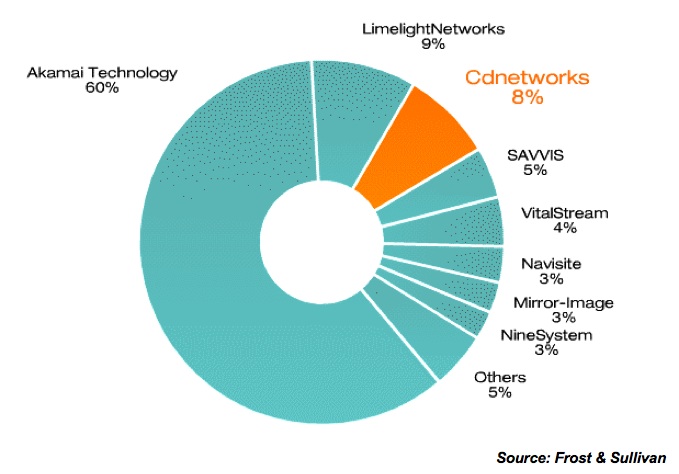
Recently, when speaking with CDNetworks they said they had 8% of the market share for CDN services and that Limelight Networks had 9%, based solely on revenue. When I asked where those numbers came from, the said from a Frost & Sullivan report on CDNs and they included a slide in their presentation showing the data.

Cd_2


I’ve see this data before from the Frost & Sullivan report as many use it, but it is just plain wrong. Not my opinion, but fact based on how they present the data. Even in the slide shown above, they contradict themselves with the data. We know that Limelight Networks did $64.3 million last year and that CDNetworks did $38.5 million. That’s a difference of $25.8 million. So how does that equal 1% difference in market share? And we know that VitalStream last year did $24 million before the Internap acquisition. So the different between CDNeworks and VitalStream is $14.5 million. But that $14.5 million apparently represents 4% of the market share? The numbers just don’t add up.

And the biggest problem with all of these reports is that none of them say anything about what market share they are talking to. Is this the CDN market share for all CDN products including those CDN services used to deliver JPG’s and GIF’s? Or is this the CDN market share just for the delivery of audio and video content? And is this the global market share or the market share in the U.S.? If it is global, then why aren’t companies like ChinaCache included? If it is global CDN market share numbers, they may say that ChinaCache is included in the slice on the chart that says "5% other". But the problem is that ChinaCache did over $10 million last year in revenue, so clearly they would not be included in the other companies that make up the 5%.

Some will say why do I care, at least someone is tying to put out some numbers on the market. That may be, but putting out numbers is useless unless the data is accurate. So what are the real market share numbers? No one knows. And no one will know unless all of the CDNs publish their revenue or the volume of data or streams they deliver. In order to compare one to the other to determine the market share, you have to have a metric to measure them all by.

Market share numbers do not matter. Revenue, profit and a sustainable business model is all that matters and those are not reflected in market share numbers. Netscape had more market share than IE, then what happened a few years later? Did their market share matter anymore? No, because their business model no longer worked. There are lots of examples like this. The industry should be focusing on the business and the long-term opportunities in the market and not where a company shows up on a pie chart.

Despite Limelight Networks Earnings, CDN Growth Still Strong

It’s good to see I’m not the only one who doesn’t think anyone needs to panic over Limelight Networks Q2 earnings that were reported yesterday. Light Reading’s article entitled "Limelight Outlook Won’t Doom CDNs" also talks to the tremendous growth in all aspects of the CDN market that I also see on a daily basis.

As much as Limelight Networks feel short of their projections by about $3 million, they did sign up 149 customers and grew revenue from Q1. The bottom line, all of the CDNs revenue from content delivery services are growing each quarter. Are they growing as much as investors want, maybe not. But since I don’t own any stock in any CDNs, I don’t care about stock prices. Stock prices do not reflect the true market opportunity. Stock prices go up and down based on many factors, most of which are all short term. And none of the CDN providers are thinking short term, they are all focusing on winning this game for the long run.

That being said, the number of analysts and writers out there who keep talking and writing about the vendors incorrectly seems to be increasing every day. No wonder there is so much confusion in the market. It’s a sign of just how hot the CDN industry is right now. But these folks need to take a deep breath, learn the market and then talk about the vendors with some clarity.

As an example, I was reading an article on Reuters about Limelight’s numbers and it says "CDNetworks is sniping at Limelight’s heels and said in July that it is well positioned take the second spot in the race to supply so-called content delivery networks used to speed up Web services." CDNetworks has less than 30 customers in the U.S. for content delivery and half a dozen employees. Limelight has over 800 customers and 58 employees just for sales alone, not to mention $100 million in sales by year’s end. CDNetworks has a third of Limelight’s revenue in Korea and will only do a few million this year for U.S. based sales. Mirror Image and Internap will do more revenue in the U.S. this year for content delivery than CDNetworks will do, so why wouldn’t they be nipping at the heels instead? The reason is that the quote the writer used is from CDNetworks and they take it as they are given it, without doing any analysis of what they are being told.

There are also a lot of articles being published talking about "startups" that aren’t startups and have been in the space for years. For instance from an article this week, "There are also an increasing number of startups in the CDN space, including players like CacheLogic, NaviSite, and Panther Express." Panther Express launched almost 2 years ago, and CacheLogic and NaviSite have been in the CDN space for a long time. The startups in the U.S. are folks like EdgeCast and CDNetworks who have launched in the past few months. That’s a startup.

In another article posted on Seeking Alpha, which talks about Akamai and the content delivery market, the author says "Upstart competitors Limelight Networks, Internap, and EdgeCast have recently received glowing press and funding from big names." Really? EdgeCast got reviewed by one press outlet. Limelight has been around for over five years and Internap is not new to content delivery. And Limelight is the only one that has gotten large funding lately.

The bottom line, there is huge growth coming from all customers. I hear from them directly and they are all putting more content online, at higher bitrates and getting longer playback times. Yesterday alone, two large content owners called me to ask advice on the going rate for CDN pricing and both said they expected to do two or three times the volume of delivery next year than they did this year. Both of whom are currently spending over $300k this year alone.

Content delivery has been around since 1994 when Sandpiper, InterVU and RBN started providing delivery services for video and it’s taken the past 14 years to get where we are today. As much as it’s been 14 years, the market is just now taking off and we’ve only scratched the surface of where this is going to go and the explosion we are going to see over the years for video delivery.

As much as people always says "content is king" the real winners in this space are not the ones who own the content but rather the ones that control the flow of delivery. The real game has just started and the winners, of which there will be many, will be the ones that are in this for the long-haul.