Adobe’s New Flash Server Pricing Improves CDNs P&L, Lowers License Fee For Customers

Fms3_60x45_5
While Adobe has gotten a lot of traction in the market with their Flash video platform, many content companies have not adopted Flash streaming due to the server license costs or the license fee that CDNs are required to charge for Flash streaming. With today’s announcement by Adobe of Flash Media Server 3 and the new Flash Media Interactive Server, those licensing costs have now been drastically reduced.

As was expected, Adobe cut the cost of the Flash Media Streaming Server which is now priced at $995 for an unlimited connection license. And the newly announced Flash Media Interactive Server, which is geared towards customizable streaming solutions, multi-way social applications, content protection and allows for more server side customization is priced at $4,500. (For technical details about the functions of each server read Stefan and Ryan’s blogs)

For some time now, Adobe has known that price has been the biggest hurdle for many customers to overcome in the adoption of the Flash platform. With the new pricing, Adobe has essentially removed the number one barrier to entry and while not discussed in the press release, has also reduced the cost that CDNs need to charge customers for Flash streaming delivery.

By reducing the costs that CDNs need to charge customers for Flash streaming, Adobe is making it a lot easier for customers to use CDNs  and enabling the content delivery networks to increase their margins. While the Adobe streaming license fee that most CDNs have been charging averages around $0.05 per GB delivered, the new Adobe streaming pricing is somewhere between $0.01 – $0.025 cents per GB depending on the CDN and the volume of Flash streaming they are pushing. Some CDNs have a better rate based on the volume they push and some CDNs include the price into their overall cost and reduce the price even further. The bottom line is that the average price per GB Flash streaming fee that the CDNs are now charging is at least 50% cheaper than what it was a few weeks ago. Within the past 2-3 weeks, quotes from many of the major CDNs have already shown lower license fees.

This is good news for the industry as a whole and for Adobe as the best way we can all truly benefit in the market is by having more widespread adoption, with a lower barrier to entry.


Sponsored by

VeriSign Expected To Sell Their CDN Business

Verisignlogo
A few weeks ago, VeriSign held they annual analyst day where they unveiled new details about the company’s strategic direction for 2008. Their newly announced strategy is to sell a number of businesses in the company’s portfolio, such as communications, billing and commerce and focus instead on their core business and a smaller group of products and services.

While VeriSign stated that it would review its content delivery offering over the next six months and decide whether or not to keep it, the CDN business is already being shopped around to other CDNs and content companies who many want to own their own network. While all the major CDN players are looking at the assets, it’s unlikely any of them will be a good match for the business. VeriSign’s CDN business really only consists of the P2P offering they acquired from Kontiki and has very little in the way of any traditional CDN products, so it’s really a P2P infrastructure sale. Most CDNs already have a P2P offering they have been working for some time or don’t have an interest in P2P until there is more traction in the market.

There is also the possibility the CDN business could be sold along with other products and services in a larger deal or all together if VeriSign as a company is sold. A few of the telcos not yet in the CDN business are currently investigating whether or not to offer a CDN product and this could be a cheap way for them to potentially enter the market with a P2P offering to start. The real question is how much revenue the CDN business is doing and what it’s assets are worth. My guess is that VerSign will probably do about $8-10M for 2007, but I don’t know for sure. One thing I would be willing to bet on is that VeriSign would unload it for a lot less than the $62 million in cash they paid for it.

It will also be interesting to see how this affects a few of the major broadcasters in Europe including
the BBC, Sky and Channel 4 who all currently use VeriSign’s P2P
solution for video delivery. Although based on a story yesterday by PaidContent.org, it sounds like Sky is abandon its P2P player and moving to a browser based system.

The biggest speculation I keep hearing is that Limelight Networks will buy the business so they can acquire a P2P offering and add some additional revenue. But the more that comes up, the more I think it’s not a fit for Limelight Networks as a company and if they were to do any acquisitions, they would have to be all stock based and one would think VeriSign does not want stock. My feeling is that VeriSign will make the decision very soon and part with the business very shortly. The real question is to who.

NBC Direct To Use P2P Video Delivery From Pando Networks

Pandologo_4
In September, NBC announced that come this fall they would launch a new service, named NBC Direct, that would enable viewers to watch some of NBC’s top TV shows as ad-supported downloads. While NBC plans to use many platforms to make their content available including iTunes, the move by NBC is essentially driven by the desire to cut out the middle man and deal directly with the viewer.

While most details surrounding the service have not yet been disclosed, three companies have been working together to build the NBC Direct service. ExtendMedia is doing the interface, YuMe is providing the advertising platform and Pando Networks has been chosen as the P2P technology of choice. When contacted last night, executives at Pando Networks would not comment for me on their involvement, but others I have spoken to have confirmed that after a long evaluation of various P2P networks by NBC, Pando has won the business.

When NBC Direct launches out of Beta, this will be the first major TV network in the U.S. to adopt P2P and make it such a crucial part of their distribution strategy. I know some will say Joost is already doing this and the BBC has been doing it for awhile but they don’t count in my eyes, for obvious reasons. The NBC Direct service will bring a lot of exposure to P2P and will help to legitimize P2P as a solution for some, not all, kinds of video delivery. NBC won’t be using P2P exclusively and as anyone who truly understands the value of P2P will tell you, it’s not a replacement for other distribution platforms but rather a compliment or enhancement.

For Pando Network’s it’s a big win and should lead to other major broadcasters and content companies giving them and other P2P platforms a legitimate shot at solving their video distribution needs. 2008 is shaping up to be the "perfect storm" for the video delivery segment of this industry.

Two weeks ago, I interviewed Yaron Samid, the Co-Founder and CMO of Pando Networks from the Streaming Media West show and discussed the current hurdles in the P2P industry and what role Pando Networks is looking to play in the market. (apologies on my audio levels as I was battling a cold)

New Book: Hands-On Guide To Creating Flash Advertising

20075235112352924
Last month, the latest book in my series came out entitled "Hands-On Guide To Creating Flash Advertising", written by Jason Fincanon. Amazon has the book the cheapest for $23.

The book covers how to create awe-inspiring, mind-blowing Flash ads and microsites that engage consumers and demonstrate their worth to clients and delivers the nuts and bolts of the development process from initial design conception to ad completion. You can views the table of contents on the Amazon website and see more details about what the book covers.

Anyone who posts a review of the book on Amazon will get a free copy of the next edition of the book when it comes out. This goes for bad reviews of the book as well, as all reviews are welcomed.

Streaming Media West Session Videos Will Be Archived Next Week

ScribeMedia.org is almost done editing all of the videos from last week’s Streaming Media West show. We should have all of the sessions uploaded into Brightcove and available for on-demand viewing by the end of next week. I’ll post the link to all of the videos as soon as they are ready.

Akamai Shows P2P Solution To Select Customers Last Week

While no official announcement was put out by Akamai last week about their P2P offering, last week in Munich Germany, Akamai showcased some of it’s P2P offering for a very small select group of clients and partners. Based on what some of those customers have told me, Akamai stated that P2P traffic will be priced lower than CDN traffic, but Akamai did not give out any pricing details.

Technical details of the service were not covered in depth, but those at the event were told to expect a technical white paper on the product within the next 60 days and were told that the P2P service will initially be limited to HTTP delivery only. No public launch date was mentioned for the service.

For me, seeing what Akamai does with P2P is important since they do have the most market share for video delivery and would be the first major non-hybrid CDN to deliver on an in-house P2P based service. With the number of video customers Akamai has, I’m eager to see how many customers are going to be willing to help push out a player to their viewers. If Akamai can get some of their major customers to do this, think Apple, then they could get some great traction for the player and give more valid exposure to the P2P industry.

CDN Pricing Data: Average Cost Per GB Declines In Q4 Due To Startups

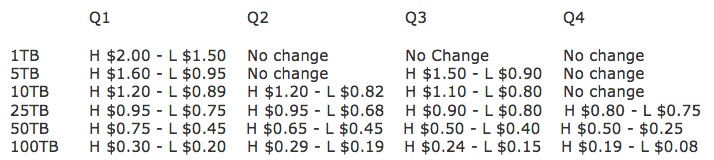
(Note: My latest pricing data can be found at www.cdnpricing.com)With all the talk in the market about the"pricing wars" taking place in the CDN industry, each quarter I review what the average going rate is and how it compares to pricing in the previous quarter. (Q3 pricing details here) The pricing data below is from my presentation last week at the Streaming Media West show entitled "CDN Pricing: Costs for Outsourced Video Delivery". The on-demand video of the presentation will be available shortly.

Before I get into pricing, there are some crucial things to cover. For starters, these are the average prices paid in the market. This does not mean that this is what every customer pays, or should pay. I list a high and low price based on the fact that there are a lot of variables with regards to the CDN product that end up determining the final price a customer pays. It is also REALLY important to understand that customers are not buying on price alone. In addition you CANNOT compare one vendor to another and doing so is not a fair apples to apples comparison. You can only compare the product lines of one vendor with another.

That being said, below is the pricing I have seen so far in Q4 and how it compares with Q3. If you look at these numbers by themselves, you will NOT get a full picture of the market. First, read my post from Monday entitled "Pricing Pressure On Akamai and Limelight Overblown By Analysts" which will give more insight into pricing.

While the high and low pricing average went down from Q3 to Q4, the reason behind that is the fact that a lot of new CDNs in the market are undercutting the more established players to try and grab some market share. Can they do this for awhile, yes. But over time, they won't be able to as they will lose money. For now, many of them have raised a lot of cash and can survive pricing lower in the market for the time being. For a new CDN, it is hard to sell a customer on value when you are new to the space and don't have a lot of customers to talk about. Over time, if they are successful, they won't have to lower prices and can sell on value, but that takes time.

These numbers also don't mean that every CDN in the market is undercutting the major players. In some cases they aren't and are selling on different features and functionality, not price. The bottom line is that pricing is still very fluid in the market on large deals, over 100TB delivered a month, BUT there is not as big of an impact in the market as many make it out to be. The whole idea that the CDN space is about to implode because there is a "pricing war" going on is inaccurate and backed up by no data. Are some companies not growing as fast as investors may like, yes. But don't blame that sole reason on the current or future price in the market. Again, there is more to a CDN than just the price.

And next year, pricing will be going up. When the new players in the market have been around for 6+ months, pricing will stabilize and many will realize they don't need to lower pricing to do a land grab. By then they should also have enough in place on their network to have an angle to up sell. We are at the point now where pricing has pretty much leveled off. Sure, there is always going to be a fluctuation in the market, but come 12 months from now, you won't see that much change in pricing at all from the established players. They won't give this stuff away at a lower price just to win business if they are going to lose money on the deal. Those days are over.

The pricing below is specific to video delivery, streaming or progressive download, there is no difference. This pricing does not include the platform license fee that CDNs charge for Flash Streaming. Before long, some things will be announced in the industry that will affect those numbers and I will cover the Flash Streaming license fee numbers at that time. The below numbers do NOT include video delivery costs via P2P. I will break those costs out in a different blog post as I now track those numbers separately.

So with all that being said, below is what the going rate is for video delivery based on a per GB delivered model. These figures are based on actual contracts and RFPs I have seen in the market and comes from customers telling me on a weekly basis what they are paying.

One_4


You can download all of the slides from my presentation here (Download DanRayburn-CDNPricingQ4.ppt)

I will be posting details on P2P pricing and P2P market trends shortly and will also cover a lot of what took place at the Streaming Media West show last week pertaining to P2P.