Limelight And Akamai To Stream NFL Games: New CDNs Not Winning Live Business

ImagesUpdated 12:12pm: Unlike the Olympics where Limelight is the exclusive provider for video, the NFL games will be streamed by both Limelight AND Akamai.

Starting September 4th, the NFL in conjunction with NBC will stream 17 Sunday Night Football games on nfl.com and nbcsports.com. While Limelight had no comment when asked about the recent announcement, I have learned that Limelight and Akamai will be the backend streaming providers working with NBC and the NFL. By my count, this makes at least five major wins or expanded contracts for Limelight in the past few months. Disney, Microsoft, Netflix, Amazon and now the NFL/NBC. While I don’t know the terms of the deal and whether the NFL or NBC will be the paying customer, Limelight is already closely working with NBC for the Olympics. The NFL content is new business for Limelight but for Akamai, falls under an existing contract they already have with NBC.

Many of the newer CDNs on the market have been talking for some time now about how they are only focusing on live delivery and how their "next generation" networks are so much better for live streaming than an Akamai or Limelight. But to date, I have yet to see any recently launched CDN win any of the big contracts for all of the live events that have happened or will soon take place. The Olympics, NCAA March Madness, Presidential Debates, Operation MySpace, Oprah’s Online Classes, Democratic National Convention, US Open for golf and tennis and the NFL Sunday Night Games amongst others. Akamai, Limelight and Level 3 combined are responsible for doing the delivery for all of these events.

This reinforces the fact that building out a global CDN to truly scale for large live events and have the required capacity and support pieces in place to handle such events is not as easy as some think it is. Live events are unique in that you get one chance and one chance only to get it right. You can’t add capacity after the fact like you can with on-demand delivery. The CDN has to be able to route traffic in real time, monitor and report back on the network to the customer in real time and deal with things like content ingestion, splitting streams across the network and working very closely with those who are capturing and encoding all the signals. Successfully delivering large scale live events it still not easy and it takes a very focused and disciplined approach to that specific segment of the market to be successful. The idea that any CDN can come along and simply add capacity and be able to handle large scale live events is just not accurate. 

Sponsored by

Microsoft’s Silverlight Player Not Required To Watch Olympics

Olympics
While news sites have been reporting for weeks about NBCOlympics.com video offering, most have stated that NBC is forcing users to download the Silverlight player in order to see live and on-demand video. This is not the case. While Microsoft is pushing users to download the Silverlight player in order to take advantage of the enhanced video options and control room that gives you access to switch between multiple live streams, those who don’t have the Silverlight player or choose not to use it will still be able to get stand alone video streams if they have the Windows Media player. When the Olympics start, users will be given an option to choose the Windows Media Player if they don’t use Silverlight. Updated: Read this post oh how to use Windows Media instead of Silverlight.

This is good news for users at work who don’t have admin rights to their desktop and can’t upgrade to the latest Silverlight player. With much of the Olympics content taking place during working hours, those inside an enterprise corporation will still be able to get the streams and tune in to the action. While NBC has not yet decided on the bitrates the video will be encoded in, I have confirmed that multi bitrate encoding will take place and should provide viewers with some really good quality.

Many have been asking me today, how Limelight and Akamai could both be streaming the Olympics. They aren’t. Limelight is delivering all of the live and on-demand video and Akamai will be caching and delivering a lot of the static content.

CDN Pricing Remains Stable In Q2: No Indications Of Slowing Traffic

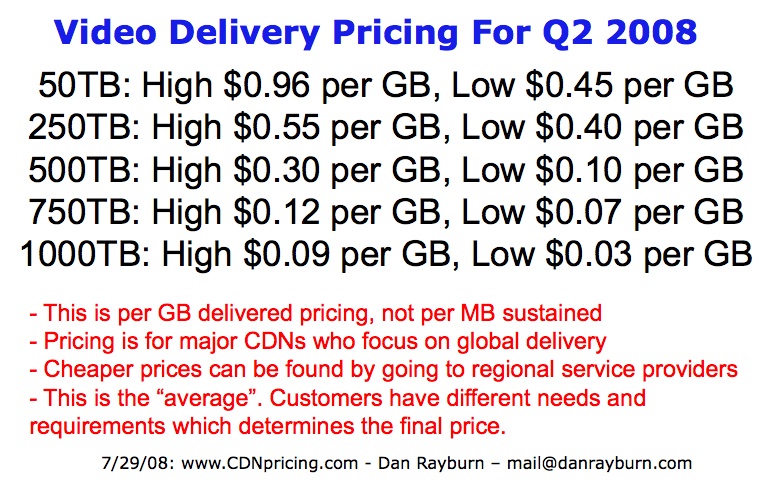
Comparing the data for content delivery pricing specific to video delivery in Q2 from the prior quarter shows pricing remained very stable in Q2 but with some new trends emerging. While pricing for Q2 is almost identical to Q1, there was a drop in the price per GB delivered for those customers who on average are doing over 1PB (petabyte) a month. While this is a small percentage of the total number of CDN customers overall, I did see new contract pricing as low as three cents ($0.03) per GB delivered on new 12 month contracts. In Q1, the lowest I saw was around two and a half cents but that was not the norm. (Note: you can easily find my latest pricing data at www.cdnpricing.com)

I think it is also important for me to point out that while many on
Wall Street are implying that the CDNs are seeing slowing traffic or less CDN growth in terms of the numbers of bits pushed, that is not the case. I don't see any market indications from customers or CDNs to lower traffic last quarter or any signs that customers are delivering less content. To the contrary, all I see is more bits pushed, more often, at higher bitrates and to more devices. With Akamai, Internap and Limelight all reporting numbers in the next two weeks, investors should be asking them details on the products that make up the numbers Wall Street cares so much about. Analyze the products the numbers come from.

One of the biggest trends I am seeing in new contracts is no monthly commits required. In its place, customers are committing to traffic over the course of the entire 12 months. While this is not brand new and has been going on for some time, it is now almost the norm for new customers who have a lot of delivery. Anyone doing more than about 500TB a month and in some cases even lower, is committing to a yearly amount of traffic instead of monthly. While this does not have much of an impact on CDNs in terms of revenue, it is good for customers as it gives them more of an incentive to push as much traffic as they can with the CDN. And since you don't pay overages on a per GB delivered model, customers are getting more content online and available for viewing. (related: Content Delivery Pricing: Understanding CDN Overages)

While some customers I talk to as well as analysts in the industry seem to think that before too long CDN services will be almost free, that could not be further from the truth. While pricing has dropped year over year, pricing has remained very stable for the last three quarters and should remain so. There is a direct fixed costs to running and maintaining a content delivery network and the services of a CDN will never be free or close to free. And while some of the smaller, newer CDNs are willing to give away the business to grab market share and are losing money on those deals, well established CDNs will not give it away and lose money. While every CDN I speak to always says they aren't losing money on any deal, I know that is not the case. I see some of the pricing on these contracts that some of the newer CDNs are charging and I know they are losing money on various deals. When they are pricing things at one or two cents per GB delivered, and they don't have the size or scale of a larger CDN to take advantage of buying transit in bulk, money can't be made at those levels. For those that worry this may erode the pricing of more well established CDN players, it won't. Customers are not buying on price alone and many customers I speak to are willing to pay more to be with a well established player who has been proving for years what their network is capable of.

At this time, I don't see pricing on these large deals going much lower when the lowest is at three cents per GB delivered. Many of the CDNs have told me that at that level, they are just breaking even and aren't making anything on those deals, which is ok since so few of their customers are getting that level of pricing. As CDNs continue to scale their networks and learn how to better optimize their servers, which gives them the ability to push more bits with less infrastructure, we could then see a small pricing decline. But I expect that will be 12-18 months off as most of the established CDN vendors don't expect to be able to really advantage of their next major network upgrade, on the software side, until that time.
CDN pricing

At the Streaming Media West show in September, I will be making two presentations on the CDN market. The first will be reviewing all of the latest pricing data and breaking down the numbers in greater details. This presentation is entitled "CDN Pricing: The Going Rate For Video Delivery".

My second presentation entitled "CDN Research Data: World Content Delivery Networks Market" will be my first report with Frost & Sullivan that will break down the CDN market specific to video. The data presented will also analyze the trends in different regional markets: Americas, EMEA, and Asia Pacific, as well as provide revenue and demand forecasts for CDN solution providers and peer-to-peer based solutions. Register for the show before Aug. 20th for the discount rate.

Winner Announced For VUDU Set Top Box Giveaway

The drawing for the free VUDU set top box is now closed. Christopher Bruss from Los Angeles, CA was selected as the winner using a random number picker website. Thanks to all who entered. I will have more product giveaways next month.

Wanted: Workshop Presenters For Streaming Media Europe

A day before the Streaming Media Europe show kicks off on October 16th, four workshop sessions are offered to give attendees some hands-on training with different technologies and products in the industry. We are currently looking for two workshop instructors for the subjects of ‘Comparing Video Formats and Encoding Tools" and "Webcasting Essentials".

These 3-hour sessions require instructors to lead the attendees through real-world examples of the technology in action and provide them with the tips, tricks and education they need to master the subjects listed below. We’re looking to pay two instructors who have experience with the topics, are based in Europe and have prior experience teaching a small group of industry professionals. Instructors who work in the industry, from a vendor organization are welcomed to submit proposals for review.

If you are interested, please contact Eric Schumacher-Rasmussen, conference chairman for the Europe show and provide him with details of your expertise on the subject, all of your contact details, and a brief outline of the topics you would cover in the 3-hour session on the subjects below. Do NOT just send him an e-mail saying, "I’ll do it". Act as if you are applying for a job and are giving your qualifications. Any questions or further details, please contact Eric directly.

Workshop 1: Comparing Video Formats and Encoding Tools
This updated workshop is a crash course to help you evaluate and select the right delivery format for your content. Independent streaming media consultant Dale Sorenson will deliver direct comparisons of the latest streaming media formats and codecs, including Flash, QuickTime/MPEG-4, RealMedia, and Windows Media, and objectively evaluate and quantify the pros and cons of each format. A comparison of encoding applications will also be discussed to help you choose the tools to get the best-quality results for your content.

Workshop 2: Webcasting Essentials
Work through the five phases of a webcast—planning, production, encoding, authoring, and distribution. To add to your real experience, the workshop itself is treated as a webcast, with the goal to webcast live from the workshop. This workshop covers production techniques and encoding hardware and software including the Windows Media Encoder and RealProducer. Workshop attendees are encouraged to participate in the webcast production to get the full "live" rush.

NY Video 2.0 Meetup Tonight In NYC

Nyvideo20
A quick reminder that tonight is the NY Video 2.0 Meetup at Webster Hall in NYC. Come see screen clips and discuss what’s working, what’s broke and where the industry is headed with Internet TV. Over 500 have people have already RSVP so if you want to go, better RSVP fast. Come hear a town hall discussion led by a panel of Internet TV innovators.

  • Robert Millis – Founder, Hudson Street Media
  • Paul Kontonis – Founder, For Your Imagination
  • Andrew Baron – Founder, Rocketboom
  • Jay Smooth – Founder, Ill Doctrine
  • Sarah Austin – Founder, Pop17
  • Kathleen Grace & Thom Woodley, Founders, Dinosaur Drama Productions

Visit the NY Video 2.0 Meetup website for all the details.

Streaming Media Magazine Launches European Edition

Smuk_europe_185 StreamingMedia.com is excited to announce that it is launching a special European edition of our print publication called Streaming Media Magazine. If you live in the UK or Europe, now is your chance to sign up for a free subscription, with its first issue to be published in September of this year. Editorial stories for this issue will include coverage of the content delivery market in Europe and the UK; a crash course in Flash video; webcasting with Windows Media; producing content for mobile devices and a preview of this year’s Streaming Media Europe show, to be held in London, 16-17 October.

Subscribe before July 31st and you’ll also be entered to win Apple’s new 3G iPhone!