
Microsoft Research Paper Measures Limelight and Akamai’s Network Performance

Microsoft_logo_2
At the end of this month, folks from the Microsoft Research team are presenting results at the Internet Measurement Conference from a recently completed CDN study with the Polytechnic Institute of NYU entitled “Measuring and Evaluating Large-Scale CDNs“. While the event is not for a few weeks, the technical study is now public and available from the Microsoft Research website. Having read through it, the paper is one of the most comprehensive technical white papers I have seen on the subject in quite a few years that is available in the public domain. (UPDATED: On October 15th, I was informed by Microsoft Research that they “decided to withdraw the paper from the Internet” and as a result, I was required to remove my links in this post to the paper.)

For the study, Microsoft Research and the Polytechnic Institute of NYU conducted extensive and thorough measurements to accurately characterize the performance of Akamai and Limelight. Their measurements included charting the CDNs (locating all their content and DNS servers), assessing their server availability, and quantifying their worldwide delay performance.

The purpose of their measurements was to shed light on two radically different design philosophies for CDNs: the Akamai design, which enters deep into ISPs; and the Limelight design, which brings ISPs to home. They compared both CDNs with regards to the numbers of their content servers, their internal DNS designs, the geographic locations of their data centers, and their DNS and content server delays.

In speaking to one of the authors of the paper yesterday, he commented that their measurement techniques can be adopted by CDN customers to independently evaluate the performance of CDN vendors and can also be used by a new CDN entrant to choose an appropriate CDN design and to locate its servers. While the Microsoft Research team was originally going to study hybrid CDNs and P2P delivery, they quickly decided that comparing Akamai and Limelight different network architectures would be a great subject to tackle.

While some might be under the impression that the divisions inside Microsoft that use Akamai and Limelight for delivery commissioned the paper, this is not the case. They were certainly interested in the results, but the report was initiated solely from Microsoft Research and the Polytechnic Institute of NYU.

I will be highlighting some of the findings of the technical paper in multiple blog posts over the course of the next two weeks.

Sponsored by

Most CDNs Still Charging More To Deliver Flash Streaming

For content owners who want to stream Flash videos with a CDN in the Adobe FVSS program, it’s always been more expensive to deliver streaming videos with Flash than Windows Media. The reason for this is that unlike Microsoft, which makes its money by charging a CPU fee per Windows server that can then run Windows Media Services, Adobe gives CDNs a special build of the Flash Media Server and then makes their money by charging CDNs a license fee based on the number of bits they deliver.

For some CDNs, they bundle that license fee into their cost of doing business. For others, they pass that cost along to content owners on an average of about a penny per GB delivered, which is much_less than it was about a year ago. For customers, that amounts to an extra $1,000 a month for every 100TB of transfer. For larger customers, Adobe has been flexible in working with CDNs to reduce the license fee if the content owner is doing a really large volume of Flash streaming each month.

To find out which CDNs still charge a license fee versus those who don’t, I asked about half of the CDNs in the Adobe FVSS program, on the record, if they charge a Flash license fee.

  • CDNetworks: Typically does not charge a license fee, but depends on price points. The lower the unit
    price, they may charge more for flash due to licensing and lesser
    efficiency of server capacity
  • ChinaCache: Does not charge any license fee
  • EdgeCast: Does not charge any license fee
  • Highwinds: Does not charge a license fee unless the pricing is for a really large deal
  • Internap: Generally does not charge a license fee but they do take Adobe royalty into account on large deal pricing
  • Level 3: Does not charge any license fee
  • Limelight Networks: Depending on the deal size they may charge a license fee
  • Velocix: Does not charge any license fee

Based on contracts I have seen in the market, Akamai and Mirror Image, who are also in the Adobe FVSS program but didn’t respond to my inquiry, charge a license fee for all Flash streaming deals. AT&T, who wasn’t listed on the Adobe site as being in the FVSS program only a few weeks ago, has just recently been added. They also didn’t return my request for details and having just been added into the program, it’s too early for me to know their Flash streaming pricing.

The good news from all of this is that EdgeCast, Velocix and Level 3 no longer charge any license fee for Flash streaming. Last year, all CDNs charged a license fee of some kind, so the fact that three CDNs in the FVSS program are no longer charging customers for Flash streaming is a good thing. Over time, I expect more CDNs will join them in doing away with the license fee as they get more traffic on their networks and ramp up their services.

While Adobe has been good at reducing the license fee amount since last year, my opinion still is that it’s a bad pricing model. I continue to hear from content owners who don’t use the Flash platform for streaming due to the increased cost, especially for those who are pushing a lot of traffic. Why should the customer have to pay more to deliver their content in one format or another? For a lot of the CDNs that have just built out their Flash streaming networks and have a lot of capacity that is not being utilized, running all their servers at 50%, the license fee is best.

But as they ramp up their business and their build-outs are done, every CDN would prefer to pay Adobe a CPU fee instead of a fee based on traffic. Right now, the Adobe Flash license fee is annoying and a nuisance to many CDNs who want to sign up content owners quickly and ramp up their business as fast as possible. Having to explain to content owners why one format is more expensive than another and trying to then figure out how much more expensive Flash streaming is, when the customer does not even know their traffic, only complicates the process.

I expect that over time, Adobe will move to a CPU based fee for CDNs that deploy Flash Media Servers. Last year, Adobe saw that the high cost of the Flash license fee was hurting adoption and hence made a move to reduce it from around five cents per GB delivered, to about one cent per GB delivered. That change had a big impact on the CDNs and Adobe and as a result, Flash streaming has gained a lot more traction in the past twelve months. To date, Adobe has been good at keeping their eye on the market and adjusting their business model to give content owners more of a reason to adopt Flash for streaming, live and on-demand. If Adobe were to take the step of doing away with the Flash license fee for content owners completely, and get their revenue stream from a CPU license from CDNs, the adoption of Flash streaming would only continue to grow.

Why Is Akamai Charging More For Streaming Video Delivery Versus HTTP Delivery?

Over the last few weeks, I am getting more and more customers asking me why Akamai is quoting one price for streaming delivery and another price for HTTP based video delivery. Am I’m not talking Flash streaming where some CDNs still charge an Adobe license fee. Even with Windows Media, Akamai is charging a higher price to deliver content via a streaming media protocol as opposed to delivering content via HTTP.

I don’t know of any other CDN in the market that is pricing video delivery this way and as a result, I see Akamai not winning a lot of new deals in the market as customers don’t understand why they should be "penalized" for doing streaming over downloads. Why would Akamai care what protocol a customer is using? Does it cost Akamai more to deliver streaming on their network versus downloads? It shouldn’t. If this was simply about Akamai charging more for their services, no problem. It’s a free economy and if you can get more for your services, more power to you. But that is not what this is about. This is about Akamai charging more for one protocol over another and not explaining to customers why they are the only CDN in the market doing this.

I asked Akamai for more details on this so that when customers call me I can educated them on Akamai’s pricing strategy. Unfortunately, all Akamai wanted to say on the subject was "we don’t discuss pricing specifics publicly." I can understand if you don’t want to "publicly" discuss it, but clearly Akamai is not even discussing it with potential new customers or I wouldn’t have so many content owners asking me for an explanation.

This is a bad practice on Akamai’s part not only because of the effect it has on them winning new deals, but also because of the impact is has on the industry. As an industry, we need to move away from the idea that content owners need to make decisions based on protocols. Should a customer really care and have to decide on what protocol their CDN is using? Absolutely not. All they want to do is use the best combination of technology and protocols based on the type of content they have for the device it is being played back on. The pricing and bundling of content delivery services should be made as simple and easy as possible for customers. Every other CDN other than Akamai has already done this in the market and charges one rate for streaming or downloading video content.

Backed By Sequoia Capital, New CDN Cotendo Launching Early 2009

Cot_logo_2
Earlier this year, Sequoia Capital invested less than $5 million into a new CDN startup called Cotendo. After spending the past year on development, the company expects to launch their content delivery offering in "early 2009". While there are already too many CDNs in the market shipping bits, Cotendo assures me that they are not going to be focusing on simply pushing traffic and instead will focus on building applications and IP.

The U.S. based company, which currently has their R&D based out of Israel, continues to add new employees to the roster. Former Limelight Networks employees Gary Baldus is now running ops and Mike Sawyer is running marketing. While it is too early to talk in detail about Cotendo’s offering, it’s a hard time for any new company who plans to enter the content delivery market. One of the biggest things Cotendo has going for them is that they have to date, only raised a small round of funding. That being said, I would not be surprised to see Sequoia Capital doing a larger, second round, sometime next year once Cotendo gets up and running. Having only gotten a few million to start, it’s simply not enough capital to bring a product offering to the market with any scale.

More details on Cotendo’s offering will be released to the market later in the year, but in the mean time, the list of content delivery networks just keeps on growing.

No Major Consolidation Amongst CDNs Anytime Soon

While some are saying there was a lot of talk at the Streaming Media West show last week about consolidation in the CDN market, no major consolidation amongst CDNs is coming anytime soon. At any conference where there are 20+ CDN vendors represented, you are always going to hear some talk about consolidation. But notice that none of those vendors talking about consolidation think they are the ones getting acquired? They all talk about how they are going to acquire someone else and usually make the case as to why they themselves don’t need to be acquired. And the idea that some CDNs will have to sell soon at a cheap price when they go under and have a "fire sale" is just not reality.

The problem with all of these theory’s is that all the CDNs have raised a ton of money, so no fire sale is going to happen for some time. Even for CDNs that are burning through startup capital, they all have at least 14-18 months before they have to worry about getting another round of funding, or re-evaluating their business strategy. Aside from Akamai and Limelight, who are always potential takeover options with the revenue and market share they both have, no other major CDN benefits from acquiring another CDN today or anytime soon. Most of the CDNs have no applications, no ecosystem tools, no IP, no patents and very little revenue. So what do you get from combining two CDNs who both sell commoditized services? There is simply no value there. If you were getting applications, work flow tools and other assets that help a CDN charge for other value add services, then potentially it makes sense. But right now, most CDNs don’t have that functionality.

And if a CDN can’t sustain itself in the market, how does acquiring it change the business model? The only thing you can hope to do is drive down the costs and scale the business and the CDN to operate more efficiently and make money. But the business model remains the same, it’s really just the infrastructure that would change. And if any large portion of the revenue from the CDN being acquired comes from the enterprise or advertising verticals, that sector has seen some slow down in growth due to the economy. Unless someone is buying a well established player, who has real revenue and a large market share, it would be a huge risk purchasing a CDN anytime soon.

While some of the more than 50 CDNs are selling on future services like HD delivery, the bottom line is that services like HD won’t have any big financial impact on the CDNs for more than two years. This means that any CDN that is building out their services for the future is going to have a hard time getting enough sales today to even last into the future. Many remember when iBEAM Broadcasting came into the CDN market and undercut everyone to get a lot of CDN business quickly, even while losing money. The idea was that they could grow fast and be around a few years later when the market really took off and then raise their prices. It was the Amazon mentality of "get big fast". It worked for Amazon, but iBEAM went under after about two years. CDNs have to build revenue today, close sales today and think about the current market, not what the market will be 2-3 years from now. What good is the market 2-3 years from now if you are not around to see it?

And inside the CDN indsutry, amongst the vendors, there is really very little talk of consolidation. The idea of consolidation comes mostly from outsiders, Wall Street and some analysts who cover some of the CDN vendors, but don’t really know the market.

CDN Pricing In Q3 Drops At Some Levels: Vendors A Bit More Agressive On Pricing

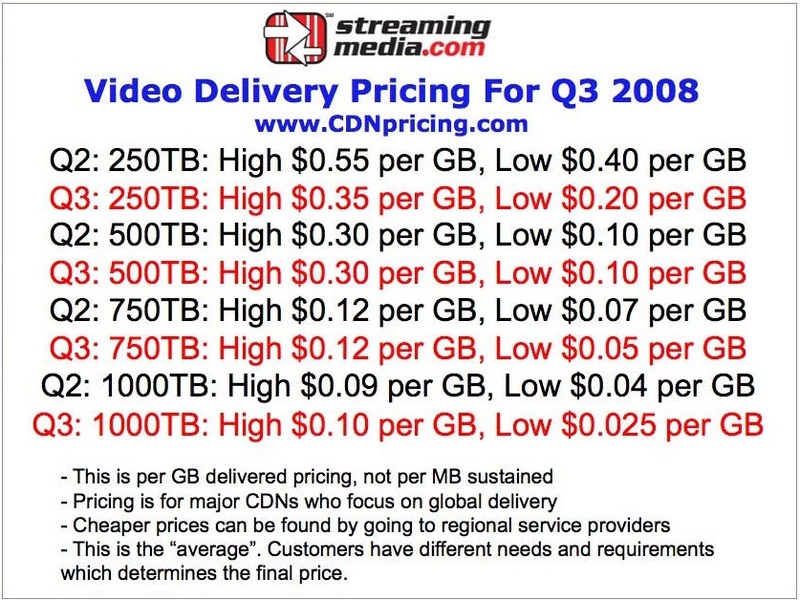
At last week's Streaming Media West show, I presented the latest CDN pricing from the third quarter for pricing specific to video delivery from the major CDNs. Overall pricing remained somewhat stable, but there was a large drop in pricing for some levels of volume compared with pricing earlier in the year. (note: you can easily find my latest pricing post at www.cdnpricing.com)

I saw the biggest drop in pricing at the 250TB a month level with pricing on the low end dropping by 50% over the previous quarter. While 250TB is not a huge customer, a lot of "average" customers are in this range. Pricing once again dropped for customers doing over 1000TB a month, but that is expected since that is such a large amount of traffic and the largest customers always have some pricing flexibility.

Overall, many of the CDNs are getting a bit more aggressive when it comes to pricing but still are NOT giving business away. I still see some of the major CDNs passing on business if the customer wants pricing that is just too low. Also, in the last two weeks, I have seen three RFPs where the major CDNs all bidding on the business were priced within four cents of each other. The exception to the rule was Akamai who was coming in at almost double to what all the other CDNs were charging and it should be noted, did not win any of those three deals.

While many report that Level 3 has the lowest pricing in the market, that is not the case. Limelight is the most aggressive with regards to price and every Level 3 deal I have seen is in line with what most of the other CDNs are charging. I do not see a huge gap between the CDNs in terms of what they are pricing deals at except with Akamai.

Below is my pricing slide from the presentation and all of my slides from the presentation can be downloaded here. Note: this pricing is for video delivery, streaming and progressive download. I don't distinguish any difference between protocols. Also, this pricing does not take into account any Flash license fee which only a few of the CDNs still charge.

Cdnpricing_2

The average contract length I am seeing for video only delivery is still 12 months. For contracts that include more than just video delivery, things like small object delivery, static caching etc. contract lengths average close to 24 months.

For those that think pricing will only continue to drop, think again. Once customers start pushing a lot more traffic, they will be at a level where the CDNs can't discount it much further or they risk losing money. The real question and the thing we have to watch closely is when the CDNs can drop pricing across the board AND still make money. This will only happen when the economics of scale kick in and the CDNs are able to operate their networks cheaper, with vastly increased scalibility than they are doing now. I think realistically, for many of them, that can happen by Q2 of next year.

I will have more thoughts on the CDN market and what I heard from the Streaming Media West show in posts later this week.

Streaming Media West Conference Videos Available Soon

Thanks to all of those who helped make the Streaming Media West conference a success once again. Hard to believe but last week’s show was the 10th year that the industry has been getting together in CA to talk about online video. Most of the presentations from the sessions are now archived and can be downloaded here. All of the sessions are currently being edited and encoded and we will start posting them online in a few days at www.streamingmedia.com/videos

I have a lot to blog about from the show and am quite behind on my posts, but will be picking it back up this week. If you attended the show and have any follow up questions, please contact me at any time.