How To Create A Customized Flash Video Player

For those who wanted to attend the canceled session at the Streaming Media West show entitled "How To Create A Customized Flash Video Player", Adobe has nicely recorded the content from this session at their office and made it available online. You can see the archived presentation on Adobe's website. The presenter, Kevin Towes, has also posted his contact info in the presentation should you have any follow up questions.

Sponsored by

Some Venture Capitalists Need To Blame Themselves, Not The Economy

I keep seeing reports, like this one on the New York Times blog, entitled "Venture Capitalists’ Confidence Plummets to an All-Time Low." Of course, many VCs want to simply blame the current economy and point their finger at the global financial troubles taking place for the reason their investments may not be looking so hot. And while some VCs are legit in saying that, to me, it seems a vast majority of them should be blaming themselves, and not the economy.

I speak to many VCs and while some of them are very knowledgeable of the market and product vertical they are investing in, many aren’t. Some have no idea how big the market opportunity it, who the major competitors are and what their product offerings look like for the industry they are investing in. How many times have we seen VCs give a large chunk of money to someone who has no real business model, no business experience, yet says they have really great technology so that’s why they invested. And I’m not talking about the content delivery business here. Think about what we saw two years ago in the UGC market, or what we’ve seen in regards to the number of "Internet TV Platforms" who have raise a lot of capital, but have almost no revenue.

Lately, companies have been coming out of the woodwork approaching me about new compression technology they have, new codecs etc… all of whom have already gotten lots of money, but literally have no idea how they are going to turn their technology into a business. All they keep wanting to talk about is their technology without the understanding that it is worth nothing if they don’t have a way to monetize it. Or they say things like, "my technology is going to compete with Flash". Ok, good luck.

Of course, we have seen this before. Many VCs are making multiple bets and hoping some of their investments pay off to help cover the ones that don’t. I understand that is how the game is played. But the idea that many VCs simply point to the economy as the sole reason why they have no confidence in any industry is wrong. VCs need to start doing a better job of truly understanding the market opportunity and competitive landscape they are investing in. The most common responses I get from VCs when I ask them why they invested into a particular company is usually, "the founders have great technical backgrounds", "many of the executives have PhD’s", or "they have the best technology we have seen". What about the business experience of the executives, the market opportunity for the product/service and the business model for the company?

Akamai & Limelight Say Testing Methods Not Accurate In Microsoft Research Paper

Last week, I posted about a new technical research paper entitled "Measuring and Evaluating Large-Scale CDNs" that was put out by the Microsoft Research division and the Polytechnic Institute of NYU. The purpose of the study was to conduct extensive and thorough measurements to compare the network performance of Akamai and Limelight Networks.

Some noticed that I did not take any stance either way on the findings of the paper, which was mainly due to the fact that I am not a network engineer and don’t pretend to know everything that is involved in properly testing a network. That being said, both Akamai and Limelight Networks responded to my requests to review the paper and provided me with their comments. Both agreed that there is a lot more to properly testing a network than just the two aspects of CDN performance the paper looked at. Limelight has posted their response to the paper on their blog and Akamai response is as follows.

Based on our internal review of the whitepaper, we believe that there are a number of stated conclusions that are incorrect. These include:

1. Akamai is less available
This conclusion is false. The researchers tested the responsiveness of a single server and group of servers independent of our mapping system – note that this is not the same as measuring the general availability of Akamai’s content delivery services. Because Akamai’s software algorithms will not direct traffic to unresponsive machines or locations, all their conclusion really points out is that a portion of our network is not in use at any time. (This may be due to hardware failure, network problems, or software updates.) We believe that any measurement of availability must take into account Akamai’s load balancing, and that if specific IPs are being tested, then the researchers are not doing so.

2. Akamai is harder to maintain
This conclusion is also false. While Akamai has more locations, and more machines, the power of the distributed model with automatic fault detection means that Akamai does not have to keep every machine or location up and running at all times.  It is incorrect to infer from the fact that some servers are down that Akamai’s maintenance costs are higher.

3. With marginal additional deployments, Limelight could approximate Akamai’s performance
We believe that this conclusion is also false. In our opinion, the research team’s performance testing methodology likely overstates Akamai’s latency numbers. This is because any of our server deployments in smaller ISPs that do not have an open-resolver nameserver would have been missed in their discovery process. It is important to note that these are also the locations where we get closest to the end users.  If those locations were discovered by their research, we would expect the average latency numbers derived from the measurements to be lower. If they are missing some of our lowest latency deployments, then naturally the average, median, 90th and 95th percentiles will change for the better. Because these deployments are the best examples of our "deploy close to the end user" strategy, missing them affects our results more than it would Limelight’s. The networks most likely missed are either smaller local ISPs in the U.S. and EU, or providers in specific countries. These are exactly the places where we’d expect Akamai to have very low latency, but Limelight to have higher latency (especially in Asia, etc.) As such, we believe that the research team’s measurement method ultimately under-represents our country, "cluster", and server counts because they missed counting these more local deployments that do not have open-resolver nameservers.

4. After testing akamaiedge.net, they concluded that Akamai uses virtualization technology to provide customers with isolated environments (for dynamic content distribution)
This conclusion is false. The akamaiedge.net domain is used for Akamai’s secure content delivery (SSL) service, used by WAA and DSA. While these services do accelerate dynamic content, Akamai is not using virtualization technology to provide customers with isolated environments – ultimately, the research team reached an incorrect conclusion after observing how we handle hostname to IP mapping for secure content. The measurements done also concluded that akamaiedge.net servers were in a subset of locations as compared to the larger Akamai network – this is correct, as our SSL servers are hosted
in extremely secure locations.

Furthermore, while the akamaiedge.net network is in fewer locations than the akamai.net network, it is still in more locations that Limelight’s entire network. In addition, the measurements done for this network also under-counted the number of servers and locations. Finally, the whitepaper did not provide figures on CDN delay for this network, only DNS delay.

It is important to reinforce that the "per server" and "per cluster" uptime and availability measurements in the whitepaper that show Limelight as more "available" bypassed Akamai’s mapping system. As such, even if our mapping system never would have sent traffic to a location, they are counting us as unavailable. 

Having a more distributed model (as Akamai does) de-emphasizes the importance of any one location, so much so that we can have entire locations down without impacting performance. Similarly, the researchers don’t sufficiently consider the penalty associated with an unavailable Limelight cluster. One down location in Japan, when it is the only region in Japan, would ultimately have a much greater performance impact than having one of 20 locations in Japan become unavailable.

Additionally, it is also important to reinforce that the research performed did not measure general performance of Akamai’s services (as we would do for a customer trial), but rather DNS lookup delays, and the delay to reach the server selected by Akamai’s mapping system – these are only two components of a full performance measurement. By unintentionally filtering out many of the best examples of our "deploy close to end user" strategy, the research team has grossly misrepresented our availability numbers and also over-estimated our latency.


Economic Conditions Not Affecting Video Traffic On CDNs, For Now

With all that is taking place with the economy, not surprisingly, the most frequently asked question I am getting is what impact is the economy having on traffic growth for video across content delivery networks? So far, I have not seen any content creators putting less video online and from all the content creators I have spoken to, they are still seeing traffic growth. But the real question is not whether or not traffic is growing, but whether video traffic growth across the CDNs is slowing.

While the CDNs don’t publish their traffic numbers on a monthly or quarterly basis, I have had in-depth conversations with many of them in recent weeks and so far, they are not seeing any signs of video traffic slowing down. Some of that might be offset by the fact that many content creators have moved to higher bitrates and as a result, are pushing more bits, which could be confused as more traffic. And while some slowdown is being seen in very specific markets for the delivery of things like ads and small objects, the traffic for video related content continues to be strong. Without knowing what percentage of traffic across a CDN comes specifically from video, some of the data from the CDNs is hard to verify. That being said, the best data comes directly from the content owners who are the ones paying for the content delivery services and the ones who know all the traffic data.

I’ve spoken to most of the major broadcasters over the past month, many of whom were at Streaming Media West, and it is clear that they are still seeing the kind of video traffic growth they expect, with no signs of that slowing. While I don’t see the economy having any impact on the CDN market in terms of traffic growth, the economy and the general market for CDN services is going to have an impact on many of the CDNs by 2010. As I have said many times, the market is not big enough, and will not grow fast enough to support 50+ video content delivery offerings in the market.

Netflix May Dominate The Online Video World, But With What Business Model?

Netflixlogo
Yesterday, the New York Times Bits blog had a post that rationalizes how Netflix could become the leader in online video content. While I agree that Netflix has made huge strides due to their deals with Xbox, Starz and of course the Roku player, the real question is how they plan to make money from this new distribution strategy?

Each time Netflix streams a movie to your PC, Xbox or Roku, they pay a fee to deliver the bits and pay another fee to the content owner for the rights to distribute the content. Right now, the streaming movie services offered by Netflix costs them money but helps them retain Netflix customers. But over time, as subscriptions to their DVD service slows, how will Netflix translate their online video offering into revenue? Can Netflix convert those who use the DVD service over to a streaming only service? And more importantly, will Netflix offer a streaming only service for those who want to stream movies to the Xbox 360 and Roku but don't want physical DVDs?

Some say that by making the Xbox 360 capable of getting Netflix content, the Xbox 360 console will be more attractive to new users who are deciding on whether to buy an Xbox 360 or PS3. I would agree that for some, it makes the Xbox 360 more attractive. But unless Netflix is getting paid by Microsoft to help sell consoles, which I don't believe they are, Netflix only sees additional revenue today if the user who bought the console is not currently a Netflix subscriber and signs up for the service. And the idea that Netflix can easily tap into the Xbox 360 community around the world is a great idea, but in reality, causes big problems since much of the content from the major studios is typically licensed on a region by region basis.

With Netflix still only having less than 15% of all their DVD inventory available for streaming, the volume of popular content continues to be a major hurdle. If Netflix can get more first-run movies online it will help, but how long will it take to get even 50% of their content online? The problem does not lie with the encoding and hosting of the video but rather the licensing deals with the content owners. Netflix's success with their streaming offering is solely dependent on the major movie studios giving them distribution deals to stream more of their library over time. But the real question is how much inventory will they allow Netflix access to and over what time period?

Netflix is smart to do all of these deals as no one will argue that it makes a Netflix membership much more valuable than it currently is if you could only get physical DVDs. But at some point, Netflix is going to have to make up for the huge amount of money they are spending to stream all of this content to devices. Right now, the Netflix streaming service is a loss leader. That's fine for now, but how quickly is Netflix going to have show how they are going to make money from the service? They may be able to do a streaming only subscription down the road or maybe advertising will creep in over time, but right now, Netflix is burning through money to make all this happen. Exactly how much we don't know, Netflix won't say on record how much their streaming service is costing them. Over time, I think they will get so much pressure from investors that they will have to break out those numbers.

For Netflix, the streaming service is a big gamble that they are betting everything on. They have to turn the streaming service into a real business model down the road or they risk having a cool service, but one that costs them money. If it was anyone else, I'd say they have some bad odds at making it. But so far, Netflix has been very smart at how they operate, doing things like making their platofrm open and providing APIs. I give Netflix about 14 months before they have to start showing investors how they are going to turn their IP based video offering into sustainable business model. I'm rooting for them.

SM West Keynote Video: Roku CEO & Founder, Anthony Wood Talks About Open SDK

On day two of the Streaming Media West show last month, Anthony Wood, Founder and CEO of Roku gave attendees a preview of how future content will be consumed on the TV. He also discussed about how Roku will soon offer a software development kit to allow their Roku box to be opened up to additional content besides Netflix movies.

Almost all of the conference sessions and keynotes from the Streaming
Media West show last month are now available online at
www.streamingmedia.com/videos.

SM West Keynote Video: Albert Cheng, Disney ABC TV

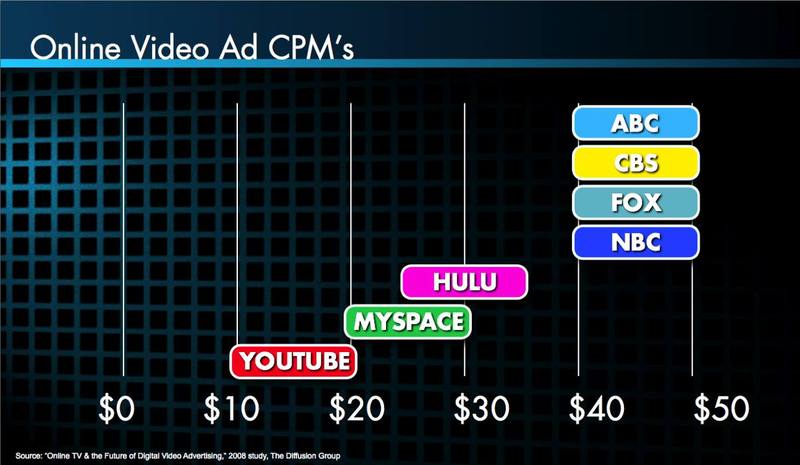
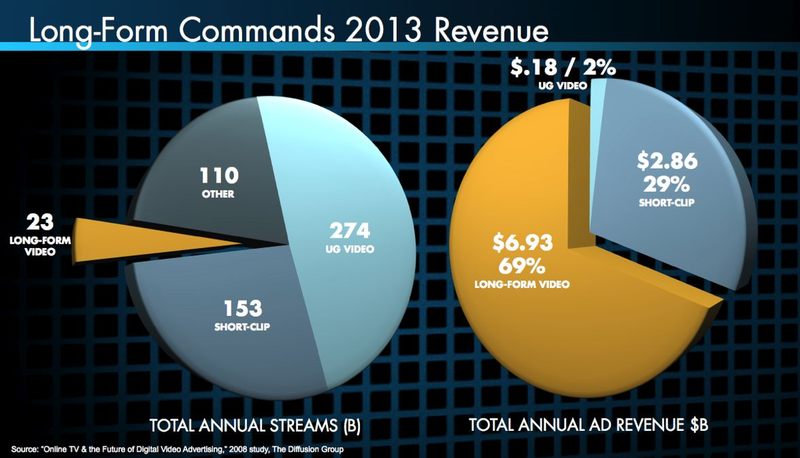
On day two, Albert Cheng, EVP of Digital Media for Disney ABC Television Group opened the Streaming Media West show with a keynote discussing the current state of the online video advertising market and ABC’s strategy with their video player. Albert’s presentation also gave details on CPM rates amongst some of the major content portals and he discussed the impact long form content will have on ad revenue in years to come. You can download his entire slide deck here.

Abccpm
Abcrevenue

Almost all of the conference sessions and keynotes from the Streaming
Media West show last month are now available online at
www.streamingmedia.com/videos.