Roku To Stream Netflix HD Movies By End Of The Year

Before the end of this year, Roku will be releasing Netflix HD content to all Roku customers as a free, automatic upgrade. While exact details on the encoding bitrates are not known, Netflix HD content on the Roku should look better than Netflix HD on the Xbox since Roku will be using "advanced profiles" encoding.

Using advanced profiles encoding will allow Roku to deliver the same HD quality video, but at lower bitrates. This enables users who don't have high-end bandwidth to still be able to get HD quality video. While interlaced video content is typically de-interlaced before encoding with the Windows Media Video codec, advanced profiles supports compression of interlaced content without first converting it to progressive content. Microsoft says that maintaining interlacing in an encoded file is important if the content is ever rendered on an interlaced display, such as a television.

While I don't expect a lot of Netflix's inventory to be available in HD at the time of launch, giving all Roku users HD quality for free will definitely help Roku sell more boxes. In addition, last week, Roku announced that it had raised a third round of funding from Menlo Ventures. Even in today's poor economy, investors clearly still believe that Roku has a chance at making a dent in the market. With the list price of the Roku box being just $99 and Roku planning to open up their box soon to content other than Netflix, they have a good shot at getting some real market penetration.

Sponsored by

Review: Hands-On With Streaming Netflix On The Mac

Netflix-mac-screen
This morning, I have been testing the new Netflix Mac streaming service that Netflix announced earlier in the week. The new watch now functionality, for Intel based Apple computers, uses the Silverlight 2 player and provides the same level of decent quality, from what I can tell, that current PC users of the watch now service get.

While Netflix won't say what bitrate the videos are being encoded in, the quality of the videos could use some improvement as any movie with quick pans, cuts or intense lightning, tends to produce some pixelation. (Click on the screen shot on the left for an example) That being said, the video quality for PC users using the watch now service is no different, so nothing experienced with the Mac offering seems to be any different than the PC one.

The Mac offering works just as well in Safari or Firefox and initially, Netflix says the availability of the new service will only be available to a small percentage of customers, with service being expanded to all users by the end of the year.

As for the user experience, the video playback and controls are nearly identical to watching and controlling Netflix content with the Roku. Jumping into any section in the movie gives you thumbnails with screen grabs of the scene and gives you a quick and easy way to see where you are in the movie. In addition, Netflix has added to the Mac and PC versions, a new set of arrow keys that allows you to jump back and forth between episodes in a series.

Overall, no real surprises with the Mac service as it's nearly identical to the PC version. But for us Mac users, this is a welcomed addition and one that we wish Netflix would have done sooner. My guess is that Netflix was waiting until Microsoft had the Silverlight 2 player out since it uses PlayReady DRM and content owners licensing their content to Netflix probably required them have to use some type of DRM technology.

Internap Closes The Door On VitalStream Acquisition: Takes $99 Million Writedown

It should come as no surprise to anyone that yesterday, in a 8-K filing with the SEC, Internap announced they would take a write down of "approximately $99.7 million" for the value of the CDN business Internap purchased from VitalStream for $217 million in 2007. While some have been speculating that the write off should have been closer to $200 million, Internap's CDN business does have some value and has to be assigned some sort of fair evaluation. With Internap reporting earnings next week, I expect we'll hear more on how they decided on the $99.7 million number and how they value their CDN business moving forward.

For Internap, it's been a really rough year for their content delivery business. With the write down now behind them and the uncertainty of what they may or may not do out of the way, hopefully this now closes the door on the VitalStream acquisition mess and allows Internap to move forward with their CDN offering. Next year is a clean slate for Internap's CDN business and if I were them, I would treat their CDN business as if it was a new startup in the market and completely re-align and re-brand their content delivery offerings.

Review: Hands-On With Netflix Movies On The Xbox 360, HD Included

Netflix2
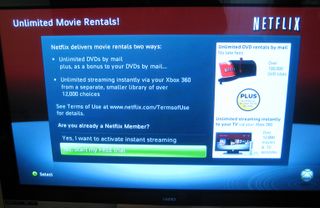
Thanks to the folks at Microsoft and Netflix, I've gotten the new Xbox 360 console upgrade and have started watching Netflix movies on my Xbox this morning. A couple gaming sites have been doing some reviews as well and have raised a bunch of questions, some of which I have already asked Microsoft and Netflix and will update this post if I get answers.

The new Xbox 360 console update, which will be release to the public on November 19th, includes the highly anticipated ability to stream Netflix content to the Xbox 360 console as long as you are a Microsoft Live Gold customer and a Netflix customer.

After downloading the new console update and then downloading a small Netflix update, you active the streaming functionality by entering a code from your Xbox 360 into your Netflix account via the computer. From there, you can add Netflix videos into your watch now queue and they instantly show up on your Xbox 360. Navigating through your movies is done by going to the Netlfix box in the "Video Marketplace" channel which takes you to an app that allows you to very cleanly and very quickly flip through the movies in your queue. The movies are represented by cover artwork of each movie and even when you have a hundred or so titles in the queue, the app is super fast. I would compare the experience to being almost identical to flipping through albums in iTunes using Cover Flow. The only major downside here is that movies still have be added via the computer first, before they can be played back on the Xbox 360.

Once you select a movie, you get a screen with details about the video and the ability to rate the content as well as the ability to start, resume or remove the video. When you select play, the app checks your connection speed and buffers the video. For me, the videos buffered very fast and I never waited more than about ten seconds for any video to start. That may not be the startup time for the average consumer though as I am on a 20MB FiOS connection. While most movies are in SD, Netflix has to date made about 300 videos available in HD, many of which are TV series and not actual movies. Watching the SD movies on a 50" plasma screen looked amazing and HD is really incredible. The quality of the stream is all based on your connection speed and I am waiting on Netflix to hopefully give me details on the encoding bitrates being used. But the bottom line, the video quality is really, really good and in my eyes, is DVD quality with no frame rate issues.

Netflix and Microsoft have clearly thought about the experience, the ease of use and the quality of the videos being delivered and overall, I expect users will be very happy. That being said, this hands on review leaves me with three main questions that will dictate how successful the offering will be.

For starters, what is the business relationship and model behind the new service? With three parties involved, Microsoft, Netflix and content owners, whom is paying whom to make all this happen and how will money be made? I know this is a new service to start and hence, a clear business model has not yet been established. But over time, one will have to emerge.

Second, does the availability of getting movies on the Xbox 360 now mean that more content owners and in particular, major movie studios, will start giving Netflix the rights to encode and deliver more first-run movies? Hopefully so, but they still control the content and have a big say in the success that the Netflix service will have.

And finally, will Microsoft and Netflix come up with a way to organize and search the entire watch now inventory directly from the Xbox 360 console without having to use a computer? From what I can see, that is the only missing functionality of the service that would make the experience better. UPDATE: In regards to adding this functionally Netflix said, "This likely will change in the future – can’t say when".


Roku Capable Of HD Streaming, Netflix HD Content Only On Xbox 360 For Now

Thanks to the folks at Microsoft and Netflix, I am currently testing the new Netflix streaming functionality to the Xbox 360 and will have my review up in a few hours. While Netflix is not currently offering HD quality video via Roku or the Netflix watch now service, about 300 pieces of video content are available in HD from the Netflix app on the Xbox 360.

In addition, while some have speculated that the current Roku box can't do HD streaming, and is the reason why Netflix does not offer HD video quality, this is not the case. Roku confirmed for me this morning that the current version of their Roku box is currently capable of streaming HD quality video. The lack of an HD offering by Netflix via the Roku box is not due to any technical limitation of the Roku hardware. While Netflix won't say what their time line is for adding HD quality video via Roku and their watch now service, they did comment to say that their HD rollout would be modest to start. To me, that makes sense. Netlfix is kicking off streaming to the Xbox 360 next month, has just added Mac support for the watch now service, thanks to Silverlight, and is adding more content from the likes of Starz and CBS to their library. Netflix will bring the HD content, but all in due time.

This is a an exciting time for Netflix, Roku and the Xbox 360. Between new console updates, Netflix streaming on the Xbox 360, Mac support for Netflix's watch now service and additional funding for Roku, things are really heating up.

Comparing HD Video Quality: Microsoft Details SmoothHD Video Encoding Specs

With multiple online HD video offerings on the market today, comparing the "quality" from one format/solution to the other is difficult and will only get harder. Many of the HD solutions look really similar to one another and have large window sizes with great picture quality. To really compare the quality of the video, the encoding specs need to be compared so you can do as close of an apples to apples comparison as possible. With that in mind, Microsoft has provided me with details on what the encoding specs are for the HD content being shown at SmoothHD.com.

The majority of the content is encoded with these settings

  • 320×176 @ 400 kbps
  • 424×240 @ 650 kbps
  • 640×352 @ 1100 kbps
  • 848×480 @ 1500 kbps
  • 1056×592 @ 2000 kbps
  • 1280×720 @ 2500 kbps

The content from Turner, MLB and NASCAR, were encoded with a 20% higher bitrate due to content complexity:

  • 320×176 @ 500 kbps
  • 424×240 @ 800 kbps
  • 640×352 @ 1300 kbps
  • 848×480 @ 1800 kbps
  • 1056×592 @ 2400 kbps
  • 1280×720 @ 3000 kbps

All audio is 64 kbps stereo using WMA 10 Pro. Since dynamic bitrate switching is based on available client bandwidth and playback frame rate, the player is able to switch between bitrates as often as every 2 seconds if necessary. Microsoft also noted that Akamai will likely also add a higher quality NBA re-encode, at 3 Mbps peak, sometime in the next day or so. Thanks to Microsoft for the encoding specs, which many times, are very hard to get from content owners or those distributing the content.

Limelight’s Recent Network Buildout Lowering CDN Pricing, Impacting Margins

Over the past few weeks, content delivery pricing for video is once again starting to show signs of major pricing declines coming in this fourth quarter. And while aggressive upstarts like BitGravity and others are leading the pack with some of the most affordable pricing in the market, Limelight Networks has quietly been getting a lot more aggressive on pricing, all the while reducing their own delivery costs.

The interesting thing I am seeing in deals is that Limelight seems to be lowering their price based on new messaging to customers telling them that due to Limelight's recent and continued network buildout, their costs to deliver video has dropped dramatically. If this in fact the case, Limelight is taking advantage of the economics of scale on their network faster than I was anticipating. I originally thought Limelight and others would be able to leverage their new scalability sometime in the first or second quarter of next year and at that time we would see another price drop in the market. Now, it appears that at least Limelight is seeing this cost savings even sooner and is passing that savings along to customers with lower pricing.

While that is good news for customers and potential bad news for Limelight's competitors, the question also has to be asked if Limelight is giving away business to grab market share and lowering their margins. While that is possible, I don't think that is happening. Limelight knows what happens when any company gives away business to grab a share of the market and Limelight is well educated on the economics of the CDN industry. If anything, I think the new scale of Limelight's network is allowing them to cut costs and should allow them to actually increase their margins.

If they can cut their own costs, pass that savings onto customers in the form of lower pricing and increase their margins all at the same time, we are going to see another huge shift in pricing in this quarter. Not to mention, Limelight is going to continue to grab a lot of the new business in the market and continue their momentum. I am already starting to see some big changes in pricing this month as compared to last quarter and if Limelight continues to put pressure on some of the other providers, we're going to see CDN pricing for video slashed over the remaining two months of the year.