YouTube’s Live Event As Overhyped As The Company

I hate to add yet another post in the blogsphere about YouTube's live event from this past weekend, but I really have to ask, does anyone really care about it? It's not a big deal. Over the past ten years there have been a lot of live broadcasts on the web with music and entertainment acts. YouTube has no business model and can't figure out how to make money, even with all of their traffic, yet people are excited that YouTube did a live webcast as if this is some new, cutting-edge trend.

And why is there so much talk about how the webcast was delivered? I see all these posts talking about how YouTube worked with Akamai as if that is some sort of big news and people seem all surprised. Of course YouTube did not stream the event themselves and used a CDN. Who did they think was going to do this? Even TechCrunch says, "We’d heard rumors that Google had partnered with one of the big three live streaming services – Mogulus, Ustream or Justin.TV", "But instead of working with them, or building their own streaming media CDN, they chose to work with Akamai." Who does TechCrunch think Mogulus, Ustream and Justin.TV uses when they do large-scale live events? They aren't CDNs either. So even if one of them was "used", the event would have gone through Akamai, Limelight or another third party anyway. Why is anyone surprised by any of this? How is this a story?

But of course, that does not stop folks like TechCrunch trying to add drama by saying, "All this expensive CDN infrastructure really isn’t necessary to handle live video streams effectively. P2P software can handle it effectively and far cheaper since the users are serving most of the video to others." Really? Of all the P2P based services on the web, almost none of them support live streaming. Some say they do, but try getting a real demo of a live P2P stream. Octoshape works (used by CNN.com), but most others aren't doing live at all. So how is P2P going to solve the problem? It won't, but it's easy to simply make a blanket statement that says CDN is crap, just solve the problem with P2P.

I think too many people were expecting YouTube to roll out their own webcasting service, which makes no sense. If YouTube were to do that, they would not do it via their own network and would have to use a content delivery network. But the bigger question is does YouTube really need a live service? Absolutely not. If they can't make money with on-demand video, they won't make it with live content either.

I also read posts from a few folks who said the live event probably broke records and that it was the largest event ever online. First, that's not true. It is not possible for anyone to know what live broadcast has had the most simultaneous users because no one shares the raw data. Anyone can say anything they want since no one is checking it. I've done enough webcasts to know what the real numbers were, only to then see the client put out a press release the next day with numbers three times as large.

I don't get all the fuss about YouTube. It has no business model, no clear ad strategy, is slow to adopt technology, has poor video quality and has absolutely no focus at all. I'm reading articles now about how YouTube is starting to offer some videos in HD. You mean the same HD quality that ABC and others started offering a year and a half ago? Welcome to the game YouTube, late as always.

I think it is a shame YouTube gets so much attention in the press. I'm not surprised it happens, but in a time when we should be looking for those companies who truly have innovative products, instead, too much of our time is reading stories about companies like YouTube. I apologize for adding another yet post about them to your RSS reader.

Sponsored by

Mobile Carriers and Content Owners Won’t Give Out Usage Data On Mobile Video

For all the talk by the major mobile carriers and content owners of how "successful" their mobile video offerings are, none of them that I speak to are willing to give out any usage data that we can use to truly judge their "success". Last week, I asked Sprint for any data pertaining to the full-length NFL games they have started broadcasting to handsets but was told they didn't have any data to share, primarily because they don't want to tip off the competition.

MediaFLO, who's service is offered in a partnership with AT&T and Verizon, won't say how many users it has for the service. And Verizon, which in September added more full-length shows to their VCast offering, won't say how many users they have, how many hours of content has been viewed or even how many pieces of content have been consumed.

Of course that has not stopped any of the carriers from proclaiming their services as being, and I quote, "widely successful, "having tremendous growth" and giving out completely generic and useless data like "viewership increased by 100%". And while I have seen some research reports state the size of the mobile video market in the U.S. and what it is expected to grow to in the future, I can't seem to get research houses to say where those numbers come from. What is the data behind these projections? Is there any or is it a complete guess?

I am constantly being pitched by various carriers in the space who want the media to talk about how "successful" their mobile video offerings are, yet they give us no data at all to make their case. How are we suppose to talk about their video offerings in the market when we have no usage data, penetration rates, consumption numbers, and trending statistics? So why won't the mobile carriers release more data on mobile video usage? I can only guess it is because the numbers are so small they feel that releasing them will look like their offering is a failure. But we have to start somewhere, we need data to build off of. Has anyone seen any of the major carriers release any data like this to the industry? If so, I'd love to see where you found it.

Akamai Cuts 7% Of Workforce, 110 Layoffs Across All Divisions Of The Company

Akamai said late today that it would cut 7% of their workforce, or about 110 employees, and will take a $4 million quarterly charge as a result. (8-K) Not good news for the CDN industry and this could be the first sign that the CDN market could see some effects from the poor economy, even with all the money that the content delivery networks have raised.

Will provide more details if I get them.  While Akamai is not saying how many layoffs happend in each group, they did confirm that the cuts are across all divisions of the company and that all 110 layoffs took place today. With 58 current job openings listed on their website, I would expect that will change over the next few days as well.

Updated: In regards to all of the open job postings on the Akamai website, Akamai says that they are still hiring for some specific roles, for instance within their Advertising Decision Solutions line. Exactly how many open jobs they still have is not known at this time.

MLB.com’s Switch To Flash Video Leaves More Questions Than Answers

Mlb-logo
Adobe got a big customer win this week when they announced that MLB.com would move from the Silverlight platform back to Flash for all their live and on-demand video. The two-year deal, which kicks off in 2009, will also see MLB providing a rich Internet application (RIA) built using Adobe AIR that will give viewers access for yet to be announced features outside of a browser. The new rich Internet application will not replace the current MLB TV Mosaic app and will be a completely new piece of software.

While there has been some speculation that Adobe may be providing MLB.com with some monetary incentive to switch back to Flash, I doubt that is the case. While similar in nature to the NFL deal, the NFL is a very different organization and has a history of feeling others should pay to be associated with their brand. Major League Baseball's Advanced Media (MLBAM) division is all about making the online video experience as easy as possible and making sure they can incorporate other forms of content outside of just video into the overall user experience.

That being said, there are quite a few interesting questions one has to ask based on this new deal, which unfortunately MLB won't answer at this time. For starters, since the majority of content delivery networks still charge more to deliver Flash streaming over Silverlight, is MLB's cost to deliver video now going up? And if it does, will it have any real impact on the cost of MLB TV? Looking at the MLB.com website, I can't find any pricing yet for the MLB TV service in 2009. Also, since the Flash Media Server can't scale as well as Windows Media in a live environment, I think a real possibility exists that MLB could move to a dual-vendor strategy for their video delivery. While Akamai has all of MLB.com's video business today, I would not be surprised if over time, some of MLB's traffic was split between Akamai and another provider.

I also wonder how moving back to Flash affects MLB's mobile based offering? Flash video does not work on many mobile devices like Blackberry's and the mobile market is one that is very important to MLB. And when it comes to DRM, Adobe has only just recently started providing a DRM solution in the market; hence folks like Netflix and others going with Silverlight, especially for Mac users. Does the new Flash DRM now restrict MLB.com in any way for videos that are purchased and downloaded to the desktop? I'm also interested in hearing if MLB.com will use On2 or H.264 for the encoding, or a combination of the two.

My initial thought is that since MLB.com has already worked with the Flash video platform in the past that a lot of this has already been worked out. But since it will have been almost a year and a half since they were offering MLB TV in Flash, quite a lot has changed with the platform. The one thing that I hope this has no impact on is the time is takes MLB.com to turn around highlights and video clips. For this past season, I was seeing Mets highlights from games in as quickly as ten minutes after they happened.

In my eyes, MLB.com has always been the leader when it comes to providing fans with a really good quality user experience actually worth paying for. I hope their switch to Flash video doesn't change any of that experience for all the various ways that fans are able to get video.

[Thanks to Beet.tv for the heads up when the news broke]

Netflix Gives Details On Their HD Quality Video Specs

As soon as Netflix started offering video content to the PC, Roku, TiVo and Xbox 360, I have been hounding them to give me details on what settings are being used for the encoding. At the risk of annoying them with too many e-mails, I'm happy to see they have agreed to make this info available and do a great job in really drilling down into the details. (thanks Steve)

While many probably think that only video "nerds" would care about the info, these are details that everyone should care about for one major reason. Quality. That word is probably used in this industry more than any other to define what type of video experience a viewer gets, yet typically there is no definition on what the word means. As more HD content becomes available, headed discussions are only going to ramp up about who is offering the best online video quality. In order to truly be able to compare one video clip to another, you must know how the clip was encoded. While two videos may look the same and have the same aspect ratio, (window size) one could be encoded with a different codec or at a higher bitrate, thereby making it impossible to compare fairly.

Knowing what bitrate, codec and settings were used in the encoding allows us to fairly and accurately compare one video offering to another. I hope other content others follow Netflix's lead and will give out the details on their encoding specs as well.

Why Amazon’s CDN Offering Is No Threat To Akamai, Limelight or CDN Pricing

As expected, I've already read half a dozen posts this morning from those who are saying Amazon's new CloudFront CDN offering is either going to challenge CDNs such as Akamai and Limelight for business or will force CDNs to cut their pricing in the market. This assumption could not be further from the truth and people should look at the facts of what the Amazon service is and how that compares to Akamai or Limelight.

For starters, have any of these writers spoken to Amazon about their offering? Because if you ask Amazon directly, even they agree that they are not trying to compete directly with Akamai or Limelight. Today, they are going after different sized customers with very specific needs, who only need HTTP delivery. Sure, there are a lot of those kinds of customers out in the market but that is not who the major CDNs are going after. Akamai is not interested in your business unless you are doing a few grand a month. Limelight's minimum is a bit lower, but again, is not targeting a thousand dollar a month customer. That's not to say that Amazon won't sign up larger customers, but that's not who the service is targeting.

This is a great service for smaller customers who have very specific needs but it won’t challenge any of the major CDNs for years to come. Amazon would have to add so much additional functionality to the service that it would take years just to build and deploy it. Too many people are under the wrong assumption that all you have to do is deploy a bunch of boxes and turn them up and then all of a sudden you can then compete with the major CDNs. It takes a lot more than just a ton of boxes and bandwidth to compete with Akamai or Limelight in terms of size, scale and functionality, not to mention revenue. Which is proven by the fact that after Limelight, the next closest company in terms of CDN revenue is doing less than half of Limelight's total revenue for this year.

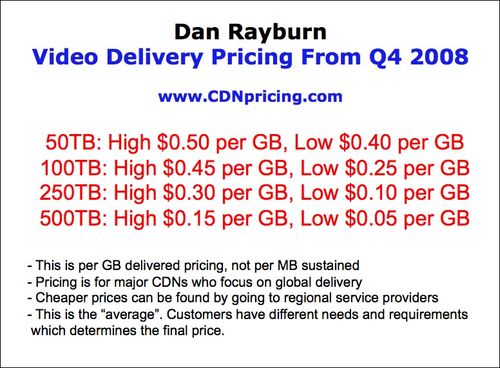
Even Amazon's own video on demand service isn't using CloudFront. Today, they still use Limelight Networks to deliver all of their videos since they are delivered in the browser using streaming protocols. And the notion that Amazon's new CDN service is somehow going to put pressure on the major CDNs to reduce their pricing is so laughable it's not even funny. For starters, Amazon is more expensive when it comes to large volume but those that are writing about pricing would not know that as they don't have any idea what the major CDNs charge. Limelight, CDNetworks, BitGravity and others are half of what Amazon's lowest pricing is at for large volume deals. The fact that Amazon's sliding scale of usage only goes to 150TB gives you an indication of what some of their average sized deals will look like. The major CDNs have customers doing three or four times that much volume and have a sliding scale that goes to 800TB a month or more.

When Amazon announced they would offer this service, many rushed to write headlines saying it would challenge the major CDNs. Now with the service out, again people are rushing to use generic phrases on how this spells doom and gloom for Akamai or Limelight. Yet, in none of these articles that I have seen have the authors provided any analysis or insight into why they think Amazon will challenge the major CDNs. Where is the reasoning behind this thought? BMW and Hyundai are both car manufacturers. Does that mean they compete with each other? Of course not. Yes, Amazon now has a CDN offering, but that does not mean that they now automatically compete with every other CDN in the market.

If you think otherwise, I'd love to hear your thoughts on why in the comments section.

Amazon’s New CDN “CloudFront” Launches With Pricing As Low As $0.09 Per GB

Last night, Amazon launched their new HTTP based content delivery service, dubbed "CloudFront", as an unlimited public beta. While I'm sure many in the market are going to compare Amazon's new CDN offering to other CDNs like Akamai and Limelight, it's important to get the facts straight on what Amazon's CloudFront service does and does not offer.

Amazon will initially support HTTP only delivery out of a total of 14 worldwide locations with 8 in the U.S., 4 in Europe and 2 in Asia. Amazon's pricing for the new service starts at $0.17 per GB for content delivered in the U.S. and $0.21 per GB for content delivered in Asia. In addition to a per GB charge, Amazon also charges a fee of $0.01 per 10,000 requests for content in the U.S. and $0.012 per 10,000 requests outside the U.S.

When a customer reaches 150 TB of content delivery per month, Amazon's pricing drops to the lowest pricing tier at $0.09 per GB for U.S. delivered content and $0.13 per GB for content delivered in Asia. Much like the other AWS services, Amazon's new offering requires no contracts, no minimum commits and no overages. You simply sign up online with a credit card and pay for what you use.

Currently, the service comes with no SLA and customers are not credited for any outages. Customers don't have the ability to call any kind of support center to reach a live person as all support is provided via web forums and online, although premium AWS support can be purchased. The service supports only HTTP delivery today, meaning no streaming and no live broadcasting is possible. Customers don't have the ability to get raw logs as only usage reporting is offered via their dashboard. In addition, in order to use CloudFront, all customers must use Amazon's S3 service for storage.

For customers that need streaming, live broadcasting, have their own origin storage, need raw logs or want SLAs and human support options, Amazon's CloudFront won't be a fit. That being said, Amazon's offering is going to go over well with a large segment of the market who does not need streaming and are smaller sized customers that want to deliver all kinds of content, not just video. As with all of Amazon's AWS offerings, their goal is to design a service that is of interest to the widest possible segment of the market and sign up as many customers as possible.

If you follow the content delivery industry you have to love this new offering by Amazon for a few reasons. For starters, there are many different sized customers in the market who have very different needs. Major CDNs are not a fit for a lot of them and that's where regional streaming service providers have always been able to do well. But for customers who don't need streaming, Amazon provides another offering in the market. While many co-lo and hosting companies have already been offering such a service, most of them are not truly global and require contracts and commitment terms.

Amazon is helping to take content delivery, which has been around for more than ten years, and make it as simple as possible. The industry has the basic fundamental building blocks of encoding, storage and delivery and now needs to focus on building video applications that utilize these building blocks. More than ten years later, we should not be focusing on how bits should be stored and delivered, especially for smaller customers who aren't doing streaming, don't have HD video or in many cases, just want to deliver small objects without tons of traffic. For these customers, delivering content should not be rocket science and should be cheap and easy to use. That's the strength of what Amazon's service brings to the table and to a wide audience. And over time, one can only imagine the service will get even cheaper.

For now, Amazon's service won't have any impact on the major content delivery networks since they primarily focus on customers who need more than just delivery, have larger volumes of traffic and have more complex business problems to solve. That being said, Amazon has a history of constantly improving all of their AWS products over time and I could see Amazon adding more functionality, including streaming, further down the road. While Cloud Front could look like a very different product two years from now, its real strength today is that it is focused and limited in it's offering.