CDN EdgeCast Licenses Web.com’s Patent Portfolio

In an interesting announcement this morning, CDN provider EdgeCast has licensed Web.com's patent portfolio and will be providing CDN services including web page acceleration and origin and edge storage for the Web.com property.

The patent license agreement grants EdgeCast a license for more than thirty issued and pending patents covering a broad range of methods and techniques including: display and delivery of rich media; unique storage systems; automated hosting and server management; load balancing technology; and dynamic DNS technologies. Some of the patent applications date back as far as 1994.

I've just started doing a little research on Web.com's patent portfolio and you can find a list of most of their patents here on their website. Most of Web.com's patents don't directly involve video and are more focused on things pertaining to DNS, managing servers and load balancing amongst other network related activities.

Sponsored by

Outlining The Market Potential For Vendors In The Digital Media Workflow

Frost-cover Frost & Sullivan’s research on the Digital Media market spanning the past decade and the entire value chain from content acquisition down to content delivery shows the market accounting for billions of dollars in 2008. Just the storage and media asset management components together achieved $6.5 billion in global revenues for 2008. The storage and content management markets are expected to grow at a combined CAGR of 13% through 2014 despite a significant dip in 2009 due to longer sales cycles caused by the economic slowdown.

Adding in the professional services and SI components, this market balloons to over $10 billion in 2008 and is expected to more that double its size by 2014 at a CAGR of 11%. The result has been a field day for system integrators (SIs) and vendors who have jumped on the opportunity to provide a solution for the missing glue that would bind such disparate and siloed workflow components seamlessly into a comprehensive, efficient and profitable tool.

Sponsored by HP, Frost & Sullivan has published a free white paper on this topic that details some of the market opportunities for vendors in the digital media workflow. You can download the free white paper here.

CDN’s Delivered 95% Of Microsoft’s Traffic In 07′, But Only 40% By Next Year

Cohen During his keynote at the Content Delivery Summit last month, Jeff Cohen, GM of Microsoft's Edge Computing Network gave out a lot of interesting data as it pertains to Microsoft's CDN business. While the theme of his presentation covered a lot of great topics, one of the points that really stood out was how quickly Microsoft is moving away from relying on third party CDNs for delivery and instead, using their own internal CDN. While this trend by Microsoft is something that has been widely known about to anyone who closely follows the CDN space, this is the first time I have seen Microsoft break out numbers that shows the split in traffic. (Note: Jeff's slides can be downloaded here, video of his presentation can be seen here)

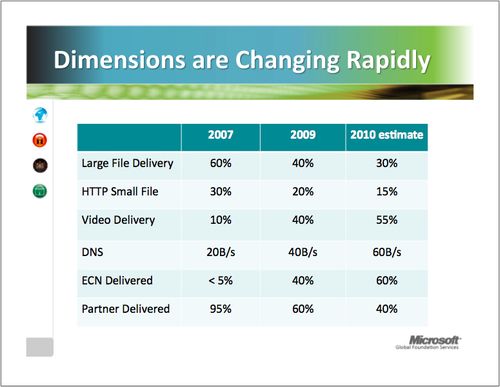
Over the past two years, Microsoft has quickly started bringing a lot of their traffic for video, software downloads and small object delivery in-house. In 2007, third party CDNs delivered 95% of Microsoft's traffic. Based on Jeff's estimate, third party CDNs will only account for 40% of Microsoft's delivery business by next year.

Msft-slide

While Jeff said that Microsoft would always have the need for CDNs to compliment their own delivery, clearly that's a lot of lost business for the CDNs in a three-year period. During that time, Akamai and Limelight have gotten the vast majority of Microsoft's business and Level 3 has received a good portion as well, but primarily just over the past 14 months. While Microsoft is not pulling the business away from CDNs overnight, it is a lot of lost traffic for them to have to make up, not to mention, revenue growth they can't rely on. Of the three CDNs that have most of the business, it probably impacts Akamai more than anyone else since Akamai always had the largest share of Microsoft's business. And with Microsoft having licensed Limelight's technology, Limelight should be making up some of that lost traffic over time with their licensing contract.

Jeff's slide also shows some interesting numbers when it comes to the type of traffic being passed over their network. In 2007, video delivery account for 10% of the traffic and in 2010, is expected to account for 55% of all traffic delivered on Microsoft's CDN. At the same conference, Level 3 also stated that video now takes up 70% of all traffic on their network. These data points are more evidence on just how quickly video traffic is growing and the challenge third party CDNs have in trying to make money. When the largest percentage of traffic on your network comes from video, yet video only account for lets say 25% of your revenue, those are some skewed numbers.

While Jeff made it clear that Microsoft will always need to rely on third party CDNs for scale and for delivery in regions of the world where Microsoft does not have a footprint, he also said that, "we want to make sure that what's strategic to our business, stays within our business". Jeff also said that the decision to move traffic to a CDN or from a CDN is done on a "property to property basis" inside Microsoft.

While I don't know what percentage of revenue Microsoft accounts for at any of the CDNs, a question I am often asked, with Jeff estimating that Microsoft's traffic is growing "between 30-100% year over year", that's a lot of additional bits the CDNs won't get to deliver in the future.

Video CDN Pricing Drops Slightly In Q1, Other Contract Trends Noticed

Dan-photo Last month I completed my review of all the contracts and RFPs I saw in
the market for the first quarter of 2009 and presented these findings at the Content Delivery Summit in NYC two weeks ago. (click on the video window for the presentation or go here here. you can download my slides here) Overall, pricing for delivery services from the major CDNs changed very
little from Q4 2008 to Q1 2009, although some price erosion was seen at
some of the mid-tier and higher level customers pushing a lot of
traffic. (note: you can always find my latest pricing post at www.cdnpricing.com – Previous Quarters: Q4 08, Q3 08, Q2 08, Q1 08.)

While I continue to see a lot of analysts reports still talking about the "pricing pressure" in the CDN market, I still don't see anyone giving examples of what the "pressure" is. I think it is important to keep that in perspective as many in the market make the pricing declines sound bigger than they actually are. While Limelight did mention some pricing pressure with some of their largest customers on their Q1 earnings call, after the call they told me the pricing reduction for these customers was typically fractions of a penny, on per GB delivered contracts. While a company like Limelight has more exposure to pricing reductions since roughly 20 of their customers make up 50% of their revenue, fractions of a penny is not a huge drop in the market. And for customers who are already pushing a ton of volume and continue to grow their traffic, they expect to get some discount based on growth.

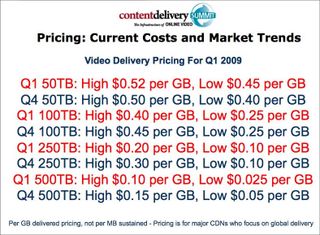
The lowest price I saw in Q1 was two and a half cents per GB delivered for over 500TB of traffic a month. When I questioned many of the major CDNs about this price, nearly all of them told me they don't price delivery that low, but the contracts say otherwise. That price is not the norm as 500TB a month in delivery is a very large customer, but there are now more than a handful of those customers on the market. Bitrates are larger, video is higher quality, some is in HD and the major content owners are pushing some ridiculous volumes of traffic. That said, my guess is that 100 top content owners probably push over 60% of all the video traffic amongst all the major CDNs. So the CDNs are still getting the vast majority of their video related revenue from probably 20% of the customers in the market. This will shift over time and is already beginning to, but the bottom line is that the major
content owners are still the ones pushing the vast majority of traffic
amongst the CDNs.
Pricing-slide

While it looks like pricing dropped by 50% at the 500TB level, keep in mind that the number of those deals that size is very small. I saw only two deals in the 500TB range for all of Q1. The vast majority of deal sizes are in the 250TB range, which remained pretty stable.

For many content owners, traffic is not growing as fast in 2009 as they saw in the first half of 2008, but it's still growing, just at a slower compound annual growth rate. That's not to say all content owners are seeing slower growth and many like Netflix, MLB, Hulu and others are seeing a lot more growth already in the new year. However, since the CDN vendors won't tell us how much video traffic they push quarter to quarter and what kind of traffic patterns they are seeing, it's too hard to make a general statement on what the overall market is doing. No doubt the traffic growth is down overall, but at what percent compared to previous years can only be compared to on a customer by customer basis until later in the year.

While many are still asking me about Akamai potentially cutting their CDN pricing for video in Q1 in the hopes of getting their M&E business to start growing again, I don't see that happening. I do however see Akamai doing more non-commit contracts with content owners which is great for the customer, but bad for the CDNs. Even content owners who aren't that big, for example doing 150TB a month of delivery, have contracts with Akamai where they don't commit to any traffic on a monthly, quarterly or yearly basis. While this is something Akamai and many of the CDNs have done in the past, I see Akamai doing more of this in the last two quarters. I think this is a sign that Akamai is trying to be more flexible, which is good, but their pricing on most deals is still 35%+ higher than Limelight or Level 3. I still also get at least one content owner each week asking me why Akamai is charging more for delivering videos via streaming as opposed to progressive download. I don't have an answer why and while Akamai is under no obligation to tell me, what I don't understand is why they can't give potential customers an answer. I still continue to see Akamai lose deals because their quote to the customer gives two rates, based on the delivery protocol being used and there is no explanation to the customer as to the difference.

In Q1, I saw more contracts from outside the U.S. from companies based in London, India and Singapore. Clearly the pricing environment is different from those regions and it is clear that many times, content owners do see a difference in performance in places like India and Singapore between Akamai, Level 3, Limelight, ChinaCache and Tata Communications. Akamai's strength still lies in their performance in these regions of the world and I do see some content owners paying more for that service. There is nothing wrong with Akamai charging more in the market, as long as they can show a measurable difference, which they seem to be doing in India and China. It's really the U.S. where Akamai is charging more for video delivery, but not showing the difference in performance and are giving up a share of the market to Limelight and Level 3.

At the Content Delivery Summit I got a lot of questions about content owners using dual vendors and if that is a shift taking place with customers. While some content owners have used dual CDN vendors for years, many others don't. It really does come down to the preference of the customer and what they need. Some want two or three CDNs, some tell me they will never use more than one. So I don't see a trend taking place either way, but I do see more of the largest content owners like Apple, Netflix, MLB, NFL, Comcast and others using two major CDNs today.

As I have written before, I don't expect to see a big decline in pricing this year. The CDNs all know that they can't give this stuff away, they have to make some margin and if pricing declined 35% for the average customer last year, I think we'll see only around a 15% decline this year, on average. The content delivery business is all about the economics of scale and CDNs have to multiply the volume of traffic on their network many times over before the next round of major pricing discounts can take place. I think it will be the first or second quarter of 2010 before we once again see a big drop in pricing across the board.

Related Posts:

Video CDN Pricing Stable In Q4: Discounts Given For Lower Bandwidth Tiers

Telcos Outline Their Thoughts On How They Can Win In the CDN Market

Amazon Building Dedicated Sales Force For CloudFront Delivery Services

Level 3's New CDN Strategy: Integration Will Make Or Break The Service

Videos From Content Delivery Summit And SM East Show Now Online

Video-player All of the sessions from the Content Delivery Summit have now been archived and are available online at www.streamingmedia.com/videos – In addition, all presentations from the sessions can be downloaded separately at www.streamingmedia.com/east

Most of the Streaming Media East videos are there are well but we still have a few more to add over the weekend. All of the videos have the ability for anyone to embed the clips directly into their website or blog if you like. I'll be highlighting some of the videos on the blog over the next few weeks.

Our thanks to Quality Tech's media services division who captured, edited and encoded all of the videos and to Brightcove for making their video platform available to StreamingMedia.com

Breakdown On How Many Streaming Entertainment Devices Sold To Date

I have a post over on GigaOM.com today that breaks down the number of Xbox 360, TiVo, Roku, VUDU, Apple TV, and Broadband-enabled TVs and Blu-ray Players sold to date. I also reference some numbers on how much content is being consumed on the Xbox 360 and across offerings such as Netflix. You can read the article here.

Moderating Webinar At 2pm ET: Topic, Live Streaming

Today at 2pm ET I’ll be moderating another StreamingMedia.com webinar on the topic of live streaming. We have Microsoft, Digital Rapids, Thomson Reuters and StreamTheWorld all presenting and we’ll be doing an extensive Q&A session after their presentations. The subject of live streaming is a topic that always garners a lot of interest and questions and we have almost 900 people registered to attend. You can register to attend this free webinar here.

We’re also giving away a TOMTOM GPS system to one lucky attendee.