
The Promise Of TV Everywhere Is Doomed For Failure, Here’s Why

A few weeks ago, I got to get hands-on with Comcast’s TV Everywhere service, dubbed “Comcast On Demand,” via a friend that’s in the trial. (I’m not in the Comcast trial personally but am in the Verizon’s TV Everywhere trial and will blog more about Verizon’s trial when I am allowed.) While Comcast continues to make a lot of noise about the service, I think consumers are going to be very disappointed when it rolls out to all 24 million Comcast subscribers by January 1st.

While I know the beta offering I saw is going to change by the time it rolls out in the New Year, the lack of any underlying business model and user limitations won’t be changing. The biggest problem is that these offerings are not truly “TV Everywhere”. You can’t get the content outside your home, when you travel, to any device other than the PC and whatever you stream with Comcast On Demand counts towards your cap.

When Comcast announced their plans, their press release said that the content will be available to any Comcast subscriber on any Internet connection which leaves one to believe that if you are on the road and traveling, you can access the offering online even if you aren’t using Comcast for the connection. But the fact is, that won’t be possible. In a call I had with Comcast a few weeks back, Comcast acknowledged that the service won’t be available to anyone outside of Comcast’s network. So if I can only get this content when I’m at home, where my TV is, why would I watch it on my computer? The value in a TV Everywhere service is the ability to get the content outside of my home, when away from my TV.

Not to mention, full channels by the broadcasters won’t be available and the overall content inventory will be limited. I have spoken to almost half of the 24 content partners in Comcast’s trial about their selection of content and the vast majority of them have said they plan to only make a small fraction of their content available online. Many of them honestly didn’t seem too excited about the service and some mentioned they are in the trial simply to test this whole idea out and collect intelligence on the market.
Continue reading »

Sponsored by

Brightcove To Showcase New Products And Features On November 18th

Next month, at the Online Video Platform Summit in San Jose, Brightcove's CEO Jeremy Allaire will showcase some of the company's new products and features during his afternoon keynote. While I can't get into too many details, I can say that Brightcove's keynote demo will include distribution strategies that span three screens, live broadcasting and mobile delivery.

Access to Jeremy's keynote on Wednesday, November 18th at 1:45pm is free with an exhibits only pass, but you must sign up online by October 30th. You can also register for the entire 2-days of the summit for only $495, using my personal discount registration code of DRF1, which gives you $200 off the conference pass.

The entire speaker lineup and agenda for the Online Video Platform Summit can be seen here on the website.

Xbox 1080p Streaming Uses IIS, Smooth Streaming, But Not Silverlight

Microsoft has given me a few more details surrounding how they are managing to stream 1080p videos on the Xbox 360 with consumers only needing a 4Mbps connection. Microsoft said that Zune Video on Xbox LIVE takes advantage of Microsoft's Smooth Streaming technology, which is a feature of IIS Media Services and that Zune Video was built from the ground-up for the Xbox 360 platform. While the Silverlight plug-in also takes advantage of Smooth Streaming technology, Silverlight is not being used on the Xbox platform.

Microsoft says that Zune video on Xbox LIVE features a state-of-the-art encoder and high performance decoder that allows them to offer instant on 1080p video and 5.1 surround sound with Smooth Streaming playback and smooth fast-forward and rewind functionality. They aren't giving out any details yet on how the videos are encoded and what the settings are, but I expect we'll hear more about that when the service launches to the public. Microsoft also said that they recommend a minimum of 4 Mbps for the full 1080p/5.1 experience but the great thing about the technology is that videos will automatically scale to the best possible resolution based on the speed of the users internet connection.

I can't wait until Microsoft is willing to give out more technical details around the Zune Video technology and how it works. A 1080p video stream, with only a 4Mbps connection, is something this industry has never seen. It really is a big deal.

Xbox 1080p Streaming Quality Is Incredible, Hands-On, With Video

This morning, I got the Xbox LIVE preview upgrade which gives me the ability to test out some of the new features coming soon to the Xbox console including Twitter, Facebook, Last.fm and 1080p streaming. Of course, the new 1080p streaming functionality is really the one I have been waiting to get hands on with and after watching a bunch of movies this morning, all I can say is that the quality it truly incredible.


After downloading a Zune video app, you can browse through movies available in 1080p and new to the movie service, you can choose to stream or download the movies. If you select streaming, the Zune app does a quick check of your connection to tell you if you can get the 1080p content and once you purchase the movie, the buffer time before it starts is less than a second. When Microsoft says that the new Zune video technology allows for "instant-on" streaming, they aren't kidding. (Updated: Limelight is delivering the streams)

While Microsoft is not yet giving out a lot of details on how the Zune video technology makes all this possible, they have stated that it only takes about 4MB of bandwidth to be able to get 1080p streaming. You really have to see it to believe it as it really is that good.

Next month, on Wednesday Nov. 19th, Marc Whitten, GM of the Xbox LIVE service will be the keynote presenter at the Streaming Media West show. Marc will be showing off the 1080p streaming technology as well as some other upcoming Xbox LIVE features and will be taking questions from the audience. We'll also have some cool surprises in store for the audience as well, so sign up now to get access to Marc's presentation. It's free to attend with an exhibits only pass if you sign up online before October 30th.

YouTube’s Bandwidth Bill Is NOT Zero, I Expect More From A Wired.com Story

This afternoon, Wired.com published a story with the headline of "YouTube’s Bandwidth Bill Is Zero. Welcome to the New Net." I don't know how they think can publish a headline like that when, as the article explains, a new report by Arbor Networks, not Wired, estimates that Google "is simply trading traffic, with no payment involved, with the net’s largest ISPs." So why is Wired.com using a headline that is telling us, as a fact, that "YouTube’s Bandwidth Bill Is Zero," when they aren't even the one's saying it? Not to mention, no where in Arbor's actual report, from what I have been told, do they imply that YouTube's bandwidth bill is zero, and in fact, in the Wired article they are quoted as saying they think Google's "transit costs" are close to zero".

Transit costs are not the same as bandwidth costs and Wired should know that. They then go on to say that, "the lack of a monthly bill in the mailbox doesn’t mean Google’s internet connection is free — it’s just that it has purchased unused fiber optic cable known as “dark fiber” — and uses it to carry its traffic to other networks where it “peers” or trades traffic with other ISPs. Its costs for bandwidth are then amortized across the life of its fiber and routers." Well make up your mind. Is it free or not free? You're saying the "bandwidth" is free, but the transit has a cost?

Even if Arbor's argument is accurate in regards to Google's transit costs, that does not mean YouTube has no cost involved in delivering video. Not to mention, the Arbor report, which is not even being released until October 19th, is only referencing how large ISP's trade traffic with Google but makes no mention of smaller ISPs. The Wired article also implies that the YouTube website uses "streaming" to deliver their videos, which we all know is not accurate. And while distinguishing between protocols may seem like splitting hairs, it's not when you're talking about delivery costs since we know that it costs more to do true streaming as opposed to HTTP progressive download.

The Wired article goes on to say that, "…the real money is in the ads and services in the packets, not in moving the bits from computer to computer. The cost of bandwidth has fallen and so too have the profit margins for moving bits, even as traffic grows at an estimated 40 percent a year." Can Wired explain what they mean by "services in the packets", what is that? They say the cost of bandwidth has fallen, but don't say by how much and they say the profit margins have fallen as well, but don't say for whom. Not to mention, they say that traffic is growing "at an estimated 40 percent a year," but don't say who's traffic they are talking about.

I'm not a brilliant writer, my grammar can use a LOT of work, but I have no editor and am a one person blog. This article by Wired not only contains bad info, but has terrible grammar mistakes in it like "dump pipe", when I think they mean "dumb pipe", and has phrases like "you might even asking". I expect a lot more from a story by Wired when they are talking about technology, yet can't even get the basic terminology or facts accurate.

Akamai Acknowledges It’s Not Delivering HD Video To The iPhone

Earlier in the month, during Akamai's webcast about their HD network, Tim Siglin pointed out on his blog that Akamai's claim that they could deliver HD video to the iPhone wasn't accurate. Tim had a lot of back and forth emails with Akamai, which he documents on his blog here, and I questioned Akamai on the same topic with a post entitled "Does The iPhone Support HD Video? I Say No. Akamai Says Yes".

Earlier today, at the Streaming Media Europe show in London, Tim reported that Akamai has changed their stance on the subject and now acknowledges that they are not delivering HD video to the iPhone. From Tim's blog post a few hours ago:

[Akamai's Suzanne Johnson, who will be appearing on my panel at Streaming Media Europe 2009 later today, has confirmed that a more accurate version of Tom Leighton's "45 million iPhones capable of playing HD content" statement should have been stated as this:

"By year's end, as part of the Akamai HD Network, up to 45 million iPhones and iPod touches will be capable of displaying high-quality video encoded from HD source content."

She also stated that Akamai understand that "the iPhone does not display true HD by definition but can offer consumers an HD-like high quality video experience that complements what they get on TV."]

I think it is important Akamai has changed their stance on this as HD quality video is very important to the future of all companies involved in the online video space as well as how it is defined. We need to keep the standards that we think of with broadcast HD quality to be the same when talking about online video so there is no confusion as to what's HD, and what isn't.

While it's good to see Akamai acknowledge that they aren't delivering HD video to the iPhone, I'd like to see Akamai define what they consider to be "HD quality" when they are talking about delivering "HD quality" video across their network. I still can't find any definition of this by Akamai on their HD Network product page.

Free Product Giveaway: Popcorn Hour C-200 Networked Media Streamer

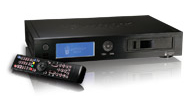
Popcorn [Update. David Boyll from San Francisco was the winner of the Popcorn unit. Thanks to all those who entered.] The nice folks over at Syabas Technology sent me one of their new Popcorn Hour C-200 networked media streamer units for me to review, but with the Streaming Media West show next month, I won't have a chance to do a product review anytime soon. CNET UK and Engadget did reviews of the Popcorn unit already so check out their sites for some more details.

While the fact I won't have time to review it is bad news for me, it's good news for one of you. Syabas has given me permission to give the Popcorn unit it away for free to a reader of my blog. All you have to do is leave one comment on this post with your real name and a valid e-mail address. I'll pick one user at random on October 26th and I'll even cover the shipping cost to the winner.

Thanks again to Syabas for the gear and the giveaway!