Google Adds Another $26.5M To On2 Bid: Don’t Think It’s Enough To Go Through

In December, On2 put out more details on their proposed merger with Google in an attempt to get On2 shareholders to be more comfortable with the deal, hoping that they would approve it when it was voted on last month. Since that tactic failed and the company didn't have enough votes to approve the merger, Google has now decided to up their offer for On2 by adding $0.15 per share in cash consideration. Shareholders are now scheduled to vote on this offer on January February 17th.

Since I don't own stock in On2 or Google, or any other company for that matter, and don't have enough of a detailed insight into On2's intellectual property, I can't say what the company is really worth. But the gut feeling I have on this one is that if the deal was going to go through, it would of already. Simply adding $0.15 per share to the deal probably won't convince too many shareholders who voted no in the past to change their mind. Even with the additional fifteen cents, most of the investors shares are probably under water.

In the press release, it says that this, "constitutes Google’s final offer", which is leading some On2 investors to think that a new suitor will now step forth in an effort to buy the company since they know Google won't bid any higher. Why that sounds nice in theory, it really does not make a lot of sense. If another company was interested, they would have come forth already. Microsoft does not need On2, so the idea that Microsoft should buy them just to keep Google from getting them does not make sense either. And when Google made their first offer, didn't they also say back then that it was their "final offer"?

The vast majority of On2's legacy business is based off of a codec. Yes, the company does a lot more than that just produce VP6 and VP8, but trying to grow a business off of a codec is very difficult. A similar analogy would be BitTorrent who for years has tried to create a business simply based on a protocol. How well has that worked out? It's not an easy thing to do. Just ask Move Networks.

Many of the On2 shareholders I hear from often, which is quite a few, all say they are holding out to "get a fair price" which they say can only come from competitive bidding. While I understand the idea, at some point On2 shareholders are going to have to come to the realization that right now, no other company wants to buy On2. That's not to say another company won't want to buy On2 down the road or that other opportunities may come the company's way if the Google deal falls through, but right now there is no other buyer.

By Google adding fifteen cents per share to the deal, it may be just enough to get shareholders who were only a couple of cents from breaking even to now vote yes. It's possible, but I still get the sense that it won't be enough to make the deal happen. We'll find out on the 17th.

Related:

– On2 Gives Update On Google Merger, Don't Think It's Enough To Make It Happen

– On2 Shareholders File Lawsuits Trying To Block Google Acquisition (Vote4On2.com)

– Debunking Some Myths Of The Google/On2 Deal, Questioning VP8's Quality

– Google's Acquisition Of On2 Not A Big Deal, Here's Why

– Why Adobe Should Buy On2 Technologies

Sponsored by

Warner Bros. Announces Deal To Give Netflix Access To Movies With 28-Day Window

This afternoon, Warner Bros. Home Entertainment announced new agreements with Netflix that gives them access to new release DVD and Blu-ray titles after a 28-day window. There has been a lot of talk lately about the potential for these kinds of content deals where the studios force someone like Netflix to wait 28 days to rent physical DVDs, with the upside being that it gives Netlfix access to more digital content faster. What I'd like to know is exactly how much digital content Netflix gets under this new agreement and how quickly Netflix gets access to it. I've asked Warner Bros. for an answer on this and will update the post if they give me one. But until we know that, I think it's pretty hard to say it's a win for Netflix or for consumers. We need to first know the size of the digital library Netflix is getting access to.

Bandwidth Pricing Trends: Cost To Stream A Movie Today, Five Cents: In 1998, $270

While working on a inquiry for WIRED magazine, I was looking through a lot of my data on bandwidth pricing over the past ten years. It's incredible to see just how much the cost of bandwidth has declined and how that rate has accelerated over the past decade. And that rate of decline is just for what content owners were paying and does not even include the rapid pricing decline we've all witnessed with transit costs.

In 1998 the average price paid by content owners to deliver video on the web was around $0.15 per MB delivered. That's per bit delivered, not sustained. Back then, nothing was even quoted in GB or TB of delivery as no one was doing that kind of volume when the average video being streamed was 37Kbps. Fast forward to today where guys like Netflix are encoding their content at a bitrate that is 90x what it was in 1998.

To put the rate of pricing decline in terms everyone can understand, today Netflix pays about five cents to stream a movie over the Internet. If Netflix tried to do this in 1998, at the same quality they are doing it today, it would of cost them $270 per movie. Of course, in 1998 no one was capable of getting a 3Mbps stream, but even if Netflix only encoded their videos for 37Kbps in 1998, it still would have cost them $2.40, $4.80 to stream one movie. (I forgot to double the number for 2 hours) Gives you an idea of just how far video quality, consumption and pricing has come over the past ten years. Yet even with the rapid rate at which pricing has declined, ten years later, companies are still struggling to figure out how to make money from online video.

Free Product Giveaway: Flash Media Streaming Server ($995 retail)

Fms-box The drawing is now closed. If you missed the last raffle on my blog for the free Flash Media Interactive Server, you've got a second chance. Thanks to Adobe, I have one more giveaway, this time in the form of a Flash Media Streaming Server, which retails for $995. To enter the drawing, just leave one comment on this post with a valid email address and I'll pick a winner at random on January 25th. A big thanks to Adobe for letting give this away on my blog. Winner: Eliezer Israel.

Grab Networks In Talks To Sell Off Their Anystream Product Line

Anystream-logo Last month, I began hearing rumors that Grab Networks was close to selling off their Anystream product line to another transcoding and workflow solutions vendor. In a call with an executive from the company last week, they confirmed that Grab Networks is in fact in discussions with numerous companies about selling off the business. Anystream is best known for their line of Agility and Velocity products, which are enterprise class transcoding and media management platforms.

I'm told that Grab Networks originally had no interest in selling off the Anystream product line and was not shopping the company until another vendor approached them to discuss the idea. Once that took place, Grab Networks started investigating all possible acquisition angles to gauge Anystream's value in the market.

While the company said they have no deal in place and are still in discussions with multiple interested parties, I'm hearing that Telestream is the leading candidate to make the acquisition, which would make a lot of sense. Anystream's product line would fit nicely into Telestream's and the company has been making a big push lately to expand into the enterprise vertical. If a deal for Anystream is reached, the company suggested it would probably happen this quarter so it could be timed around the NAB show in April.

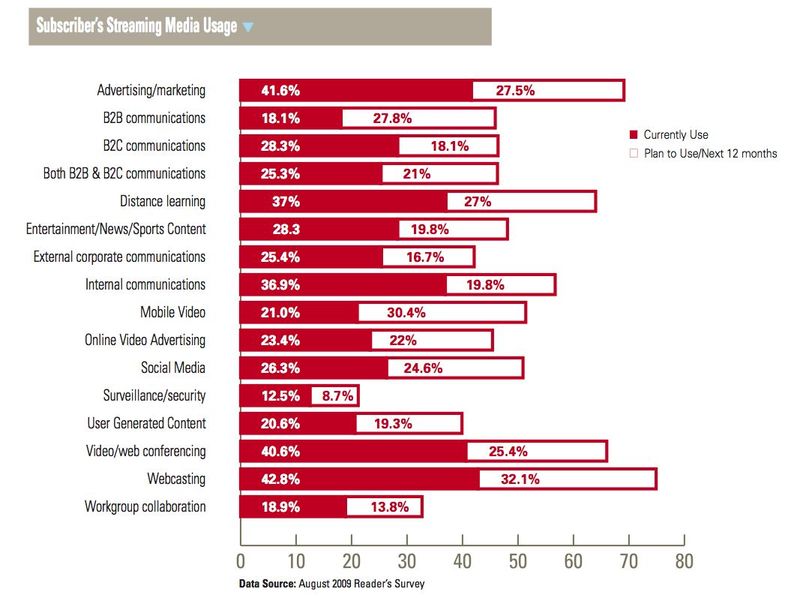
Survey Shows Content Owners Interested In Mobile Video And Webcasting In 2010

Subscribers to the special edition of Streaming Media magazine, the 2010 Sourcebook, said in a recent survey that webcasting and mobile video are the two video applications they plan to invest the most money in for 2010. The results from the survey, which you can see below, are tabulated from 562 responses and gives details on the video applications being used today and where content owners see growth in the New Year.

Sm-sourcebook  

Make sure you get a FREE copy of the sourcebook for yourself by subscribing here. The issue ships later this next month.

Sonic Launches Next Generation Of CinemaNow, Still No Support For Mac Users

Cinema-now-logo Today, Sonic Solutions announced their "next generation" CinemaNow platform which brings new features like support for 1080p quality, 3D content, and interactive services but STILL no support for Mac users. I know Mac users have their own Apple based movie service with iTunes, but the CinemaNow platform is used by Blockbuster, BestBuy and a host of others. By not supporting Mac users are all these companies ceding the share of the Mac market to Apple? That's a pretty big market that these folks are missing out on.

Both Netflix and Amazon have no problems supporting Mac users with their streaming service, so why can't CinemaNow support it? The company says their new platform is the "next generation", yet confirmed in an email to me this afternoon that it does not support Apple users today. How is that "next generation" if you can't even support Apple users? Analysts who track the personal computer market in the U.S. say that Apple has anywhere between 10-15% of the market and Apple continues to ship a ton of new computers each quarter, even in a down economy. You'd think that with all of this evidence in the market, companies would stop treating Apple users like it was the year 2000 and giving us excuses.

The reality is that today, it's easier to make a list of the platforms and services that don't support Apple than the one's that do. CinemaNow is on that very short list as well as the services from Blockbuster and BestBuy.