Why Can’t YouTube’s Player Auto-Detect When A User Should Get HD Quality?

For all the praise that the industry and the media continues to give YouTube, I don't understand why those same people never hold YouTube up to the standards that other media companies are held to. While everyone wants to discuss the business model behind YouTube, no one ever seems to question why the videos look so bad and why some of the most basic features that other sites have had for years are completely lacking with YouTube.

While the media was quick to cover how YouTube was moving to HD quality video last year, I didn't see a single person commenting that the YouTube player does not currently have the ability to auto-detect when a user should get the HD copy instead of the SD copy. This technology has been around for years and most sites have been using it for quite a long time. Why isn't YouTube? Why do I have to manually click on an HD icon to actually get the HD stream? Why can't YouTube auto-detect that I am on a fast enough connection to get HQ the quality video to begin with? It is so annoying that when you visit a page where the video is set to auto-start, you have to click on the HD icon to get the one you want and then wait again for it to re-buffer.

Today on YouTube's blog, they are asking people to send them ideas on how they can improve the service and to vote on what they think are the most important features that are missing, or not needed at all. First suggestion, FIX ALL THE BUFFERING ISSUES! A quick look at the comments section on YouTube's own blog shows I am not the only one who continues to have buffering problems – for the last THREE years! (2007, 2007, 2008, 2009)

YouTube needs to get with the times and have a user interface that actually takes advantage of some of the technology that has been in the industry forever. YouTube does not use any streaming protocols, only downloads via HTTP, has no player auto-detection feature and lately, 50% of the time myself and many others upload a file to YouTube we get an error message of "try again later." In addition, while YouTube has very limited functionality for variable bit rate (VBR) encoding for HD quality videos, they don't have the option at all for SD quality videos and default to a constant bit rate (CBR). The whole point of VBR is to improve the user experience by providing higher quality video without the need for the video to re-buffer. It's a standard on the web today, but apparently YouTube has not realized that.

If this was the search business and Google was missing some of the most basic features that every other search engine had, the media would hold Google accountable for it and there would be a lot of discussions taking place on the subject. Of course, we know Google does not have any of these problems in their search business but if they did, they would address them and correct them very quickly. But with YouTube, they don't seem to follow the same strategy. The service has been bad for years, the user experience is still very poor, the quality of the videos is not up to par with others on the web and the the YouTube platform has a long list of really major problems that still aren't being addressed or corrected. Users of YouTube are complaining about these problems in public forums, yet the media and many in the industry continue to heap praise on the company even though they are not doing anything to address the poor user experience.

Related:

– Bandwidth Pricing Trends: Cost To Stream A Movie Today, Five Cents: In 1998, $270

– Detailing Netflix's Streaming Costs: Average Movie Costs Five Cents To Deliver

– Platform Overload: How Many Content Platforms Can Survive On TVs And Devices?

– TV Everywhere: The Future of Television, or Another Over-Hyped Promise?
Sponsored by

Rackspace Cloud Servers Versus Amazon EC2: Performance Analysis Results

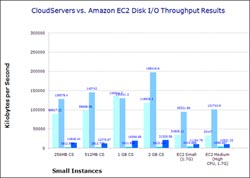
Rackspace This morning, Encoding.com put out a press release with Rackspace talking about how Encoding.com is using Rackspace’s cloud service to enable them to scale their transcoding platform. But the really interesting part of the Encoding.com release is that Rackspace Encoding.com commissioned Bitsource to compare Amazon’s EC2 performance versus their own cloud offering and is sharing the results.

While most companies put out statements all the time about company A being better than company B, they usually don’t provide any details. But in this case, Bitsource has published all of their performance findings along with their methodology for anyone to review.

I don’t know much about performance when it comes to cloud computing so I’ll let someone else analyze the results, but kudos to both companies for not simply delivering a bunch of marketing terms and actually showing us, in detail, what they compared and how they did the comparison. You can check out the results here.

Platform Overload: How Many Content Platforms Can Survive On TVs And Devices?

After all the news that came out of CES last week on the number of companies working on software platforms for TVs and devices, one has to wonder if these platforms are destined to follow the fragmentation we currently have on the hardware side. As an industry, we still haven’t figured out what devices can survive and co-exist in the long run. We currently have so many broadband enabled devices in the market including the Roku, TiVo, VUDU, PS3, Xbox 360, TVs, Blu-ray players, Apple TV and soon to be Boxee and Popbox, without having to figure out what platforms they can all run.

While it’s good to see the industry starting to talk about the platform that will enable us to find and consume the content, as opposed to being so focused on the hardware, the conversation is only going to get more confusing now that so many platforms exist. Here is a list of the platforms that I could think of:

  • VUDU: While VUDU started off as a hardware device, the company has since changed to a platform licensing model for third party devices and now has deals with LG, Mitsubishi, Samsung, SANYO, Sharp, Toshiba and VIZIO.
  • Yahoo!: While Yahoo! originally started off with some widget functionality that didn’t seem like a big deal, at CES, they announced a whole bunch of new partnerships with chip makes, TV manufactures and media player companies for their Connected TV effort. To date, they have deals with VIZIO, ViewSonic, Hisense International, Intel, Samsung, LG Electronics, Sony MIPS Technologies and Sigma Designs.
  • TiVo: While TiVo has always been a hardware and platform company, they have been working for years to try and diversify their revenue by licensing their platform to the MSOs. Recently, they have been very vocal that MSOs should use the TiVo platform as a gateway, or portal for OTT type content to enable MSOs to offer something similar to a VOD service. So far, they have signed up Virgin Media in the UK.
  • Netflix: While most think of Netflix as simply a content partner inside a platform like the Roku or Xbox 360, Netflix is also a stand alone platform for the numerous deals they have cut with device manufactures. Netflix said they expect to be on more than 100 broadband enabled devices by the end of this year which easily makes Netflix not only a content option, but also their own stand alone platform.
  • Best Buy: While we don’t know exactly when or what devices the Best Buy platform is coming to, Best Buy plans to enter the market some time this year with a digital download offering that’s powered by CinemaNow. Users will be able to download content via BestBuy.com and via select devices sold in Best Buy stores.
  • Blockbuster: While the company has been slow to get their platform, powered by CinemaNow, onto many hardware devices, expect to see a slew of consumer electronic deals announced this year. Blockbuster is available via TiVo’s platform and to date has one direct manufacturer deal with Samsung.
  • PlayStation Network (PSN): While the PSN always went along with Sony’s gaming devices, the company announced at CES that they would soon bring the PlayStation network to other Sony hardware products including TVs and Blu-ray players.
  • DivX: At CES, DivX announced the launch of of their embedded Internet TV platform called DivX TV along with a list of partners from integrated circuit manufacturers and consumer electronic companies including LG, ADB, Broadcom Corporation, Iomega and Viewsonic amongst others.
  • Rovi: While the company does not have any deals with hardware manufactures yet, it’s only a matter of time before Rovi branches out to devices with their recently announced TotalGuide EPG platform. The company’s goal is that their platform will become an interactive program guide integrated into TVs and set-top-boxes.
  • iTunes: While Apple’s iTunes platform is not yet connected to any TV device other than Apple’s own Apple TV, I would expect the company to start cutting licensing deals this year with major CE manufactures.
  • Boxee: For a company who’s platform has gotten more press and hype before even having a product out on the market, Boxee announced last week that it would also be entering the hardware market later in the year. While still a platform company at heart who’s main goal is to get integrated via set-top-boxes, Boxee now straddles both sides of the fence with a hardware and platform business.
  • CinemaNow: While the company has focused on white labeling their technology platform for Blockbuster and Best Buy, the company is planning to work directly with CE manufactures in the New Year.

Even with the names I probably overlooked from this list, that’s already a dozen platforms all targeting TVs and broadband enabled devices. So what happens when, years from now, we actually have a lot of these devices out in the market? How fragmented are all of these content services going to be when consumers buy a Blu-ray player or broadband connected TV and it has movies from one studio but not another? Are content companies going to have to follow the path of Netflix and get their content on every device out there, or can any of these video platforms get enough of an install base to really dominate the market?

For years we’ve been complaining about how fragmented the device market is, but if we thought that was bad, just try to envision what the platform market is going to look like three years from now. It won’t be pretty.

Call For Speakers Now Open For Streaming Media East: Moderators Wanted

Smeast_logo The call for speakers for the 2010 Streaming Media East show, taking place May 11-12 at the Hilton hotel in NYC is now open. And I’m excited to announce that once again I’ll be organizing the Content Delivery Summit, taking place the day before the East show on Monday May 10th. I’ll have more details about the summit shortly.

In the mean time, the call for speakers is now open. The deadline is January 25th. I have roughly 110 speaking spots and typically get over 800 speaking requests. Everyone always wants a speaking spot but I simply don’t have enough to go around. The key is to get a submission in on-time and for vendors, introduce us to customers. 75% of the speaking spots go to content owners and end-users, the companies who buy and use online video services. I always need introductions to new customers.

In addition, I always need moderators who can help organize panels. So if you wanted to moderate a session at the show, organize a discussion around a topic of interest to you or get involved in helping to create the programming of a session, now is the time to contact me. For me, the hardest part is always finding moderators that are neutral and understand the importance moderators play in helping us produce quality programming.

If you have experience moderating and are looking to help out and get involved, you need to contact me ASAP. I’m also looking to pay some moderators who are willing to help out with more than one session.

Roku Holds The Title Belt, For Now, With More Than 1M Units Sold

I don’t usually post numbers without concrete data to back it up but in this case, I think it’s a safe bet to say that with the number of units Roku sold during the holidays, it now gives them over 1M devices in the market. I know for a fact that in March of 2009, Roku had already sold over 300,000 units. And in the third quarter of last year, the company was quoted in an interview as saying they had sold a “high six figures” worth of units.

I’ve been keeping an eye on Roku’s ranking on Amazon over the past two months which shows just how popular it has been and gives you an indication of just how many they sold during the holidays. For the last 42 days, Roku has been in the top one hundred best selling items in the electronics category, still ranked at number 13 today, even ahead of the 64GB iPod Touch. And in the televisions and video category on Amazon, they are the number two bestselling product.

While the company would not provide me with any data on the number of units sold and only said “we had a great holiday“, I think that would be an understatement. While 1M units is still small when compared to the Xbox 360 or PS3, those are gaming devices targeting a much different audience. Aside from TiVo which has sold more than 1M DVRs, but probably less then 1M Series 3 units, I can’t think of another broadband enabled device in the living room that is as widely adopted as the Roku.

Roku will get some serious competition this year from the Popbox as well as TV and Blu-ray players that continue to add more video platforms and content models to their hardware. But for now, Roku still holds the title belt for the most units sold in the market.

Related:

– Syabas To Challenge Roku With Netflix Enabled, Popbox Streaming Device

– Roku Announces Two New Devices, Hands-On, With Video: More Content Coming

– Review: Hands-On With Amazon On The Roku, Close To 300,000 Units Sold

– Netflix Player By Roku Nearing 100,000 Units Sold: 1% Of Netflix’s Subscribers

Winners Announced: Xbox 360, Flash Server, Roku and Expression Studio Giveaways

A big thanks to Microsoft, Roku, Adobe and the Xbox for giving me some awesome products as free giveaways on my blog last month. The drawings are now closed and I've used a random number generator to pick the winners. Congrats to all the winners below.

Xbox360 The winner will get one Xbox 360 Pro console, a 12-month Xbox LIVE membership, 1600 points and an Xbox 360 Messenger Kit. Winner: Douglas S. from Austin, TX.


Flash One lucky reader of my blog will get a copy of Flash Media Interactive Server 3.5. This is an incredible
giveaway as the software retails for $4,500 from Adobe's website. Winner: Sean D. from New York, NY.

Roku Last month Roku announced the launch of their new Channel Store and in celebration of the launch, I'm giving away one Roku HD-XR unit. Winner: Josh B. from New York, NY.

Studio Thanks to the Silverlight team, I have two copies of Expression Studio 3 to give away. Each of these retails for $599 from Microsoft's website and will go to two different winners. Winners: Lon Van W. from Boise, ID and Logan D. from Seattle, WA.

Netflix’s Deal With Warner Brothers Is Not A Good Deal For Consumers

I’m really surprised that many people in the industry think that yesterday’s announcement by Warner Bros. which limits Netflix’s access to new release DVD and Blu-ray titles after a 28-day window is such a good thing. While the argument is that Netflix now gets access to more digital content, Warner Brothers is not willing to say just how much content Netflix will get or how new any of that content will be. If this deal is so good for everyone involved, why won’t anyone give out specifics? Why won’t they tell us how many new hours worth of digital content this gives Netflix? Why should we believe that the consumer is the one that is really going to benefit from this?

In my mind, all this does is allow Warner Bros. to further control how and when consumers watch content. It removes choice from the market and simply allows the studios to continue to have way too much control over the consumer. I know the argument by some will be that Netflix is betting big on streaming and that this is about the future, but streaming movies are not going to replace DVD or VOD rentals in the next five years. Even Netflix says they expect to still be renting DVDs in 2020. While everyone wants to rally behind the fact this deal pertains to digital content, it makes no real impact on the market other than reducing Netflix’s costs, which is good for the company, but bad for giving consumers more control in the market.