Grab Networks In Talks To Sell Off Their Anystream Product Line

Anystream-logo Last month, I began hearing rumors that Grab Networks was close to selling off their Anystream product line to another transcoding and workflow solutions vendor. In a call with an executive from the company last week, they confirmed that Grab Networks is in fact in discussions with numerous companies about selling off the business. Anystream is best known for their line of Agility and Velocity products, which are enterprise class transcoding and media management platforms.

I'm told that Grab Networks originally had no interest in selling off the Anystream product line and was not shopping the company until another vendor approached them to discuss the idea. Once that took place, Grab Networks started investigating all possible acquisition angles to gauge Anystream's value in the market.

While the company said they have no deal in place and are still in discussions with multiple interested parties, I'm hearing that Telestream is the leading candidate to make the acquisition, which would make a lot of sense. Anystream's product line would fit nicely into Telestream's and the company has been making a big push lately to expand into the enterprise vertical. If a deal for Anystream is reached, the company suggested it would probably happen this quarter so it could be timed around the NAB show in April.

Sponsored by

Survey Shows Content Owners Interested In Mobile Video And Webcasting In 2010

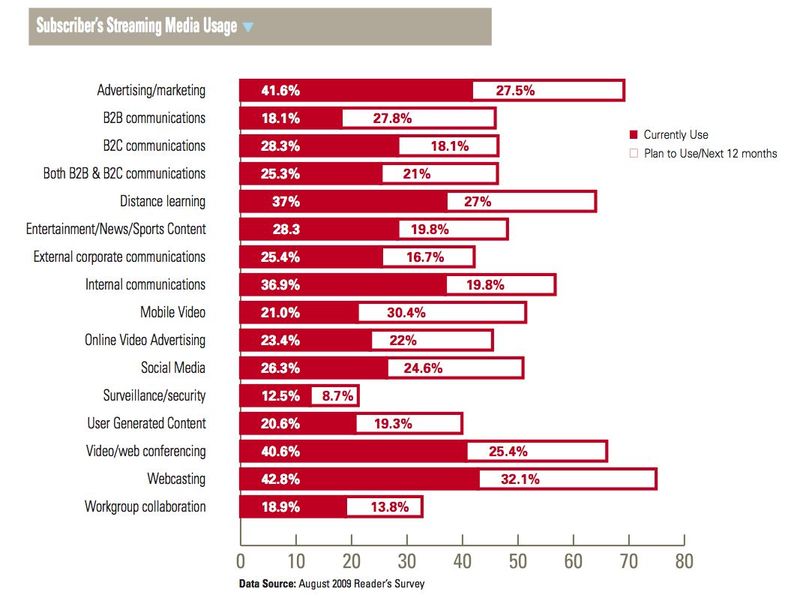
Subscribers to the special edition of Streaming Media magazine, the 2010 Sourcebook, said in a recent survey that webcasting and mobile video are the two video applications they plan to invest the most money in for 2010. The results from the survey, which you can see below, are tabulated from 562 responses and gives details on the video applications being used today and where content owners see growth in the New Year.

Sm-sourcebook  

Make sure you get a FREE copy of the sourcebook for yourself by subscribing here. The issue ships later this next month.

Sonic Launches Next Generation Of CinemaNow, Still No Support For Mac Users

Cinema-now-logo Today, Sonic Solutions announced their "next generation" CinemaNow platform which brings new features like support for 1080p quality, 3D content, and interactive services but STILL no support for Mac users. I know Mac users have their own Apple based movie service with iTunes, but the CinemaNow platform is used by Blockbuster, BestBuy and a host of others. By not supporting Mac users are all these companies ceding the share of the Mac market to Apple? That's a pretty big market that these folks are missing out on.

Both Netflix and Amazon have no problems supporting Mac users with their streaming service, so why can't CinemaNow support it? The company says their new platform is the "next generation", yet confirmed in an email to me this afternoon that it does not support Apple users today. How is that "next generation" if you can't even support Apple users? Analysts who track the personal computer market in the U.S. say that Apple has anywhere between 10-15% of the market and Apple continues to ship a ton of new computers each quarter, even in a down economy. You'd think that with all of this evidence in the market, companies would stop treating Apple users like it was the year 2000 and giving us excuses.

The reality is that today, it's easier to make a list of the platforms and services that don't support Apple than the one's that do. CinemaNow is on that very short list as well as the services from Blockbuster and BestBuy.

Syabas To Challenge Roku With Netflix Enabled, Popbox Streaming Device

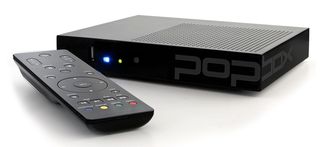
Popbox-real This morning Syabas, best known for their Popcorn Hour media player, announced that come spring they will launch a new $129 box similar to Roku called the Popbox. I got a detailed briefing on the new device last week and had the chance to speak with Syabas COO Alex Limberis on what their business model will be.

While the Popbox is very similar to the Roku with its small form-factor and fanless design, the Popbox has a couple of key features that sets it apart from the Roku. For starters, the Popbox plays just about every video format out there including MPEG1/2/4, Open MPEG-4 HD, Xvid-HD, WMV9-HD, VC-1 and H.264. On the audio side, it also supports MP1/2/3, WMA, WMA Pro, Ogg Vorbis, AAC, AC3, DTS, PCM, WAV and FLAC. It also supports a lot of image formats, Windows Media DRM and a bunch of subtitle and metadata formats as well.

Syabas says that one of the main strengths of the box is that it has a
very powerful video processor and essentially uses the same processing
platform as the Popcorn Hour. The box supports 1080p and can do up to
100Mb/sec video decoding, which about is two times what Blu-ray does. The company says that as a result, the Popbox can deliver better video quality than the Roku. This could be accurate, but since I have not been hands-on with the Popbox, I'm not going to state it as a fact. It would be easy to test as you could simply playback a local file on both units and compare the quality, but until Roku enables the USB port on the XD-HR unit, there is no way to do the comparison.

While the Popbox has no hard drive, it does ship with a 2GB SD card, two USB ports and one HDMI port. The ports allow you to plug in other devices like Flip cameras and external hard drives enabling users to ingest their networked media content. While some might expect the included SD card to be used for storing content, that's not supported. The Popbox SD card enables the box to store what Syabas calls "popapps" for their  Popbox store (screenshot) and the main purpose of the SD card is to store those apps and the metadata. The company has announced more than twenty content partners for the Popbox store including Netflix, Twitter, Facebook, Photobucket, Next New Networks, Revision3, blip.tv, IMDB and Funspot Games have all developed Popapps for the platform. While I have only seen screenshots of the Popbox store, the UI is beautiful and clearly beats Roku's interface hands-down.

Continue reading »

Can We Stop Talking About 3D TVs Already? It’s Nothing But Hype

I don't know about you, but I am so sick and tired of hearing about 3D TVs and all the hype that surrounds them. For a product that barely exists in the market, I'm seeing way too many articles, quotes and marketing fluff surveys talking about how the 3D industry is going to be this huge business. Sure, 3D TVs might be a big business 5+ years from now, but it won't have any series impact on the market in the meantime. In fact, most analysts who track the market predict that only between 30-40M 3D capable sets will be sold by 2014. That's a very small number and nothing to get excited about.

Of course, that's not stopping companies like Sony who make the sets to predict that by next year, there will be a 3D TV set "in every home", referencing a specific region in Europe, not the U.S. But even still, how can Sony possibly think this? Consumers aren't even buying $150 Blu-ray players in large volumes yet, but Sony and others think people will drop a few grand for a 3D set sometime in the next few years? Most 3DTV sets won't even be out until late 2010 and you're going to have to wear glasses at all times to see anything in 3D. And the sets that don't require glasses, Panasonic says it will be, "at least 10 years before the technology is advanced enough to provide a similarly robust 3D experience without glasses". Ten years? Remind me why I am suppose to be excited about 3D TVs today?

Even with all those facts and numbers, I continue to see more and more surveys, like this one, that say consumers want 3DTV content. Duh. Of course we want better viewing experiences, but none of these surveys ever seem to say what consumers are willing to pay to get it. Depending on which analyst report you look at, the penetration rate of HDTVs in the U.S. isn't even at 50%, but we're suppose to be excited over 3DTVs and what might happen five or more years from now? The SMPTE isn't even suppose to deliver a 3DTV standard until sometime in 2011, although other organizations like CEA are working on their own standards as well.

3D TVs look great at CES and in product demos, but they do not represent what the average consumer is going to purchase anytime soon. How many consumers who spent $1,500 to upgrade to an HDTV this year are then going to be willing to spend another $2,000 three years from now to get a 3D experience? That's not realistic. 3D TVs may be the "future" but that future is not anytime soon. Weren't Internet connected TVs suppose to be the future as well? No question they have a better shot at adoption, but even their sales projections are low, under 5M sold in the next three years.

I'm tired of the TV manufactures and content owners trying to convince us what the next kind of technology is that we want, what we should be excited about as consumers or what we should be buying. We are the consumer, we decide with our wallets what we want. If content owners and TV manufactures continue to make big bets on 3D TVs being adopted in the next few years, they are going to be really disappointed when they lose.

Limelight Networks To Acquire EyeWonder, $200M In Combined Revenue Next Year

This morning, Limelight Networks announced an agreement to acquire privately held EyeWonder in a cash and stock deal valued at $110M. The deal is expected to close sometime in the first half of next year. After DoubleClick and maybe Pointroll, EyeWonder is one of the largest rich-media ad platforms in the space, billing about $35-$40M in revenue for this year. With Limelight’s 2009 projected revenue of $140-$150M this deal should easily make the combined companies into a $200M+ organization in 2010.

For Limelight, this is a smart move and the immediate affect is two fold. It increases their revenue by a third and more importantly, they are acquiring a company that has 70%+ margins on their business. EyeWonder’s overhead is low since they are not in the infrastructure business and this will allow Limelight to diversify their revenue with a product line that’s not competing solely on price, like we have seen in the CDN space for so long.

Already I am hearing some say that the combined EyeWonder and Limelight ad solution will compete with Akamai’s advertising solution, which is not the case. Akamai acquired acerno to get into the behavioral targeting business. EyeWonder is a platform that allows for rich-media ads on the web and within video games. Two very different ad solutions, solving two very different problems for content publishers.

Of the $110M in purchase price for this deal, Limelight is paying for $62M of it in cash. This leaves Limelight with about $100M left in the bank and I would not be surprised if we saw them make a few more smaller acquisitions in the near term.

Free Product Giveaway: Microsoft Expression Studio 3 ($599 retail)

Box_studio3 The drawing is now closed. Thanks to Microsoft I have two copies of Expression Studio 3 to give away. All you have to do is leave one comment on this post telling Microsoft what you'd like to see in the next version of the product. If you are a newbie to the product, no worries, just leave your contact details. Make sure you use your real name and a valid e-mail
address and I'll pick two lucky users at random at the end of the month. Winners: Lon Van W. from Boise, ID and Logan D. from Seattle, WA.

A big
thanks to Microsoft for giving me two copies to give away.