Looking For Speakers: HTML5 And Web Video Standards

I think it's a safe bet that one of the most popular panels at the Streaming Media East show in May will be on the topic of HTML5 and the the debate on whether it will impact on the video market any time soon. I'm looking for some really good speakers for this panel who want to talk about the pros and cons of HTML5 as it pertains to video and have the technical expertise to talk about the subject from all angles. I'm also looking for a REALLY hardcore moderator who knows the technology inside out.

I've read some really good blog posts about the topic lately and if you've come across a post by a blogger you think would be a good moderator or speaker, please put it in the comments section below. So if you are interested, or think you know of someone who would be great on the panel, please send me an email asap. Here are the details on the session:

HTML5 And Web Video Standards – Tuesday May 11, 2010 – 4:00 p.m. – 5:00 p.m.
As video becomes increasingly important on the web, content providers, browser developers, and end users can no longer afford to have the primary video delivery mechanisms locked up in standards that cannot be adapted to new environments. This is especially true for emerging trends such as mobile video and cross-device video technologies. HTML5 Video might be the answer, and we'll discuss what it is, the challenges it's facing, and how it affects other formats such as Flash and Silverlight, as well as how leading platforms and web giants such as Google, Mozilla, and Apple are supporting it.

Sponsored by

Akamai To Become The Primary CDN For Netflix, But At A Very Low Price

While Netflix has always had a dual-vendor approach for their streaming delivery by using CDNs Limelight and Level 3, in the beginning of the year Netflix continues to move away from Level 3 and will be taking just over half of their traffic to Akamai. While this is clearly good news for Akamai, the price point at which Akamai is charging is the lowest price I have ever seen the company offer.

We've all known that for the past two quarters, Akamai has been getting aggressive on pricing with their M&E business and lowering pricing to win or retain customers. But this latest round of Akamai pricing shows just how much they are now willing to compete with Limelight and Level 3 and in many cases, are looking to price business at levels they know the other CDNs can't or won't match. While they are finally acting like they now want to own the CDN market outright and keep their competitors from growing, the flip side is they are now the single biggest company driving down CDN pricing in the market. What use to be Limelight and Level 3 driving pricing down, has now been replaced by Akamai offering pricing that is well below what the others offer, on many large deals.

Lately, Akamai has been giving some large companies like Netflix a very discounted rate if the customer agrees to give Akamai at least 51% of their traffic. In exchange, Akamai offers the content owner a highly discounted rate for three of four months as an incentive. In this case, Netflix is paying Akamai about one and half cents per GB delivered for a couple of months before Netflix's pricing goes back to about six cents per GB delivered. At a penny and half, that's about 3x cheaper than what Limelight charges Netflix and is at a price that Limelight simply can't match. While I'm hearing that Netflix just renewed their contract in the new year with Limelight, one has to wonder what Limelight would do in 2011 if Akamai keeps their pricing at this level.

One way to look at this is that Limelight has a little less of Netflix's traffic, but at a higher price which should mean they can make more money from it. Akamai on the other hand has more traffic, but at a greatly reduced price point which means they can only make money from getting a lot more traffic, or by having a lower internal cost than Limelight, something we don't know when it comes purely to their CDN business. Akamai's thinking has to be get the M&E business it in the door at all costs so they can drive volume on the network and have a chance at upselling customers to higher margin products. Essentially, CDN can be a loss leader for Akamai if it had to be in order to act as the catalyst to grow their value ad services business. The real winner in this case is Netflix, which continues to drive down their cost of streaming movies.

Akamai is clearly making some really aggressive moves in the market right now and is looking like a company that really wants to once again dominate the CDN space. While many have been talking for the past 18 months about all kinds of other companies that are going to enter the CDN space, or compete with the leaders in the CDN space, it's very clear that the race is still between Akamai, Limelight and Level 3 for the largest portion of the CDN market.

Workshops On Streaming And Flash Delivery Taking Place In NYC On March 23rd

Lisa Larson-Kelly and Jan Ozer will be hosting two half-day workshops on Streaming Production and Flash Delivery on March 23, 2010, at the Fashion Institute of Technology in New York City. The workshop courses detail the complete streaming production and delivery workflow, from set design to Flash Media Server setup, from H.264 encoding to Flash Player creation. A full day course is really affordable and only costs $300.

Lisa and Jan have been the instructors at our Streaming Media East and West shows for many years and they really know their stuff. If you're in the NYC area and want to get some hands-on training, you can't go wrong with these workshops. You can get all the details on the workshops here.

Why Is MSNBC Porting Poor Quality Internet Video To The Xbox?

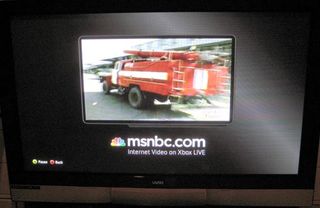
Xbox-window Over the past two weeks, the Xbox LIVE dashboard has been featuring a bunch of MSNBC.com video highlights from the Olympics as well as news headlines. I decided to check some of them out last night and I was really disappointed to see that MSNBC.com is simply taking the low-bitrate stream for the web and using it on the Xbox platform. As a result, the video window is small, gets centered in your TV and most of your screen is filled up with a big border all around the video, as you can see in the photo above.

As we all know, the Xbox 360 is capable of displaying really good quality video, even 1080p. But in this case, MSNBC.com is not taking advantage of the Xbox 360 platform and instead, is using what looks to be around a 500Kbps stream, which is being encoded specifically for the web, not for a device connected to your TV. While I don't think Olympic highlights has to be in 1080p, we are talking about sports content with a lot of motion that looks really bad at 500Kbps. Why wouldn't a news organization as big as MSNBC.com have the content encoded specifically for the device it is being played back on? Is it purely an effort on their part to save money on video distribution costs?

A person I spoke to involved with Xbox agreed that it was not a good example of the Xbox 360's video capabilities and that the Xbox team was aware of it. A spokesperson for MSNBC.com said, “we’re in the process of providing video in full HD and will let consumers know when it’s available.” When I pressed them for a date, I was told, "later this year". While that's nice to know, I can't understand why they wouldn't have the proper video quality to begin with from day one.

Internet Enabled TVs Are Not A Big Deal For The Video Industry, Here’s Why

With Walmart buying VUDU, some are speculating that the value to Walmart is the deals that VUDU has in place with seven leading TV manufactures to carry VUDU's platform on their sets. While this might look good on paper since it enables Walmart to sell as many TVs from their stores as possible with a platform they own embedded into the hardware, the problem is that even Walmart can't sell enough TVs over the next few years for it to matter.

While we keep hearing a lot about broadband enabled TVs, widgets and TV apps, no one seems to be asking how many Internet enabled TV sets need to be sold to actually make a difference in the market. If you look at the number of sales analysts are predicting for 2010, the numbers are all over the map. iSuppli predicts just over 13 million, Parks Associates predicts 7 million, TDG predicts 4 million and DisplaySearch predicts 12.9 million. That averages out to 8 million sets this year, which is a really small number.

Out of that, many analysts who cover the TV market also estimate that only about 25% of those sets will actually be connected to the Internet. So that leaves us with about 2 million sets for 2010. How are those numbers to get excited about?

Microsoft has more than 20 million consoles connected to the Internet today. Yet that one device by itself has not changed the market in terms of content owners making money or impacting the revenue of any vendor in the Xbox video ecosystem. So how are a few million Internet connected TVs going to change this market so broadly like people keep saying? Even if we look at projections for the number of Internet connected TVs in the U.S. by 2013, iSuppli predicts almost 23 million and TDG predicts 43 million by 2014, it's still not a big number. If I take an average of their numbers and say there will be around 25 million sets in 2013, even if 75% of those are connected to the net, you're talking 18.7 million TV's, which doesn't change anything.

I think it is fair to say that if we combined the multiple Internet connected devices like TVs, gaming consoles and Blu-ray players they could create a real positive impact five years from now on the market. But TVs by themselves won't make that much of an impact in the next five years. Even some of the TV manufactures I speak to directly don't have any of their own estimates on how many models they will sell with broadband functionality built in as they don't see the numbers being that big. I think Internet enabled TVs are cool, make sense for some consumers and many, many years from now will matter to the industry. But for any content owner who thinks the Internet TV platform is going to change their syndication or monetization strategy anytime soon, they are going to be in for a big letdown.

Walmart To Acquire VUDU: Get Ready For Another Failed VOD Offering

In January, Peter Kafka broke the news that rumors were circulating that Walmart might acquire VUDU and it appears a deal has now been reached. The New York Times is reporting that the deal is done and while there is no official word from VUDU or Walmart, I just spoke to a consumer hardware vendor that has a deal with VUDU that confirmed they were briefed on the news earlier today. Updated: Here is the official release from Walmart.

While we don't know the terms of the deal or how VUDU made out, it's a really bad business for Walmart to try to get into. This would be Walmart's third or fourth attempt to get into the digital media space after trying to compete with Netflix and trying a movie download and kiosk service that they killed within a year. While I like VUDU, Walmart will not know what to do with them. I know some will say that this is Walmart showing that they get digital and that it is the future, but that's not what this means at all. Walmart does not own any content or hardware which means the success or failure of any offering will be dependent on the studios and hardware vendors.

In order for any video on demand service to take off it has to have scale. And while Walmart sells a lot of CE devices that they could get the VUDU platform onto, the price would still be too high for any type of mass market adoption. Considering you can rent DVDs for $1 from Redbox and Blockbuster Express, why would I want to purchase a device to access movies at four or five times that cost? Maybe Walmart plans to sell content and compete with iTunes, but then won't get the reach Apple has since they don't have any devices of their own.

If Walmart really wanted to get into the space and was serious, they would buy Netflix and hit the ground running. While they would have to spend a lot more money for Netflix than they did for VUDU, they would have something to show for it. With VUDU, all they get is technology and some studio relationships. VUDU has less than 100,000 stand-alone devices in the market and Walmart now has to find a way to get enough devices in the market that have their platform on it. While VUDU has been cutting deals with CE manufactures and moving away from the hardware business, they still don't have enough deals in place to give Walmart any sizeable footprint today or anytime soon.

Yes, Walmart has a huge reach and physical presence with consumers, but that does not automatically translate over to success with regards to digital media, especially when the media is being consumed without the need for having to go anywhere, like to a physical Walmart store. For VUDU, they had to sell at some point as they could not survive long in the current state they were in and if they got a lot of money from Walmart, good for them. But I think whatever Walmart spent on this acquisition will be shown to be a complete waste of money and time on their part, sooner than they think.

Does anyone see an upside to Walmart from this?

Added: While some are suggesting that Walmart bought VUDU for the deals that VUDU has in place with seven TV manufactures to carry VUDU's platform, four of those manufactures don't even have TV sets out in the market. And if you look at the number of total Internet connected TVs expected to be sold in 2010, most analysts put that number around seven million. And out of that seven million, analysts predict about 25% will be connected to the Internet. That's not a lot of TVs.

Selling Off Some Of My Domain Names With Streaming Media and Online Video

Over the years I have acquired almost a hundred domains names related to streaming media and online video topics. I really don't need many of them anymore and need to start getting rid of them. Rather than letting one of the domain auction services grab them when they expire and then charging someone way too much for them, I'd rather sell them to someone for cheap who can use it for their own blog or business purpose. Here's the first batch that I am getting rid of.

  • StreamingMediaVideo.com
  • ContentDeliveryPatents.com
  • P2PVideoBlog.com
  • EnterpriseVideoBlog.com
  • StreamingMediaBooks.com
  • VideoIPBlog.com
  • WebVideoMagazine.com
  • ManageTheWorkflow.com
  • DigitalMediaPatents.com
  • StreamingMediaPatents.com
  • StreamingMediaBlogs.com

If any of them interest you, drop me an email and we can work something out.