
Why Is It That The Moment You Blog About Apple, People Lose Their Minds?

I don't know what it is about Apple, but anytime a blogger writes anything negative about Apple, or does not agree with what Apple says, many readers bring their emotions into the conversation. What is it about Apple that drives so many people to lose their minds? The moment someone does not agree with something Apple is doing and blogs about it, many readers treat it as if you just said insulted their mom.

Because of the anonymity that the web offers, many times, you really don't know the reason behind someone's comments. Maybe they have stock in Apple, maybe they work for the company or maybe their business relies on Apple's content ecosystem. While it's really hard to know, one thing is clear. Many people can't have a real discussion about Apple, and the facts and points at hand, without getting emotional.

In my post from earlier today entitled "Steve Jobs Blogs On Why He Hates Flash, But Can't Get His Facts Straight", of the 150+ comments on three different blogs about my post (one, two, three) you can't find anyone who's arguing against my counter-point to Jobs when he said, "iPhone, iPod and iPad users aren’t missing much video." If you don't go to sites that have video, then you are minority of all web users today. The vast majority of web users all visit sites each day and consume video on a daily basis. So why is no one arguing with me that about that? Why is no one arguing with me that some major websites like Hulu.com, NFL.com, Amazon.com, Zappos.com and others don't have videos that work on the iPad? The simple reason is because you can't argue with facts. Now of course that does not stop some people and one person commented that unless the info I am presenting comes from a "third party", then we should believe Apple.

How sad. If you take an iPad, or go to the Apple store and use one and type in NFL.com, you will see there right there on the home page the phrase, "To see this content please go to Adobe.com to download the latest version of the Flash Player." Do you really need a third party company to tell this you? Do you not trust your own eyes?

While many want to think I'm crazy to disagree with Apple, clearly I am not the only one who thinks this way and if after reading these posts below, if others still want to call all of us crazy for disagreeing with Apple, then I consider myself to be in good company:

I also find it absolutely hilarious that so many people commenting don't even own an iPad and have never used one because if they did, they would see that videos on my blog are in H.264, and NOT Flash. Yet, many are quick to leave comments saying my blog is outdated or built using a proprietary video platform. 

I get the sense that many want to dry and drown out anyone that does not agree with Apple by inundating them with so many comments, name calling and personal attacks that the blogger will just give up. Sorry to tell some of you this, but that won't make me stop and it won't drive me away. If anything, it will only make me blog about it more.

Note: If all you want to do is curse me out, any posts with curse words will be removed. I don't allow that language on my blog.
Sponsored by

Steve Jobs Blogs On Why He Hates Flash, But Can’t Get His Facts Straight

Added 4/30: Since I published this, I have gotten more than one email sent to me threatening me with bodily harm for writing this post. In fact, quite a few. So if you are reading my post, or any other post on this topic and then feel the need to want to hurt someone, I would suggest you stay calm, relax and then go about the rest of your day. This topic is not worth anyone getting that upset over it.

—-

Clearly Apple must be feeling some pressure from the large group of consumers who are tired of not being able to get Flash content, specifically video, on Apple’s iPad and iPhones because Steve Jobs just posted an article on Apple’s website entitled “Thoughts On Flash”.

Steve starts off by saying that, “Adobe has characterized our decision as being primarily business driven“, which is correct, but of course Steve says that, “in reality it is based on technology issues“. While Steve spends some time to talk about what an “open” environment really means, and rants about how Flash is not open, he also then says that “the operating system for the iPhone, iPod and iPad is proprietary“. So on one hand he calls Flash out for not being open, then rightly states that neither is Apple when it comes to their OS, but also then says that in fact, Apple is the one that has an open system, not Adobe. Make up your mind Steve, do you think Apple is open or closed? The reality is both companies have proprietary systems.

Of all the things that Steve says in his article, he’s flat out wrong when it comes to his description of the “full web” experience and he should be ashamed to try to think he can fool us. Steve says that, “Adobe has repeatedly said that Apple mobile devices cannot access “the full web” because 75% of video on the web is in Flash. What they don’t say is that almost all this video is also available in a more modern format, H.264, and viewable on iPhones, iPods and iPads.” Steve also says that, “iPhone, iPod and iPad users aren’t missing much video.”

This comment by Steve is simply a lie, which is not my opinion, but a fact. Anyone who uses an iPad can’t get video from the websites of NFL.com, MLB.com, Petfinder.org, Amazon.com and many other really popular websites. So to say that users aren’t missing much video and that almost all of this video is also available in H.264, is wrong and you can’t argue with it. I guess Steve does not feel that the NFL and MLB sports leagues command that big of an audience. Use an iPad, go to those sites and see all the video you can’t get. Does Steve think we don’t notice that? Of course, he also goes on to list all of the websites that have video that works on the iPad, but as I pointed out weeks ago, many of those sites only have a limited amount of their video that works. Is that his idea of a “full web” experience, seeing only a portion of the content on a website?

Steve ends his post by saying that, “Flash was created during the PC era – for PCs and mice.” Well I hate to tell you this Steve, but it’s still the PC era. For all the growth of the mobile space in the U.S., how much of that content consumed on a mobile device is video? Very little. No one is getting rid of their PCs because they have a mobile device, the PC is not going anywhere and the volume of content that is delivered to PCs will always surpass what will be delivered to mobile. Apple’s iPhone and iPad’s are not going to replace the PC experience, ever.

If Apple does not want to support Flash, that’s their right. But for Steve to think we’re all dumb and that he can tell us something works, when we clearly see it doesn’t, that’s simply an insult to consumers. And for him to say that this is not about business, but rather a technology issue, his actions prove otherwise.

Apple knows that a lot of the ads on the web are delivered in Flash. So Apple clearly wants to divert some of those dollars over to Apple by having a platform that forces you to take webpages and convert them into micro apps making it impossible for the content creator to load any kind of ads. Then you launch your own proprietary mobile ad platform iAds and you make money by taking a small percentage of every ad impression on your closed platform. Steve needs to stop trying to make this into a “technology” issue when this is all about money. If you came out and said you’re not supporting Flash because you can make more money without it, fine by me, I won’t argue with that. But to try and disguise it as something else, that only makes Apple look bad, not Adobe.

SM East Show: Web Video Journalism, Future Or Fantasy?

News organizations want the additional ad revenue from video but often find they can't create high enough quality to keep advertisers happy, and outlets including the Washington Post, Newsweek and others have been forced to cut back on their staff of video journalists. So how does a news organization create a niche and build an audience with limited resources?

At the Streaming Media East show, May 11th and 12th, we've got a great session entitled "Web Video Journalism: Future Or Fantasy?". Hear directly from some of these news organizations on how they're using video now and what the business for video journalism looks like in the future.

  • Moderator: Craig Duff, Multimedia Editor, TIME
  • Bill McCandless, GM, Executive Editor of Multimedia, TheStreet.com
  • Richard Tanner, Senior Producer, Video, New York Times
  • Bill Smee, Executive Producer, Slate V
  • Adam Najberg, Senior Editor, Video, The Wall Street Journal

It's not too late to get a pass to the show and readers of my blog can register using my own personal discount code of DRF1, which gets you $200 off the ticket price.

Google To Announce List Of Vendors Who Will Support VP8 On May 19th

On May 19th, Google plans to announce a list of vendors in the online video ecosystem that will support VP8 on day one of Google's plan to move to an open-source video codec. Once the On2 deal was finalized, Google has been hard at work meeting with many different vendors in the online video ecosystem including video platform providers, encoding companies, hardware vendors and others to convince them to support VP8 in their product lines. So far, they have been successful in their efforts and have quite a few vendors who have agreed to support VP8 have been busy over the past few months building that support into their platforms.

In addition, I've also learned that some major content owners also plan to support VP8 soon after it becomes open-sourced and that while Google is not working directly with them, they are using the vendors in the video space to help convince them to encode to VP8. Things are going to get pretty interesting if Google continues to get vendors in the video eco-system to support VP8 and gets them to help push it to content owners.

SM East Show: Understanding Adaptive Bitrate Technology And HTTP Video Delivery

Adaptive bitrate encoding methods are gaining traction in the industry as Apple, Adobe and Microsoft have all recently started offering new ways to encode and deliver video, including via HTTP. But what does that mean for the average content owner who is trying to figure out the best way to improve the viewing experience?

At the Streaming Media East show on May 11th and 12th, we've got a great session entitled "Understanding Adaptive Bitrate Technology And HTTP Video Delivery".  You'll hear directly from some of the platform providers and content owners themselves to see how this technology is impacting their content offerings and plans. We'll also get their guidance on best practices, cost and overhead considerations, and real impact to their users – and the bottom line.

  • Moderator: Matt Smith, Senior Director, Systems Architecture and Strategy, Inlet Technologies
  • Joe Inzerillo, SVP, MLB.com
  • Shujaat Ali, Director, Digital Services, NBC Universal
  • Glenn Goldstein, VP, Media Technology Strategy, MTV Networks
  • Jeff Misenti, Manager, VP, Fox News Digital

It's not too late to get a pass to the show and readers of my blog can register using my own personal discount code of
DRF1, which gets you $200 off the ticket price.

SM East Show: How Streaming Video is Changing The Television Landscape

Streaming sites like Hulu, CBS, ABC, and others have proven that savvy audiences are turning to their computers for entertainment, and in a way that's profitable. How are traditional and cutting-edge companies capitalizing on this trend?

At the Streaming Media East show on May 11th and 12th, we've got Dan Frommer, Deputy Editor for The Business Insider moderating a panel on "How Streaming Video is Changing The Television Landscape". The session will discuss how content owners are taking advantage of this connected platform and how online video based subscription offerings may affect cable
companies.

  • Dan Frommer, Deputy Editor, The Business Insider
  • Anthony Soohoo, SVP, GM, Entertainment and Lifestyle, CBS Interactive
  • Nick Johnson, VP Sales, NBC Universal Digital Media
  • Scott Doyne, Sr. Director, Business Operations, Turner Sports,
    NASCAR.COM
  • Roxanne Austin, CEO, Move Networks

It's not too late to get a pass to the show and readers of my blog can register using my own personal discount code of DRF1, which gets you $200 off the ticket price.

Netflix Offering Customers 10% Savings To Active Streaming On Their Wii

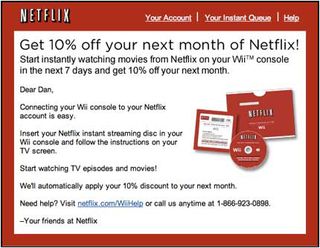
Netflix-email Recently I got my Netflix disc in the mail that enables me to stream movies to my Wii console but I've been too busy to even try it out. Yesterday, I got an email from Netflix telling me that if I use the disc and active streaming on my Wii within the next seven days, Netflix will give me a 10% discount on next month's bill. While the savings is not a big deal and amounts to just over a dollar for me, you've got to love Netflix's approach.

The whole idea behind this is that Netflix is pro-actively encouraging their customers to adopt the streaming service due to the positive impact is has on their business and the company is even willing to give customers some financial encouragement to follow through with the activation. Netflix did confirm for me that this applies only to the Wii and not to any other gaming console.

I'm going to activate Netflix on my Wii tonight, not because I can save a dollar, but because I want to support Netflix being so pro-active in getting customers to stream. To me, Netflix is like the Zappos of the entertainment industry where it's nearly impossible to be un-happy with their service. Yes, their stock price is crazy and hit a record high of $102.49 today, but they deserve it.