
Netflix’s Streaming Service In Canada Could Have 40% Margins, But Market Size Small
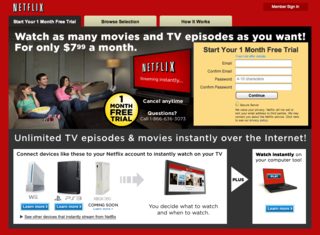
Screen-capture (Updated 9/29: As some have pointed out, I originally listed Canada's population number as total Internet users which was not accurate. I have updated and corrected the numbers. Thanks for catching.)

Today, Netflix announced a streaming only subscription service for Canadian consumers with a monthly price of $7.80 in U.S. dollars. While many are discussing what content is or is not available for streaming, the real thing to look at are Netflix's costs for the service and the size of the market. As of December of 2009, Canada had a broadband penetration rate of 29.6%, with just over 33M 13M total Internet users. That means that the size of Netflix's total market opportunity in Canada is about 10M 4M potential subscribers.

While that's not a big number, Netflix's margins on the digital only offering should be pretty good and I estimate they should be around 40% once you factor in the "average" cost of content licensing and content delivery. Netflix is playing the law of averages with their digital offerings as some users might stream forty movies a month while someone else only streams five. So figuring out what the average user may consume is hard to do without data directly from Netflix on the subject. But based on some of the licensing deals I have seen and the cost to deliver content in Canada, I think it's very realistic that Netflix could make about $3 per "average" subscriber. Netflix's lowest DVD subscription price in the U.S. is $8.95 a month so Netflix is getting nearly their full DVD rental price in Canada, for a digital only offering.

It will be very interesting to watch how quickly the service takes hold in Canada come next year since Netflix is not initially supported on the Xbox 360, Roku, Vizio TVs and other devices. Support is expected to come by the end of this year for some of them, but it really looks to be Q1 of 2011 before the service is up and running at full speed.

Another thing to keep an eye on is the caps that are imposed by Canadian telcos. Some broadband packages by Rogers and others have a limit of as little as 2GB a month, which would only allow for users to stream one Netflix movie a month. Others have caps at 15GB and 60GB which are still quite small considering one Netflix movie can take up between 1.8GB – 2.9GB of total bandwidth. You also have to wonder if some of the ISPs want to keep Netflix from being successful and will put pressure on the service by keeping caps low. Someone like Bell Internet also has low caps because like cable, Bell potentially stands to lose TV revenue since they are a satellite TV provider, not to mention, they now own CTV so they have a clear stake in distributing and producing television content.

Will be very interesting to see what kind of success Netflix is having in Canada in 6-8 months time.

Update: Here is a link to Shaw's Internet packages and a link to Rogers so you can see the breakdown on costs and bandwidth caps.


Sponsored by

Save The Date: Announcing The 2011 Content Delivery Summit

Sticky I'm very excited to announce that I will once again be organizing the special one-day Content Delivery Summit, taking place the day before the Streaming Media East show on Monday May 9th, 2011 at the Hilton Hotel in NYC. Now in its third year, the CDN Summit is the place for cable operators, telcos, service providers, network operators, ISPs and vendors in the CDN ecosystem to showcase and discuss the business and technology of content delivery.

While I won't start planning the show until December, the agenda for the summit continues to evolve each year to focus on new emerging business models and delivery technologies for content outside of just video. Services like application acceleration, dynamic site acceleration, mobile video, carrier grade hardware and software solutions and more will all be discussed and demonstrated at next year's show. As the CDN market evolves, so do the solutions in the market and the 2011 summit will have a heavy focus on how cable operators, MSOs, network service providers and network operators are deploying and using various CDN technologies on a global basis.

While I won't open the call for speakers until December, if you have any ideas on topics you want to see covered or want to get involved with the show in any way, please reach out to me at any time.

Moderating Webinar At 2pm ET Wednesday With Adobe On “Content Protection”

On Wednesday at 2pm ET, join me as I moderate a Q&A session with Adobe’s content protection guru, Florian Pestoni in our next installment of StreamingMedia.com’s Ask Adobe Web Event Series. You won’t want to miss out on this opportunity to ask Adobe how to monetize and deliver protected content to multiple devices. Learn all about Adobe’s content protection solutions including RTMPe and Flash Access and get your questions answered. The webinar is free and you can sign up here.

Few Speaking Spots Open For Streaming Media West: Looking To Fill ASAP

The Streaming Media West conference and exhibition in LA is only six weeks away and the final program is nearly done. We've got an excellent lineup of speakers and I have a few spots left to fill. If you are interested in any of the speaking positions, please send me an email with FULL DETAILS, don't just send me an email that says "I want it." Here is what's open:

Tuesday, November 2nd, 2010
Mobile Video Syndication: App Stores and Smartphones
(One open panelist spot. Looking for content owner or device manufacturer.)
For content creators looking to monetize their video across mobile devices, the market can be pretty confusing. How do content creators reach the widest possible audience across so many different devices and mobile platforms like Android, Apple, Symbian, RIM, and Palm? Are dedicated video apps the answer or simply a way for companies like Apple to remain in control? This session will outline some of the differences between the different mobile platforms, what it costs to develop for them and how can content creators can reach consumers on their smartphones.

Wednesday, November 3rd, 2010
Cutting The Cord On TV: Will Online Video Really Lead To Cable's Demise?
(One moderator spot open. If interested, make sure you send me details on your knowledge of the subject.)
From Hulu to Netflix, streaming video is having a powerful impact on the traditional television industry. But are consumers really cutting the cord and bypassing cable operators in favor of online video? With the broadcast networks facing some of the same threats as the newspaper industry, will services like TV Everywhere and over-the-top (OTT) content be the industry's savior? These topics and more will be addressed by this panel of content heavyweights.

Wednesday, November 3rd, 2010
Monetization And Video Advertising Formats
(One moderator spot open. If interested, make sure you send me details on your knowledge of the subject.)
For all the buzz about online video advertising, most content owners have yet to be able to turn their online video from cost center to profit center. Still, strong signals suggest that video monetization is around the corner, provided content owners don't pull back in today's tight economy. What will it take to reach that tipping point, and what direct cost and revenue impact will it have on content owners? With all the different ads formats on the web today, which ones have the greatest ability to help content owners monetize content and why?

Wednesday, November 3rd, 2010
HTML5 And Web Video Standards
(Moderator and panelist spots open. Looking for someone to really lead this session.)
As video becomes increasingly important on the web, content providers, browser developers, and end users can no longer afford to have the primary video delivery mechanisms locked up in standards that cannot be adapted to new environments. This is especially true for emerging trends such as mobile video and cross-device video technologies. HTML5 Video might be the answer, and we'll discuss what it is, the challenges it's facing, and how it affects other formats such as Flash and Silverlight, as well as how leading platforms and web giants such as Google, Mozilla, and Apple are supporting it.

Wednesday, November 3rd, 2010
Cost Savings From Enterprise Streaming: How The Conversation Has Changed
(Multiple panelist spots open. Looking for Fortune 500 customers.)
Years of conclusive statistics show that streaming can offset travel costs, outsourced services and production costs, and the opportunity costs of removing employees from the office for meetings. But once you've proved the ROI and gotten your program going, the question becomes "How do we know this is working?" This session will feature firsthand examples from Fortune 500 organizations that are employing metrics to prove cost savings and employee engagement of using streaming to support core communications, training, and educational programs.

Commoditization Is Not A Dirty Word, Online Video Vendors Need To Embrace It

Whenever I use the word commoditization to describe a technology or service in the online video industry, it tends to upset some people, especially vendors. I routinely get emails from executives telling me that I'm not helping them or the industry by using that term and they want to argue with me that many of the services I talk about are not commoditized. I think many vendors don't truly understand what the word commoditized really means or the positive impact that commoditization has on their business and on the industry.

The definition of commoditized is, "a good or service widely available and interchangeable with one provided by another company" or "a good or service easy to obtain by making it as uniform, plentiful and affordable as possible." This is exactly what has happened with online video in today's market. All pieces of the video ecosystem are affordable, don't require a huge capital investment and have become very easy to obtain, with dozens of vendors offering very similar services.

No one can debate the fact that today, the underlying technology of online video including storage, encoding and delivery are completely commoditized. Services like YouTube are free to the masses and even someone like my Mom can very quickly and very easily shoot, upload, encode and distribute a video clip. The actual technology behind that process is commoditized and this is a good thing for everyone. Services like YouTube have made vendors jobs easier by educating their customers and allowing many of them to become familiar with the basic technologies and terminologies that drive our industry.

Thanks to services like YouTube, vendors can spend their time showcasing the features and functionality of a platform, rather than having to explain to a content owner the process of getting video online or how to embed a video player. This is a good thing for everyone, including vendors and is one of the main catalysts of growth for our industry. Whenever I use the term commoditized I'm also using it to describe the basic fundamental building blocks that all of these video application run on top of. Encoding is completely commoditized but that's not to say that the quality of encoding is the same amongst all of the different services in the market. Online video platforms are commoditized but it's the scalability and functionality of these platforms that makes them unique. Delivering video on the web is absolutely commoditized, but it's things like the performance and reach of the network that makes the service offering unique.

No single individual including myself decides what technology or services are commoditized in our industry. The market and customers decide what they think is unique and worth paying more money for and what isn't. Last year we saw pricing for video delivery services across CDNs drop on average between 35-40%. The reason for this is that content owners decided that the differences amongst many of the vendors, specific to video delivery, were very similar. Many CDN vendors want to disagree with this notion but the fact is, every CDN is focusing on services they call "value add". They are spending more of their time and effort to show customers the differences in their services, the value they provide and the reason why a customer should pay more for that service. This is a good thing!

In a truly capitalist society, the ability to commoditize anything is seen as a benefit to all, and opens up resources that can be put to better use to further innovate in the industry. That's exactly what we are seeing today. Online video platform vendors are no longer talking about how they encode video or how they embed the player, they have moved on to valued services like the integration with ad networks and the necessary analytics that are required for the service. Content delivery networks no longer talk about simply delivering content in mass volume, they are talking about being able to deliver the right content, to the right user, on the right device for a customized experience. All of this is possible due to the fact that the underlying technologies and services are commoditized.

Far too many are quick to think of the word commoditized as bad or one that gives a black eye to our market. The fact is, it's the commoditization of the service that allows vendors to show how the quality, scalability, performance, reach and functionality of their offering is different in the market. Without the commoditization of much of the technology in our industry, none of that would be possible. Used in the proper context, the word commoditization is something vendors should embrace and be able to talk about in a positive light, instead of being so quick to simply think of it as dirty word in this industry.

Moderating Webinar At 2pm ET Today On “Encoding Best Practices”

Today at 2pm ET I'll be moderating another StreamingMedia.com webinar on the topic of Encoding Best Practices and Strategies. High-quality, efficient encoding and transcoding is crucial to the success of any online video initiative. But there are so many issues to consider — format, codec, bitrate, aspect ratio, and more — that the whole subject can be more than a little intimidating. Come learn the latest tips, tricks, and technologies from Sorenson Media, Microsoft, Internap and Discover Video for making your video look the best it can.

Topics to be covered include:

  • Choosing video and audio formats
  • Optimizing bitrate for bandwidth
  • Transcoding content for multiple device delivery: PC, mobile, and TV
  • Encoding and transcoding best practices
  • Industry-leading transcoding technologies

So, register today and be sure to bring your list of questions. We'll answer as many as we can live, but rest assured that each and every questions will be answered.

YouTube Confirms Live Streaming Service Will Only Be For Content Partners

Youtube Earlier today, in a conversation with YouTube, a company spokesperson confirmed that YouTube's live streaming service, which they have been testing for the past two days, will only be available to content partners when the service rolls out "in the coming months". The service will not be available to non-content partners and average YouTube users. The company did not detail how many partners will have access to the service or how a content owner meets their partner criteria. YouTube's decision not to open up the live streaming service to everyone probably comes as no surprise as it's clear that YouTube wants to help premium content owners monetize their live streams.

The company also confirmed that the live streaming is taking place across YouTube's network with no support from any third party CDN and that the technology has been, "built from the ground up by YouTube engineers". While it's really too early to know exactly what the service will look like when it launches, from what I could tell of the testing over the past two days, the streams are being delivered via HTTP and encoded for 640×360 at 1500Kbps. It will be interesting to see what kind of ad options YouTube offers with the live streaming service since pre-roll and overlays tend to be the wrong kind of ad formats for live streams.