Today’s Webinar: Strategies for Delivering Video to Tablets and Mobile Devices

Today at 2pm ET I'll be moderating another StreamingMedia.com webinar, this time on the topic of "Strategies for Delivering Video to Tablets and Mobile Devices". If you distribute or produce content that will be digitally consumed, you are faced with preparing your media for a multitude of screens. From Android-based tablets to the iPad, iPhone 4, and beyond, mobility is the new video frontier. So what's the right strategy to reach all these devices? How many variants of one clip must a publisher create? Which platforms will yield the greatest uptake?

Join Unicorn Media, KIT Digital, Kaltura and Wowza Media Systems and you will learn how to:

  • develop an effective and efficient mobile device strategy
  • simplify the complexity of video delivery to mobile devices
  • increase views and reach a broader audience with mobile video
  • overcome the challenges for monetizing video to mobile

Presenters will also discuss some of the differences between mobile apps and mobile browsing and show some examples of brands who have effectively used mobile video solutions to change the way they speak to their audience.

Sponsored by

Updated List Of Vendors In The Content Delivery Ecosystem

It’s been about a year since I updated my list of carriers, telcos and pure-play companies in the CDN business and in that time, there have been quite a few changes in the market. I’ve decided to add to this list transparent caching providers and other vendors who are tied into the content delivery ecosystem for video. I’ve also added to the list a lot of providers who have long since been acquired and noted who they were acquired by. I think it is important that there is a running history of the vendors that helped shape the content delivery business since its inception nearly 15 years ago.

While content delivery is a generic term and probably includes hundreds of vendors if you include cloud based services, co-location companies, regional service providers, P2P networks and mobile platforms, I’ve tried to keep this list to vendors specifically tied to the delivery of video, be it as a service or platform for both On-net and Off-net applications. (To make the list easier to find on my blog, all you have to do is go to www.cdnlist.com for the latest update.)

Pure-Play CDNs

Non Pure-Play CDNs (telcos/carriers)

CDN Management Platforms/Transparent Caching Platforms:

If you think a current or former company should be added to my list, I’m happy to hear suggestions in the comments section below.

Facebook In Deal With Ooyala To Use Their Online Video Platform

Ooyala-logo Over the 4th of July weekend I've learned that Ooyala has closed an agreement with Facebook that will have the social networking site using Ooyala's online video platform. I don't have all the details of the deal, but Facebook has been testing Ooyala's platform for some time now and both companies are expected to announce the deal before long. This marks another big customer win for Ooyala hot on the heals of their recent deal with Yahoo! Japan.

I don't know if this has anything to do with the Facebook news briefing being held tomorrow.

[Ooyala didn't respond to my request for more info]

Netflix To Offer Streaming Service In Central America, South America and the Caribbean

As I reported back in February, Netflix's plans to offer a streaming subscription service in Latin America and the Caribbean are now official with the company announcing the news this morning. Netflix says the service will be available in 43 countries but has not said when the service will launch. As I broke out in February, here is what the broadband penetration and speeds look like in some of these South American countries:

  • Argentina: As of March 2010 the country had a 64% Internet penetration rate with 26.6M users with an average broadband speed of 3.33Mbps. 
  • Brazil: As of Dec. 2009 the country had a 37.8% Internet penetration rate with 75M users with an average broadband speed of 4.46Mbps.
  • Chile: At the end of 2009 the country had a 50% Internet penetration rate with 10M users with an average broadband speed of 6.62Mbps.
  • Colombia: In mid 2010 the country had a 48% Internet penetration rate with 21M users with an average broadband speed of 4.32Mbps.
  • Mexico: In 2010 the country had a 27% Internet penetration rate with 30.6M users with an average broadband speed of 3.54Mbps.
  • Peru: As of June 2010 the country had a 27% Internet penetration rate with 8.8M users with an average broadband speed of 4.62Mbps.

In 2010, South America had a estimated population of just under 400M with 156M Internet users. Latin America had a estimated population of 154M with 38M Internet users. Depending on which territories exactly Netflix launches in, the company has the potential opportunity of expanding into a new market with a combined population of more than 500M users, with just under 200M of them online, with a combined average broadband speed of 3.2Mbps.

* Data on broadband penetration, population and download speeds were compiled from Wikipedia, the US Census Bureau, AMIPCI, ITU, eMarketer and SpeedTest.net

A Closer Look At Akamai’s Strengths & Weakness For A Licensed CDN (LCDN) Offering

[CDN consultant Frank Childs contributed to this article.]

As I wrote about last week, Akamai is looking to throw their hat into the telco CDN market with the development of a licensed CDN initiative (LCDN). Why the largest CDN player is now looking to enter this market, and more importantly, what it might mean for network operators is something I've been getting a lot of questions about. Akamai is in the development stage of their LCDN product and is still looking to hire engineers and others to build it out. So while it's too early to know what their product offering will look like, but here are some of Akamai's strengths and weaknesses when it comes to an LCDN offering.

Akamai has worked with network operators for years, installing their edge servers/caches inside the ISP's data centers. In the early days of the web, Akamai would receive payment from operators because of the perceived value to the operator. The ISP would save transit and backbone costs and would simultaneously improve the subscriber experience. Gradually, those payments from service providers have been drying up, but Akamai still gained access to regional data centers by promoting a win-win strategy.

The operator would give Akamai access to rack space, power, and network ports and in return would gain all the advantages of the Akamai caches inside the network. While they received no monetary compensation, Akamai would still get the benefits of being at the edge of ISP network with access to millions of subscribers, and free network bandwidth. This has been used by Akamai to differentiate their CDN offering on a worldwide basis as their servers/caches were closer to the end user, typically referred to as the last-mile.

Now that ISPs are developing their own CDN offerings, Akamai is trying to capitalize on this trend by developing a licensed CDN (LCDN) product to sell directly to network operators or through traditional telecom vendors such as Ericsson (see announcement). I have had several conversations with network operators, and while Akamai has proven technology, there are clearly several significant challenges that they will face to gain entry into these telco CDN projects. But first let's look at why an operator looking to jump start their CDN offering would consider Akamai:

Large Customer Base and Content Relationships: Akamai is the largest CDN and serves more traffic than any other CDN network. Depending on the structure of the LCDN deal, an ISP may gain instant access to a number of content companies looking for closer proximity to their subscribers. The ISP wins by quickly turning up a proven CDN; Akamai wins by licensing technology and by differentiating their CDN; Akamai's customers win by improved service quality, and the ISP subscribers win by a more responsive Internet delivering a higher Quality of Experience (QoE).

Proven Technology: Akamai has been doing this longer than anyone, and clearly knows all of the required components behind delivering a CDN platform. While many other vendors focus on specific elements within the CDN ecosystem, for instant just video, Akamai can deliver a platform that is more diversified and handles content caching, dynamic site accelerating, video delivery, etc. By going with a platform that addresses many different types of content delivery, an operator may gain a more complete solution from day one and avoid the costly process of having to integrate and manage multiple CDN elements from multiple vendors.

Internet Video Services: Akamai was early to the game of delivering video over the Internet (via their acquisition of INTERVU in Feb. of 2000), and while they may have lost some traffic to Level 3, Limelight, and others, they are still a dominant player that knows the space. At the same time, many ISPs today offer their own video services including linear broadcast channels, premium channels, and Video-on-Demand (VoD). In most cases, these ISPs are looking at increasing internet video services to complement existing triple play offerings. These services include: web content portals; three screen offerings; iPad and tablet apps; streaming to Internet set-top devices (Xbox, Roku, Boxee, etc.); and partnering with OTT video services (YouTube, Hulu, etc.). Some operators have developed their internet video offerings internally using vendors such as Cisco (Telstra announcement). Others are clearing looking for a more turnkey video solution which is what Akamai is looking to provide.

Clearly Akamai has some distinct advantages as they look to productize an LCDN offering. But they also have some serious challenges that will need to be addressed.

Not Embedded in the Network: To date, Akamai's direct interface with the broadband infrastructure has been minimal. They connect to network ports within their regional data centers, like many application servers. They have been accustomed to sitting in the data center and using DNS to receive traffic specifically for their customers. Moving closer to the broadband subscriber edge will require a tighter integration between their cache engines and other network elements which may include edge routers, Radius servers, policy management, and traffic management. Developing products that are more tightly integrated with other network elements has never been Akamai's focus, and it is certainly not trivial.

Telco, MSO, and ISP expectations and requirements of any network element that directly interfaces with the edge of their network are very different from what Akamai is accustomed. This is the world of Ericsson, Alcatel-Lucent, Cisco, Juniper and the like. Being able to identify and deliver on these requirements, and create the necessary partnerships, will be a challenge and will largely determine Akamai's level of success for the LCDN.

Does Not Support All Traffic: As network operators discuss moving caching and CDN capabilities closer to the edge of their networks to greatly reduce costs, improve network efficiency, and deliver superior performance, they desire a cache engine that addresses the most amount of traffic. The ISP would like to optimize their network in the most efficient manner, and they certainly do not want to deploy and manage multiple solutions. So an approach where they would need an Akamai cache, and a Google cache, and an Apple cache, and VoD server will not fly. It remains to be seen whether Akamai will offer a solution that is comprehensive enough to include traffic regardless of its point of origin.

Secretive Style: I have spoken to many Akamai customers that feel the company's service operates too much as a black box and that customers have very little transparency into how Akamai's network actually works. When it comes to analytics, they tell you what they see fit. When it comes to how they operate, the same rule applies. Telcos, MSOs, and ISPs are not in the habit of deploying black boxes in their networks. That may be fine for an application sitting in the data center, but not when deployed closer to the edge of the network where an incident could affect tens of thousands of customers. And not for something as strategically important as video and CDN.

So if Akamai really wants to play in the telco CDN space, they are going to have to participate in the telco RFI/RFP process, and respond in detail on their capabilities, processes, roadmap and the like. In addition, they are going to have to allow the telco to deploy, operate, maintain, and report on the inner workings of the CDN, because it will be their product. This is not something Akamai is accustomed to culturally, and will represent a significant shift in their actions if the want to sell into the telco space.

Is this a trojan horse strategy?:  This is a real question and concern that I hear from network operators. Perhaps the greatest challenge that Akamai faces is in convincing operators that their intentions are pure, and that this is not principally a strategy to gain valuable real estate inside the ISPs network. Fifteen or so years ago, Akamai sold web caching to ISPs, and used that position to gain an upper hand in the nascent world of CDN. As the value to the ISP began to shrink, network operators began to view Akamai as someone who consumed massive amounts of bandwidth and got a free ride. Now they have to convince the ISP that this time is different, and that the offering is genuinely for licensing technology to the ISP to delivery video and other content. There certainly is a growing market for this technology, but from many conversations that I have had, network operators are not yet convinced that Akamai is the answer to their problems; both technically, but more important strategically.

While it's too early to know how this will all play out, I think Akamai has a shot at being successful with an LCDN offering, but only if they can change the culture of the company and provide a lot more transparency into their technology and develop a platform specific to telcos that has a much deeper integration into the network. If Akamai can't do that, I don't think they can truly be successful with an LCDN offering and that could potentially impact how they are deployed inside last-mile networks.


Telcos And Carriers Forming New Federated CDN Group Called OCX (Operator Carrier Exchange)

Lately, there has been a lot of talk in the industry about carriers and telcos getting together to connect their CDNs with one another, thereby creating a "federating" of CDNs. While this idea has been circulating in the market for many years, with little to show for it, carriers now appear to be more serious about the idea. Over the last few months, I've spoken to a group of carriers who are the founding members of a new group called the Operator Carrier Exchange.

While none of the founding members want me mentioning their company names yet, the OCX is getting close to making their initiatives public. The idea of the OCX is for carriers and telcos to share ideas, come up with some CDN standards and allow one another to connect their CDN networks, in a yet to be determined fashion. As we heard from carriers and telcos directly at last month's Content Delivery Summit, they now want to compete with traditional CDNs and take control of delivering video across their own network.

In principle, the idea of carriers taking over more control of video delivery makes a lot of sense since carriers own the last mile and right now, more than two dozen carrier and telcos around the world are actively building out their own CDNs. BT, France Telecom, Telstra, Telecom Italia, Telefonica, KPN, TeliaSonera, Polska Telekom, Bell and others are all starting to spending some serious CAPEX on their CDN initiatives and others like Verizon are already far along. I've heard some suggest that the carriers have been talking about building out their CDNs for years, so this is nothing new, but the truth it, the industry and Wall Street has been talking about it, not the carriers.

Three years ago, multiple carriers were out in public saying they didn't want to build out their own CDNs as the market was too small, a message they reiterated in 2009 and part of 2010. Instead, carriers decided to partner and resell solutions from the traditional CDNs and spent very little money on any kind of On-net buildout. So while we have been hearing for years that the carriers were going to dominate the CDN market, that message has been coming from Wall Street, not the carriers. Within the last few quarters, carriers are now delivering that message themselves, of getting into the CDN business, but one can't say that carriers have been talking about this for years and done nothing.

Exactly what model the OCX will put forth in terms of how their federated CDN model works is still not known. One model could be where the carrier has a direct relationship with the content owner and then uses the exchange to get access to many other CDNs and a wider footprint. Another model could be where one carrier or a group of carriers act as a broker for the CDN services of every company in the exchange. However the exchange works, carriers will obviously have to have some kind of bilateral agreements with each other and there are many different kinds of interconnection models that could potentially work.

Of course all of this makes sense on paper, but the carriers and telcos have to execute it properly in the market in order for it to work, which is no small task. I would agree with many who would say that the carriers won't move quickly and can't compete with the traditional CDNs in the short-term, but long-term, this is where the market is moving. It's part of the reason why Akamai is developing a licensed CDN offering (LCDN) and why companies like Cisco and others are speaking out on what they are seeing with regards to a federated CDN model.

Some have suggested that CDNs will never work with one another as they see each other as competition, but that's not usually the case. One thing many people forget is that carriers and telcos, for the most part, are regional and only care about their end-user eyeballs. They don't need to be global and build out their own footprint around the globe and this is where the federation model would allow for a larger footprint without more deployment. Also, this would reduce their local transport costs, complement IP transit and peering relationships and allow a regional carrier to sell Internet wide delivery.

As Cisco pointed out during their keynote at the CDN Summit last month, any federated CDN model would have to include a request-routing system, a way to distribute content from one carrier to another and the ability to move accounting data from one carrier to another for billing and reporting purposes. This is no small task, but it can be done. Part of the advantage that carriers have is that they have been working with or reselling CDN solutions mostly from Limelight and EdgeCast Networks for a couple of years, which has given them a good amount of time to get insight into the CDN business and learn about the solutions they will need to provide. That's a big advantage they have since they aren't entering the market blind.

So what's the short and long-term impact of a federated CDN model? In the short-term there is not much of an impact on the traditional CDNs business or market share. For most of them, it's still business as usual, but some like Akamai are thinking about how they might be able to leverage their software to help carriers building out their own CDNs. Long-term, meaning 18 months from now, the CDN market is going to look very different and we will have more carriers competing directly with CDNs. Just look at the deal HBO has with Verizon for streaming and it's clear that more content deals like this will happen in the near-term.

As for the OCX, it's too early to know if they can bring to fruition what their ultimate goal is, which is to try and sign up about 20 carriers to join their federated model. If they do happen to accomplish that, and I hear that they already have half that number of carriers who have agreed to it in principle, those 20 carriers combined would control roughly 85% of all the eyeballs around the world, which would change the current CDN landscape, for video delivery, quite a bit. It's too early to bet if they can do it or not, but with or without the OCX, make no mistake, carriers will play a much bigger role in the delivery of video in the near-term.

Flashback: Player Download Buttons From Back In The Days

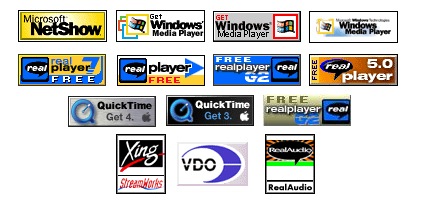
For those old school folks in the industry, the below images will probably bring back a few memories. In the early days when the many of us were just starting to put video online, video players weren't embedded into the browser like they are today. For a couple of years, every video was in a stand-alone pop-up player and the user experience for downloading and updating their player was nothing like it is today.

Player-icons

From the earlier days of Xing Streamworks, VDO.net, Netshow, RealAudio and QuickTime these little download icons covered websites. It's amazing to think how quickly that user experience changed when the competition between Microsoft and RealNetworks hit its peak between 1998-2000, when both companies were developing new players at a furious rate. Personally, I still think more advances and development took place in those two years in the industry than during any other two year period since.