Win A Roku 2 XS Angry Birds Limited Edition Player

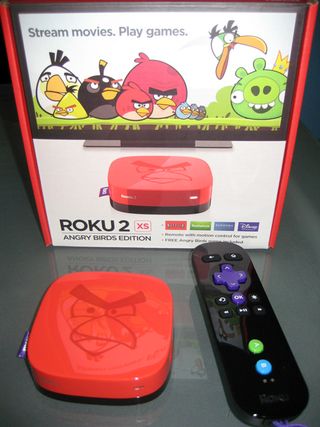
IMG_0097I've gotten my hands on one of the limited edition Angry Birds Roku 2 XS players and am giving it away to one lucky reader of my blog. It comes brand new in the box. To enter the drawing, all you have to do is leave one comment on this post and make sure you submit the comment with a valid email address. The drawing is open to anyone with a mailing address in the U.S. and I will select one winner at random in two weeks. And if you don't win, remember that Roku now has models that start at only $50, (Roku LT) so it's still the best device on the market and the most affordable. Good luck!

Sponsored by

Webinar 2pm ET Today: The Truth about HTML5 Video Performance & Compatibility

Today at 2pm ET,  I will be moderating another StreamingMedia.com webinar entitled, "The Truth about HTML5 Video Performance & Compatibility". By now it's apparent that HTML5 video is the key to reaching a large part of the fastest growing mobile audience. But many publishers are unaware that the fragmented distribution of operating systems and browsers used by mobile devices increases the complexity associated with publishing video to these devices. 

Please join me and presenters from Brightcove for this webinar, where we will present the findings of a wide ranging survey of HTML5 video tag usage and performance. We will explore how device, operating system, and browser differences affect the HTML5 video experience and effectiveness of business-critical plug-ins, such as advertising and analytics, and outline how Brightcove Video Cloud can help you to ensure consistent playback on HTML5 devices.

In addition, all registrants will receive a complimentary copy of Brightcove’s newest report on HTML5 Video Performance and Compatibility.

Register here and bring your questions for the presenters for the live Q&A portion of the event.

Transparent Caching Market $142M This Year, Growing To Over $400M By 2014

In addition to my role at StreamingMedia.com, I'm also a Principal Analyst at Frost & Sullivan. We do a lot of private research for companies in the industry and we also produce quite a few reports each year that focus on the size of different products and services in the digital video ecosystem. One of the reports new to our list this year is on the topic of transparent caching, entitled "Analysis of the Global Transparent Caching Market".

As video streaming and rich media downloads continue to flood operator networks, with no end in sight, network operators are evaluating and deploying transparent Internet caching inside their networks to address a broader range of Internet content. The intent is two-fold. The first is to reduce the network infrastructure and bandwidth costs associated with over the top (OTT) content and the second is to differentiate their consumer broadband service and deliver better user performance. By eliminating any potential delays associated with the Internet or even the content origin, caching allows the operator to highlight their investment being made in the access network and deliver more content at top speeds.

The global transparent caching market is poised for robust growth driven by an increased demand for web based video and a rush of telco operators seeking to deploy CDN services to meet that demand. Still in its infancy, the market's worldwide revenues should equal just over $140M this year and is expected to grow at a compound annual growth rate of 39.3 percent from 2010 to 2014 to reach over $400M dollars in revenues by 2014. Leading factors that will impact the market include increase in the unfettered viewing of video over broadband from IP enabled mobile devices and other consumer products, higher adoption of CDN services for video delivery by media and entertainment companies, and launch of CDN services by communication service providers.

In addition to detailing the market drivers, the report also outlines the restraints to market growth, product and pricing trends, the competitive landscape, and market forecasts and trend analysis broken out by region of the world for the next four years. The report also highlights vendors in the transparent caching market including Alcatel-Lucent, Blue Coat, BTI Systems, Huawei, Juniper, Oversi, PeerApp, Verivue and calls out those like Cisco who are expected to become challengers in the industry over time.

Copies of the report are available to any customer who has a subscription to Frost's Digital Media research service and anyone interested in getting a subscription can contact me for more details. Also, while many research analysts at other firms won't talk to someone unless they are a customer of that firm, I have and always will talk to any company who is interested in getting more details on any aspect of the video, streaming and content delivery ecosystem. You don't have to be a customer of Frost & Sullivan for me to take your call and do a briefing with you, so call anytime.

Learn more about Transparent Caching:

An Overview Of Transparent Caching and Its Role In The CDN Market

A Summary Of Transparent Caching Architectures

Blue Coat's New Transparent Caching Appliance Adapts In Real-Time To Changes In The Web

EdgeCast and PeerApp Team Up To Combine CDN With Transparent Caching

Language In The DMCA Limits How ISPs Can Cache Content On Their Network

Netflix’s Long-Term Business Model Flawed, Competitors Willing To Give Content Away

As much as Netflix says they aren't trying to create a subscription based content service that competes with cable, that's exactly what they are trying to do. The company is licensing exclusive content in an effort to try and retain customers and sign up new ones, but their long-term business model is flawed. Netflix thinks that having access to a series like Mad Men is enough to keep customers subscribed in perpetuity but the problem is that once a customer blows through the episodes and has nothing else to watch, they will cancel.

Netflix's CEO has compared their licensing of exclusive content to what HBO does, but that's a bad comparison. While cable channels like HBO have exclusive content, they also have fixed delivery time frames. This means that customers can only watch content when HBO wants them to, including modifying what content is available on-demand. When Netflix was the only service in the market to offer this kind of content, Netflix focused on the breadth of their library, not exclusivity. But with competitors like Amazon willing to give away the same content that Netflix is charging for, as a loss leader for their other products and services, Netflix is now scrambling by trying to get exclusive content to keep customers. The problem is that long-term, this approach by Netflix can't last because they have no way to compete against free.

Long-term, Netflix business model for licensing exclusive content won't work. When a competitor comes up with a way to deliver streaming content in breadth, think Amazon and Google, Netflix is done. Netflix can't afford to give the content away like Amazon, Microsoft, Sony and Google can and Netflix doesn't have any other products or services they can sell. In addition, when it comes to the digital delivery of video, the studios have complete control of the content, the MSO's own the last mile and Netflix's prior advantages in the physical world of DVDs completely disappears in the digital world. If Netflix doesn't own the content or delivery, then why would they have a superior service when others are willing to use movies and TV shows as a loss leader?

Some might argue that Netflix will just acquire a large library of content on an exclusive basis, but that won't happen. Studios make the most money by licensing the same content for many platforms, not just one. Netflix can never charge enough for their subscription service to make up for displaced DVD revenues and Netflix doesn't have enough money to license a large catalog of content on an exclusive basis when it is estimated that Mad Men alone is costing them $75-$100M for seven seasons. We all know that studios make their money by selling us the same content multiple times for different platforms. An on-demand offering for one low monthly price would kill the studios business model since consumers would not want to watch the content via other platforms if they knew it was already available on-demand any time they wanted. Netflix's model completely disrupts the studios window strategy for making money.

In addition, someone I was talking to about Netflix made a good point about the studios not wanting to be “iTuned” like the music industry was. The studios will try to encourage as many channels for content delivery even at the expense of short term profits to maintain longer term survivability. Having one company like Netflix control 80% of the streaming movie business, the way Apple owns 80% of the music market, is not in the best interest of the studios. For many years, Netflix's strategy was that no one else could have the breadth of content they have or be on as many platforms and devices. But that's no longer the case with Amazon and other competitors are starting to catch up very quickly. Now, Netflix is focusing their efforts on exclusive content, with the same strategy that Blockbuster had, thinking that content exclusivity would save them. In the long-run, it won't work.

Netflix is no longer the only game in town. With content subscription services from Hulu, Amazon and DISH, video on demand from the MSOs, services like Comcast XFINITY TV, and other competitors like Microsoft, Sony, Google and Redbox all entering the market soon, Netflix is going to get squeezed. This is the whole reason no MSO has bundled Netflix's service in with their cable TV offering, it's competition. I expect we'll see this happen for Netflix's service in Latin America, but that's more out of a necessity for Netflix since most consumers in Latin America don't have credit cards and Netflix will need to use the local MSO for billing purposes.

People always fall back to the argument that Netflix's content is better, but it comes down to what's "good enough" and what people are willing to pay for. Also, most seem to argue that Netflix is only $8 a month, but remember that Netflix is not a replacement for other services. So it's $8 a month of top of a $100 cable bill plus other services like Hulu Plus that a consumer might also be taking. And for a consumer that already has something like XFINITY TV and Hulu Plus or Amazon Prime, do they really need Netflix? You have to add up the value of all the services a consumer has and then compare it, as a whole, to Netflix's offering.

Netflix has the chicken and egg problem. To get subscribers, Netflix needs content. To get content, Netflix has to pay the studios which requires subscribers. Netflix is having to commit to up front massive payouts to studios for whatever content they can get. But if subscriber growth stagnates, Netflix could quickly find itself upside down in those agreements. From a financial perspective, Netflix has already estimated it won't be profitable next year as they expand into new territories in a clear sign that content costs are skyrocketing.

Long-term, Netflix is going to face some serious problems, some of which we are already starting to see. Netflix's continued need to increase their content library, and have exclusivity, has a lot of upfront costs that could increase monthly fees in the near-term and slow subscriber growth rates. And while Netflix content might be a bit better than the competition, competitors services will become good enough and make Netflix's cost of customer acquisition and churn increase. 2012 is going to be a very tough year for Netflix.

Updated: I've gotten a few emails from people saying that no one seemed to be making these arguments when Netflix's stock price was at $300 a share. Actually, many were. In September of last year, when Netflix stock price was at $165, I was making the very same arguments, as were others. So it's not about people all of a sudden piling on Netflix when the company is having trouble.

Disclaimer: I have never bought, sold or traded a single share of stock in any public company ever.

Amazon Says It Has 20,000 CDN Customers; But What Does That Really Mean?

On Tuesday, Amazon announced via their AWS blog that the company now has 20,000 active customers for their CloudFront CDN service. In addition, Amazon believes that their 20,000 customers would make Amazon CloudFront “the largest global CDN according to published customer counts“. The problem is that while the 20,000 number sounds impressive, without more granular details, there is no way to know what it really means.

If the majority of Amazon’s customers are start-ups, or developers, then the average revenue per user (ARPU) is probably a few hundred dollars a month, with many paying even less than that. And since Amazon does not require monthly commits, a customer could be here today, but gone next month which means their business would have a very high rate of churn. Amazon did define in their post that the 20,000 “active” customers means that the customer “has used CloudFront in the given month,” but we still don’t know what kind of volume the average customer is doing or even what percentage of their customers come from which verticals. In a follow up with the company, Amazon did verify for me that all of their “active” customers are in fact “paying” customers.

Is the number of customers a vendor has really the best way to distinguish who the “largest” CDN is? I would argue no. Customer count is one of the many data points that the industry should be looking at, but total revenue and profitability matters more. Would a CDN vendor rather have the most customers in the industry and be losing money, or have fewer customers and be profitable? One CDN could have many smaller customers, who don’t do as much volume and another CDN could have fewer customers who do much larger volume. One could be “larger” based on the customer count, but the other could be “larger” based on the volume of traffic going over the network. In the end, there is no one data point alone that can be looked to say who the largest CDN is. Multiple data points on customers, ARPU, churn, rate of growth, volume of traffic, capacity of network and profitability all have to be looked at together.

In Amazon’s case, they do have a big advantage over other CDNs in that they can afford to spend years building their CDN business, at a loss, and will still be around years from now to turn the business into something that is profitable when this market really begins to grow. Many other CDNs didn’t and still don’t have that advantage. So I do expect Amazon to be one of the few big players in the CDN space years from now and the company does have a lot of advantages with CloudFront thanks to their entire portfolio of Amazon Web Services (AWS).

Amazon won’t say how much revenue CloudFront does, which is pretty typical of the CDN vendors as a whole since most of them never discuss revenue or number of customers per service type. In August of this year I detailed that by my estimates, Amazon’s CloudFront service should do around $75M in revenue this year. Of course, that’s not a scientific number and Amazon has never given any guidance, but talking with some of Amazon’s competitors who watch what kind of volume and capacity the company has for their CDN service, some of Amazon’s competitors have expressed to me that they feel pretty confident that Amazon is well under $100M in CloudFront revenue for 2011.

All this aside, Amazon’s CloudFront service is seeing some dramatic growth in traffic volume and getting some nice traction in the market with mostly small and mid sized content owners. But Amazon has bigger ambitions and also plans to really start going after the larger content owners in the New Year which should make things interesting, especially since they bring so much transparency with pricing to the market. In the last couple quarters, I have gotten more questions from content owners about Amazon’s CDN service than any other vendor and Amazon has been pushing their service via marketing, speaking engagements and sponsoring of events. So word is getting out that Amazon’s CDN service is no longer something that is only thought of for developers and the company has rolled out an amazing amount of new features and support for the service in the past 18 months. (see below for a list)

Plus, it’s only a matter of time before Amazon starts offering services that fall under the “value add services” umbrella for CDN companies, especially when it comes to the acceleration of content. And one would expect Amazon to bring the same kind of transparency to those services as they did for CDN, which is going to make things very interesting considering those are the services that currently have high margins that so many CDNs now rely on.

It’s clear that Amazon’s CloudFront team really wants to show off the success they are having in the market, but have their hands tied by the fact that as a company, Amazon really never divulges too much info on their AWS platform. So it makes sense they would put out whatever data they can, even if it is just a customer count number that really does not tell us much. Over time, their customers will act as their mouth piece as we’ll hear from more and more of them using the service who are willing to talk about the success they are having with CloudFront. One thing though is for sure. Amazon is not going away, they are heavily investing in their AWS platform and they will be one of the leading CDNs in the market, for all kinds of content delivery services, years from now.

As a side note, Amazon currently has 341 900 job openings worldwide, just for their AWS group. That alone shows you the kind of long-term investment they are making in AWS.

Similar Posts:

Amazon Lowers CloudFront CDN Pricing, Estimate CDN Business Brings In $75M

Amazon’s CDN Quickly Gaining Momentum, Now Supports Live Flash Streaming

Amazon’s CDN Gets More Competitive, Adds SLA, New Edge Locations, Lower Pricing

Amazon’s CloudFront Now Offers Flash Streaming, This Will Disrupt The Market

Amazon Building Dedicated Sales Force For CloudFront Delivery Services

Amazon Lowers CDN CloudFront Pricing Down To $0.05 Per GB For Volume

Amazon Slowly Turning Into A CDN For Video

Amazon Prime Streaming Will Disrupt Netflix, Here’s How

Amazon’s New CDN “CloudFront” Launches With Pricing As Low As $0.09 Per GB

Call For Speakers Now Open For 2012 Streaming Media East Show In NYC

The call for speakers for the 2012 Streaming Media East show, taking place May 15-16 at the Hilton Hotel in NYC is now open. The submission deadline is Monday, January 20th, 2012 but I typically receive more than 800 submissions and only have room for about 120 speaking slots. So I would suggest you don't wait till the last minute as many speaking spots go very fast.

If you are interested in moderating your own round-table session at the show and are looking to help organize and participate in the topic and creation of a session, please contact me immediately with your idea. I am also looking for more presenters who can do stand-alone how to sessions and am looking for proposals for some 3-hour workshops on topics pertaining to HTML5 video.

Also, I know that many vendors want to speak at the show and sometimes feel frustrated that they don't get picked. The way I choose which vendors get the speaking spots at our East and West shows is based on those vendors that bring customers to speak at the show. So when you submit your speaking request, please make sure you fill out the entire form where it asks about potential customers that may be able to speak at the show. More details on this selection process can be found here and if you have any questions, please pick up the phone and call me. I prefer to talk about proposals much more over the phone than via email and am always reachable at 917-523-4562.

In conjunction with the 2012 East show we will also have the Content Delivery Summit taking place on Monday May 14th, with the call for speakers opening next week. In addition, the Streaming Media East show will once again feature the special Broadband Device Pavilion and will be expanded this year to include tablets. It is still the only place that I know of where you can come get hands on with over 25 different devices as well as nearly three dozen different content platforms.

There is a lot going on for our 2012 shows, so I am starting the planning much earlier this year. If you have an idea, want to run something by me, want to propose or pitch me on anything, please pick up the phone and give me a call. I'd be glad to talk to you.

Cotendo In Talks To Be Acquired, Akamai The Likely Buyer

Over the weekend, details of what I have been hearing about for over a month finally made it out into the media with multiple news outlets reporting that Cotendo may be acquired. Talks between Cotendo and Akamai have taken place multiple times over the years, but only recently heated up when executives from Cotendo met with Akamai back in October. After hearing about the meeting, I reached out to Akamai for comment and on November 4th, as expected, Akamai said they “don’t comment on any rumors or speculation“. Executives reached at Cotendo said they were not for sale but didn’t dispute or deny some of the details I had about the discussions taking place in the market.

To date, I had not heard of the valuation Cotendo and Sequoia were looking for, but news outlets over the weekend pegged the evaluation at between $300M-$350M. I don’t know if those numbers are accurate as I don’t have any first-hand details on the numbers, but valuing Cotendo at more than $300M seems a bit high to me in today’s market. The details I heard was that a deal with Akamai had been agreed upon and that AT&T, who had the right of first refusal to purchase Cotendo, wasn’t willing to offer a high enough price. Others are reporting that Juniper, an investor in Cotendo, is also in talks to acquire the company, but to date I have only heard of Akamai making a real offer.

While various news sites are reporting on the Cotendo sale rumors, some aren’t getting the basics right. The Globes article says that Akamai “controls 90% of the content management and streaming market” with Cotendo and another competitor controlling the remaining 10% except that Cotendo doesn’t even offer any streaming services. And Akamai does not control 90% of the content delivery market for streaming. Also, by my last count, Cotendo has more than 400 customers for their services, not the “50 paying customers” as of this past June that the Globes article reports. In May of last year, the company already had 120 customers and has been blowing through their own internal customer growth projections each quarter.

Another Globes article incorrectly says that Cotendo offers “Dynamic Spectrum Access (DSA)” as a service, which is not what DSA stands for. Dynamic Site Acceleration is the service that Cotendo is known for along with application acceleration and mobile content acceleration. (see: How Dynamic Site Acceleration Works, What Akamai and Cotendo Offer) The article also incorrectly says that “Cotendo’s prices are half the prices of Akamai“, but that’s not the case. On average, Cotendo’s DSA pricing is about 25%-30% cheaper than Akamai and many customers tell me the performance of Cotendo’s DSA product is about 20% better than Akamai. Cotendo has been selling on performance and does not need to cut Akamai’s pricing in half to win deals since customers care about and measure DSA performance very closely. Reuters reports that Cotendo was the “first to offer web surfing services for cellular devices“, whatever that means and others are incorrectly calling Cotendo a “startup”. If there is one thing that is clear, it’s that the media really has no clue what services Cotendo offers.

If Akamai acquires Cotendo it would be a great win for the company on multiple levels. Akamai has really fallen behind when it comes to launching new products in the market and is getting beaten by the smaller and more nimble Cotendo. Akamai has yet to launch their joint mobile content acceleration product with Ericsson, yet Cotendo already has their mobile content acceleration product out in the market, which they launched back in June. (see: How Mobile Acceleration Works: An Inside Look At Cotendo’s Newly Announced Service). Cotendo also has their joint product with Citrix out in the market, launched last month, again beating Akamai to the market with their joint Riverbed product, currently in beta. And a year ago, Contendo worked with Google to deploy and commercialize a new Page Speed Automatic service, based on an open source project developed at Google. In the two and half years since Cotendo launched in the market, they have really proven their technology and platforms expertise and recently, have really been giving Akamai some serious competition, for certain deals.

In September, I wrote that the pressure on Akamai was growing and that the company needs to make some acquisitions to jumpstart their business. Acquiring Cotendo would be one of the best acquisitions for Akamai that they could make as it would allow them to take their number one competitor for non-CDN services out of the market. As a result, Akamai would see almost no pricing pressure for their value add services going forward, margins would remain high and they would capture a larger share of the market for value add services. Of course while all of this would be good for Akamai, it would be bad for the industry and customers as a whole since no other vendor is yet able to compete with Akamai on these services at scale. The outcome would be higher pricing in the market and not a lot of alternatives other than Akamai for customers to use, although Amazon will help drive prices down in the market for services like DSA when they enter the market.

When Cotendo launched in the market, the industry was already crowded with far too many CDNs primarily focused on delivering video. While many of the other CDNs in the industry were trying to change their product portfolio to provide value add services and diversify their revenue, Cotendo was already blazing a trail, focusing on these services from day one. Less than three years later, the company has a lot of blue chip customers, a major deal with AT&T (see: AT&T Partners With Cotendo For App Acceleration, Will Challenge Akamai) and is quickly ramping revenue and getting a very good reputation in the industry. Cotendo is exactly the kind of company that Akamai should be using some of their cash to acquire as it allows Akamai to protect their margins and gives them access to some really good technology platforms to expand their product portfolio moving forward.

Of course, if someone were to step in and somehow match Akamai’s price, which I don’t think will happen, or Juniper makes an offer for Cotendo, which I don’t think they are serious about, Akamai will no longer benefit. But from what I hear, Akamai is in the driver’s seat on this deal and other potential suitors would have to get a lot more serious than that are now if they want to beat Akamai from acquiring Cotendo.