Livestream’s $495 Broadcaster Is Here, Unboxing Photos, Review Coming Soon

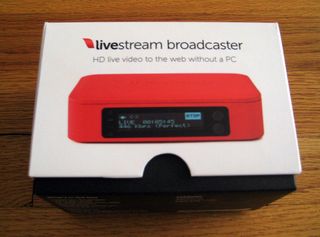
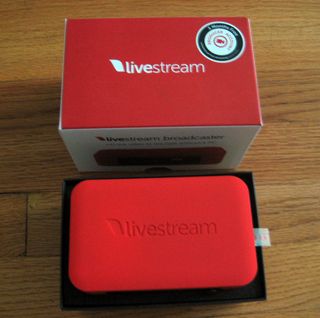
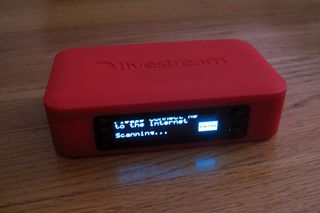
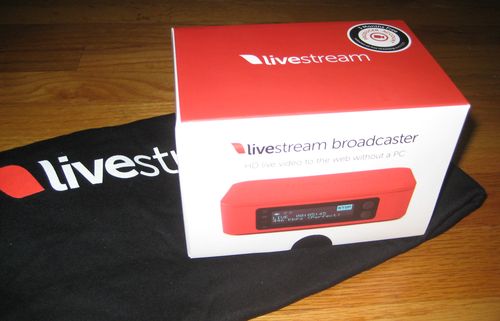
IMG_0317In April, Livestream announced a new hardware encoder called the Livestream Broadcaster. I’ve just received my unit in the mail and have included some unboxing photos below. I’ll be posting a full review of the device shortly, but in the mean time, my initial impressions from being hands-on with it is that it’s really well designed.

One of the first things you notice when you pick it up is how solid it feels, even though it is only 4.8 x 3.0 inches in size and 1.25 inches in height. It’s small, but the broadcaster doesn’t feel cheap at all. It’s also been really well thought out with the top cover held on by magnets so that it’s easy to swap the AA batteries inside. The two buttons on the front that also act as joysticks to navigate the on-screen menu work really, really well.

If this performs as well as it looks and feels, then this $495 encoder will make encoding and distributing live HD events to the web and mobile devices easy and very affordable for many.

If you have specific questions about the device you want to know the answers to, put it in the comments section and I’ll make sure to answer them during the testing process.

1 2 3 4 5

Sponsored by

Advisory Board Members Announced for the Enterprise Video Conference

Screen shot 2012-06-18 at 6.31.59 PMLast week I blogged about our newest conference, the Enterprise Video Conference, taking place in conjunction with our Streaming Media West show, Oct. 30 – 31 in Los Angeles.

Today I’m happy to announce the seven advisory board members who will help with the planning of the show, will co-chair the event and will lend their industry expertise to put together the best lineup of speakers and content. The advisory members are:

  • Patty Perkins, Team Leader, Creative Services Technology, Wells Fargo
  • Erica Schroeder, Director, Business Video, Cisco
  • Larry Bouthillier, Media Technology Architect, Harvard University
  • George Levar, Video Service Delivery Lead, Accenture
  • Michael Newman, VP/GM, Video Content Management, Polycom
  • Paul Riismandel, Director, Curriculum Support, School of Communication, Northwestern University
  • Eric Hards, Manager, Digital Media and Streaming, Enterprise Digital Media, Lockheed Martin

While I am in the very early planning stages for the event, the schedule will permit for a total of 18 session slots, eight of which will be 45 minutes in length and ten of which will be 60 minutes in length. About a third of the slots will be reserved for customer case studies and in total, I expect about 70 speaking slots. We’ll also be having four keynotes, two each morning, and dedicated networking events.

Next month we’ll have the website live at www.EnterpriseVideoConference.com and the call for speakers will officially open. But anyone interested in speaking is welcome to email me now with their speaking request and I’ve already gotten a few dozen submissions from some great Fortune 500 corporations and universities. In a few weeks we’ll also have details on sponsorships and the first batch of confirmed speakers.

If you have any questions about the Enterprise Video Conference, feel free to reach out to me anytime. I’m still recovering from arm surgery and am not online much yet, but I will respond to your inquiry when I can.

What would you think our Twitter hash tag should be for the event? Love to hear suggestions in the comments section.

Thursday Webinar: “Best Practices for Advanced Encoding and Transcoding Techniques”

Take your encoding and transcoding knowledge to the next level with this instructional webinar, starting at 2pm ET, that will highlight the latest advanced encoding techniques. Get details on delivering higher video quality at lower bit rates and how to prepare high quality video for delivery to any screen using multiple formats. The webinar will cover advanced practices from Telestream, Harmonic, Haivision and Sorenson Media and will cover:

  • advances in AVC algorithms
  • advanced GOP features in H.264
  • live and file-based transcoding workflows and requirements
  • different frame types, what they are and what they mean
  • how to optimize encoding presets
  • optimizing video for the iPad and Apple TV
  • what are the hot new formats, who's using them, and what settings do we recommend?
  • how to prepare content for Dynamic Adaptive Streaming over HTTP (DASH)

Register here and bring your questions for the presenters for the live Q&A portion of the event.

Announcing the Enterprise Video Conference, Two-Days Of Content Focused on Enterprise and Edu Video Deployments

Screen shot 2012-06-18 at 6.31.59 PMI’m pleased to announce that in conjunction with our Streaming Media West show, taking place Oct. 30-31 in Los Angeles, we will be launching a brand new conference focused on video deployments within the enterprise and education verticals. While a portion of the content at our East and West shows have always included topics pertaining to video within the firewall, we think more focus is needed on enterprise video and will now have a whole show dedicated to the topic.

Called the “Enterprise Video Conference“, the event will be two-days in length and have two concurrent tracks with case study presentations, round-table panels, how-to sessions and possibly their own keynotes. While I wanted to wait until the website was up before I announced the show, I need to get started on the agenda and the call for speakers.

In addition to the work I will be doing to plan the show, I am also recruiting an advisory board of industry experts as well end-user customers who deploy and use these solutions every day to help me plan the content of the show. Multiple enterprise organizations who deliver video inside the firewall have agreed to help as well as numerous universities. I’ll announce the advisory committee shortly and if anyone wants to be considered for an advisory role to help me shape the content of the conference, please reach out to me ASAP.

As with all of our events, end-user customers are going to be a key focus of the show. There will be room for vendors to speak as well, but I really want to highlight as many customer success stories as possible. Vendors have done an excellent job at getting many of their fortune 500 customers to speak and present at past shows and I’ll looking for suggestions for the Enterprise Video Conference as well.

Until the website is up with more details, anyone interested in getting involved, submitting a customer to speak or wanting to pitch me any ideas or suggestions can simply send me en email. I don’t have deadlines yet for speaking submissions, but I suspect the deadline will be in about 30 days from now. Those interested in potentially being advisory members or moderators who want to organize a session of their own need to contact me quickly – by the end of this month.

There are tons of conferences and shows in the industry, but very few are focused, bring a qualified audience and are geared only towards the use and adoption of video amongst enterprise and educational institutions. This isn’t our show, it’s the industry’s and this is your chance to give feedback, pitch in and help make the Enterprise Video Conference show people that there is more to video than just media and entertainment content. Video deployments inside the enterprise and edu don’t get enough credit and with your help, we can change that.

So if you have ideas, suggestions, want to speak, moderate or be involved in way, the flood gates are open. Email me, call me (917-523-4562) and please realize that speaking spots will go fast. The content for this conference will come together quickly, so don’t wait too long to reach out if you want to be involved.

Call For Speakers Open For The Streaming Media West Show

The call for speakers for the next Streaming Media West show, taking place October October 29-31 in LA, has been open for a few weeks and anyone interested in potentially presenting or speaking at the show needs to submit a proposal via the website. The deadline for proposals is June 22nd. Proposals are always welcomed after the deadline, but I get seven or eight times the number of submissions I can use by the deadline, so getting it on time is important.

At our May show in NYC, I cut out 1/3 of all the round-table sessions and replaced them with how-to presentations. I will be doing the same for the West show which means there will be fewer spots for speakers on panel sessions. Attendees have told us to "talk less and show more", so that's what we're doing with more hands-on presenters. If you'd like to pitch a hands-on presentation, please look at the list of ones we had at the May show to get an idea of the topics we cover.

I get asked time and again how I pick speakers and for info on the speaker selection process, as well as what is required from vendors if they want to speak. I've explained that in detail on my blog many times so if you are new to the process, please see my post here that explains it in detail. [Here's How Vendors Can Speak At The Streaming Media West Show In LA] While the post talks to last year's show, it still applies.

Based on the proposals I have already received, I probably have 75% of my topics decided upon and outlined. But if you want to moderate a session and help create the content and invite speakers, please contact me ASAP if you haven't already.

Also, I know that many other shows wait till a month or two before the event to place a lot of their speakers. I have 150 speakers, 20 how-to sessions, four workshops and two keynotes over three days, so a lot of the planning happens well in advance. Trying to get a speaking spot last minute is nearly impossible, so please understand that when you call me two weeks before the show asking why you can't speak.

We'll be adding a new conference to the West show this year called "The Enterprise Video Conference". The purpose of the conference is to have a dedicated event focused on the enterprise and education verticals and their adoption of video. I'll post more info on my blog about that event shortly and will announce a list of industry executives who make up the advisory committee helping us plan the new show.

TV Isn’t Dead or Dying, And It Doesn’t Need To Be Saved

It seems a week can’t go buy without my RSS feed being full of articles talking to the demise of the TV medium and its business model. This in the face of record profits by operators like Comcast, reports from cable operators of no subscriber losses of any significance and MSO’s seeing their average revenue per user (ARPU) growing every few quarters. Yet even in the face of all this data, many in the media seem to have a personal agenda of wanting to get others to agree with them that cable TV is a dying medium and that it will follow the downward spiral of the newspaper business.

Their arguments, if you can call them that, are almost always based on the speculation of products that don’t even exist yet, think Apple TV, or al la carte pricing, and they try to argue that one medium, like online video, will replace another service instead of being a compliment to it. Many are under the assumption that they know what consumers want and what they are willing to pay for and are quick to count new services as a disruptor, even if there are no customers. The media is so adamant about saying how much consumers hate paying their cable bills, even though we have the evidence to prove that so far, consumers have not voted with their wallets and canceled their cable in any large numbers. You almost never see any of these articles mention that there are more than 100M consumers in the U.S. who pay for cable TV or that to date, all combined, the cable TV operators haven’t even lost 1% of their subscribers in any one-quarter.

None of that seems to matter though because these days, if you write about the online TV business, it seems you are almost expected to bash cable TV and spend more time creating the title of your post than the actual contents. Many writing about the cable TV industry try to top one another with headlines that spew doom and gloom for the cable TV industry, using words like “death” and “dying”. Their motive is to entice a reader with drama, rather than to inform them of what’s really going on. Many write about how easy it is to cut the cord and speak to it as a viable alternative to cable, but then have never used the devices and platforms they are writing about. They aren’t hands on, don’t know how the services work, and the vast majority of those who write about the online TV space couldn’t even tell you the simple mathematical formula used to figure out how much bandwidth an online video stream takes up.

Probably eight out of every ten articles I read about the cable TV industry never seems to tell the story of what’s actually taking place with cable TV today. All the media wants to do is speculate about what could or may happen down the line and they are more concerned with trying to crystal ball everything, instead of looking at real data we have in the market today. Naturally every time I write an article like this I get comments from people who say that they are talking about the “future” and that I must be an idiot not to agree that the TV model will change. If by idiot you mean realist, I’ll take that as a compliment because change does not imply “disruption” or “death” like many suggest. And many of these authors are some of same people who were saying in 2007 that the cable TV model will be dead in a few years and that TV everywhere, Netflix and the Apple TV box would “kill” off cable. Five years later, none of that is true, TV everywhere is hardly deployed and Apple has only sold 5.5M of their $99 Apple TV’s in the past 21 months.

Today I read an article that started off by saying, “it was only a few years ago that it looked like TV was a dying medium.” Really? To whom? It didn’t look like that to anyone with any sense. While some might argue with my notion that many posts about cord cutting don’t contain lots of data, the problem is that the data they highlight is 100% irrelevant. Firms spend a lot of time and money to collect data from consumers who say they don’t want to pay their cable bill and want to cut the cord. But the only thing that matters is not how many say they “want” to do it, but how many actually do. Is anyone surprised that when you ask consumers if they’d rather get something for free instead of paying for it most say they would? That’s suppose to be the data to support their cord-cutting argument? It’s useless.

It reminds me of when Netflix announced their higher pricing. Analysts surveyed customers and then said that Netflix could lose up to 30% of their members because they were so up in arms about the higher prices. However when it came time for Netflix to report their numbers, Netflix didn’t lose a lot of members at all. Because complaining about not wanting to pay for something versus actually canceling the service are two very different things. But these are the kinds of meaningless data points writers use to try to sound rational, as if it gives them ammunition for their argument. I’ll go back to my earlier example. Why is it that the majority of cord-cutting articles never mention how many total consumers pay for cable or satellite TV? Go back and look at the last five articles you read about cord-cutting. I’ll bet you all of them didn’t give out that data. Because the moment they do, their title loses all of its punch and it’s no longer as dramatic as they made it out to be.

It’s also clear to see from most of the posts about cord-cutting that the writers don’t have any real understanding of how video is delivered on the Internet. They think of themselves as being experienced with technology but the fact is, most of them have never worked at a technology company. They are quick to talk to the content choices, syndication models and what consumers want, but not about whether any of these services can or will work from a technical level. Every time some kind of new service is announced, they don’t question the technology, what the quality is when compared to TV, how the service could scale, what the QoS is or how it actually works. Far too many hear how it works, might see a demo and then assume it could displace a large portion of an already well established offering like cable TV that has been proven at scale.

Today, far too many bloggers who cover the topic of cable TV and the impact online video is having write for headlines. Opinions are giving as facts, real data is ignored and unreliable data is quoted as scripture. Too many writers want to use words and phrases to always show the negative side of something, instead of telling the story of what’s really taking place. Look at how many authors spend so much effort to try and convince the reader that they should cut the cord and dump cable. Why? As a writer for a news outlet, that’s not their job. I believe the job of the media should be to tell a story and not to try and spend so much time and effort trying to get the reader to agree with the author’s opinion that cable TV is dead or dying. Give out the data, present the facts and then let the reader decide on their own. Trying to use doom and gloom to sell a story is a bad approach to take to editorial.

Videos From The Content Delivery Summit Now Online

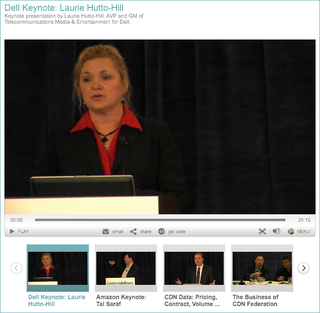
Screen shot 2012-06-11 at 5.27.25 PMAll of the presentations and sessions from the Content Delivery Summit are now online and available for viewing on the show website at www.ContentDeliverySummit.com.

You can also download all of the presentations from the event on the agenda page. You may use use or embed the videos any way you like. The Twitter hashtag for the event is #cdnsummit