[Updated March 5 2013: The Roku 3 has been announced. See my updated post here for a comparison of the Roku 3 vs. Apple TV] or keep reading below for a comparison of the Roku 2 vs. Apple TV. And if you want a shot at winning a free Roku 3, I’m giving one away to one lucky reader of my blog. You can enter the drawing here.
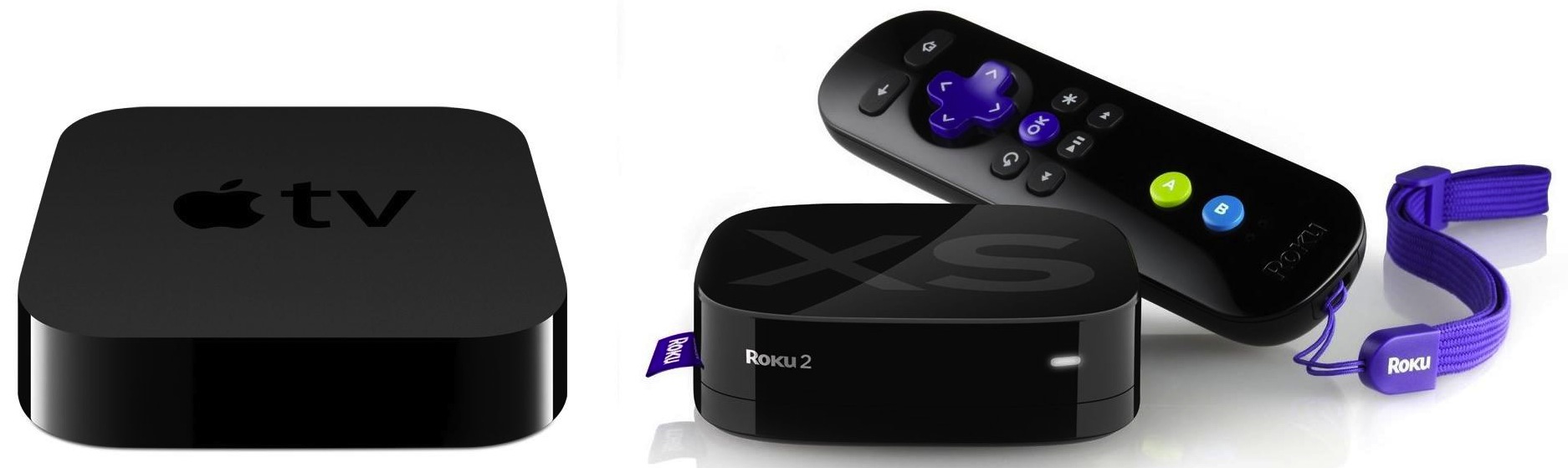
While there are currently seven different $99 streaming boxes in the market today, the two most popular and best-selling are the Roku 2 and Apple TV. I get a lot of questions from readers asking me which box I think they should buy and many always want to know how the two boxes compare. While I have done many side-by-side reviews in the past, here’s the latest comparison on how the boxes stack up, the pros and cons of each and the factors you should use to determine which $99 streamer you should buy. While Roku currently has four different models of boxes available on the market, ranging in price from $49 to $99, this post will compare the $99 Roku 2 XS to the $99 Apple TV. And if you want to win your very own Roku 2 XS or an Apple TV, I’m giving both away in two separate drawings. (Enter Apple TV drawing | Enter Roku 2 XS drawing)
Hardware
To date, Apple has sold over 6M of their $99 Apple TV devices and Roku has sold more than 3M globally. Based on available industry data, they are the number one and number two selling $99 boxes in the market today. It’s no wonder considering both boxes come loaded with features including HDMI out, 802.11n Wi-Fi, an ethernet jack and support for 5.1 surround sound and 1080p video. Both boxes are about the same in size (Roku 2: 0.9″ x 3.3″ x 3.3″ vs. Apple TV: 0.9″x 3.9″ x 3.9″) and consume very little in the way of power (Roku 2W, Apple TV 6W). Each box comes with a 90-day warranty and a simple power cord with no power brick. You can add an extra one year warranty to the Apple TV for $29 or $$15 for the Roku 2. While both are great streamers with very similar hardware, there is one big compatibility difference between the two that could determine which one you should buy.
If you plan to hook the box up to a newer TV with built-in HDMI, then both boxes are a great choice. But if you have an older TV without HDMI, the Roku is your only option. Unlike the Roku 2, the Apple TV has no support for older TVs. The Roku 2 XS supports older TVs and provides 480i video quality via composite video and has support for analog stereo via left/right/composite video RCA, thanks to a mini-jack. So if you have an older TV with no support for HDMI, The Roku 2 is the box for you. Two other hardware advantages the Roku 2 has over the Apple TV are a microSD card slot for additional game and channel storage and a USB port.
While the Apple TV has a mini micro USB port, it cannot be used to playback local content via a USB device. The port is only used by Apple for servicing the unit. Since the first generation of the Apple TV device was released (the 720p model), many have speculated that Apple would enable the mini USB port to allow users to play back local content. However nearly two years later, that has not happened. Roku’s USB port can be used to playback content from a USB hard drive or thumb drive and supports MP4 (H.264) and MKV (H.264) content only. So if you have content in these formats and want the option to playback some local content, the Roku 2 is the box to choose. The Apple TV box has an optical audio port and the Roku 2 XS doesn’t, so that might be important for those who want to use these boxes for audio content more than video.
Setup/Wi-Fi Strength
Both boxes are super easy to set up, passing my Mom test which has involved me giving her each of these boxes to set on her own. Roku’s box takes a bit longer to set up than the Apple TV as Roku requires you to go to Roku.com on a computer to enter all of your contact information and credit card details. While Roku only collects your credit card data to have it on file in case you make any content purchases via the Roku Channel Store, many have voiced their complaints that it is an unnecessary step in the setup process, especially if you have been given a Roku 2 as a gift, are giving it to a young person with no credit card or simply don’t want to have your credit card on file with Roku. Currently, there is no way to skip entering your credit card details in the setup process, so if this is a problem for you, stick with the Apple TV, which doesn’t require any credit card details during setup. (Updated: Roku now gives you the option to skip entering your credit card info in the setup process if you want.)
As long as you know your Wi-Fi password and the box is within range of your Wi-Fi signal, each box takes less than 10 minutes to set up. I have seen many in the industry debate which box has better Wi-Fi strength, but I have yet to see any testing of the two that has shown conclusive results. A lot of factors go into how well Wi-Fi works including the type of Wi-Fi router, the position of the router and the type of Wi-Fi protocol (a/b/g/n) being used. Everyone has their own unique setting within their house that determines how strong and how far their Wi-Fi signal works, so it’s very individual. That said, both boxes have what I would consider to be identical Wi-Fi strength and of all the testing and use of the boxes I have done over the years, I’ve never encountered any Wi-Fi differences between the two.
Remote Control
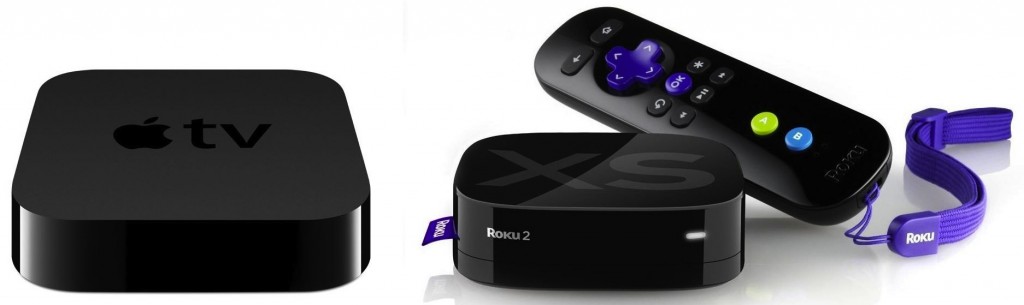
When it comes to the remotes, both work very well and are very responsive. One of the things I don’t like about the Apple TV remote is that it doesn’t take standard sized batteries. It’s not a huge deal breaker, but I have a lot more triple AAA batteries lying around for the Roku remote, as opposed to the watch batteries (CR2032 or BR2032) that the Apple TV remote takes. The Roku 2 XS comes with a Bluetooth game remote with motion sensing for playing games and supports what Roku calls “instant replay”, which allows you to skip back in 10 second increments while a video is playing without having to re-buffer the stream. Apple’s remote is smaller and much thinner than Roku’s, but personally, I like how Roku’s works better than the Apple TV remote. Apple’s remote design is all about less is more, but I tend to find the few additional buttons on the Roku remote are there for a reason and are used often. All of this aside, no one is picking one box over another based solely on the remote and both remotes work very well and work from 30′ away.
In addition to the physical remotes that come with these boxes, you can download remote control apps for your iPad/iPhone that will control your Roku 2 XS or Apple TV. See this link for Roku and this link for Apple TV.
Content/User Interface
As for the content available on both devices, this is really where the Roku 2 is the box to beat. Apple TV supports content from Netflix, Hulu Plus, MLB.TV, NHL GameCenter, NBA, Flickr and YouTube as well as the ability to purchase and rent content from iTunes. It also supports some free Internet content from folks like Revision3, WSJ and others, but all of that content is lumped in under the Podcast heading in Apple TV, so most folks probably don’t see it. The Apple TV use to support $0.99 rentals from ABC, Disney, Fox, and the BBC via iTunes, but Apple has since discontinued that option and shows now have to be purchased for $2.99. For those that want XBMC support on the Apple TV, it’s possible, but only works if you are willing to jailbreak the device.
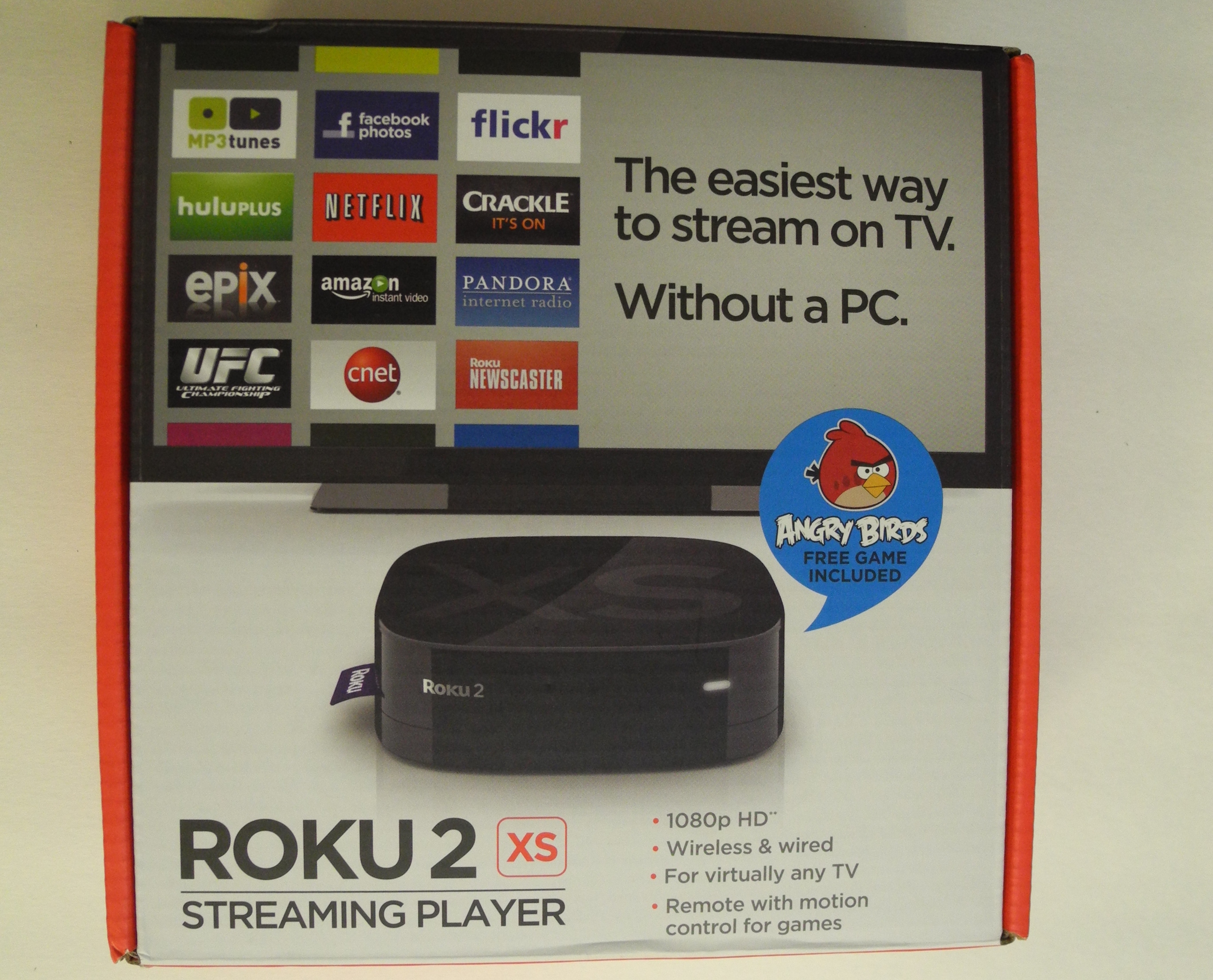
The Roku 2 has channels for Netflix, Hulu Plus, Vudu, Amazon Instant Video, HBO GO, Epix, MLB.TV, NHL GameCenter, NBA, Major League Soccer, UFC TV, CNBC, FOX News, NBC News, AOL HD, TED, Pandora, Crackle, Flickr and has support for PLEX. Roku has more than 250 public content channels listed on their website, has an open SDK and as a result, has a lot of content partners working to bring more channels to Roku devices. In addition, you can browse over 1,000 “private” channels available for the Roku and add them if you know the correct code. (see the list of private channels here) Compare that to the Apple TV which today, has no SDK and doesn’t run any apps on the box. (Updated: Roku says they have more than 600 content channels, but don’t have them all listed on their website, which is in the process of being updated.)
While Roku has support for nearly every content channel around, it does NOT have support for YouTube. For more than a year now, Roku has said they are working on an official channel, but they won’t give any estimate on when it will arrive. Some have been speculating for over 18 months now that the Apple TV will run apps in the future since internally it has 8GB of Flash storage, but none of that has yet to happen. So when deciding which box to buy, don’t listen to rumors of what the box may or may not do down the road, evaluate the boxes in the market based on what they can do today. If you want the most content choices available, the Roku 2 beats the Apple TV hands-down. But if support for YouTube is a requirement, then the Apple TV is your only choice. I should also mention that neither the Apple TV or Roku 2 XS are DLNA compliant, so is that is a requirement for you, then pick the $99 Vizio Co-Star or the $99 Western Digital WD TV Live box. Neither box has any kind of we browser built in, so you can’t browse the web with the Roku 2 or Apple TV.
The Roku user interface is not as polished as the Apple TV interface, but it’s simple, easy to navigate and you can customize the layout of the channels. The browsing experience on the Apple TV is great for picking movies and TV shows in iTunes, with large cover art, straightforward navigation and Rotten Tomatoes ratings. Both the Roku 2 XS and Apple TV have simple interfaces and while they look different, they both perform well and do exactly what they should, with dead-simple navigation. In addition to streaming content, the Roku 2 XS also allows you to play nearly 30 games, with the most popular being Angry Birds. Roku’s regular remote doubles as a gaming remote and works really well for simple gaming. And if Angry Birds is something you’re really into, Roku even has a limited edition version of the console that comes in red.
Playing Videos From Local Computer
If you’re into Apple devices and already have an iPad, iPhone or Mac, then it makes a lot of sense to pick the Apple TV over the Roku due to how all the devices work together in Apple’s ecosystem. You’ll have less content choices than the Roku 2 XS, but all the devices talk to one another and sharing content amongst all the devices is very easy. Any movies or TV shows that you purchase in iTunes via the Apple TV are stored in the cloud and will be available for download to an iPad or iPhone. Enabling your Apple TV to see your local computer allows you to stream just about any media you have on your computer that is running iTunes including your music collection, any video that iTunes can play and your photo collection.
And with Apple’s Airplay technology, you can start watching a video on an iPhone, iPod or iPad and then move that content over to the Apple TV in realtime, for content rented or purchased via iTunes. Airplay also supports the streaming of video from third-party apps on the iPad and iPhone to your TV set with Apple TV in the middle, but only if the app developer enables Airplay functionality. For instance, Airplay works with TNT’s iPhone app, but is disabled in TNT’s iPad app. Also, Airplay does not allow you to play back any DVD images from your computer.
While most people aren’t aware of it, the Roku 2 XS can be used to playback content from your local computer, but it is not as easy or seamless as Apple’s solution to use and it is not built-in to the Roku. Installing a third-party channel on the Roku, like Roksbox, or using PlayOn or PLEX will turn your computer into a media server that can stream movies, pictures, and music from you computer, wirelessly to your Roku device. That said, the Roku 2 XS will NOT play back iTunes content that has been protected via Apple’s DRM. Even with PLEX, the Roku 2 XS can’t playback Apple’s copy protected content. So while you can play back content that is in your iTunes library, it just can’t be content you purchased from iTunes that is protected via Digital Rights Management (DRM). I’ve also experienced cases where the Roku will play back some music tracks but not others depending on how it was encoded. Content purchased via the Roku 2 XS through Amazon Instant Video can be downloaded to an iPad via the new Amazon Instant iPad app.
Replacing Your Cable TV (cord-cutting)
Despite all the hype about cord-cutting, the Apple TV and Roku 2 XS will NOT allow the average person to drop their cable TV package. Neither box has an internal hard drive for storage, has no DVR functionality and has no support for picking up live TV stations via an over-the-air antenna. In addition, many of the content services available for the devices don’t won’t have every piece of content you want, at the quality you want and in the business model (rent/purchase/subscription) that you want. Even a great subscription service like MLB.TV has local blackout restrictions, so these $99 streamers are not a replacement for cable TV for 99% of consumers.
Conclusions
While many people are always willing to give their two cents on which device you should buy, everyone has different tastes when it comes to the type of content they want to watch, how they watch it and whether they rent it, buy it, or play it back from a local computer. Do your research and figure out what YOU want the box to do as opposed to what others are using it for. Picking the best box is pretty easy if you can answer the following questions:
- Does the TV you plan to hook it up to have support for HDMI?
- What specific content do you want to watch?
- How do you want to get your content? Via subscription, purchase or both?
- Do you want the ability to play back content (MP4, MKV) via a USB drive?
- Do you want to use the streaming box for casual gaming?
- Do you already own other Apple devices and want to use Apple’s ecosystem?
- Do you plan to play back a lot of content via iTunes?
Keep in mind that these boxes are cheap at only $99 and getting them via Amazon means you can take advantage of their great return policy. If you pick one up and it doesn’t work the way you had hoped, return it and try a different one. At $99 each, with free shipping from Amazon, and an easy return process, you really can’t go wrong by trying them out. That said, the Roku 2 XS and Apple TV are only two of the SEVEN streaming boxes currently priced at under $100. (If you are looking for a box that streams Netflix and other subscription services and also has the Google TV platform built-in, then check out my review of Vizio’s recently released $99 Co-Star box.)
When it comes to deciding which $99 streaming box to get, there are a lot of choices in the market. I’ve created a chart that shows the hardware specs of each device and also lists which content choices are available on them. You can check out the chart and compare a total of 13 different boxes by visiting www.StreamingMediaDevices.com
If you still don’t know which box to get or have additional questions, put them in the comments section or drop me an email and I’ll be glad to help you try to pick the right one, based on your needs. And if you want to try and win your very own Roku 2 XS, Apple TV or Vizio Co-Star, I’m giving all three of them away in separate drawings. You must enter each drawing separately.

 I’m happy to announce that the advanced program for the Enterprise Video Conference, taking place in conjunction with our Streaming Media West show October 30-31st in LA is nearly complete. This new two-day conference will focus on video deployments within the enterprise and education verticals and will be co-chaired by seven industry peers.