The Video CDN Business Is Flawed, YouTube Subsidizes Video Bandwidth On The Net

While many want to imply and insist that video delivered over the internet is going to one day rival or surpass cable TV as the main broadcast medium, which is an incorrect notion on its own, most are missing the bigger picture and ignoring the business side of the discussion. They want to argue about network capacity, improved compression algorithms, server deployments and other technology pieces without realizing or even acknowledging that the business model of delivering video does not work. Delivering video over the web, even at scale, isn’t profitable, unless you’re YouTube and you can afford to subsidize the bandwidth of nearly the entire Internet.

Even at scale, you can’t make money from delivering video on the web. It’s a flawed business because unlike traditional broadcast TV and radio models, with video on the web, each new viewer you get costs you money. You don’t have a fixed cost when it comes to delivering video and the cost to a CDN always rises. Just ask any content delivery network why they are diversifying their revenue away from video and focusing on high-margin value add services. They can’t make money from video only content, and that’s not going to change any time soon.

Last year, Limelight Networks cut their capex from about $40M in 2011 to about $25M in 2012 as the company decided they could no longer spend money to build out scale for video customers they don’t make money from. And last month, Akamai, the largest service based CDN, said on their earnings call that they will be, “winding down some contracts with a few media accounts in the first quarter that are not of long-term economic value.” They also said that moving forward they would, “refuse to pursue deals that we deem to be unprofitable or of little strategic value”, pertaining to their media and entertainment CDN business. This is Akamai’s way of saying these contracts didn’t have margins that were good enough to make it worth their time.

Delivering video on the web isn’t profitable. No CDN today is profitable, based solely on delivering high volume, low priced bits on the web. The only reason there is so much web based video to begin with is the fact that Google subsidizes it. And while some will argue that the price of bandwidth will always decline, it’s not declining at the rate it used to. Between 2009-2012 the industry witnessed the slowest rate of decline in CDN pricing ever (www.cdnpricing.com). On average, pricing was only down 20%, versus previous years dating back to 2000, when CDN pricing would drop at least 45% every year. Today, CDNs can’t afford to give it away, their costs are always rising and no one can debate or argue about their lack of profitability.

Many are quick to point out that online video advertising is growing and that’s going to allow content owners to monetize their content and as a result, make more money and be able to pay for more video delivery services. That would be the case if video delivery pricing fell at 30-40% each year, but it’s only falling at about half that. It’s one of the reasons that all of the projections made years ago of just how big the online video ad market would be are completely off. None of those numbers came true and part of that is due to CDN prices not falling as fast as some thought, which has had a direct impact on the growth of the online video advertising market.

Broadcast TV networks were built to distribute video and the Internet was built to distribute everything but video. Large objects weren’t even around when guys like Akamai started building their CDN and even fifteen years later, the Internet is still not capable of delivering TV quality video to the number of subscribers cable/satellite have, at the same quality. When a webcast does take place, for everyone who says they got the stream, there are always others who had problems. Just look at the recent webcasts of the Super Bowl, launch of the iPad Mini, Red Bull Stratos or the recent PlayStation 4 press event. They all had problems, for a large portion of viewers.

Every time I write about the topic of cable versus Internet video distribution, some always want to argue about technology. But no one can argue about the business model of delivering video on the net, which to date, has never been a profitable business for any CDN, at scale. In 2000, I remember many in the industry saying that in five years, everyone would watch all video online, cable TV would be dead and the Internet would give you the ability to watch anything, anytime, on any device. Remember Quest’s “ride the light” commercial? That was thirteen years ago yet still, many continue to preach that Internet video will displace cable TV.

Some might argue that Netflix has already proven this model as they currently have more subscribers than a lot of MSO’s, but comparing a service that costs $9 a month to a service that costs $50+ a month isn’t exactly fair. Not to mention, Netflix’s quality isn’t even close to what you get via cable from an HD channel and they have less choice. Also, no one seems to mention that Netflix is being forced to change their CDN strategy and move away from using service based content delivery networks due to the fact that the CDNs don’t want Netflix’s video delivery business anymore. Sure, they love using the Netflix name as a customer, but they all make slim margins on Netflix’s traffic and the capex required to support Netflix is huge. In Q4 of 2010, Level 3 disclosed they spent at least $14M in capex to add capacity to their network, just for Netflix. Level 3 is the one CDN who actually owns their network and has a lower cost of delivering video, so for them, the Netflix business makes sense. Three years ago all the major CDNs were fighting over Netflix’s video business but today, they no longer see it as a smart use of their network capacity or resources. What does that tell you about the business of delivering video on the web, even at scale?

And even with the business CDNs already have today, many still struggle to deliver it with good quality. Conviva measured the video quality of 22.6B video streams in 2012 and found that roughly 60% of all streams experienced quality degradation. Viewer interruption from re-buffering affected 20.6% of streams, 19.5% were impacted by slow video startup and 40% were plagued by grainy or low-resolution picture quality caused by low bitrates. And these streams are the ones that matter as they come from content owners like ESPN, HBO Go, Turner, Disney, Vevo and others who actually have content consumers want to watch and a way to monetize them. 4% of all streams Conviva measured never started. When was the last time you turned on the TV and your video signal didn’t work 4% of the time? Video delivered over the web simply isn’t reliable, for large audiences, at good quality and things like multicasting, better codecs, more fiber etc. isn’t going to change that.

The reality is that without Google subsidizing a large portion of the Internet’s bandwidth, thanks to YouTube, we’d have far less video on the web today. But even by YouTube’s own data, they monetize less than 25% of all their video streams every day. So they are paying to deliver billions of streams each month that no one can make money from. Does this sound like a business model that makes sense or better yet, one that will allow streaming media technology to displace cable TV as the broadcast medium that the majority of people will use to get their video? No chance. Those who suggest that cable TV will be replaced by video being delivered over the web can debate and argue all day about the technical details, but you can’t argue with nearly sixteen years of CDN data which proves that it’s a not a business companies can make money from. If there is not a profitable business model behind any technology, it can only go so far.

I’m not down on the CDN market, it’s still a very important part of the video ecosystem and many vendors will still be in the industry for years to come. But video delivery is not the portion of their business they will make money from and it’s not the product that will grow their top line. Profitability is now the measure of a CDN’s success and not the number of video streams they deliver.
Sponsored by

Roku 3 vs. Apple TV: How To Pick The Right Box

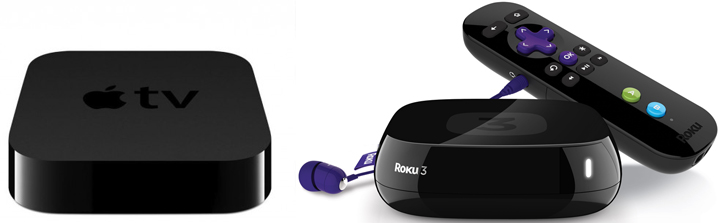
roku3-appletvNow that the Roku 3 has been announced, consumers have even more choices in the market when it comes to $99 streaming boxes. With Apple TV and Roku being the two most popular, and best selling, how do you pick the right box? While many are quick to call one box better than another, there is no one box in the market that is the “best” because not everyone needs the same features or watches the same type of content.

While I have done many side-by-side reviews of boxes in the past, here’s the latest comparison on how the Roku 3 stacks up to the Apple TV, the pros and cons of each and the factors you should use to determine which $99 streamer you should buy. While Roku currently has four different models of boxes available on the market, ranging in price from $49 to $99, this post will compare the $99 Roku 3 to the $99 Apple TV.

For starters, no Roku box can stream content from your iTunes library. So if you already have other Apple devices and want to continue to live in the Apple ecosystem and stream content from iTunes to your TV, then the Apple box is the only box in the market that can do that. But the Apple TV lacks a lot of the content choices that Roku has, so in many cases, consumers might have to get both boxes to truly accomplish what they want.

Hardware
To date, Apple has sold about 15M of their $99 Apple TV devices and Roku has sold 5M globally. Based on available industry data, they are the number one and number two selling $99 boxes in the market today. It’s no wonder considering both boxes come loaded with features including HDMI out, Wi-Fi, an ethernet jack and support for surround sound and 1080p video. Both boxes are about the same in size and consume very little in the way of power and both have HMDI to support connections to newer TVs. Neither box offers support for older TVs with no HDMI port. Each box comes with a 90-day warranty and a simple power cord with no power brick . (To clarify, the Appe TV has just a regular plug and Roku does have a small power supply, but it is not like a “brick” like you get with the Xbox 360.) You can add an extra one year warranty to the Apple TV for $29 or $15 for the Roku 3. While both are great streamers with very similar hardware, there are some big differences between them.

The Roku 3 has a microSD card slot for additional game and channel storage and a USB port which allows you to play back local content. While the Apple TV has a micro USB port, it cannot be used to playback local content via a USB device as the port is only used by Apple for servicing the unit. Since the first generation of the Apple TV device was released (the 720p model), many have speculated that Apple would enable the mini USB port to allow users to play back local content. However nearly two years later, that has not happened. Roku’s USB port can be used to playback content from a USB hard drive or thumb drive and supports MP4 (H.264) and MKV (H.264) content only. So if you have content in these formats and want the option to playback some local content, the Roku 3 is the box to choose. The Apple TV box has an optical audio port and the Roku 3 doesn’t, so that might be important for those who want to use these boxes for audio content more than video.

Setup/Wi-Fi Strength
Both boxes are super easy to set up, but Roku’s box takes a bit longer to set up than the Apple TV as Roku requires you to go to Roku.com on a computer to enter all of your contact information. As long as you know your Wi-Fi password and the box is within range of your Wi-Fi signal, each box takes less than ten minutes to set up. Previously, there has been a lot of debate whether the older Roku 2 box or Apple TV had better Wi-Fi strength as many users complained of WiFi connectivity issues with their older Roku models. But with the new Roku 3, and their support for dual-band WiFi routers, Roku’s WiFi strength now better than the Apple TV. Everyone has their own unique setting within their house that determines how strong and how far their Wi-Fi signal works, so it’s very individual. But users should have no problems with the new Roku 3 thanks to their dual-band WiFi support.

Remote Control
When it comes to the remotes, both work very well and are very responsive. One of the things I don’t like about the Apple TV remote is that it doesn’t take standard sized batteries. It’s not a huge deal breaker, but I have a lot more triple AAA batteries lying around for the Roku remote, as opposed to the watch batteries (CR2032 or BR2032) that the Apple TV remote takes. The Roku 3 comes with a Bluetooth game remote with motion sensing for playing games and supports what Roku calls “instant replay”, which allows you to skip back in 10 second increments while a video is playing without having to re-buffer the stream. Apple’s remote is smaller and much thinner than Roku’s, but personally, I like how Roku’s works better than the Apple TV remote. Apple’s remote design is all about less is more, but I tend to find the few additional buttons on the Roku remote are there for a reason and are used often.

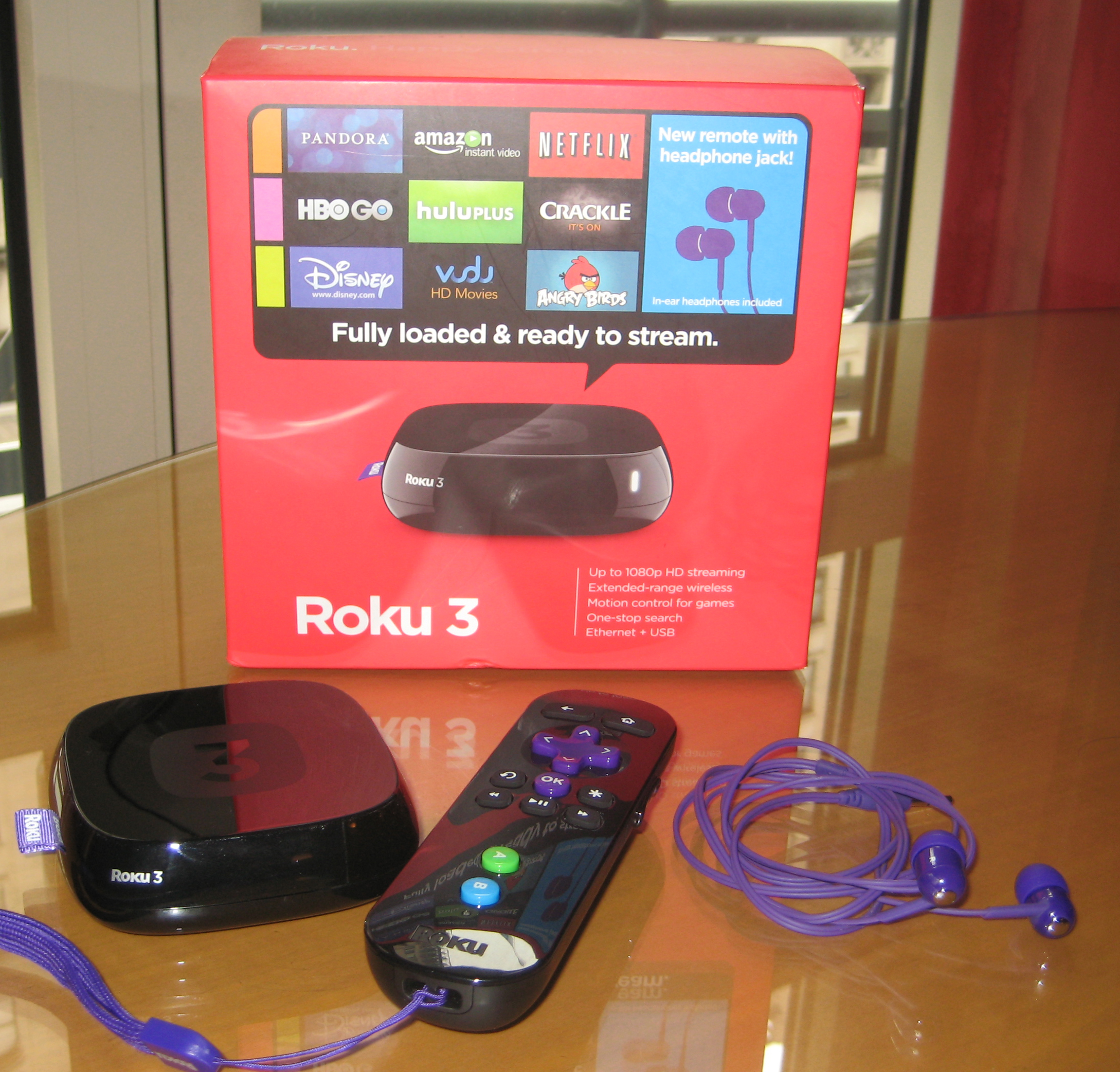
With the Roku 3, the company has added a new headphone jack in the remote, which lets you listen to your content with a pair of headphones. The Roku 3 ships with purple headphones complete with different sized interchangeable rubber earpieces and audio is sent from the Roku 3 to the remote using WiFi, thanks to a WiFi chip inside the remote. This is really a very nice option that can be used by those who want to watch content without bothering others around them or for those who don’t hear well and might have to use subtitles. This is one of the nicest features of the new Roku 3 and one that is extremely practical, considering many consumers have to contend with background noise while trying to watch their favorite shows or movies. In addition to the physical remotes that come with these boxes, you can download remote control apps for your iPad/iPhone that will control your Roku 3 or Apple TV.

Content Choices
As for the content available on both devices, this is really where the Roku 3 is the box to beat. Apple TV only supports content from Netflix, Hulu Plus, MLB.TV, NHL GameCenter, NBA, Flickr and YouTube as well as the ability to purchase and rent content from iTunes. It also supports some free Internet content from folks like Revision3, WSJ and others. For those that want XBMC support on the Apple TV, it’s possible, but only works if you are willing to jailbreak the device.

The Roku 3 has channels for Netflix, Hulu Plus, MLB.TV, NBA, NHL Game Center, EPIX, HBO Go, Amazon Instant Video, Vudu, Major League Soccer, UFC TV, CNBC, FOX News, NBC News, AOL HD, TED, Pandora, Crackle, Flickr and has support for PLEX. Roku has more than 750 public content channels listed on their website, has an open SDK and as a result, has a lot of content partners working to bring more channels to Roku devices. In addition, you can browse over 1,000 “private” channels available for the Roku and add them if you know the correct code. (see the list of private channels here) Compare that to the Apple TV which today, has no SDK and doesn’t run any apps on the box. In addition to streaming content, the Roku 3 also allows you to play nearly 30 games, with the most popular being Angry Birds. Roku’s regular remote doubles as a gaming remote and works really well for simple gaming. And if Angry Birds is something you’re really into, Roku even has a limited edition version of the console that comes in red.

While the Roku 3 has support for nearly every content channel around, it does NOT have support for YouTube. For more than two years now, Roku has said they are working on an official channel, but they won’t give any estimate on when it will arrive. With the launch of the new Roku 3, which contains a new A9 chip inside, this may finally allow for an official YouTube channel, something you get more details on here. Some have been speculating for over two years now that the Apple TV will run apps in the future since internally it has 8GB of Flash storage, but none of that has yet to happen either.

So when deciding which box to buy, don’t listen to rumors of what the box may or may not do down the road, evaluate the boxes in the market based on what they can do today. If you want the most content choices available, the Roku 3 beats the Apple TV hands-down. But if support for YouTube is a requirement, then the Apple TV is the one to pick. I should also mention that neither the Apple TV or Roku 3 are DLNA compliant, so if that is a requirement for you, then pick the $99 Vizio Co-Star or the $99 Western Digital WD TV Live box. Neither box has any kind of we browser built in, so you can’t browse the web with the Roku 3 or Apple TV.

User Interface
Fans of the most current Roku models will be happy to know that the new and improved user interface that comes with the Roku 3 will also roll out to many older Roku models as well, specifically the Roku LT, Roku HD (model 2500R), Roku 2 HD, Roku 2 XD, Roku 2 XS and the Roku Streaming Stick. The new user interface is nice, very clean, easy to navigate and retains the simple and straight-forward approach users have always loved about the Roku. Many times when a new UI is released, it can be sluggish and buggy but the new UI I got to use on the Roku 3 was very fast, much faster than the current UI on the Roku 2 models.

In addition to the new navigation, Roku also has a new search function which lets you search amongst all content channels and returns results for both subscription and PPV services. It’s a universal search option with predictable results that reminds me of the look and feel to the search function when using TiVo. The browsing experience on the Apple TV is great for picking movies and TV shows in iTunes, with large cover art, straightforward navigation and Rotten Tomatoes ratings. Both the Roku 3 and Apple TV have simple interfaces and while they look different, they both perform well and do exactly what they should, with dead-simple navigation.

Playing Videos From Local Computer
If you’re into Apple devices and already have an iPad, iPhone or Mac, then it makes a lot of sense to pick the Apple TV over the Roku due to how all the devices work together in Apple’s ecosystem. You’ll have less content choices than the Roku 3, but all the devices talk to one another and sharing content amongst all the devices is very easy. Any movies or TV shows that you purchase in iTunes via the Apple TV are stored in the cloud and will be available for download to an iPad or iPhone. Enabling your Apple TV to see your local computer allows you to stream just about any media you have on your computer that is running iTunes including your music collection, any video that iTunes can play and your photo collection.

And with Apple’s Airplay technology, you can start watching a video on an iPhone, iPod or iPad and then move that content over to the Apple TV in realtime, for content rented or purchased via iTunes. Airplay also supports the streaming of video from third-party apps on the iPad and iPhone to your TV set with Apple TV in the middle, but only if the app developer enables Airplay functionality. For instance, Airplay works with TNT’s iPhone app, but is disabled in TNT’s iPad app. Also, Airplay does not allow you to play back any DVD images from your computer.

While most people aren’t aware of it, the Roku 3 can be used to playback content from your local computer, but it is not as easy or seamless as Apple’s solution to use and it is not built-in to the Roku. Installing a third-party channel on the Roku, like Roksbox, or using PlayOn or PLEX will turn your computer into a media server that can stream movies, pictures, and music from you computer, wirelessly to your Roku device. That said, the Roku 3 will NOT play back iTunes content that has been protected via Apple’s DRM. Even with PLEX, the Roku 3 can’t playback Apple’s copy protected content. So while you can play back content that is in your iTunes library, it just can’t be content you purchased from iTunes that is protected via Digital Rights Management (DRM). I’ve also experienced cases where the Roku will play back some music tracks but not others depending on how it was encoded. Content purchased via the Roku 3 through Amazon Instant Video can be downloaded to an iPad via the new Amazon Instant iPad app.

Replacing Your Cable TV (cord-cutting)
Despite all the hype about cord-cutting, the Apple TV and Roku 3 will NOT allow the average person to drop their cable TV package. Neither box has an internal hard drive for storage, has no DVR functionality and has no support for picking up live TV stations via an over-the-air antenna. In addition, many of the content services available for the devices won’t have every piece of content you want, at the quality you want and in the business model (rent/purchase/subscription) that you want. Even a great subscription service like MLB.TV has local blackout restrictions, so these $99 streamers are not a replacement for cable TV for most consumers.

Conclusions
While many people are always willing to give their two cents on which device you should buy, everyone has different tastes when it comes to the type of content they want to watch, how they watch it and whether they rent it, buy it, or play it back from a local computer. Do your research and figure out what YOU want the box to do as opposed to what others are using it for. Picking the best box is pretty easy if you can answer the following questions:

  • Does the TV you plan to hook it up to have support for HDMI?
  • What specific content do you want to watch?
  • How do you want to get your content? Via subscription, purchase or both?
  • Do you want the ability to play back content (MP4, MKV) via a USB drive?
  • Do you want to use the streaming box for casual gaming?
  • Do you already own other Apple devices and want to use Apple’s ecosystem?
  • Do you plan to play back a lot of content via iTunes?

Keep in mind that these boxes are cheap at only $99 and getting them via Amazon means you can take advantage of their great return policy. If you pick one up and it doesn’t work the way you had hoped, return it and try a different one. At $99 each, with free shipping from Amazon, and an easy return process, you really can’t go wrong by trying them out. That said, the Roku 3 and Apple TV are only two of the eleven different streaming boxes currently priced at under $100.

  • Apple TV
  • ASUS Qube with Google TV (coming March 2013)
  • Boxee TV
  • D-Link MovieNite Plus
  • Hisense Pulse with Google TV
  • Netgear NeoTV (3 models)
  • Netgear NeoTV PRIME with Google TV
  • RCA Streaming Media Player DSB772E
  • Roku (4 models + Roku Streaming Stick)
  • Sony SMP-N200
  • Vizio Co-Star with Google TV
  • Western Digital WD TV (3 models)

When it comes to deciding which $99 streaming box to get, there are a lot of choices in the market. I’ve created a chart that shows the hardware specs of each device and also lists which content choices are available on them. You can check out the chart and compare a total of 13 different boxes by visiting www.StreamingMediaDevices.com (The chart is being updated to account for all of the recently released devices)

If you still don’t know which box to get or have additional questions, put them in the comments section or send me an email and I’ll be glad to help you try to pick the right one, based on your needs. And if you want a shot at winning a free Roku 3, I’m giving one away to one lucky reader of my blog. You can enter the drawing here.

Free Giveaway: Win A New Roku 3 Player!

roku3[The drawing is now over] Earlier today I reviewed the new Roku 3 streaming player in an article entitled “Roku Announces New Roku 3 Player And New User Interface. To go with the review, I am giving away one Roku 3 device to a lucky reader of my blog. To enter the drawing, all you have to do is leave one comment on this post and make sure you submit the comment with a valid email address. The drawing is open to anyone with a mailing address in the U.S. and the winner will be selected at random later this month. Good luck! Congrats to Karen Hatfield from Los Angeles, CA who won the drawing.

A9 Chip Inside The Roku 3 May Finally Allow For An Official YouTube Channel

With Roku’s announcement of their new Roku 3 box and new user interface, many were hoping to finally see an official YouTube channel for the device. Unfortunately, that didn’t happen and when asked, Roku said they would like to have a YouTube channel, but didn’t have any update on when/if one would be available. While the company isn’t giving any update, I think that based on the new A9 chip inside the Roku 3, an official YouTube channel could come to the Roku 3 shortly.

For those that don’t know the history of YouTube on Roku, or already have a YouTube channel on their device, he’s some background. In April of 2010, an independent developer launched a private YouTube channel that some Roku users added to their device. Roku liked the work of the developer so much they hired him. But Google took offense to the private channel and Roku was sent a takedown notice from YouTube’s legal team. About a year after the private channel was released, Roku was forced to disable it and no longer allows new customers to sign up for the channel. Since then, other developers have come out with a private channel to get YouTube content, like RateRix, but each time they do they don’t last long before YouTube makes some kind of change in their system to render the apps non-functional. Video Buzz was the latest private YouTube channel to come out and some users report it working for them, but last time I tried I couldn’t get it to work.

Clearly Google wasn’t happy with Roku for allowing the private channel to begin with and many suggest that’s the reason why Roku still had no official YouTube channel today, because Google won’t allow it. But I don’t believe that’s the case. Sources inside Google tell me that they aren’t keeping Roku from having a YouTube channel, rather that the outdated chip in Roku 2 models aren’t capable of supporting Google’s new requirements for any partner who wants to have a YouTube channel on their device.

Google requires partners to integrate their HTML based YouTube app on their device and Roku has previously said that performance of HTML based apps on their Roku 2 boxes didn’t perform to the levels they wanted. All Roku 2 models have an old ARM11 chip, first released in 2003, and the new Roku 3 models have a dual-core A9 chip, a big improvement over the legacy chips. The Arm 11 chip has never been powerful nor a very efficient processor and the dual-core A9 chip is exactly the opposite and is up to 5x faster than the ARM11. One thing I noticed during my hands-on time with the new Roku 3 is that apps and video open and play much faster over the Roku 2, by a noticeable difference. Part of that may be to the amount of memory in the new Roku 3, which allows for the caching of content, but Roku won’t comment on how exactly they setup the video to buffer, saying that’s part of their secret.

If Roku can get an official YouTube channel on their Roku 3 boxes going forward, many will upgrade. Roku would then be the only $99 box in the market to have YouTube, Netflix, Hulu Plus, MLB.TV, NBA, NHL, EPIX, HBO Go, Amazon, Vudu and UFC. The Xbox 360 has all of these channels, plus ESPN, but costs twice what the Roku does and is really targeting a different market and type of user. Whatever the exact reason(s) are for how the new Roku 3 box handles video, it’s a better experience. Consumers will benefit from the better UI and faster video playback and the new chip should also allow Roku to bring some better games to the box as well.

And if you want a shot at winning a free Roku 3, I’m giving one away to one lucky reader of my blog. You can enter the drawing here.

Roku Announces New Roku 3 Player, New User Interface, Still Best Streamer In The Market

roku3Popular streaming device maker Roku has announced a new $99 streaming box, named the Roku 3, based on a faster chip, better WiFi support, as well as a newly redesigned user interface, which will also roll out to some older Roku boxes. I had a chance to get some hands-on time with the Roku 3 last week and was impressed with this upgrade since channels load faster, video starts up with less buffering and WiFi has been improved, with dual-band support. Add in the new UI, the ability to listen to audio via some Roku branded purple headphones included in the box, plus the number of content channels available and the Roku is still the best streamer in the market. Roku expects to sell their 5 millionth box to date by then end of this month.

The new Roku 3 is a little smaller than the Roku 2 with but rounded corners and has built-in ethernet, HDMI, USB, MicroSD slotand support for dual-band Wi-Fi a/b/g/n and 1080p video. The Roku 3 also has a very cool new feature with a built-in headphone jack in the remote, which lets you plug in headphones for private listening. In addition, after a long wait, Roku has finally revamped their user interface (video of it here) and made using, searching and navigating all the content channels much faster and easier to use. For those that were hoping for an official YouTube channel, I’m afraid it’s still not available. But read my other post entitled, “A9 Chip Inside The Roku 3 May Finally Allow For An Official YouTube Channel“, to learn more about why I think a YouTube channel may be coming soon.

The Roku 3 is based on a new processor and sports a dual-core A9 chip, a big improvement over the legacy ARM11 chips in the older Roku 2. The Arm 11 chip has never been powerful nor a very efficient processor and the dual-core A9 chip is exactly the opposite and is up to 5x faster than the ARM11. One thing I noticed during my hands-on time with the new Roku 3 is that apps and video open and play much faster over the Roku 2, by a noticeable difference. Part of that may be to the amount of memory in the new Roku 3, which allows for the caching of content, but Roku won’t comment on how exactly they setup the video to buffer, saying it’s a secret.

In addition to the new chip, the Roku 3 can now take advantage of dual-band WiFI routers. This is a big improvement over the Roku 2 models as many users complained of WiFi connectivity issues with their Roku models. I had issues with the Roku 2 models where in some cases, the WiFi signal would be very weak when every other device sitting next to the Roku would be strong. It’s always hard to pinpoint the exact problem when it comes to WiFi issues as many factors affect the signal strength and reach of one’s WiFi signal in their home, but the new Roku 3 should eliminate most WiFi coverage issues for anyone with a dual-band router setup.

The Roku 3 ships with the same motion controlled remote as the Roku 2 XS except for the addition of the new headphone jack in the remote which lets you listen to your content with a pair of headphones. The Roku 3 ships with purple headphones, complete with different sized interchangeable rubber earpieces and audio is sent from the Roku 3 to the remote using WiFi, thanks to a WiFi chip inside the remote. This is really a very nice option that can be used by those who want to watch content without bothering others around them or for those who don’t hear well and might have to use subtitles. This is one of the nicest features of the new Roku 3 and one that is extremely practical, considering many consumers have to contend with background noise while trying to watch their favorite shows or movies.

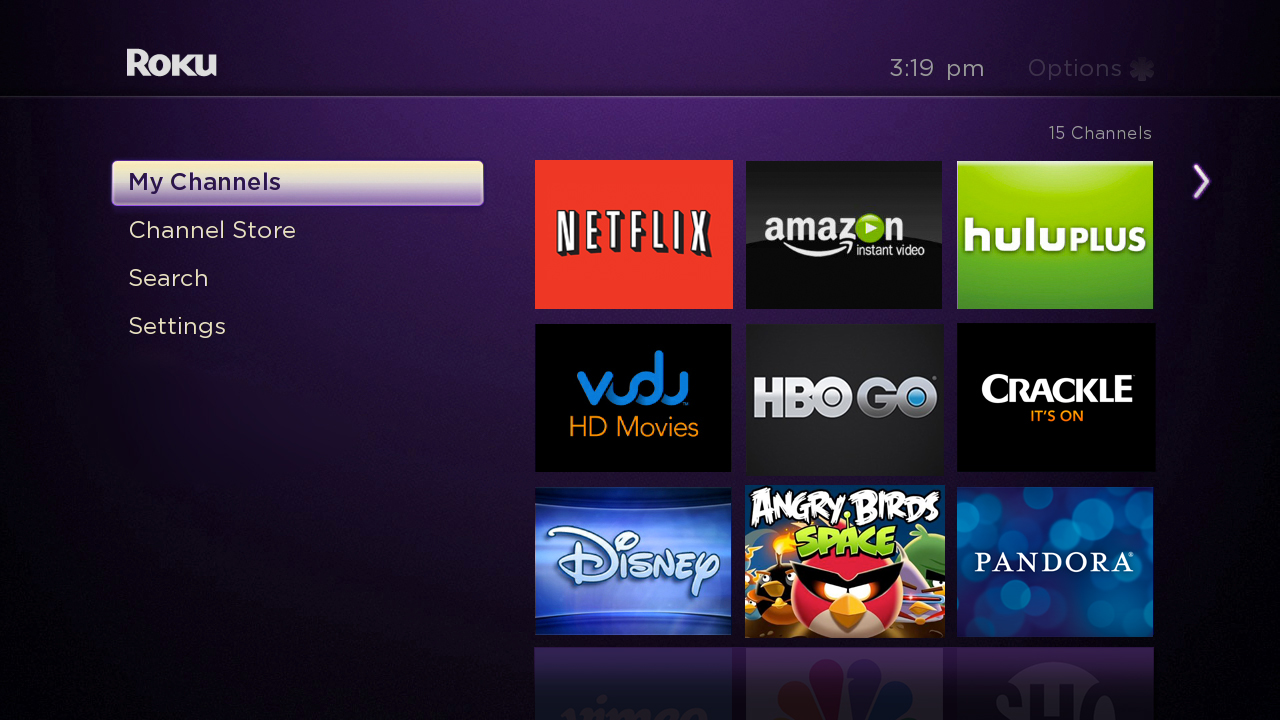
MyChannelsFans of the most current Roku models will be happy to know that the new and improved user interface that comes with the Roku 3 will also roll out to many older Roku models as well, specifically the Roku LT, Roku HD (model 2500R), Roku 2 HD, Roku 2 XD, Roku 2 XS and the Roku Streaming Stick. Roku didn’t give me an exact date of when the updates would be available but did say “sometime in April”. The new user interface is nice, very clean, easy to navigate and retains the simple and straight-forward approach users have always loved about the Roku. Many times when a new UI is released, it can be sluggish and buggy but the new UI I got to use on the Roku 3 was very fast, much faster than the current UI on the Roku 2 models. I haven’t had the chance to test the new UI to see how is works on older Roku boxes, but I expect it will perform well. In addition to the new navigation, Roku also has a new search function which lets you search amongst all content channels and returns results for both subscription and PPV services. It’s a universal search option with predictable results that reminds me of the look and feel to the search function when using TiVo.

Roku isn’t announcing any new format or codec support for content being played back via USB and those looking for a streamer that can act as a media hub to playback all kinds of various formats should look to other boxes in the market made for that purpose. Roku’s not going after that market but rather those consumers who want a quick and easy way to stream content from the widest selection of content. If Roku can get an official YouTube channel on their Roku 3 boxes going forward, many will upgrade. Roku would then be the only $99 box in the market to have YouTube, Netflix, Hulu Plus, MLB.TV, NBA, NHL, EPIX, HBO Go, Amazon Instant Video, Vudu and UFC. The Xbox 360 has all of these channels, plus ESPN, but costs twice what the Roku does and is really targeting a different market and type of user.

Roku already had the best content available and with a new user interface, faster loading channels, increased WiFi performance and quicker video playback, the new Roku 3 is easily the best $99 streamer in the market. While Roku isn’t currently offering any kind of upgrade option the company did tell me that from time to time, existing customers will receive different offers to upgrade from older Roku models. The Roku 3 comes with a 90-day warranty, is available and shipping from the Roku.com website today and will be available via Amazon.com and retail stores in April.

And if you want a shot at winning a free Roku 3, I’m giving one away to one lucky reader of my blog. You can enter the drawing here.

Lexmark Acquires Online Video Platform Provider Twistage

twistage_logo_pcEarlier today, Lexmark announced the completion of two acquisitions, including San Francisco based online video platform provider Twistage. The total acquisition price for both companies was approximately $31.5 million. I don’t remember the exact amount of funding Twistage had raised to date but it was small. Lexmark isn’t commenting on what value they placed on Twistage but I would guess it was $10M or less. I haven’t had the chance yet to speak with Twistage’s CEO but will update this post once I have more details.

Amazon Has A Shot At Disrupting Akamai And The Dynamic Site Acceleration Market

Nine months ago, Amazon launched their new dynamic content delivery service in beta and two weeks ago, I posted details on how their product is coming along and outlined new features they have added since launch. Every since Amazon announced their new service, people keep asking me if Amazon will disrupt Akamai’s DSA business and drive pricing down in the market as a whole. While Amazon still has a long way to go before that has the possibility of happening, make no mistake, they are gunning for Akamai, even though they won’t call out Akamai by name.

Today, Akamai is still the undisputed king of the dynamic site acceleration industry and to date, no one has even come close to taking a large percentage of their web optimization business or knocked them from the top spot. But over the past four or five years, market dynamics have changed. Companies no longer have to spend hundreds of millions of dollars to enter this market, services are getting cheaper to deploy and scale and the old rules of how to build out web acceleration services has drastically changed. Cotendo proved this better than anyone else. In under three years, Cotendo was able to disrupt Akamai’s dynamic site acceleration margins so much, Akamai was forced to acquired them, even though Cotendo wasn’t doing that much in revenue and had only raised about $40M in funding.

While Cotendo drove pricing down in the market and pressured Akamai, the one thing Cotendo didn’t do was generate a lot of revenue. Services can only scale and grow so much when you have $40M in funding, but it was still enough to impact the market as a whole and get Akamai’s attention. Cotendo’s service didn’t have the scale or functionality of Akamai’s service, yet it was still able to be a disruptor. In Amazon case, they have the opportunity to not only impact Akamai’s margins for their services, but also generate a lot of revenue on top of it. Amazon has more resources than Cotendo, more money, more R&D, more marketing reach, a well known brand and a built-in customer base that is projected by Analysts to do at least $2B in revenue this year from their web services division, AWS.

That’s not to say Amazon is ready to disrupt Akamai tomorrow, they won’t. But don’t be fooled by Amazon’s approach, which may appear slow to some. Amazon has a very methodical way of rolling out products and services to the market and it typically takes them about 18-24 months before a product goes from beta to a full-fledged offering with a lot of the features and functionality of their competitors. Look at their CDN product, CloudFront, which went from a bare-bones beta product to one that could compete, by my estimate, for 75% of the commodity CDN market, in 18 months. CloudFront is estimated to have generated more than $100M in revenue last year and Amazon continues to build out additional services to support their CDN, announcing their video transcoding service last month.

From purely a features standpoint, Akamai’s dynamic content delivery service still trumps Amazon’s, by a wide margin. But that’s not going to last for too long and little by little, Amazon is already starting to close the gap. Amazon’s working on rolling out a lot more functionality and while they will never be able to compete for 100% of Akamai’s DSA business, they will continue to get stronger and go after more of the business that doesn’t require a ton of professional services. Amazon will never compete for 100% of the market, but they don’t need to. All they have to do is continue to roll out features, add an SLA, lower pricing and prove their dynamic content acceleration services performs well and can scale, with reliability. Of course building all of that out to scale doesn’t happen overnight, but it’s not as hard as some vendors make it out to be and Amazon has the resources to make it happen and more importantly, has multiple lines of businesses to generate revenue from. Amazon can be patient and grow the business over time.

I don’t expect Amazon to disrupt the market in the next one or two quarters, but come Q4 of this year and into Q1 of 2014, I expect we’ll see signs that Amazon is starting to have a major impact on the dynamic content acceleration market and Akamai in particular. This is an interesting time for Akamai right now. For the first time in Akamai’s history, that I can remember, they have a growing competitor they can’t acquire. Akamai’s competitive strategy has always been to simply acquire anyone who impacts their business and remove them from the market, but they can’t do that with Amazon. And unlike two years ago when Cotendo was really the only competitor to Akamai for dynamic content acceleration services, Akamai now faces competition from more than just Amazon. Small startups like Yottaa want to be the next thorn in Akamai’s side and more established players like EdgeCast and Level 3 are making moves to get into the market, or expand their focus.

The good news from all of this is that customers will have more options in the market for dynamic content acceleration services, at different price points, in different regions of the world, for small and large deployments. As a result, these services will become mainstream, demand will increase and prices will decline. Customers will become educated as to the business benefits and learn there is more than one way to deliver content on the web with scale and performance. For Akamai, this will cause a negative impact on their margins if Amazon can disrupt their business the way Cotendo did, but on a larger scale.

Keep in mind though that as dynamic site acceleration pricing declines in the market, it won’t be at the rate video content delivery pricing declined. Unlike delivering video on the web, performance measured in fractions of a second does matter when it comes to delivering dynamic content. For video, customers aren’t willing to pay a premium to have their video start-up half a second faster on one CDN over another. Half a second does not impact a video based business. But half a second of performance difference in the dynamic site acceleration market can mean the loss of revenue for a customer. So the good news it that customers will be willing to pay for different levels of DSA performance, which will help to keep prices from falling as quickly as they did for video.

Amazon does not charge any premium for dynamic content delivery, something Akamai has done for a long time. Amazon customers who have been previously reluctant to adopt dynamic content acceleration services due to the cost, will now be able to simply buy it as an add-on, without worrying about any type of premium pricing. It’s hard to compare Akamai and Amazon’s pricing side-by-side for dynamic content services, because there is still a wide gap in performance, and they both charge a bit differently, but it’s a safe bet to say that Amazon’s price is anywhere between 50-75% cheaper than Akamai’s. That’s a really big difference and will continue to be more of an apples-to-apples comparison, once Amazon’s dynamic content delivery service becomes closer to Akamai’s in functionality.

The bottom line is that Amazon still has to prove themselves in the market. They are still the new kid on the block and Akamai has first mover status and a proven business, but Amazon has a lot more advantages in the long run. Akamai may be at the top right now, but Amazon’s following their tried and true method of methodically rolling out more products and services. To think they won’t be able to disrupt the market, at some point in the near future, which would impact Akamai, would be foolish. It will happen, the question is how quickly and to what degree.