Wednesday Webinar: Best Practices for Live Video Encoding

Screen Shot 2013-06-17 at 2.14.04 PMThere’s more to getting a live event online than just being there with a camera and a box. What efficiencies are you overlooking, and how can you ensure the best experience for the widest possible audience at the best price? What’s missing from your toolbox? Wednesday June 19th, at 2pm ET, I’ll be moderating another StreamingMedia.com webinar, this time on the topic of, “Best Practices for Live Video Encoding.”

Join Ustream, Brightcove and Haivision for this event and learn how to:

  • Choose the right technologies and delivery platform for live streaming video.
  • Build lasting value into your seminars, product launches and training sessions combining Live, on-demand, and “as-live” linear video.
  • Plan and execute your live event workflow to ensure flawless delivery to every screen and maximize your audience reach.
  • Incorporate social media and audience participation for an engaging and interactive event.

We’ll have a full Q&A session in which your questions will be answered and as always, all StreamingMedia.com webinars are free. So register here and save the date for this instructional webinar.

Sponsored by

New White Paper From Frost & Sullivan on Next-Generation Content Protection Strategies

Frost & Sullivan recently released a new white paper that discusses the security challenges operators face as they embrace multi-network, or hybrid, architectures to implement next-generation TV Everywhere content services.

Entitled, “Cardless Content Security: The Smarter choice for Hybrid Networks,” we examine how challenges like fragmentation of devices and networks and the need to deliver consistent user experiences across all screens can be more effectively overcome. We discuss industry-proven best practices in architecting security solutions for the next-generation ecosystem of multiple transmission networks and devices in a way that minimizes head-end complexity and ensures a future-proof investment. The paper outlines:

  • Key challenges of extending a branded, compelling pay-TV experience to every subscriber on every device and screen in a revenue-enhancing manner
  • How the power of the Internet can be harnessed to facilitate content protection and secure revenue
  • Advantages of cardless security over smart cards, including overcoming a weakness in DVB standards and its unique ability to leverage two-way networks
  • Why content security solutions are moving away from managing silos for digital rights management (DRM), CA systems and watermarking to a complete revenue security platform
  • Scenarios on how a unified multi-network security architecture if preferable over managing separate cardless and smart card-based systems

Monetization of video is a particularly interesting challenge, since business models in the OTT and TV Everywhere space remain experimental and online revenues have yet to become significant contributors to MVPD businesses. That said, our recently released Frost & Sullivan study on consumer video devices shows that the devices industry is already in the throes of realizing the lucrative potential of ubiquitous video.

Examining segments including set-top boxes, smart phones, tablets, game consoles, smart TVs, IP streaming devices and more, we found that total unit shipments in 2012 were well past the 1 billion mark, with total revenues exceeding $350 billion. With device shipments on track to triple by 2017, operators across the globe are grappling to bring their ubiquitous video offerings to this critical new ecosystem of unmanaged devices in a scalable, secure fashion.  Unmanaged is the key word here – managed set-top boxes only account for under 1/5 of all video-enabled devices shipped in 2012. At the same time, network traffic studies are consistently showing continued growth in long form content consumption on unmanaged devices.

Piracy of course is always a top of mind consideration for content owners and operators when deploying OTT/TVE services. The issue gets more critical as live linear content and premium VOD content are delivered equivalently to managed and unmanaged devices in HD resolution.

It’s not news to operators that, in contrast to the tightly controlled execution environment of set-top boxes, consumer owned and managed (COAM) devices are far more challenging platforms on which to secure content. Operators are cognizant of the need to support these myriad devices with compelling content offerings despite these challenges in order to minimize churn and remain competitive. The problem is, with revenues still small and business models yet unproven, operators are incurring this complexity and cost with limited upside ROI, particularly when they attempt to extend their traditional conditional access (CA) infrastructure to meet far more dynamic multi-screen needs.

The future of the devices market and the security market are both promising to be interesting. Those at NAB couldn’t have missed the HEVC and 4K demonstrations that were running at nearly every booth. Widespread initiatives to deliver HD+ and 4K content to unmanaged devices raise a whole new set of content protection questions.

For example, screen captures of 4K content can easily yield very high quality SD content (perhaps even HD content) for recompression and subsequent piracy, and the incentive for professional hackers to pirate 4K content is thus much higher. Studios and content owners will almost certainly require stronger security standards in terms of encryption and usage enforcement for 4K content. At the same time, as we discuss in this same paper, it will also be important to rely on traitor tracing and piracy tracking technologies, such as watermarking and fingerprinting, to holistically manage this inevitable problem.

We will continue to track these developments in our research coverage of the encoding, transcoding and content protection markets and you can join the Frost & Sullivan group on LinkedIn and further discuss the topic with us.

Instart Logic Launches New CDN To Focus On Delivering Web Applications Over Mobile Networks

instartlogicThere are a lot of different types of content delivery services in the market, pushing content over various types of networks and across many different devices. While the market is crowded with CDN vendors focusing on the delivery of video, fewer solutions exist in the market for delivering web applications, especially over wireless networks. This morning, a new CDN named Instart Logic launched in the market looking to solve the problem of delivering web applications, with good performance, over mobile networks.

For many of you tracking the web performance world closely, you know it’s been some time since we have seen any really new innovative technology come along. Most of the “new” offerings have generally been improvements to existing established technologies such as content and application delivery networks (caching and network acceleration) or front-end-optimization (rewriting web code to implement performance best practices).

Instart Logic has released a new type of web performance service promising to speed up delivery of websites beyond what traditional approaches like a CDN or FEO solution can provide. The team behind Instart Logic comes from a diverse set of backgrounds including Big Data (Aster Data), virtualization (XenSource, VMWare) and, logically, the web performance world (Netli, Cotendo, Akamai). The original founding engineering team actually had no direct experience with the web performance world and as a result took a fresh look, and built a very different way to deliver web sites to browsers. (the company has a white paper with lots of tech details here)

The team was looking to specifically address new challenges with delivering visually rich and personalized web sites and apps to users accessing them on congested wireless networks. The approach moves beyond operating at a network level like traditional CDN/ADN approaches (caching and network acceleration) to working at the application level. They claim the product was built by thinking “mobile-first” and designed with the mobile world in mind from the start, not as an afterthought. Because of this approach, Instart Logic says their new system is able to provide much higher levels of performance by having a detailed understanding of the component parts of web sites and applications and how they load in modern web browsers. It works by sending a smaller amount of data up front to a browser to get the web page loaded and then bringing the other data down in the background.

The key to pulling this off is a new type of web delivery architecture that includes an active client side component that runs in the end user’s browser, along with a cloud service that has a detailed understanding of how web sites and applications actually load and execute in modern browsers.

On the client side it uses a thin JavaScript based virtualization layer they call the “HTML5 NanoVisor” that is added to a web site or application automatically by the service. Using this client, the Instart Logic system can learn how a web site or application loads and executes in different browsers. The NanoVisor then works with a cloud service they call the “Personalized AppSequencer” which has a detailed understanding of the component parts of a web application. For example, it understands how visual information is encoded in image formats like JPG and PNG and how to divide up those files into smaller fragments for streaming at different points in the page load process. It can also determine which parts of dynamically-generated HTML are actually the same across a broad set of users and send it up front to a browser while the dynamic portions are created on the backend.

Once the service determines the minimal set of data to allow a web page to display and become interactive, it uses the NanoVisor to allow streaming of this information to standard web browsers. After the initial display the NanoVisor then brings down the rest of the data that makes up the page and stitches everything together in the end user’s browser. By doing this, it allows for fast initial display and interactivity, while still being able to provide the full quality experience as designed by the web publisher a few moments later.

Web publishers can quickly integrate with the system by updating a few DNS entries to flow all or a portion of their traffic through the service. It is designed to replace the use of a CDN and as a result the company has set up a global footprint of 30 delivery locations worldwide and they have a similar technology to dynamic site acceleration they call Global Network Acceleration.

Instart Logic’s system is an intriguing new entry into the web performance and delivery space. When they demoed the product for me, it was easy to see noticeable differences in Web page load performance, particularly for pages with lots of scrolling image tiles and graphics-rich HTML5 games. They have been running customers with production traffic since last summer and have been winning over converts from some of the traditional CDN vendors. The new service looks promising and most of the recent vendors that have come to the market with focused solutions, looking to solve a specific problem, have tended to do well. Strangeloop Networks, Blaze, Cotendo and others have all been acquired in a short period of time – mostly due to their focus and lack of desire to be a all-encompassing CDN.

Of course any new service like Instart Logic’s has to be validated by customers, at scale, while still improving performance, so it will be some time before we know just how scalable their solution is and how well the company can do. But they are a promising new entry into the market and one I will be keeping an eye on.

Instart Logic is funded by Andreessen Horowitz, Greylock Partners, Sutter Hill Ventures, Tenaya Capital, and several notable Silicon Valley angel investors and received $17M in Series B funding in April.


Thursday Webinar: Delivering Live Video In Three Easy Steps

Thursday June 13th, at 2pm ET, I’ll be moderating another StreamingMedia.com webinar, this time on the topic of, “How To Deliver Live Video In 3 Easy Steps.” Live video is an incredible opportunity to present audiences with engaging content, however the actual execution can present challenges for any online business. From encoding to delivery, the nuances and technical challenges of live streaming can seem downright daunting.

This webinar will cover pragmatic business advice and high-level technical tips through real-world examples. Companies that need to deliver live video will benefit from this discussion. At the end of this webinar, attendees will have the key tools to implement live streaming and avoid common challenges.

Attendees will learn:

  • Steps required to deliver from camera to encoder to CDN
  • Preparing for potential traffic spikes
  • Delivering to mobile devices
  • Protecting a live stream from unauthorized viewing
  • Geo-blocking a live stream
  • Business case studies and lessons learned

We’ll have a full Q&A session in which your questions will be answered and as always, all StreamingMedia.com webinars are free. So register here and save the date for this instructional webinar.

Amazon Gets More Competitive With Announcement Of Custom SSL Support For Static & Dynamic Content Delivery

Late in the day on Tuesday, Amazon announced that custom SSL domain names and root domain hosting support features have now been enabled for content owners who want to deliver static and dynamic content via Amazon’s CloudFront delivery service. These two new features are something a lot of content owners have been waiting on and many I have spoken with have been wanting to move to or use Amazon, but couldn’t until Amazon supported these features, especially SSL domain support. While Amazon still has more work to do before they have most of the same functionality as Akamai’s dynamic site acceleration (DSA) product, this new announcement by Amazon opens up a much larger portion of the market to them and puts more pressure on other CDNs. Not to mention, the pricing they just announced with this, not surprisingly, is really cheap. Here’s more details on what Amazon now supports:

Custom SSL Domain Names

  • Custom SSL Certificate support lets content owners deliver content over HTTPS using their own domain name and SSL certificate. This gives visitors lower latency and higher reliability along with the security benefits of CloudFront over an SSL connection that uses their own domain name. Amazon customers can also configure CloudFront to use HTTPS connection for origin fetches so that the data is encrypted end-to-end from origin to the end user.
  • Customers can sign up for an invitation to use the Custom SSL Certificate feature by filling out the form on the AWS website and once approved, customers can upload the SSL certificate and use the AWS Management Console to associate it with their CloudFront distributions.
  • Customers will pay $600 per month for each custom SSL certificate associated with one or more CloudFront distributions. This monthly fee is pro-rated by the hour. For example, if a customer had a custom SSL certificate associated with at least one CloudFront distribution for just 24 hours (i.e. 1 day) in the month of June, their total charge for using the custom SSL certificate feature in June will be (1 day / 30 days) * $600 = $20.

Root Domain Hosting

  • With Root Domain Hosting, customers can use Amazon CloudFront to deliver content from the root domain, or “zone apex” of their website. For example, they will be able to configure both http://www.example.com and http://example.com to point at the same CloudFront distribution, without the performance penalty or availability risk of managing a redirect service.
  • To use this feature, customers create an Amazon Route 53 Alias record to map the root of their domain to their CloudFront distribution.
  • There will be no extra fees from Route 53, as Alias queries that are mapped to a CloudFront distribution are provided free of charge.

These two newly supported features in CloudFront come on the heels of them recently adding functionality for configurable minimum time-to-live (TTL), query string caching, support for multiple origins and URL based cache behaviors. Add in new support for cookies, front-end-optimization, lower pricing and new edge locations and Amazon’s CloudFront service is quickly becoming a real-world content delivery service, for static and dynamic objects, that many content owners are relying on. I continue to hear more and more large content owners using Amazon and that’s only going to grow faster, now that CloudFront has even more functionality.

As I blogged about back in February, one of the biggest reasons companies have taken note of Amazon’s new dynamic content delivery service is the fact that Amazon doesn’t charge a premium for their service, something most other vendors do. Amazon’s dynamic content delivery pricing is exactly the same as their CloudFront CDN pricing. There are also no platform fees, setup fees, overage charges, and many customers find that they don’t need to use expensive professional services to configure dynamic applications, further decreasing the cost of using CloudFront for dynamic content delivery.

Amazon’s strength, with all of their AWS services, is their ability to develop products that specifically target the largest portion of any market they enter, make it simple and easy to use, bring transparency to the offering and offer low pricing. That’s the definition of a company that has the ability to disrupt any market it enters and that’s exactly what Amazon is starting to do with their CloudFront delivery service and will continue to do even more over time.

Streaming Media East Conference Videos Now Online

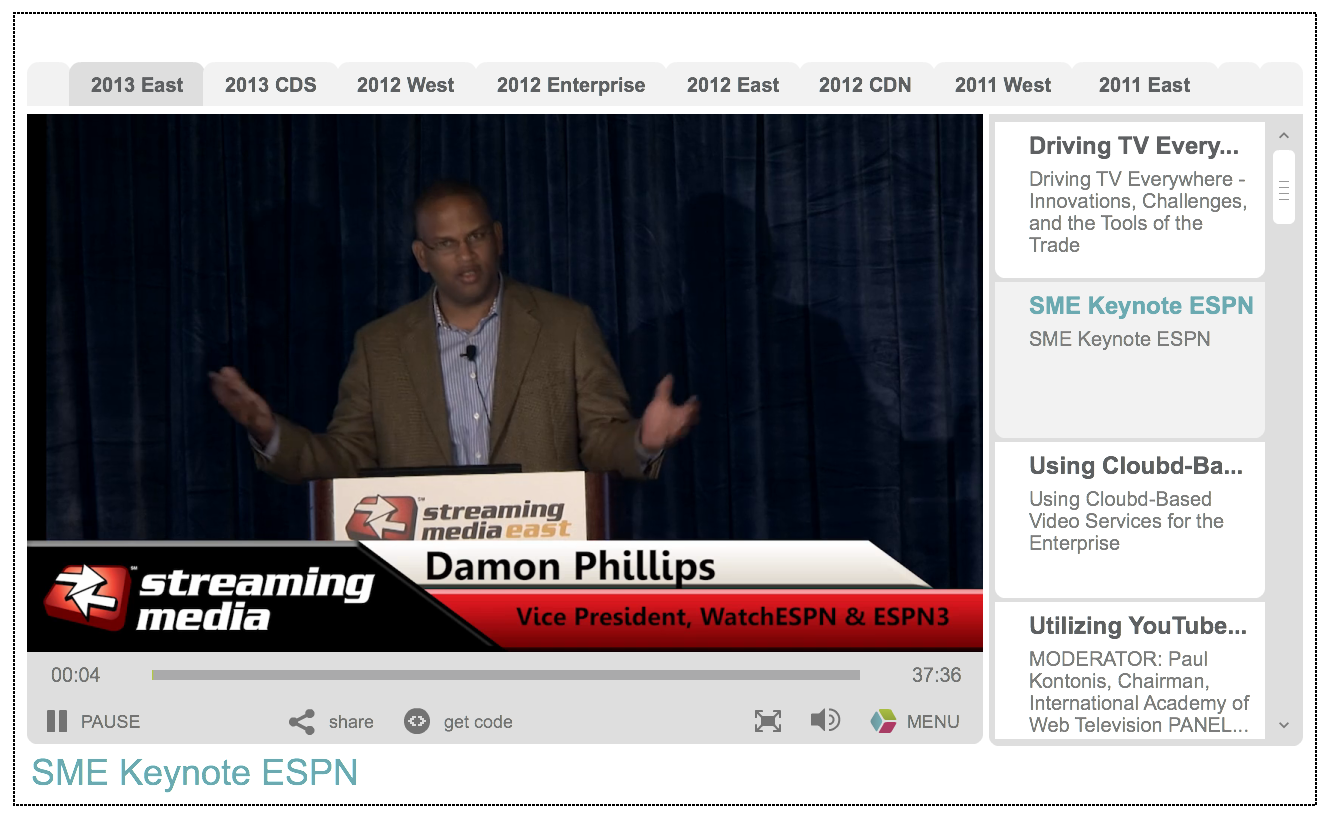
Screen Shot 2013-06-11 at 4.31.30 PMThanks to a lot of really great speakers and presenters who covered content, business and technical topics around online video, we had a great Streaming Media East conference last month. Almost all of the videos from the event are now available online, for free at www.streamingmedia.com/videos and most of the slides from the presentations can be downloaded from the Streaming Media East agenda page. We have about half a dozen videos to still post and some slide decks are still missing that I will upload as soon as the presenters send them to me.

The 2014 Streaming Media East conference will take place May 12-14, at the same venue, so mark your calendars now. If you have any follow-up questions from the event, please don’t hesitate to contact me at anytime.

Beet.TV Video Coverage From Streaming Media East: See The Interviews

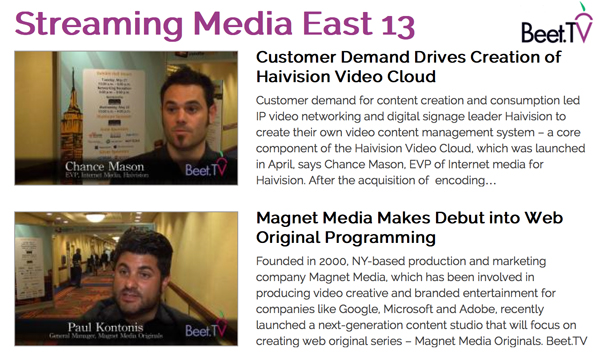
Andy Plesser from Beet.TV was on hand at the Streaming Media East show two weeks ago and did his usual great job of interviewing a bunch of speakers, videos of which are now online. Click on the image below to check out all of Andy’s coverage.

beettv