Why MSOs Should Not Consider Switching Directly from MPEG-2 to HEVC

imagesWith all the excitement around HEVC and all the reports we have put out at Frost & Sullivan on the topic, we get asked all the time if MSOs should skip AVC and directly switch from MPEG-2 to HEVC. Why is this such an enticing notion and does the idea actually bear merit? To answer that question, first, some history is in order.

Back in the nineties as North America transitioned to digital cable, MPEG-2 was the state of the art compression technology at the time. North America was ahead of the game even with HD and thus nearly all cable applications relied on MPEG-2 for SD and HD alike. But the industry paid a price for that early innovation – no sooner were they done with HD deployment than AVC broke onto the scene and fundamentally disrupted the video compression equation. Faced with a weak economical outlook (remember the dot com crash of 2002, anyone?), and having just made major investments in HD rollouts, the cable industry was unable to take advantage, in a meaningful way, the benefits offered by AVC. In contrast, as Europe began to transition somewhat later in the game, they did use MPEG-2 for SD digital cable but predominantly use AVC for HD.

Fast forward to 2013, when the growth of North American cable subscribers slows and IPTV is surging in popularity with its vast array of content and the lure of rich applications enabled by bi-directional connectivity. The writing on the wall is clear to MSOs –they can transition their primary business to broadband services, or they must dramatically reinvent themselves and the user experience they offer to remain relevant as mainstream Pay TV service providers. Wherein lies the rub – how do MSOs meaningfully and strategically invest in infrastructure that will ensure they are at state of the art over the next decade?

AVC has matured since its early days, and state of the art AVC encoders can themselves offer twice the compression efficiency of first generation AVC encoders. Transitioning to AVC is the most obvious route to grow quality and/or quantity of Pay TV content without expensive expansions of bandwidth. (Arguably technologies like Switched Digital Video are also options, but let’s not complicate the discussion). The problem is, this is easier said than done. Consider the USA has approximately 56 million cable subscribers, with approximately 2 set top boxes per subscriber. Multiply that by a conservative $100 per replacement set top box, and the cost of transitioning end user clients alone exceeds a staggering $11B. Add to that the costs of truck rolls, upgrading head-ends, overhauling quality monitoring infrastructure, and more, and it’s easy to see why no MSO wants to do this type of systemic upgrade twice. Which brings us to HEVC.

In theory, HEVC promises twice the efficiency of AVC. Why, MSOs might ask, should we allow history to repeat itself and spend so much on one systemic upgrade when another disruptive technology is right around the corner? It’s a fair question, but let’s take a look at three of the key assumptions it is predicated on:

  • HEVC offers twice the compression efficiency of AVC: Well, yes and no. That’s the theoretical advantage, but practical encoders are only offering about 20-30% improvement on HD content and even less on SD content. That, by the way, is the same level of improvement that state of the art AVC encoders can offer over legacy MPEG-2 encoders at this point in time. Moreover, they can do this at a fraction of the cost, a fraction of the power consumption and a fraction of the rack space. Given that a large number of modern encoders are built-in software (even if they are appliance form factors) rather than rigid hardware, CAPEX is not in jeopardy if a service provider upgrades to an AVC encoder immediately and eventually soft-upgrades it to HEVC when that ecosystem is mature and ready.
  • HEVC products are being released very quickly, and if I do not transition I will fall behind the curve: There’s certainly plenty of buzz around HEVC; it’s arguably the hottest hash tag at IBC this year. However, there is a difference between first generation products that are a must-have for pilot testing, and a mature product ecosystem that enables mainstream creation, monitoring, delivery and storage of a compression format form end to end. The AVC ecosystem is ready and available today, and costs are falling rapidly as commoditization sets in. The opportunity cost of waiting three years for HEVC products to mature needs to be weighed against the ability to cost-efficiently purchase and deploy AVC infrastructure immediately.
  • UltraHD is coming, and HEVC is the key enabler: Again, yes and no. Certainly twice the compression efficiency is critical if you are quadrupling resolution. HEVC’s flexible transform unit size is ideally suited to compressing UltraHD content. However, there are catches. First, if a service is only deploying one or two channels in the short-term, there is usually enough bandwidth already available to achieve this via AVC. Second, there’s not enough UltraHD source content available yet to justify the deployment of content beyond – most likely – nature, sports and movies. If that. With global penetration of HD itself at under 33% despite the age of the technology, expecting a more rapid pace of deployment for new UltraHD technology is, well, optimistic. Third, there are gaps in the technology ecosystem – for example HDMI 2.0, which is necessary to enable full UltraHD rendering, has not yet been finalized. So UltraHD may be coming, but it’s not something that will happen as a mainstream movement tomorrow morning.

The metrics behind these assumptions will definitely change over time, and the ROI that HEVC can deliver will definitely improve over time. While it’s clear that HEVC is a solid technology advancement and no mere flash in the pan, it is important to keep in mind that a mature ecosystem takes time to develop. By all means, MSOs must begin evaluating HEVC as a key technology component for future infrastructure. However, there’s little reason to consider jumping straight from outdated MPEG-2 to unproven HEVC. AVC offers concrete benefits immediately, and by selecting software-based products during this upgrade, MSOs can ensure long-term, future-proof returns on infrastructural investments.

We’ve done a lot of work at Frost & Sullivan on the topic of HEVC and in addition to three reports analyst Avni Rambhia has already published, we’ve done a lot of private research on HEVC for clients. If you’re looking to get more details on HEVC technology, get copies of our reports, or need any custom research on the HEVC market, please feel free to reach out to me for more details.

More HEVC related posts:

– Cutting Through The Hype Of HEVC (H.265)

– HEVC (H.265) Adoption Is At Least Five Years Away For Consumer Content Services

Sponsored by

Thursday Webinar: Best Practices for Enterprise YouTube Deployment

Most enterprise organizations use some kind of a “YouTube like” social video platform for streaming on-demand video and live webinars inside their firewall. As global enterprises seek to leverage video to improve communication, engagement and collaboration, the need has arisen for an enterprise quality video portal that solves the challenges of governance, security and delivery, with all the functionality employees have grown to expect from exposure to consumer technologies. On Thursday September 5th, at 2pm ET, I’ll be moderating another StreamingMedia.com webinar, this time on the topic of, “Best Practices for Enterprise YouTube Deployment.”

Join this streaming webinar to learn best practices from recent enterprise YouTube deployments at medium and large enterprises across various industries. Some of the challenges examined will include:

  • Delivering HD video to a globally distributed workforce
  • Creating multimedia presentations for internal and external viewers
  • Delivering video to audiences with varying bandwidth requirements

We’ll have a full Q&A session in which your questions will be answered and as always, all StreamingMedia.com webinars are free. So register here and save the date for this instructional webinar.

Majority of Industry Executives Believe OTT Can Be Supported As Its Own Direct-Payment Channel

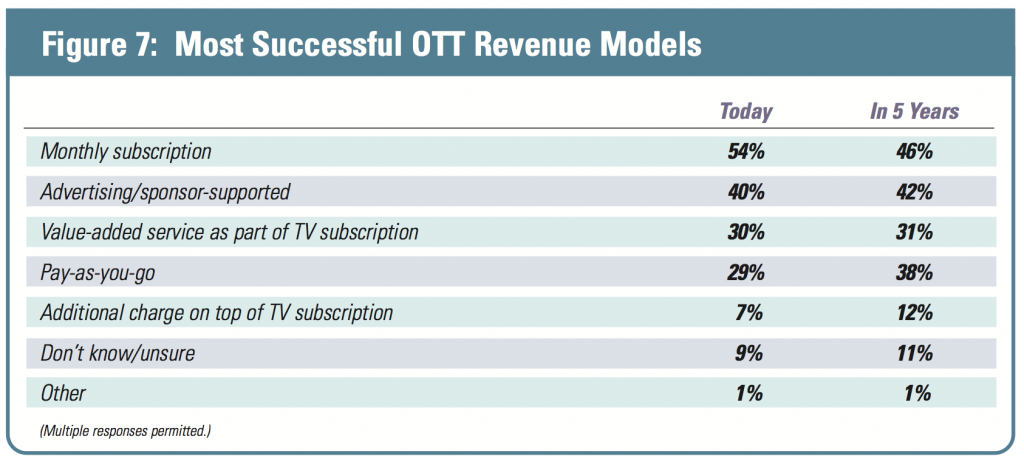
A majority of industry executives believe that OTT is valuable enough to support direct payments from consumers. These are some of the findings of a new StreamingMedia.com survey of 758 media industry executives, which sought to uncover their views on the current and future state of OTT video from inside the trenches. 54% say a monthly subscription-based model is the best economic model for OTT delivery. However, looking down the road a few years, there will be more impetus for charging consumers on a pay-as-you-go (rental or purchase, sometimes referred to as “pay-per-view”) model for programming. Fewer executives see the monthly subscription approach as working over the long run—the percentage seeing this as the best revenue model slips from 54% today to 46% seeing it as feasible in five years.

Screen Shot 2013-09-02 at 9.22.11 PM

Instead, many executives predict the pay-as-you-go model for program delivery will catch hold over the next few years. Close to two-fifths, 38%, of respondents predict the pay-as-you-go model will prevail in five years, up from 29% that see it working today.

While in the minority, there is still a sizable segment of executives who believe in the advertising-supported model to monetize OTT programming, enabling faster distribution to a wider audience. About 40% support advertising-supported delivery, a number that will hold five years from now as well. There is less support for OTT as being delivered as an adjunct to traditional pay-TV packages. About 30% foresee OTT being funded as part of a value-added service as part of TV subscriptions, while only 7% feel it will work as an additional charge on top of TV subscriptions.

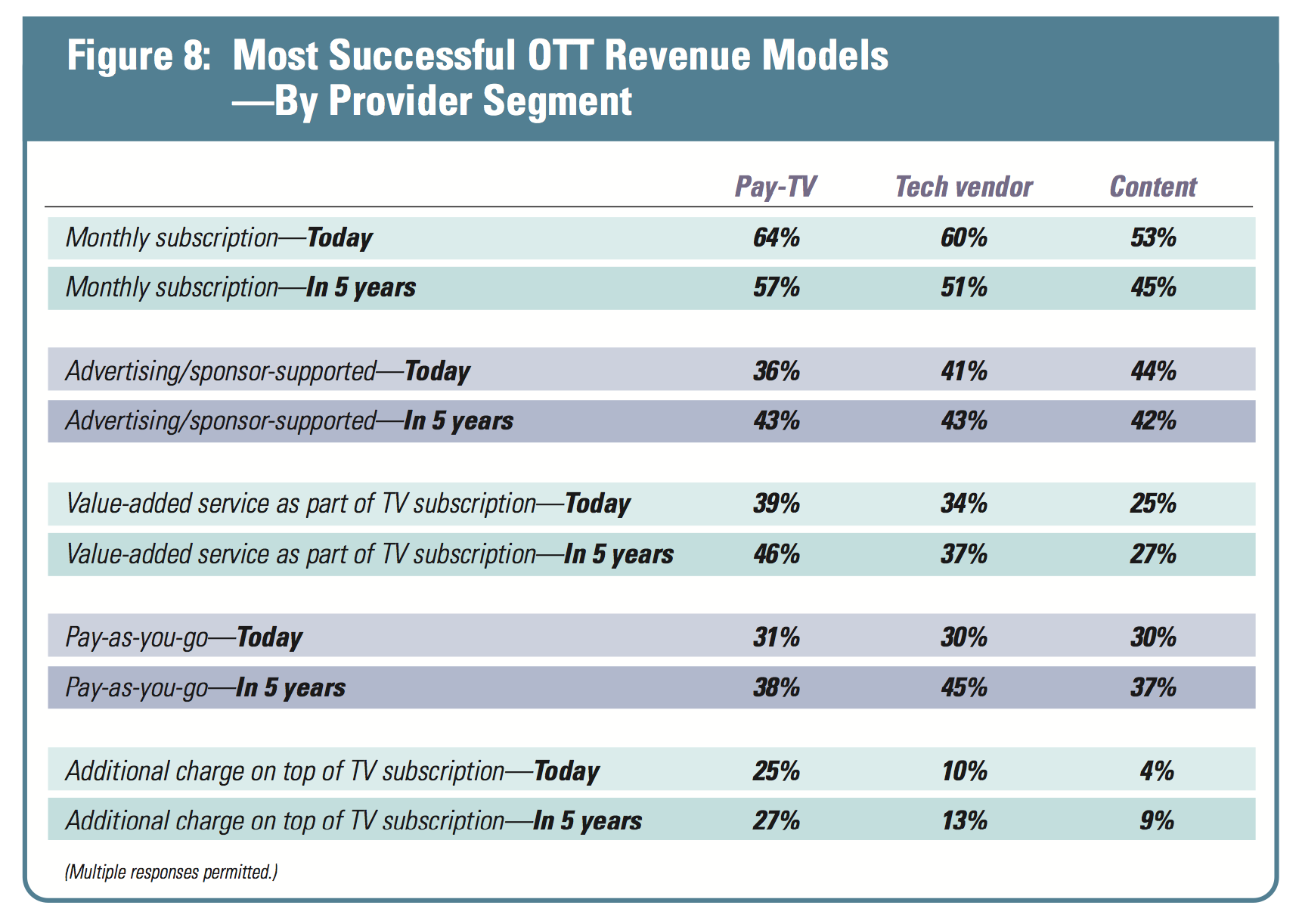
When looking across the three primary industry segments, there is general agreement that monthly subscriptions to OTT services are the dominant approach, and will remain so with a rise in pay-as-you-go plans as well. Pay-TV operators are more inclined than their counterparts to see more potential in bundling OTT services into pay-TV subscription plans.

Screen Shot 2013-09-02 at 9.27.31 PMUltimately, in the view of at least one respondent, pay-as-you-go is the most logical business model for OTT going forward. “If the costs are kept proportional, pay per view is the highest plateau of ‘democratic’ viewing,” the respondent says. “Viewers are choosing the program, and their money can go directly to the source—producers and delivery providers— eliminating the need for commercials. That means more revenues for content creators and delivery providers.” However, the respondent adds, there is still a place for commercials, which “can still find eyeballs if content is free to watch.” To be successful in this new hybrid market, providers need to “trade in high-cost delivery, which only reaches a top tier of income earners, for more viewers at lower cost.”

Full results from the report, entitled “OTT Video: Coming to a Paid Channel Near You” is available as a free download from the StreamingMedia.com website.
Tuesday Webinar: Best Practices for Video Search and Discovery

Screen Shot 2013-08-19 at 2.10.36 PMAnalysts agree that video is growing, both in terms of volume and the need to expose it to search. In fact, Cisco’s 2013 VNI study predicts that globally, consumer Internet video traffic will be 69 percent of all consumer Internet traffic in 2017, up from 57 percent in 2012. But video as a format inherently lacks comprehensive metadata that would make it searchable in the same way text-based content is, thus rendering it an “invisible” asset even if the content is appropriate and meaningful. Applying rich metadata to video content is manual, time-consuming and costly — until now. On Tuesday August 27th, at 2pm ET, I’ll be moderating another StreamingMedia.com webinar, this time on the topic of, “Best Practices for Video Search and Discovery.”

During this session, you will learn about several best practices that can be applied to unlock the value in your video, and make it more discoverable for your target audiences, including:

  • How automatically creating a rich metadata “fingerprint” for video enables it to be discovered via search
  • How that metadata can be further exposed and cultivated to create experiences that drive users to related content, and increase video stream starts and time on site
  • How metadata can be used to drive contextual advertising experiences that offer additional revenue generating opportunities for you and your advertisers.

We’ll have a full Q&A session in which your questions will be answered and as always, all StreamingMedia.com webinars are free. So register here and save the date for this instructional webinar.

CDN Provider Highwinds Closes $205M In Debt Financing

This morning, content delivery provider Highwinds announced they have closed $205M in a debt financing deal with Cerberus Business Finance and Goldman Sachs BDC, Inc. along with a follow-on investment from General Catalyst Partners. Highwinds plans to use some of the money to buyout older investors, but won’t say how much of the $205M will be left once that’s done. The company raised $100M in financing between 2006-2010, so one has to imagine at least half of the new debt financing will go directly to Highwinds expansion.

Highwinds has been in the industry since 2002 and use to be in the large volume, low price, video delivery business but exited that market a few year’s back to focus on the gaming, advertising and software delivery markets. The company plans to use the money to expand their network in China and Russia and further expand their presence in Latin America. The company has egress capacity in excess of 4Tbps and plans to add to that as well. Highwinds isn’t disclosing revenue numbers, but I expect the company will do about $100M this year. One thing Highwinds is open about is that they are profitable, with the business generating a lot of positive cash flow each month. The majority of Highwinds business is CDN related, HTTP and NNTP delivery, with only a small portion coming from transit and co-location products and services. The company has done a good job of signing up PC gaming customers including Valve, GameFly, Wargaming.net, Hawken, World of Tanks, Bigpoint and others.

Why AOL Paid Too Much For Adap.tv, Inside The Numbers No One Else Is Mentioning

This morning AOL announced it would buy ad technology platform provider Adap.tv for $405M in cash and stock. The strange part is that for all the news outlets that covered the deal, more than 86 by my count, none of the more than two dozen articles I have read even mentions what Adap.tv’s revenues are. I don’t see anyone asking what multiple AOL paid for the company or an article that gives any kind of breakdown on the valuation AOL put on Adap.tv’s business.

I’ve read articles on Ad Age, Ad Week, USA Today, Forbes, Business Insider, New York Times, CNET, Bloomberg, Tech Crunch, GigaOm, WSJ, Venture Beat, PC Magazine and not a single one mentions anything pertaining to Adap.tv’s revenue. As a whole, the media did a really bad job reporting this deal and it seems everyone simply rushed to get something up, but no one told any kind of real story. There is also no real mention in the articles I read on what Adap.tv does, what makes it different from an ad “network” or ad “exchange” and very little details on what Adap.Ttv’s growth has been like over the past seven years. It’s another example of why the current blog model, for most blogs, is wrong when all they are focused on is getting up as many posts as possible that are 700 words or less.

Adap.tv has been around about seven years now and last year, did under $100M in revenue. No one at the company wants to give an exact number, but from multiple sources I have spoken to they put the number at about $85M. Some at the company have been quietly telling people since the beginning of the year that they are on a run rate of “under $140M in revenue for 2013”, but realistically, I expect 2013 revenue to be more in the $120M range. Based on that 2013 projected number, AOL paid 3.5x revenue for Adap.tv. Keep in mind that AOL did say that Adap.tv has “grown global revenue over 100% per year in each of the last three years”, so whenever a company grows revenue by 100%, for many years in a row, you know the base number they are working off of is small. The one post I did read that mentioned revenue numbers (WSJ), said AOL paid 5x Adap.tv’s 2012 revenue, but these deals are done on the projected run rate of revenue for this year, not what they did last year.

Some might suggest that Adap.tv used the recent IPO of Tremor Video, which has a market cap of just over $400M as a way to measure their value, but Tremor Video had raised 2x more cash than Adap.tv ($116M vs. $50M), yet their revenues weren’t 2x higher. Tremor Video did $105.2M in 2012 revenue and wasn’t profitable. Adap.tv wasn’t profitable in 2012 either, but with the scale and resources they will now get thanks to the AOL platform, they probably could be.

I’m sure this is a long-term play for AOL and they are looking at what the future of online video advertising will grow into, but keep in mind that every projection made for this segment of the industry has historically been wrong. Four years ago I wrote a blog post entitled “What’s The Size The Online Video Advertising Market? All Depends On Who You Ask“, and of the eight sources I listed who gave out projections for the next three years, none of them look right. People have been making a lot of predictions about the size and growth of the online video ad market but the truth is, the market has simply not grown as fast as some want to imply. When the largest vendors in any space are doing $100M in revenue (Tremor Video, Adap.tv) the market is not as big as many want to suggest. And when you go to CNN or ESPN or any of the other major web portals and they deliver you the same video pre-roll ad literally ten times in a row, it’s clear there are plenty of problems with the market. Video ad targeting does not truly exist. Video CPM rates have been stagnant for years. All the vendors will say otherwise, but we all see what kinds of video ads we get.

While you may not think it from what I have written so far, I actually like this acquisition by AOL. Adap.tv was doing a good job in the market, they have a smart executive team and combined with the video plans that Ran Harnevo is in charge of executing at AOL, Adap.tv is fills a void AOL was missing. But AOL overpaid and based on how AOL’s CEO is talking about the deal, realistic expectations aren’t being set. During an interview on CNBC, AOL’s CEO was talking about the size of TV advertising being $240B and that’s going to move online over the next decade. What he does not say is what percentage of that AOL predicts will move online and over what time. He mentions Adap.tv is the number one technology in this space, yet they don’t even capture 3% of the programmatic ad buying market, which eMarketer estimates will be more than $3.36B this year. Also, while I see others using the eMarketer estimates, note that they say that number is for “all digital display spending”, not just video. So video is a much smaller fraction of the overall $3.36B number.

I’m sure many will say that this is a long term bet for AOL and I get that. But if you look at the estimates analysts gave out ten years ago, on what the video advertising market will be in 2013, none of them were even close, in some cases off by tens of billions. So AOL has a long way to go before they can show they got $405M in value from this deal. I hope they get it, but it’s going to be many, many years before they can show justification for paying the price they did.

Streaming Media West Conference Program Published: Speaker Placement Starts Today

Screen Shot 2013-06-03 at 9.16.27 PM

We’ve got a great lineup of content planned for the 2013 Streaming Media West conference (nov. 19-20), and have moved the event to a beautiful new venue this year, located in Huntington Beach. Below are all of the topics that will be covered at the show and we’ll have a combination of “how-to” instructional sessions, “presentations” by stand alone speakers and “round-table” panels that consist of a moderator and four panelists.

imagesIf you want to speak, download the full agenda and follow the instructions. Here’s the list of what content will be featured at the show and as you can see, we’re covering a lot of really great subjects:

  • Instagram vs. Vine: Hands On With Social Video Apps
  • Online Distribution and Monetization Strategies for the TV Industry
  • Understanding the Significance of HEVC/H.265
  • LTE and The Mobile Video Business Opportunity
  • How-To: Evaluating Your H.264 Encoder
  • YouTube Strategy for Brands
  • How To: Using Google Glass to Capture and Publish Videos
  • Connected Device Support: Creating OTT Apps
  • The State of Over-The-Top Video and TV Everywhere Rollouts
  • MPEG-DASH: Commercial Deployments and Outlook Towards HEVC and 4K
  • Requirements For TV Everywhere Enablement
  • How To: Choosing an Enterprise-Class Video Encoder
  • Video Capture and Delivery For Students in Higher Education
  • Building An Open Source DASH-AVC/264 Player
  • OTT Services and Their Effect On The Bundled TV Model
  • How To: Making the HTML5 Video Element Interactive
  • The Future of Digital Entertainment in a Multiscreen World
  • Using Cloud-Based Video Services For The Enterprise
  • Cutting Through The Hype Of HEVC
  • How To: Using YouTube’s Platform For Live Events
  • Best Practices For Implementing Accessible Video Captioning
  • Matching Up Streaming Video Metrics with Traditional TV Ad Buys
  • Re-Inventing Education With Video
  • Best Practices For Live Streaming
  • The Business of TV Everywhere
  • How To: Picking and Choosing A Video Management Solution
  • How-To: Choosing a Cloud Encoder
  • Truths, Half-Truths and Outright Myths About Live TV and Streaming Consumption
  • The Keys To HEVC’s Successful Deployment and Growth
  • How The BBC Built A Resilient Broadcast Grade System In The Cloud
  • Best Practices For Building An Enterprise Video Platform
  • Overcoming The Challenge Of Getting Live Video To Android Devices

I can’t reinforce enough how fast spots will go. So if you want to speak, don’t wait!