Blog Readers Can Get Discount On My New Book “Streaming and Digital Media: Understanding the Business and Technology”
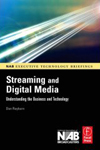
Danrayburnbookcover
Yes, some may see this as shameless self promotion, but for some of you, or some of your customers, it may be useful. My publisher Focal Press has been kind enough to offer anyone who reads my blog to get a copy of my newest book at a discount.

The book, entitled "Streaming and Digital Media: Understanding the Business and Technology" is one of the books in the NAB Executive Technology Briefings series.

I always felt that authors should stand behind their books more than they do, so I will make this commitment. If anyone who buys the book with the discount link feels they did not learn anything from it or that reading it wasted their time, I will personally provide a full refund if the book is returned to me. I don’t want anyone keeping anything they feel does not help them so I’ll take it back and refund your money. Yes, I know that is odd for an author to do, and some will say I am crazy to do it, but I think more authors should stand behind their work.

Also, anyone who posts a review of the book on Amazon will get a free copy of the next edition of the book when it comes out. This goes for bad reviews of the book as well, as all reviews are welcomed.

Sponsored by

BitTorrent Entertainment Network To Get Ad-Supported Downloads

Zeropaidlogo
ZeroPaid.com, a website that tracks news in the file sharing and P2P community did a write up yesterday on a deal that BitTorrent announced with YuMe Networks. The joint agreement calls for BitTorrent to use the new YuMe advertising network to insert advertising within videos available for download from the BitTorrent network.

Some industry observers are saying that this will have a big impact on content models as to date, all downloaded content is either free or only monetized via pay per view. This idea has me confused as does portions of this announcement and as anyone who knows me will tell you, I am always skeptical when a press release says its product or service is "game-changing", "First-Ever", "taking online video advertising to another level," and "never before been available".

For starters, how are the ads being inserted? Once I download a video, can the ad be updated or changed? And part of the big draw of the new ad network in YuMe’s eyes is that they say they can track “view-throughs” rather than “click-throughs”. But if I download a video, and then take it with me on a plane on my MacBook, and have no connection to the Internet, how is YuMe tracking anything?

YuMe is quoted as saying, "What we’re saying is that video streaming is a fundamentally different thing. You need to do it cross-platform and you should be able to take a video ad, associate it with a set of content and demographics and allow the advertiser to associate that regardless of where the content is being watched — be it the Web, a mobile phone or a BitTorrent download — and aggregate the reporting all across that."

I disagree. It’s no different than the ad model that the content owners are trying to get to work when it comes to streaming videos online. The fact that YuMe will insert an ad into a downloaded video as opposed to one that streams really does not change the monetization. In order for a major media content owner to give away the content as opposed to a pay per view model, how many eyeballs and downloads are they going to need to get before the advertising model will work?

We are a long way off from the point of where major content owners are going to give away their content because they have been able to monetize it via advertising. Yes, the potential exists, but not anytime soon until some of the major business and technical hurdles get solved.

Looking For Flash Video Advertising Case Studies

Adobelogo_3
A new book is slated to come out in my book series entitled "Hands-On Guide to Creating Flash Advertising", to be written by Jason Fincanon.
We are currently looking for case studies to include in the book and are open to suggestions from vendors and content providers.

If you have a case study or know of a company we should talk to about doing a case study, please contact me. The book will be going to print this summer.

How The Industry’s Online Video Conferences & Exhibitions Can Improve

With online video as hot as it is, I’ve been getting a lot of questions lately about what I think of all the online video conferences and exhibitions that have popped up within the past twelve months. I’d also like to hear your comments on this topic as well.

As far as I am concerned, the more conferences we have about the technology AND business of online video, the better. Do I see this crop of new shows as competitors to the shows we produce at StreamingMedia.com?  Not really. There are some big differences between all of the shows and many of them are focusing on just one niche or in my opinion, are not focused at all. But any one show, helps all the shows as it helps to educate the market. That being said, here are some things I think the new shows are doing wrong:

  • The cost to go to the conference is too expensive. The way to grow a show is to look at it from the bigger picture and realize that the cheaper you keep it, the more people you can get. Yes, the short-sided approach would be to charge $3,000 for a conference pass and make more money today, but do you really think you can grow a show at that ticket price? You have to think about the longevity of the show.
  • These shows don’t give out attendee numbers or attendee profiles. If you are going to say your show is a success, judge that success based on what attendees and exhibitors tell you. Yes, the number of attendees you get is important, but I find very few shows ever give out those numbers. Why? What do you have to hide? If the numbers are not as good as you hoped for, fine, then work on growing the show. But don’t hide the number as it automatically gives people an impression that your traffic expectations were not met.
  • Why are there so many speakers on one panel? If you have an hour long panel, or even an hour and fifteen minutes, how can you have six or seven speakers? That’s the wrong format. Putting more speakers on a panel than you really want just so you have a long list of speakers is not beneficial to the attendee. And why does each speaker get five minutes to introduce themselves? If you have six speakers, it’s takes 20-25 minutes just to get through introductions. Limit the introductions to one minute, and one minute only like we do. Yes, sometimes due to logistics a panel may be a bit bigger than you want (for East we have two sessions with five speakers) but all your panels should not be this way.
  • Why are there so many suppliers speaking? Where are all of the end user customers? Why do so many of these shows allow companies to buy their way into speaking spots? Yes, that may work now, and you may get more suppliers, but in the long run, the show will not grow in terms of attendees. You can call them what you want, but too many of the stand-alone sessions at these shows are product pitches.
  • How are you marketing your show? You need to have more than just blogs and word of mouth to market a show. You have to reach attendees via many forms of marketing. Many of those shows don’t even have an e-newsletter let alone anything they send you. I have signed up to receive marketing materials for many of these shows in a digital form and haven’t even gotten those.
  • Know your subject. How can you advertise your show as being the place to go for info on this subject and then spell the word QuickTime as "Quick time" on your website. It may sound silly, but how legit does that make you look, especially when you haven’t even put on your first show yet.
  • Where are all the how-to sessions? So many of the sessions I see are from companies showing you how to use their product but not showing you how to do things in general. Why aren’t there more how-to sessions that show attendees how to actually do all of this stuff we talk about? You can only have so many sessions on theories and the future.

When it comes to show logistics, many show organizers have limited control over various aspects of the event. For instance, we don’t offer WiFi at our East show which I know a lot of people
complain about. The problem is not that we don’t want to, but that the hotel keeps us from doing so since they sell WiFi as a paid service. That being said, what do we do wrong at our shows that we can control? I’d love to hear
coments on this as well as what you see other shows doing well.

I try and improve on every show we produce but it is hard too when we don’t get feedback and know what people want and what they feel we did wrong. Usually the only kind of negative feedback we get is about what kind of soda we did or did not serve at lunch. So here is your chance, I’d love to hear from you what we did wrong or what we are not doing at the show so I can improve on it.

Carriers Speak Out On Peer to Peer

Andrew Schmitt from Nyquist Capital has posted his coverage of the Optical Fiber Conference that took place last week. Andrew had the opportunity to ask speakers from AT&T, BT, Comcast and Verizon if they view P2P technology as an opportunity or threat and why.

As you can imagine, the answers were varied and for the most part, all four of the carriers see the growth of P2P but didn’t seem too worried about it. For all the talk we hear of P2P, I still know of very few legal applications that’s it’s currently being used for and I know of very few consumers who have ever consumed content via P2P. Yes, we know services like Joost will soon launch and BitTorrent did just recently, but if those content models don’t work, then P2P will be dead in the water. Keep in mind that services like Joost and BitTorrent are NOT P2P services, they are content services that happen to use P2P.

Job Opening: Engineering Manager, Streaming Technology, Akamai

Akamai_logo
Akamai is looking to hire a full-time Engineering Manager/Director to lead it’s Stream OS
team in San Diego. This person will build a team that will help develop
and deploy distributed web applications around the Akamai Stream OS
product offering. Akamai is seeking someone with streaming
technology/rich media, web applications, software development, and
management experience.

Contact Marcus Tgettis at Akamai who is conducting the search if you are interested.

If you are looking for a new position, have taken a new job or are a company that has a job opening, let me know. In many cases I will highlight it here on the blog – free of charge.

Online Video Is Not Web 2.0 Or In A “Bubble”

I am getting really tired of people writing about the online video industry in the media and referencing the technology as Web 2.0 or worse yet, describing our industry as being in a "bubble". Online video is not in a bubble and the technology has been around 13 years. I don’t think you can call any technology part of Web 2.0 when it’s been around as long as streaming media has and personally, I think the whole Web 2.0 term is nonsense anyway.

Many of these writers who are writing about online video have got it all wrong. User generated content is in a bit of a bubble right now, not video. Just because video is part of the whole UGC space, which includes blogs, podcasts, vblogging etc… does not make the technology of video as something that should not be taken seriously.

Many of you, especially the vendors, who have spent a lot of time, effort and money to brand and market your products and services have done so to present a real product or service. You’ve done all this work so that your offering will be seen as anything but something in a "bubble". I think it’s bad for the entire industry when vendors products and services are treated as if they just part of some online video bubble. So the next time you are at a conference, read an article or hear someone reference the online video industry and your products and services as being part of a "bubble", set them straight.